Soundtracks:  A B C D E F G H I J K L M N O P Q R S T U V W X Y Z #


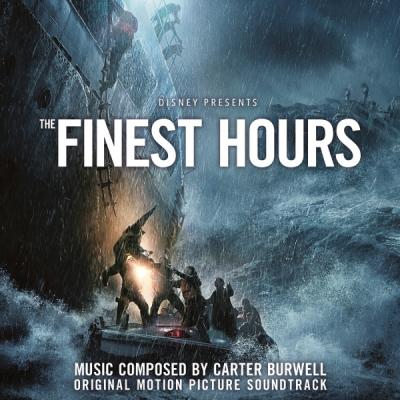
Finest Hours Album Cover

"Finest Hours" Soundtrack Lyrics

Movie • 2016

Track Listing


"The Finest Hours (Original Motion Picture Soundtrack)" Soundtrack Description

Official trailer still from The Finest Hours: Coast Guard motor lifeboat CG 36500 facing towering waves at night
The Finest Hours — official trailer frame, 2016

Overview

How do you score a rescue where nature is the villain and hope is smaller than the boat? Carter Burwell answers with a muscular, old-school orchestral palette—low brass, big drums, and aching strings—tempered by restraint. The album is a pure score release on Walt Disney Records with one period-flavored closer: Kodaline’s sea-shanty arrangement of “Haul Away Joe.”

In-film, the needle-drops are 1950s jukebox and stage fare—crooner sides, jump-blues, and a Guys and Dolls showstopper—used sparingly around the central thriller. Trusted reference points: Disney Music Credits confirms the recording and personnel, Carter Burwell’s official notes trace the cue architecture and revisions, and trade coverage in Variety/The Hollywood Reporter highlights how the score frames the film’s “old-school” mood.

Trailer still: split-screen feel between the stricken tanker and the small lifeboat, storm spray cutting across the frame
Big sea, small boat — the music scales both

Questions & Answers

Who composed the score?
Carter Burwell. Philip Klein contributed additional music and orchestrations on select set-pieces.
What label released the album and when?
Walt Disney Records, January 29, 2016 (digital release across major platforms).
Is the album mostly score or songs?
Mostly score. The closing track is Kodaline’s “Haul Away Joe.” Period songs heard in-film are licensed but not compiled on a separate “songs” album.
Where was it recorded?
Primarily at the Eastwood Scoring Stage (Warner Bros., Burbank), with sessions also in New York and El Segundo.
Who performed the orchestral score?
Hollywood Studio Symphony (feature credits); the album credits list a large LA orchestra contracted by Peter Rotter.
Any notable rewrites or editorial changes?
Yes. Several storm/action cues were reworked close to the final edit; the album preserves some unused originals.
What’s the end-credits song?
“Haul Away Joe,” performed by Kodaline—an arranged sea shanty fitting the 1952 setting.

Notes & Trivia

  • The album includes unused Burwell cues that differ from the final film mix.
  • “Crossing the Bar” (title nod to Tennyson) underscores the treacherous Chatham Bar run.
  • Kodaline’s “Haul Away Joe” closes the credits; an earlier diegetic shanty is sung on the boat.
  • The crew briefly break into “Sit Down, You’re Rockin’ the Boat” as gallows humor.
  • ScoringSessions documented the stage: large brass and heavy percussion to match wave impact.

Genres & Themes

Classic orchestral action — broad brass chorales and taiko-like percussion for storm physics; strings carry duty and doubt.

Sea shanty DNA — work-song pulse appears diegetically (“Haul Away Joe”) and as rhythmic subtext in the score.

1950s source cues — crooner & jump-blues set courtship and small-town texture; a Broadway standard adds crew-room esprit.

Trailer still: interior of tanker stern with crew under red work lights, metal groans matching percussion hits
Metal vs. melody: percussion mirrors hull stress

Tracks & Scenes

“The Hucklebuck” — Frank Sinatra with Axel Stordahl & His Orchestra
Where it plays: Opening credits; Gus drives Bernie to a Wellfleet diner (≈ 0:01, diegetic/radio).
Why it matters: Plants the period and the film’s romantic thread.

“When He Comes Home to Me” — Paula Watson
Where it plays: Bernie and Gus enter the diner; Bernie first sees Miriam (≈ 0:03, diegetic).
Why it matters: Domestic warmth before the weather turns.

“I’ll Get You Bye and Bye” — Pete Peterson
Where it plays: Miriam weighs a boat date; Gus pitches the idea (≈ 0:05, diegetic).
Why it matters: Charming needle-drop that nudges the proposal subplot.

“Hey Jack” — Lester Williams
Where it plays: Bernie asks to borrow the Anna G for Miriam (≈ 0:08, diegetic).
Why it matters: Jump-blues edge for a shy lead’s big ask.

“Vaya Con Dios” — Kate Davis with Rico Barr & The Jump ’N’ Jive Review
Where it plays: Bernie teaches Miriam to dance; she proposes (≈ 0:09–0:10, diegetic).
Why it matters: A sweet, period-styled cover calibrates their tempo.

“Our Love” — Ernest Bradshaw
Where it plays: Parking-lot conversation after the proposal (≈ 0:11, diegetic).
Why it matters: Tender source as doubt surfaces.

“Sit Down, You’re Rockin’ the Boat” — from Guys and Dolls
Where it plays: Tiny leads a sing-along on the Pendleton to lift spirits (≈ 0:16, diegetic).
Why it matters: Gallows humor as morale tool; a literal warning about “rocking the boat.”

“Haul Away Joe” — The Clancy Brothers & Tommy Makem (arr.)
Where it plays: The CG 36500 crew start singing as they cross the Bar (≈ 0:57, diegetic).
Why it matters: Work-song cadence as courage metronome.

“Haul Away Joe” — Kodaline
Where it plays: End credits (≈ 1:52, non-diegetic song on album).
Why it matters: Modern shanty take that honors the setting.

“Crossing the Bar” — Carter Burwell (score)
Where it plays: The lifeboat’s near-impossible bar crossing (non-diegetic).
Why it matters: Theme + pounding percussion = ordeal physics.

“Rescue” — Carter Burwell & Philip Klein (score)
Where it plays: Extraction and turn-for-home sequence (non-diegetic).
Why it matters: Brass resolves from dread to purpose.

“Safe Harbor” — Carter Burwell (score)
Where it plays: Homecoming/aftermath (non-diegetic).
Why it matters: Long-form catharsis; the album’s emotional coda.

Trailer music notes: Early trailers used Zella Day’s “Compass” and a bespoke cue “Dread” by The Hit House; neither appears in the film or on the album.

Music–Story Links

Source cues track intimacy and community: jukebox tunes bookend Bernie and Miriam’s arc; Broadway and shanty songs become survival tactics. The score treats the CG 36500 like a character—every surge in low brass is the boat taking another hit; every string ascent is the crew collecting themselves for one more try.

Trailer still: CG 36500 bow lights punching through spray; storm noise implied as horns surge
Morale in the songs; momentum in the score

How It Was Made

Composer: Carter Burwell. Additional music/orchestrations: Philip Klein. Recording/mix led by Michael Farrow; orchestra contracted by Peter Rotter. Sessions centered at the Eastwood Scoring Stage. Several late editorial changes pushed action cues toward hybridized orchestrations while keeping the acoustic core. Disney’s album includes both final and unused versions for context. (Trusted sources: Disney Music Credits; Carter Burwell’s official site; PR Newswire release.)

Reception & Quotes

Critical response to the music ranged from “old-school mood” praise to complaints of excess in the dub, but consensus acknowledged its power in the storm set-pieces.

“Working in a far more classic idiom… helps craft a very old-school mood.” Variety
“Particularly thunderous, mirroring the onscreen action.” The Austin Chronicle
“Bombastic” in the mix, though the film needs the muscle. The Hollywood Reporter
“Insistent… crashes down like the 30-foot waves.” The Verge

Additional Info

  • Album runtime ~47–51 minutes depending on platform; 20 cues listed on digital editions.
  • Hollywood Studio Symphony credited on the feature; the album lists detailed LA player rosters.
  • Sea-shanty presence is both diegetic (crew) and non-diegetic (credits arrangement).
  • Trailer music featured Zella Day (“Compass”) and The Hit House (“Dread”), not in the film.
  • Period sources include Sinatra’s “The Hucklebuck” and jump-blues cuts to fix the 1951–52 timeline.

Technical Info

  • Title: The Finest Hours (Original Motion Picture Soundtrack)
  • Year: 2016 (album released Jan 29, 2016)
  • Type: Original score album + end-credits song
  • Composer/Producer: Carter Burwell
  • Additional music/orchestrations: Philip Klein; orchestrations also by Sonny Kompanek
  • Performers: Hollywood Studio Symphony (feature); large LA orchestra (album personnel)
  • Studios: Eastwood Scoring Stage (Warner Bros., Burbank); additional sessions in NY/El Segundo
  • Label: Walt Disney Records
  • Selected placements: “The Hucklebuck” (opening diner), “Sit Down, You’re Rockin’ the Boat” (crew morale), “Haul Away Joe” (bar crossing; end credits), “Crossing the Bar”/“Rescue”/“Safe Harbor” (key score cues)
  • Availability: Apple Music, Spotify, YouTube Music (digital)

Canonical Entities & Relations

SubjectRelationObject
Carter Burwellcomposed & producedThe Finest Hours (Original Motion Picture Soundtrack)
Philip Kleincontributed additional music & orchestrations toThe Finest Hours score
Walt Disney RecordsreleasedThe Finest Hours score album (2016)
Hollywood Studio Symphonyperformedfeature film score
Kodalineperformed“Haul Away Joe” (end credits)
Craig GillespiedirectedThe Finest Hours (2016)
Frank Loesserwrote“Sit Down, You’re Rockin’ the Boat” (used diegetically)
Frank Sinatraperformed“The Hucklebuck” (opening diner)

Sources: Disney Music Credits; Carter Burwell — official project page; Apple Music; Spotify; SoundtrackRadar; Soundtrakd (scene/timestamp listings); PR Newswire; Variety; The Hollywood Reporter; The Austin Chronicle; The Verge.

One of those very fantastically heroic movies, after which it is wanted to feel like a man. And to change the narrowed leggings to harsh masculine blue jeans, to grow a beard, to wear a plaid shirt and to exchange own caramel smoothie with marshmallows & small tartlets on sandwiches with stale bread and cheese along with the water from the water tap in a metal mug. One of those films where you really worry for what will happen to the main characters. There is no smeared pink snots in it like “I’m breaking up with him, he does not listen to lyrics of Justin Bieber” or “he made me look like a fool in front of my friends because didn’t buy my dog Kiki this nice little pink cushion with sequins”. Here everything is very polar. On the one side: life. On the other: death in severe iron arms of shroud of your sinking ship or a death in the ice-cold waves reaching the size of the house, which at once spike your body with a myriad of deadly needles, as only you immerse into them. All the music for this film brings either a steady mood (The Hucklebuck), or decadent (Vaya Con Dios), so if you succumb to latter, you will remain in the ocean forever and it is ready to devour you. Kodaline in parallel with Clancy Brothers and Tommy Makem sing an Irish folklore composition with the same name, Haul Away Joe, which the best reflects the mood of the film. If you try to put together all the feelings that occur from watching this movie it is the Haul Away Joe comes to mind as a collective image of all those experiences that the people of Ireland have gone through in their rich history. Frank Loesser did a melody in two genres and its lyrics sung in the embodiment of a large choir – it is represented on this site, so it gained several extra shrill colors and is listened very powerfully.

November, 09th 2025

"The Finest Hours": IMDb, Wikipedia
A-Z Lyrics Universe

Lyrics / song texts are property and copyright of their owners and provided for educational purposes only.