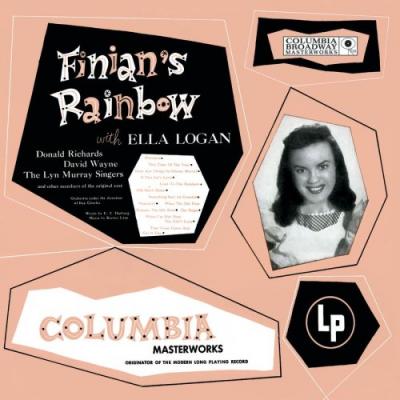
"Finian's Rainbow" Soundtrack Lyrics
Musical • 2000
Track Listing
Finian's Rainbow Cast
Finian's Rainbow Cast
Finian's Rainbow Cast
Finian's Rainbow Cast
Finian's Rainbow Cast
Finian's Rainbow Cast
Finian's Rainbow Cast
Finian's Rainbow Cast
Finian's Rainbow Cast
Finian's Rainbow Cast
Finian's Rainbow Cast
Finian's Rainbow Cast
Finian's Rainbow Cast
Finian's Rainbow Cast
Finian's Rainbow Cast
"Finian’s Rainbow (Original Broadway Cast Recording) — 2000 Remaster" Soundtrack Description

Overview
Can a 1947 cast album feel new again? The 2000 Sony/Columbia remaster of Finian’s Rainbow (Original Broadway Cast Recording) proves it can. Sourced from original acetates and restored with bonus author material, the reissue puts Burton Lane’s tunes and E. Y. “Yip” Harburg’s wordplay back in sharp focus—chorus bright, dance music reinstated, and vocals free of shellac hiss.
Historically, this title is a landmark: Columbia’s first Broadway cast recording and later a calling card for the LP format. The 2000 CD (also the basis for current digital listings) presents the core 16-track program plus archival extras from Harburg himself—short spoken/sung glimpses into how “Glocca Morra” and other numbers were built. Trusted source mentions in-line: AllMusic, Masterworks Broadway, and Wikipedia.
Questions & Answers
- What exactly is the “2000 remaster”?
- A Columbia/Sony CD/digital edition released May 30, 2000, remastered from original 1947 acetates, with restored material and bonus Harburg tracks.
- Who are the principal performers on the OBC album?
- Ella Logan (Sharon), Donald Richards (Woody), David Wayne (Og), with Ray Charles (arranger-conductor) and the Lyn Murray Singers.
- What’s musically “new” versus older issues?
- Dance/transition music recorded in 1947 but trimmed for LP length was reinstated; the warm transfer reduces noise without dulling the orchestra.
- Does this album include everything from the stage score?
- It covers the major numbers from the 1947 production; like most period cast albums it is selective and compact.
- How does it differ from the 1960 cast album?
- The 1960 revival disc is stereo, a different cast, and includes some alternate dance music; the 2000 disc preserves the 1947 performances.
- Is this the film soundtrack?
- No. The 1968 film has its own soundtrack; this is the original Broadway cast (stage) recording, remastered in 2000.
- Where can I hear it?
- On major services under “Finian’s Rainbow (Original Broadway Cast Recording)”—the digital listing mirrors the 2000 remaster.
Notes & Trivia
- Columbia’s first Broadway cast album; the title later helped showcase the LP format.
- Recording date: April 3, 1947; venue: Liederkranz Hall, New York.
- 2000 reissue restores dance music cut for time on early LPs and adds Harburg’s spoken/sung bonus tracks.
- David Wayne’s Og performance later won the first Tony Award for Featured Actor in a Musical.
- The OBC chorus is billed as the Lyn Murray Singers; Ray Charles is the arranger-conductor (not the R&B star).
Genres & Themes
Irish-tinged Broadway lyricism — lilting melodies and modal turns (“Glocca Morra,” “Look to the Rainbow”) map longing and belonging.
Social satire via swing/gospel — numbers like “Necessity,” “The Begat,” and “Idle Poor/Idle Rich” yoke groove to critique.
Romantic standard-writing — “Old Devil Moon” and “If This Isn’t Love” carry pop-standard DNA: clean hooks, conversational rhyme.

Tracks & Scenes
“This Time of the Year” — Company
Where it sits: Act I opener in Rainbow Valley, Missitucky; sharecroppers push back against authority; ensemble introduces stakes (book musical number).
Why it matters: Sets the labor/economic satire that the show will keep pricking.
“How Are Things in Glocca Morra?” — Sharon
Where it sits: Sharon’s homesick solo after arriving in America; intimate stage picture, lyrical rubato.
Why it matters: The show’s signature ballad; the reissue’s cleaner transfer flatters Ella Logan’s phrasing.
“Look to the Rainbow” — Sharon & Ensemble
Where it sits: A father’s myth turned credo; Sharon recalls Finian’s lesson; dance music links into scene change.
Why it matters: The 2000 remaster reinstates dance material previously trimmed for LP length.
“Old Devil Moon” — Sharon & Woody
Where it sits: Pastoral flirtation blooms into duet; classic AABA writing with echo structure.
Why it matters: A standard born; the close-miked 1947 balance keeps the romance upfront.
“Something Sort of Grandish” — Sharon & Og
Where it sits: Wordplay showcase as leprechaun meets literalist; comic seduction via suffixes.
Why it matters: Harburg’s rhyme-games are the show’s calling card; the chorus interjections snap.
“If This Isn’t Love” — Sharon, Woody & Ensemble
Where it sits: Community dance grows from banter to barn-burner; ensemble claps into the refrain.
Why it matters: Integrates romance and town; a template for mid-century book-musical staging.
“Necessity” — Delores Martin & Chorus
Where it sits: Blues-gospel pulse mid-Act I; money and survival spelled out with a wink.
Why it matters: Social bite in a foot-tapper; the restored transfer clarifies choir blend.
“That Great ‘Come-and-Get-It’ Day” — Sharon, Woody & Company
Where it sits: Act I closer; communal optimism peaks as plans click.
Why it matters: Anthem scale without bloat; brass and chorus sit forward in the 2000 master.
“When the Idle Poor Become the Idle Rich” — Sharon & Ensemble
Where it sits: Act II satire; prosperity flips behavior and reveals hypocrisies.
Why it matters: Harburg’s class critique lands with dance energy rather than sermon.
“The Begat” — Senator Rawkins & Gospeleers
Where it sits: Gospel-parody lampooning political piety; rhythmic call-and-response.
Why it matters: Daring in 1947; still sharp. The groove sells the joke.
“When I’m Not Near the Girl I Love” — Og
Where it sits: A leprechaun’s humanizing confession; patter lyric with internal rhymes for days.
Why it matters: David Wayne’s deft comic timing—essential document of the role.
“Fiddle Faddle” — Og
Where it sits: Light-footed Act II bit; character comedy to reset pacing.
Why it matters: Keeps the show’s fantasy element playful, not saccharine.
Music–Story Links
Ballads (“Glocca Morra,” “Rainbow”) anchor immigrant longing; love duets push plot (“Old Devil Moon,” “If This Isn’t Love”). The satire tracks—“Necessity,” “Idle Poor/Idle Rich,” “The Begat”—translate policy into pulse. Og’s numbers are structural ballast: comic release with character information, not digressions. The 2000 remaster helps all three lanes—heart, politics, comedy—read clearly.

How It Was Made
Original sessions: April 3, 1947 at Liederkranz Hall (New York). Issued as a six-disc 78 rpm set; later a seminal early LP. The 2000 CD remaster (Columbia/Sony) drew from acetates, reinstated recorded dance music, and appended three Harburg bonuses (spoken/sung), offering context straight from the lyricist. For at-a-glance credits and dates, see AllMusic; for the reissue’s specific restorations, the Masterworks Broadway note is especially clear; Wikipedia documents the recording arc from 78s to CD.
Reception & Quotes
The remaster prompted renewed praise for Harburg/Lane craft and for preserving 1947 performances rather than re-orchestrating them.
“The 2000 [OBC] re-issue… returned [recorded] dance music to where it belonged.” Masterworks Broadway (Peter Filichia)
“We also heard Harburg himself sing… one of which, ‘Don’t Pass Me By,’ didn’t survive the Philadelphia tryout.” Masterworks Broadway (Peter Filichia)
Additional Info
- Album runtime ~52 minutes on CD/digital (core program + bonuses).
- CD issue date: May 30, 2000; digital storefronts list the same lineup.
- OBC vocals: Ella Logan, Donald Richards, David Wayne; chorus: Lyn Murray Singers.
- Arranger-conductor credit: Ray Charles (vocal arranger—distinct from the R&B artist).
- Sibling recordings: 1960 Broadway revival (RCA); 2004 Irish Rep cast (Ghostlight); 2009 revival (PS Classics).
- Film (1968) uses the same songbook but differs in orchestration and selections.
Technical Info
- Title: Finian’s Rainbow (Original Broadway Cast Recording) — 2000 Remaster
- Year: 2000 (originally recorded 1947)
- Type: Original Broadway Cast; archival remaster with bonus tracks
- Music/Lyrics: Burton Lane / E. Y. “Yip” Harburg
- Primary cast on album: Ella Logan, Donald Richards, David Wayne
- Conductor/Arranger: Ray Charles; Chorus: Lyn Murray Singers
- Recording site/date: Liederkranz Hall, NYC — April 3, 1947
- Label (reissue): Columbia / Sony Music (CD/digital, May 30, 2000)
- Notable inclusions: Restored dance music; Harburg bonus tracks
- Availability: Apple Music, Spotify, other digital platforms
Canonical Entities & Relations
| Subject | Relation | Object |
|---|---|---|
| Burton Lane | composed music for | Finian’s Rainbow (stage musical) |
| E. Y. “Yip” Harburg | wrote lyrics for | Finian’s Rainbow |
| Original Broadway Cast | performed on | 1947 cast recording (remastered 2000) |
| Ray Charles (arranger) | conducted | OBC recording sessions |
| Lyn Murray Singers | performed chorus on | OBC album |
| Columbia Records / Sony Music | released | 2000 remastered edition |
| Masterworks Broadway | published notes on | 2000 reissue content/restorations |
Sources: AllMusic; Masterworks Broadway; Wikipedia; Apple Music; Discogs.
November, 09th 2025
A-Z Lyrics Universe
Cynthia Erivo Popular
Ariana Grande Horsepower
Post Malone Ain't No Love in Oklahoma
Luke Combs Good Riddance (Time of Your Life)
Green Day Bye Bye Bye
*NSYNC You're the One That I Wan
John Travolta & Olivia Newton-John I Always Wanted a Brother
Braelyn Rankins, Theo Somolu, Kelvin Harrison Jr. and Aaron Pierre The Power of Love
Frankie Goes to Hollywood Beyond
Auli’i Cravalho feat. Rachel House MORE ›