Soundtracks:  A B C D E F G H I J K L M N O P Q R S T U V W X Y Z #


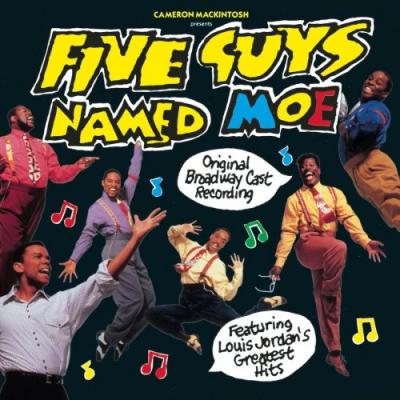
Five Guys Named Moe Album Cover

"Five Guys Named Moe" Soundtrack Lyrics

Musical • 1992

Track Listing


"Five Guys Named Moe (Original Broadway Cast Recording)" Soundtrack Description

Five Guys Named Moe revival trailer still: the five Moes in bright plaid suits on bandstand
Five Guys Named Moe — trailer imagery used for reference (revival marketing)

Overview

What happens when a breakup at 5 a.m. meets a jump-blues radio? In this show, five crooning mentors climb out of the set and fix a life with Louis Jordan songs. The 1992 Original Broadway Cast Recording captures the revue’s live-band punch—tight horns, walking bass, and call-and-response vocals—while preserving the narrative spine (Nomax learns, then acts). It’s a cast album that feels like a club set.

The disc documents the Broadway company at the Eugene O’Neill Theatre and runs 27 tracks (≈66 minutes). Sony’s release date is October 12, 1992. For quick verification and credits, see Masterworks Broadway, Apple Music, and the IBDB production page. The material is almost entirely Louis Jordan—jukebox in origin, dramaturgically shaped by Clarke Peters.

Bandstand and neon club look from revival trailer; brass section silhouetted
Cast album energy: horn section up front, vocals riding the groove

Questions & Answers

What album are we talking about?
Five Guys Named Moe (Original Broadway Cast Recording), released October 12, 1992; 27 tracks; ℗ 1992 Sony Music Entertainment.
Who wrote the show?
Book by Clarke Peters; score drawn from songs by Louis Jordan (and collaborators).
Who starred on Broadway and on the album?
Jerry Dixon (Nomax), Doug Eskew (Big Moe), Milton Craig Nealy (Four-Eyed Moe), Kevin Ramsey (No Moe), Jeffrey D. Sams (Eat Moe), Glenn Turner (Little Moe).
Where and how long did the 1992 production run?
Eugene O’Neill Theatre, opened April 8, 1992; 445 performances, 19 previews.
Is there also a London cast album?
Yes—an Original London Cast Recording (1991) exists; arrangements and setlist overlap, but the Broadway disc adds numbers and reprises.
What’s the band like?
Six-piece jump-blues combo (piano, bass, drums, trumpet/flugelhorn, trombone, sax/clarinet) recorded with onstage bite.
Does the album include dialogue?
Only brief patter and tags; the flow stays music-forward so it plays cleanly as a Jordan tribute record.

Notes & Trivia

  • Tony Award nominations (1992): Best Musical; Best Book of a Musical.
  • Olivier Award (1991 London season): Best Entertainment.
  • The Broadway “Moe” band personnel are credited by name on official materials.
  • Both London (1991) and Broadway (1992) cast recordings were issued; the Broadway disc runs longer.
  • A video capture of a later West End cast (1995) was commercially released.

Genres & Themes

Jump blues / early R&B — backbeat, riffing horns, and shout choruses equal confidence lessons for Nomax.

Big-band swing — polished brass voicings cue “public swagger” vs. private regret.

Comedy novelties — quick-rhythm patter songs deliver advice as punchlines.

Close-up from trailer: frontman leading call-and-response with horn stabs
Style map: jump-blues drive, swing sheen, patter-song wit

Tracks & Scenes

“Early in the Morning” — Nomax
Where it lands: Cold open at 5 a.m.; Nomax alone with the radio, hungover and heart-sore (non-diegetic within the stage world).
Why it matters: Sets the premise—music will talk back.

“Five Guys Named Moe” — The Moes
Where it lands: The quintet blasts out of the radio and introduces themselves; full band, call-and-response.
Why it matters: Signature anthem; announces the show’s rulebook: advice will swing.

“Brother, Beware” — The Moes
Where it lands: Cautionary clinic about bad habits and worse decisions; comic side-coaching around Nomax.
Why it matters: Advice as rhythm section—every warning comes with a punchline.

“I Like ’Em Fat Like That” — The Moes
Where it lands: Playful taste-confession number; strut groove with stage business.
Why it matters: Shows the revue’s humor lane and the album’s crisp ensemble blend.

“Messy Bessy” → “Pettin’ and Pokin’” — The Moes
Where it lands: Dating do’s and don’ts, delivered as back-to-back comic turns.
Why it matters: Tight sequencing on record mirrors the show’s sketch-comedy rhythm.

“Life Is So Peculiar” — The Moes
Where it lands: Philosophy in a bounce; Nomax starts listening.
Why it matters: Light touch; you hear the Jordan wit without losing momentum.

“I Know What I’ve Got” — The Moes
Where it lands: Value yourself or lose the plot; harmonized refrain.
Why it matters: One of the album’s cleanest vocal stacks.

“Azure Te (Paris Blues)” — Quartet feature
Where it lands: Dreamy detour; croon and reeds.
Why it matters: Color change—album pacing breathes.

“Safe, Sane and Single” — The Moes
Where it lands: Comic retreat from commitment; brisk two-beat.
Why it matters: Sets up Nomax’s counter-move in Act II.

“Push Ka Pi Shee Pie” — Company
Where it lands: Nonsense-syllable romp; audience interaction in many stagings.
Why it matters: Party valve before the turnaround.


“Saturday Night Fish Fry” — The Moes
Where it lands: Act II blow-out; story pauses so the band can cook.
Why it matters: Pure Jordan joy—album highlight for drums and reeds.

“What’s the Use of Getting Sober (When You’re Gonna Get Drunk Again)” — The Moes
Where it lands: Tough-love lesson aimed at Nomax’s crutch.
Why it matters: Punchy moral, never preachy—horn hits do the scolding.

“If I Had Any Sense (I’d Go Back Home)” — Nomax
Where it lands: The pivot; he admits the fix is his to make.
Why it matters: The album’s character beat—less band, more confession.

“Let the Good Times Roll” — Company
Where it lands: Mood resets; the party is now about choosing joy, not hiding in it.
Why it matters: Road back to Lorraine starts here.

“Reet, Petite and Gone” → “Caldonia” — The Moes
Where it lands: Showmanship suite; stacked riffs, call-backs to earlier gags.
Why it matters: Documented barnburner on the Broadway disc.

“Ain’t Nobody Here but Us Chickens” — The Moes
Where it lands: Comic caper energy; staging bits with freeze-frames.
Why it matters: Precision ensemble timing you can hear on the record.

“Don’t Let the Sun Catch You Crying” — The Moes
Where it lands: Cooler, late-night counsel; Nomax steels himself.
Why it matters: Dynamic drop before the push to action.

“Choo Choo Ch’Boogie” — Company
Where it lands: Momentum back on; train-groove exit.
Why it matters: A built-in curtain-call engine.

Music–Story Links

The Moes deliver advice in styles: novelty warns, swing charms, jump-blues emboldens. Nomax’s solos narrow the band, then rejoin the groove as he commits to act. When the horns are biggest, he’s most teachable; when the rhythm section thins, he faces the truth. It’s music-theatre logic, not just a hits parade.

Revival trailer frame: front line pointing outward during audience call-and-response
Advice as rhythm — when the horns shout, Nomax listens

How It Was Made

Origins. Built on Louis Jordan’s catalog (1940s jump-blues/early R&B), with a framing book by Clarke Peters. The Broadway staging (1992) was directed and choreographed by Charles Augins; Cameron Mackintosh produced. Masterworks Broadway summarizes the concept crisply.

Band & arrangements. The onstage sextet (piano, bass, drums, trumpet/flugelhorn, trombone, sax/clarinet) is credited by player name in production materials; the album lets that section punch like a club date. IBDB and Playbill confirm run, venue, and credits.

Reception & Quotes

“A big party with conga lines, sing-alongs and enough high spirits to launch a rocket.” Los Angeles Times
“Silly story… can’t stop the musical from working its charms.” Los Angeles Times
“Energetic… the good times roll.” Variety

The cast album benefits from that same “party first” approach—cleanly mixed band, bright ensemble mics, minimal dialogue.

Additional Info

  • Licensing: Music Theatre International.
  • Broadway album: 27 tracks; London album: 24 tracks (different sequencing).
  • Broadway run: April 8, 1992 – May 2, 1993 (445 performances, 19 previews).
  • Band credits are listed individually on official notes; the combo sits onstage in many productions.
  • A 1995 West End capture (Albery Theatre) preserved the staging on video.
  • Notable broadcast: 1992 Tony Awards performance featured the title tune and “Caldonia.”

Technical Info

  • Title: Five Guys Named Moe (Original Broadway Cast Recording)
  • Year: 1992 (album) / 1992 (Broadway premiere)
  • Type: Original Broadway Cast Album
  • Music/Lyrics: Louis Jordan (and collaborators); Book: Clarke Peters
  • Broadway venue: Eugene O’Neill Theatre
  • Producer (stage): Cameron Mackintosh
  • Label: Sony Music (Masterworks); street date Oct 12, 1992
  • Album length: ~66 minutes; 27 tracks (songs + reprises)
  • Awards: Tony nominations (Best Musical; Best Book); Olivier Award (Best Entertainment – London)
  • Availability: Apple Music, Spotify, Masterworks Broadway catalog

Canonical Entities & Relations

EntityRelationEntity
Clarke Peterswrote book forFive Guys Named Moe (musical)
Louis Jordansongs featured inFive Guys Named Moe
Charles Auginsdirected & choreographed1992 Broadway production
Cameron Mackintoshproduced1992 Broadway production
Jerry Dixonperformed asNomax (Broadway cast/album)
Doug Eskew; Milton Craig Nealy; Kevin Ramsey; Jeffrey D. Sams; Glenn Turnerperformed asThe Moes (Broadway cast/album)
Masterworks Broadway / Sony Musicreleased1992 Original Broadway Cast Recording
Eugene O’Neill Theatre (Jujamcyn)hosted1992 Broadway run

Sources: Masterworks Broadway; Apple Music; IBDB; Playbill.

November, 09th 2025


A-Z Lyrics Universe

Lyrics / song texts are property and copyright of their owners and provided for educational purposes only.