Soundtracks:  A B C D E F G H I J K L M N O P Q R S T U V W X Y Z #


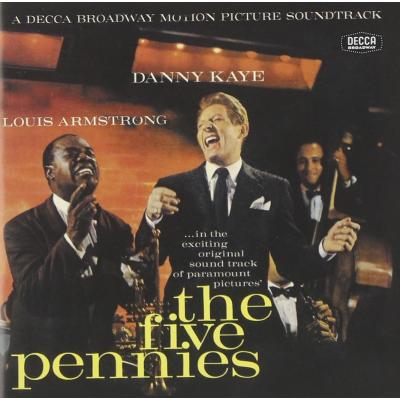
Five Pennies Album Cover

"Five Pennies" Soundtrack Lyrics

Movie • 2004

Track Listing


"The Five Pennies (Original Motion Picture Soundtrack / Remastered 2004)" Soundtrack Description

1959 trailer frame: Danny Kaye and Louis Armstrong on stage in The Five Pennies
The Five Pennies — original theatrical trailer (1959)

Overview

How do you sell a jazz life story to a 1959 crowd and a streaming-era ear at once? This soundtrack does it: Leith Stevens’ warm studio orchestra, Sylvia Fine’s original songs, and on-screen star power (Danny Kaye, Louis Armstrong) — later cleaned up and reissued as a compact 2004 remaster that circulates today.

The film is a Red Nichols biopic; the album captures both the period standards and the newly written numbers that glue the drama together (“The Five Pennies,” “Lullaby in Ragtime,” “Good Night, Sleep Tight”). The remaster clocks in at ~38 minutes across 18 cues (UMG’s Universal Classics Group release) and preserves the show-within-a-film feel: big-band swing, dixieland breaks, and tender lullabies in studio polish.

Trailer frame: club bandstand with brass section and spotlighted singer in The Five Pennies
From club floor to cradle song — the album follows the film’s swing-to-lullaby arc

Questions & Answers

Is this a 2004 movie?
No — the film premiered in 1959. The commonly available album is a 2004 remaster of the original soundtrack.
Who wrote the original songs?
Sylvia Fine. She contributed “The Five Pennies,” “Lullaby in Ragtime,” and “Good Night, Sleep Tight,” among others.
Who composed the score cues and led the studio orchestra?
Leith Stevens, credited with the film’s musical scoring and main-title orchestral work.
Whose cornet do we hear when Danny Kaye “plays” Red Nichols?
Red Nichols recorded the cornet parts heard in the film; Kaye mimed to Nichols’s playing.
Does Louis Armstrong actually sing and play in the film cues?
Yes. Armstrong appears as himself and is featured on several performance numbers captured on the album.
Who sings for Barbara Bel Geddes?
Eileen Wilson dubbed Bel Geddes’s vocals in pieces like the “Good Night, Sleep Tight” material.
What label issued the 2004 remaster?
Universal Classics Group (UMG). Digital platforms credit ℗ 2004 UMG Recordings, Inc.

Notes & Trivia

  • Four Academy Award nominations: Score (Leith Stevens), Original Song (“The Five Pennies”), Cinematography (Color), and Costume Design (Color).
  • “Lullaby in Ragtime” is by Sylvia Fine; the “ragtime” is more lullaby croon than Scott Joplin stomp.
  • “The Five Pennies Saints” is a playful, lyric-twisting riff on “When the Saints Go Marching In,” performed by Kaye and Armstrong.
  • Eileen Wilson dubs Barbara Bel Geddes’s singing; Susan Gordon (who plays Dorothy) appears on certain medley vocals.
  • Multiple album configurations exist: the concise 2004 remaster (18 tracks) and later comps with similar material.

Genres & Themes

Dixieland / early swing → ambition and camaraderie. Brass-forward charts announce Red’s drive and the band’s esprit.

Studio-orchestra lyricism → family and forgiveness. Stevens’s strings and woodwinds cradle the domestic beats without syrup.

Novelty duets → public charm masking private strain. Kaye–Armstrong patter tracks sell showmanship while the script tightens the screws offstage.

Trailer frame: spotlight on Danny Kaye with cornet; orchestra in soft focus
Style map: dixieland bite, orchestral glow, and comic patter stitched together

Tracks & Scenes

Placements are performance-based; exact minute marks vary by edition. All items below are diegetic unless noted.

“The Five Pennies” — Danny Kaye (song by Sylvia Fine)
Where it plays: A late-evening lullaby to Dorothy; later reprised during the comeback medley.
Why it matters: The film’s emotional thesis — success means nothing if the family can’t dance again.

“Lullaby in Ragtime” — Danny Kaye & (dubbed) Barbara Bel Geddes
Where it plays: Intimate vocal piece that threads through home and club moments; also folded into the “Good Night, Sleep Tight” medley.
Why it matters: A quiet counterweight to the brassy show numbers; Fine’s lyric gives the family story its heartbeat.

“After You’ve Gone” — Louis Armstrong
Where it plays: Club performance sequence, Satchmo front and center.
Why it matters: A classic torch turn that doubles as narrative foreshadowing for Red’s forced hiatus.

“Bill Bailey, Won’t You Please Come Home” — Danny Kaye & Louis Armstrong
Where it plays: Lively stage duet, horns punching over a two-beat.
Why it matters: Old-time repertoire as star handshake — a joyful summit of personas.

“Back Home Again in Indiana” — Ensemble
Where it plays: Radio/college-date montage; brisk sectional trade-offs.
Why it matters: Places the band in the touring circuit; geography as groove.

“The Five Pennies Saints” — Danny Kaye & Louis Armstrong
Where it plays: Showstopper comedy riff on “When the Saints Go Marching In.”
Why it matters: Audience-pleasing patter and call-and-response; the album preserves the bit’s grin.

“The Music Goes ’Round and ’Round” — Danny Kaye & Susan Gordon
Where it plays: Lighthearted father–daughter stage moment.
Why it matters: Turns a novelty into character work; Dorothy isn’t just a plot device — she sings back.

“Carnival of Venice” — Danny Kaye
Where it plays: Virtuosic showpiece staged as a band feature.
Why it matters: A wink at cornet flash; under the hood you’re hearing Red Nichols’s horn on the soundtrack.

“Good Night, Sleep Tight” / “Lullaby in Ragtime” / “The Five Pennies” — Medley
Where it plays: Comeback sequence medley (with Eileen Wilson’s dubbing heard for Bel Geddes).
Why it matters: The family thread resolves musically before the final ovation.

Finale: “The Five Pennies Finale” → “Battle Hymn of the Republic”
Where it plays: Closing stage celebration; orchestra swells under chorus.
Why it matters: A triumphant coda that folds personal victory into crowd-pleasing Americana.

Music–Story Links

Every big-band flare is career momentum; every lullaby is a check on ego. When Red quits the circuit, the soundtrack cools to softer orchestral textures; when he returns, the horns and Armstrong’s genial presence restore swing and dignity. The medley at the comeback show turns private promises into public sound — the plot literally sings its resolution.

Trailer frame: final ovation feel with band, chorus, and waving crowd in The Five Pennies
Private lullaby, public ovation — the score bridges both rooms

How It Was Made

Leith Stevens shaped the score and studio charts; Sylvia Fine supplied the original songs that carry the narrative spine. Red Nichols recorded the cornet parts used for Kaye’s on-screen performance, a choice that gives the picture its authentic horn voice. Barbara Bel Geddes’s vocals were dubbed by Eileen Wilson. Armstrong’s sequences were pre-recorded and staged for camera, preserving his vocal charm and ensemble rapport.

Reception & Quotes

“Highly palatable schmaltz served up with a Dixieland beat.” The New York Times (A. H. Weiler)
“Exuberant music… sharpened Jazz Age atmosphere.” Maclean’s (via contemporary roundup)
“Solidly crafted… glosses the real history, but the songs soar.” Rotten Tomatoes critics summary

Additional Info

  • Album runtime (remaster): ~38:00; 18 tracks.
  • Key medleys: “College Montage” (“Washington and Lee Swing,” “Runnin’ Wild,” “Follow the Leader”).
  • Multiple reissues exist (2010 comp variants list 17 tracks with similar sequencing).
  • DVD-era restoration (mid-2000s) re-popularized the score; the remaster followed suit on digital.
  • Armstrong/Kaye duet pieces (“Saints,” “Bill Bailey”) remain the fan gateways to the album.

Technical Info

  • Title: The Five Pennies (Original Motion Picture Soundtrack / Remastered 2004)
  • Film Year: 1959 (Paramount Pictures)
  • Album Year: 2004 (remastered reissue)
  • Type: Film soundtrack — songs & score
  • Composers / Songwriters: Leith Stevens (score/orchestration); Sylvia Fine (original songs)
  • Featured Performers: Danny Kaye; Louis Armstrong; Red Nichols & His Five Pennies (instrumental); Eileen Wilson (vocal dubbing); Susan Gordon (select vocals)
  • Label: Universal Classics Group (UMG) — ℗ 2004 UMG Recordings, Inc.
  • Availability: Major DSPs (Apple Music/Spotify) and assorted CD reissues; legacy vinyl listings on Discogs.

Canonical Entities & Relations

SubjectRelationObject
Leith Stevenscomposed/scoredThe Five Pennies (film) cues
Sylvia Finewrote“The Five Pennies,” “Lullaby in Ragtime,” “Good Night, Sleep Tight”
Red Nicholsperformedcornet parts for the film soundtrack
Eileen WilsondubbedBarbara Bel Geddes’s singing voice
Danny Kaye & Louis Armstrongperformedduets including “Bill Bailey” and “The Five Pennies Saints”
Universal Classics Group (UMG)released2004 remastered soundtrack
Paramount PicturesreleasedThe Five Pennies (1959 film)

Sources: TCM; Apple Music; Spotify; Discogs; Wikipedia; Down Beat (1959); Rotten Tomatoes; MusicBrainz; Dippermouth blog.

November, 09th 2025


A-Z Lyrics Universe

Lyrics / song texts are property and copyright of their owners and provided for educational purposes only.