Soundtracks:  A B C D E F G H I J K L M N O P Q R S T U V W X Y Z #


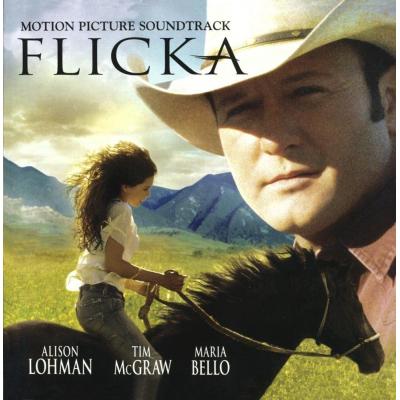
Flicka Album Cover

"Flicka" Soundtrack Lyrics

Movie • 2006

Track Listing


"Flicka (Motion Picture Soundtrack)" Soundtrack Description

Flicka (2006) official trailer still highlighting the film’s music and Wyoming vistas
Flicka — theatrical trailer, 2006

Overview

What does a country-pop compilation do in a modern Western coming-of-age film? In Flicka (2006), it softens the grit without sanding off the stakes. The song album leans on heartfelt country, adult-contemporary pop, and a few evergreen classics to mirror Katy’s tug-of-war with family duty and personal freedom.

Two parallel releases carry the film: a Various Artists song album on Curb Records and Aaron Zigman’s orchestral score on Varèse Sarabande. Together they play optimism against tension—the songs voicing Katy’s inner diary, the score handling sweep, peril, and catharsis. Source: Apple Music; ScoringSessions.com.

Flicka trailer frame emphasizing orchestral swells and wide-open ranch landscapes
Flicka — trailer imagery and musical tone

Questions & Answers

Who composed the original score?
Aaron Zigman wrote and conducted the score with a large studio orchestra. Source: ScoringSessions.com.
Who supervised the songs?
Music supervision is credited to Jason Alexander, with Tim McGraw also steering repertoire choices tied to his circle. Source: Variety; RadioFree.com interview.
Is Natasha Bedingfield’s “Wild Horses” a Rolling Stones cover?
Yes—her cover brings a pop-gospel lift to the Stones’ 1971 ballad.
What song runs over the end credits?
Tim McGraw’s “My Little Girl” closes the film. Several contemporary reviews note this explicitly.
Does Alison Lohman sing in the film?
Yes—she sings parts of “All the Pretty Little Ponies” onscreen; the album version is sung by Catherine Raney. Source: OnMilwaukee review.
Are there songs in the movie that aren’t on the main album?
Yes—e.g., “Texas in 1880” (Radney Foster & Pat Green) and “Go Johnny” (Ken Tamplin) are listed in film credits but not the core album.

Notes & Trivia

  • Tim McGraw stars as Katy’s father and also contributes the single “My Little Girl.”
  • The soundtrack album preceded the U.S. theatrical release by three days in October 2006.
  • Zigman’s score album is a separate release from the songs compilation.
  • The track “Catch the Wind” brings a 1960s folk color into a 2000s family drama—an intentional nod to timelessness.
  • “All the Pretty Little Ponies” doubles as an in-world lullaby and an end-title mood piece, depending on the version.

Genres & Themes

Country & heartland rock underscores ranch labor, rodeo scenes, and familial duty—steady tempos and warm guitars equal reliability and tradition.

Adult-contemporary pop (Chantal Kreviazuk, Natasha Bedingfield) marks Katy’s private longings and self-talk—piano and airy harmonies signal vulnerability and resolve.

Orchestral Americana in Zigman’s score handles geography and jeopardy: brass for risk (roundups, storms), strings for reconciliation and the father-daughter bridge.

Flicka trailer still tied to the soundtrack’s country-pop and orchestral blend
Country-pop meets orchestral sweep — the film’s musical blend

Tracks & Scenes

Note: placements reflect film credits and contemporary coverage; exact timestamps vary by edition.

“My Little Girl” – Tim McGraw
Scene: Plays over the end credits; a direct father-to-daughter benediction after the final reconciliation (closing minutes; non-diegetic).
Why it matters: Ties the parental arc to McGraw’s on-screen role and frames the film as a family letter.

“Wild Horses” – Natasha Bedingfield
Scene: Used to underline Katy’s yearning and the film’s wide-open imagery (non-diegetic montage use).
Why it matters: A pop-gospel cover of a classic about freedom—an obvious mirror for a mustang drama.

“4:35 A.M.” – Gemma Hayes
Scene: Early-film mood setter for quiet, reflective beats around home and horizon (non-diegetic).
Why it matters: Indie hush that sells Katy’s introspection before the storms hit.

“Alive” – Becki Ryan
Scene: Teen-energy cue for Katy pushing past limits (non-diegetic).
Why it matters: The lyric perspective aligns with risk-taking and self-definition.

“The Things We Don’t” – Watertown
Scene: Bridges unspoken tensions between Katy and Rob (non-diegetic).
Why it matters: The unvoiced grievances become text through song.

“Catch the Wind” – Donovan
Scene: A contemplative breather, often over transitional scenery (non-diegetic).
Why it matters: Folk classic = timelessness; suggests the ranch’s continuity beyond one conflict.

“Weight of the World” – Chantal Kreviazuk
Scene: After a setback, Katy recalibrates her resolve (non-diegetic).
Why it matters: Piano-led ballast for the story’s lowest ebb.

“The Fireman” – The Dancehall Doctors
Scene: Workaday ranch activity / light-boots montage (non-diegetic).
Why it matters: A bar-band pulse that keeps the cowboy grit present.

“Where Did I Go Right” – The Warren Brothers
Scene: A reflective interlude as choices reverberate (non-diegetic).
Why it matters: Country rock that points at course-correction and grace.

“Rodeo Road” – Holly Williams
Scene: Around the rodeo sequence where fate and family collide (non-diegetic).
Why it matters: The lyric’s transience and asphalt imagery pair with Katy’s high-risk bid.

“All the Pretty Little Ponies” – Catherine Raney
Scene: Lullaby color; in the film, Alison Lohman sings parts diegetically, while the album features Raney (non-diegetic on album).
Why it matters: Humanizes Katy beyond the horse-girl archetype; knits family intimacy to the mustang myth.

Not on the main album but in the film credits: “Texas in 1880” (Radney Foster & Pat Green); “Go Johnny” (Ken Tamplin); “Don’t You Know” (City Fritter). These appear in-film/credits but are absent from the core Curb Records compilation.

Music–Story Links

When Katy defies expectations, pop-leaning tracks (“Alive,” “Wild Horses”) voice interior courage while Zigman’s strings temper the rush with stakes. During rodeo action, country cues (“Rodeo Road,” “The Fireman”) keep us grounded in place—boots, dirt, and risk. The closing “My Little Girl” reframes conflict as care, turning a ranch standoff into a father-daughter covenant.

Flicka trailer close-up aligning with father–daughter themes underscored by the end-credits song
End-credits mood and the film’s family thesis

How It Was Made

Composer Aaron Zigman recorded the score with an 85-piece Hollywood Studio Symphony; photos from the session show Zigman with Fox Music executives and veteran contractors and mixers. The orchestration leans lyrical, with action set-pieces (“Flicka Chase”) balancing pastoral cues.

On the songs side, country star Tim McGraw (who plays Rob) contributed “My Little Girl” and helped steer repertoire choices from his creative circle (Warren Brothers, Holly Williams, The Dancehall Doctors). Music supervision is credited to Jason Alexander, coordinating studio and label clearances across Curb (songs) and Varèse Sarabande (score). Source: ScoringSessions.com; RadioFree.com interview; Variety.

Reception & Quotes

Critics were mixed on the film but often singled out the music’s fit and the landscape-scale sentiment. The album charted modestly yet respectably on U.S. Billboard lists.

“A landscape so vivid and beautiful.” Stephen Hunter, The Washington Post
“A beautifully photographed slice of pony-… for the preteen set.” Slant Magazine

Availability: the songs compilation streams widely (Apple Music, Spotify). Zigman’s score album is a separate title. Source: Apple Music.

Additional Info

  • The single “My Little Girl” (released Aug 7, 2006) doubled as a tie-in to McGraw’s hits set and the film.
  • The soundtrack album streeted on Oct 17, 2006; U.S. theatrical opened Oct 20, 2006.
  • Soundtrack chart peaks (U.S.): Billboard 200 #123; Top Country Albums #27; Top Soundtracks #6.
  • Licensing split: songs via Curb Records; original score via Varèse Sarabande/Colosseum.
  • “All the Pretty Little Ponies” functions diegetically in-film (Lohman) vs. non-diegetic album cut (Raney).
  • IMDB’s soundtrack page lists additional cues not on the core album (e.g., “Texas in 1880”).
  • Trailer art used standard Fox marketing cuts; no commercial single was billed as “trailer music.”

Technical Info

  • Title: Flicka (Motion Picture Soundtrack) — Various Artists (songs); Flicka (Original Motion Picture Score) — Aaron Zigman
  • Year: 2006 (album & film)
  • Type: Film soundtrack (compilation) + separate score album
  • Composers: Aaron Zigman (original score)
  • Music supervision: Jason Alexander
  • Selected notable placements: “My Little Girl” (end credits); “Rodeo Road” (rodeo sequence); “Wild Horses” (freedom-themed montage)
  • Release context: U.S. theatrical Oct 20, 2006; soundtrack Oct 17, 2006; single “My Little Girl” Aug 7, 2006
  • Labels: Curb Records (songs compilation); Varèse Sarabande (score)
  • Charts: Billboard 200 #123; Top Country #27; Top Soundtracks #6

Canonical Entities & Relations

SubjectRelationObject
Flicka (2006 film)musicByAaron Zigman (score)
Flicka (Motion Picture Soundtrack)recordLabelCurb Records
Flicka (Original Motion Picture Score)recordLabelVarèse Sarabande
Tim McGrawperforms“My Little Girl” (end credits song)
Natasha Bedingfieldperforms“Wild Horses” (cover)
Alison Lohmanperforms (diegetic fragment)“All the Pretty Little Ponies” (in film)
Jason AlexandermusicSupervisorForFlicka (2006 film)
Fox 2000 PicturesproducedFlicka (2006)
20th Century FoxdistributedFlicka (2006)

Sources: Apple Music; Spotify; IMDb; Wikipedia; ScoringSessions.com; Washington Post; OnMilwaukee; SoundtrackCollector; MusicBrainz.

November, 09th 2025


A-Z Lyrics Universe

Lyrics / song texts are property and copyright of their owners and provided for educational purposes only.