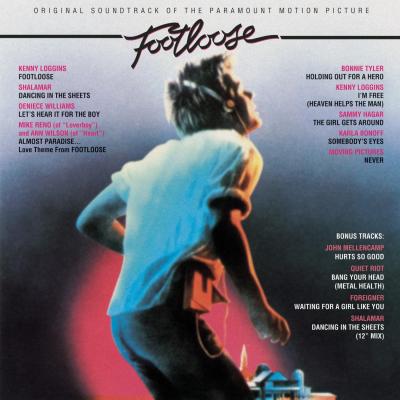
"Footloose" Soundtrack Lyrics
Movie • 1998
Track Listing
Kenny Loggins
Rusty, Ariel, Irene, Doreen
Ann Wilson/Mike Reno
Bonnie Tyler
Shalamar
Kenny Loggins
Karla Bonoff
Sammy Hagar
Moving Pictures
Quiet Riot
Foreigner
John Cougar Mellencamp
Shalamar (12" mix, bonus track)
Joe Rappe and Gang
Kenny Loggins
Irene Cara
"Footloose: Original Soundtrack of the Paramount Motion Picture (15th Anniversary Collector’s Edition)" Soundtrack Description
Overview
Can a pop album carry a drama about a town that bans dancing? Footloose proved it. The 1984 soundtrack turned nine radio-friendly cuts into story engines, then returned in 1998 as a “15th Anniversary Collector’s Edition” with four bonus tracks heard in the film but absent from the original LP. Trusted source: RIAA.
Important clarification: there is no 1998 movie. 1998 marks the Broadway musical premiere and a CD reissue of the 1984 film soundtrack. The album’s core—Kenny Loggins, Deniece Williams, Bonnie Tyler, Shalamar, Moving Pictures—doubles as scene architecture: training montage, tractor “chicken,” warehouse catharsis, prom release. Trusted source: Wikipedia (soundtrack).
Questions & Answers
- Why does “1998” matter for Footloose?
- It’s the 15th-anniversary reissue year for the 1984 soundtrack (bonus tracks), and the year the stage musical opened on Broadway. There was no 1998 film.
- What changed on the 1998/anniversary CD?
- Four extras used in the film: Quiet Riot’s “Bang Your Head (Metal Health),” John Mellencamp’s “Hurts So Good,” Foreigner’s “Waiting for a Girl Like You,” plus a 12″ remix of Shalamar’s “Dancing in the Sheets.”
- How successful was the soundtrack?
- US 9× Platinum and a long Billboard 200 run; two Hot 100 #1 singles (“Footloose,” “Let’s Hear It for the Boy”). Trusted source: Billboard / RIAA.
- Who handled the film’s dramatic score?
- Miles Goodman adapted/orchestrated connective cues around the songs; the album release is song-led.
- Is the music mostly diegetic or non-diegetic?
- Both. Bars/drive-in scenes lean diegetic; training, tractor duel, warehouse, and prom sequences use non-diegetic needle-drops.
- What’s the cultural “canon” status?
- The title song entered the US National Recording Registry (LoC) and AFI’s 100 Songs list. Trusted source: Library of Congress.
Notes & Trivia
- “Footloose” and “Let’s Hear It for the Boy” were both Oscar-nominated for Best Original Song (1985).
- Reissue dating varies by territory; pressings are commonly labeled “1998 15th Anniversary Collector’s Edition.”
- The Broadway musical (1998) repurposes lyrics/assignments—e.g., “Somebody’s Eyes” becomes a town-watch warning trio instead of a soft-rock lament.
- The soundtrack was issued ahead of the film to prime radio familiarity—then echoed in music videos cut with movie footage.
- AFI ranked “Footloose” #96 on its 100 Songs list.
Genres & Themes
AOR / pop-rock anthems → risk-taking and release (Kenny Loggins, Moving Pictures). Up-tempo patterns mirror teen defiance and forward motion.
Bombastic rock & power-ballad drama → Jim Steinman/Bonnie Tyler’s “Holding Out for a Hero” frames contest-as-myth; “Almost Paradise” reframes the story as an earnest romance.
R&B/dance-pop sheen → Shalamar and Deniece Williams supply social-space glue for bars, drive-ins, and gym floors—music the characters could plausibly hear.
Tracks & Scenes
Timestamps vary by cut; diegetic = heard by characters.
“Footloose” — Kenny Loggins
Scene: Opening credits (dancing feet montage) and the prom’s final explosion of dancing; non-diegetic.
Why it matters: Bookends the film—rebellion in miniature at the start, communal catharsis at the end.
“Let’s Hear It for the Boy” — Deniece Williams
Scene: Training montage where Ren teaches Willard to dance; non-diegetic, montage-cut.
Why it matters: Turns character work into pop momentum; Willard’s growth beat lands because the groove does.
“Holding Out for a Hero” — Bonnie Tyler
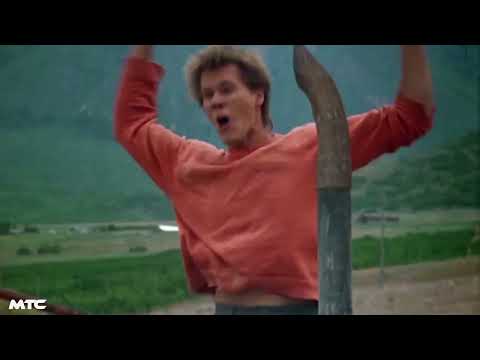
Scene: Tractor “chicken” showdown with Chuck; non-diegetic, intercut with crowd reactions.
Why it matters: Steinman’s maximalism mythologizes a farm-field dare into a showdown.
“Never” — Moving Pictures
Scene: Ren’s warehouse/flour-mill “angry dance”; non-diegetic.
Why it matters: The score drops out; the song becomes the character’s engine—kinetic therapy as plot.
“Dancing in the Sheets” — Shalamar
Scene: Drive-in/parking-lot dancing around cars; largely diegetic (speakers/tape); transitional montage.
Why it matters: Social temperature check—the town still dances, just outside the line.
“Almost Paradise (Love Theme)” — Mike Reno & Ann Wilson
Scene: Intimate Ren–Ariel beats and slow-dance moments near prom; non-diegetic.
Why it matters: A straight, un-ironic heart valve that humanizes the fight over rules.
“I’m Free (Heaven Helps the Man)” — Kenny Loggins
Scene: Late-film release/credits and connective action; non-diegetic.
Why it matters: The action-anthem flips from struggle to earned freedom.
“The Girl Gets Around” — Sammy Hagar
Scene: Ariel’s reckless ride/road scene; non-diegetic.
Why it matters: Paints her danger-seeking streak with hard-rock bravado.
Trailer/marketing extras & reissue adds: “Bang Your Head (Metal Health)” (Quiet Riot) briefly plays from Ren’s car radio; Mellencamp’s “Hurts So Good” and Foreigner’s “Waiting for a Girl Like You” are film-used catalog cuts added on the 1998/anniversary CD.
Music–Story Links
Contest cues (“Hero,” “I’m Free”) score rule-breaking as rite-of-passage. Social cues (“Sheets,” Deniece Williams) sketch where dancing survives—in parking lots and state-line bars—so the prom can feel earned when it legalizes joy. Ballad cues (“Almost Paradise”) protect the film’s moral center: kids aren’t rebelling just to rebel; they want ordinary rites—together.
How It Was Made
Screenwriter-lyricist Dean Pitchford built song briefs into the script and co-wrote with multiple producers (David Foster, Jim Steinman, George Duke, et al.). Singles were serviced before release to prime the market. Miles Goodman adapted/orchestrated non-song score cues to stitch scenes cleanly. Trusted source: Wikipedia (film & soundtrack).
Reception & Quotes
The film drew mixed notices; the album became the consensus hit and a pop mainstay. Anniversary pieces keep circling back because the cues still chart the movie in memory.
“Two #1 singles and a nine-times-platinum juggernaut—radio and cinema moving in lockstep.” Billboard / RIAA summary
“Footloose remains one of the defining ’80s soundtracks.” Entertainment Weekly
“A seriously confused movie… part of the time it wants to be a music video.” Roger Ebert
Additional Info
- Original album: 9 tracks (Columbia, Jan 27, 1984); 1998 collector’s CD adds 4 film-used cuts.
- Two Hot 100 #1s in 1984: “Footloose” (3 weeks), “Let’s Hear It for the Boy.”
- US sales: over 9 million (RIAA); international #1s in multiple territories.
- AFI’s 100 Songs: “Footloose” ranked #96.
- Stage musical (1998) reassigns/rewrites several songs for character ensembles.
- Music-video strategy: single edits with film footage boosted awareness pre-release.
- Reissue listings sometimes appear as 1999 “15th Anniversary” depending on market metadata.
Technical Info
- Title: Footloose: Original Soundtrack of the Paramount Motion Picture (15th Anniversary Collector’s Edition)
- Film Year: 1984 (reissue: 1998 collector’s edition)
- Type: Various-artists soundtrack (song-led with light score interstitials)
- Key Artists/Producers: Kenny Loggins (with David Foster); Deniece Williams (prod. George Duke); Bonnie Tyler (prod. Jim Steinman); Shalamar (prod. Bill Wolfer); Moving Pictures; Sammy Hagar
- Score: Miles Goodman (adaptation/orchestration)
- Label: Columbia (Sony)
- Selected notable placements: “Footloose” (opening & prom), “Let’s Hear It for the Boy” (training), “Holding Out for a Hero” (tractor duel), “Never” (warehouse dance), “Dancing in the Sheets” (drive-in), “Almost Paradise” (romance/slow-dance), “I’m Free” (release/credits)
- Chart/awards: Billboard 200 #1 (spring 1984); two Oscar song nominations; AFI #96
- Availability: Original 9-track and the 1998/anniversary CD on major services; multiple international pressings in print
Canonical Entities & Relations
| Subject | Relation | Object |
|---|---|---|
| Dean Pitchford | co-wrote songs for | Footloose (1984 film) |
| Kenny Loggins | performed/wrote | “Footloose”; “I’m Free (Heaven Helps the Man)” |
| Deniece Williams | performed | “Let’s Hear It for the Boy” |
| Bonnie Tyler | performed | “Holding Out for a Hero” (prod. Jim Steinman) |
| Shalamar | performed | “Dancing in the Sheets” |
| Moving Pictures | performed | “Never” |
| Miles Goodman | adapted/orchestrated score for | Footloose (1984 film) |
| Columbia Records | released | Footloose soundtrack (1984; 1998 CD reissue) |
| Paramount Pictures | distributed | Footloose (1984 film) |
Sources: RIAA; Billboard; Library of Congress (National Recording Registry); Wikipedia (film & soundtrack); ScreenRant; Apple Music; Movieclips/Paramount trailer & scene excerpts.
November, 09th 2025
A-Z Lyrics Universe
Cynthia Erivo Popular
Ariana Grande Horsepower
Post Malone Ain't No Love in Oklahoma
Luke Combs Good Riddance (Time of Your Life)
Green Day Bye Bye Bye
*NSYNC You're the One That I Wan
John Travolta & Olivia Newton-John I Always Wanted a Brother
Braelyn Rankins, Theo Somolu, Kelvin Harrison Jr. and Aaron Pierre The Power of Love
Frankie Goes to Hollywood Beyond
Auli’i Cravalho feat. Rachel House MORE ›