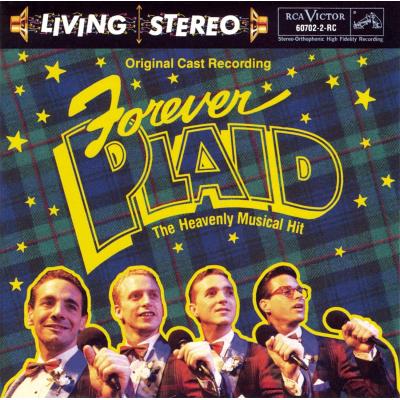
"Forever Plaid" Soundtrack Lyrics
Musical • 1990
Track Listing
Forever Plaid Cast
Forever Plaid Cast
Forever Plaid Cast
The Crew
Forever Plaid Cast
Forever Plaid Cast
"Forever Plaid (Original Off-Broadway Cast Recording)" Soundtrack Description
Overview
What if a perfect 1950s harmony group died on the eve of its first big break—and then returned to finally sing the set they’d rehearsed in a plumbing-supply basement? Forever Plaid answers with satin chords, clean choreography, and a setlist of mid-century standards that treat nostalgia as plot. The 1990 Original Off-Broadway cast album bottles that concept: four voices (Frankie, Jinx, Smudge, Sparky), piano and bass, and arrangements that chase blend over bombast.
The recording’s character is rigorous: close-miked, immaculately tuned four-part voicings, and comic medleys that move with TV-variety precision. It’s not a rock retro; it’s the “flip side” of the era—Four Aces/Four Freshmen polish, Perry Como ease, novelty bits, and a famous Ed Sullivan whirl. Album-wise, it plays like a live concert with patter compressed to musical setups, so the jokes land through style and placement as much as through dialogue. As Masterworks Broadway and Music Theatre International materials emphasize, Stuart Ross’s premise stays simple so the arrangements (by James Raitt) can do the storytelling.
Questions & Answers
- Is this a jukebox score or an original score?
- Jukebox revue. The book is original (Stuart Ross), while the numbers are classic 1950s–early ’60s songs arranged for tight male harmony.
- Who shaped the album’s sound?
- James Raitt handled musical continuity, vocal/choral arrangements, and music direction; his parts drive the unmistakable blend.
- What distinguishes this cast album from many nostalgia revues?
- It treats blend as narrative: medleys (Como tribute, Ed Sullivan sprint) function as story beats, not just hits strung together.
- How does the movie version differ musically?
- The 2008/2009 filmed staging keeps the concept; some items (e.g., “The Golden Cardigan,” “Catch a Falling Star”) are absent in the cut.
- Is the music diegetic?
- Almost entirely. The Plaids are performing a concert; gag sound effects and brief underscoring aside, songs happen “on stage” inside the story.
- What release info matters to collectors?
- Original Off-Broadway cast recording issued in 1990 (running ~49 minutes). Digital listings credit ℗ 1990 BMG; later cataloged by Masterworks Broadway.
- Do later editions change orchestration?
- Some regional and later cast recordings tweak medley pacing or patter, but the core piano-bass + four-part framework remains.
Notes & Trivia
- The Plaids’ backstory hinges on February 9, 1964 (the Beatles’ Ed Sullivan debut)—a neat temporal stamp for the show’s “lost era” idea.
- “Deus Ex Plaid” opens like a mock liturgy for harmony nerds—then immediately flips into “Three Coins in the Fountain.”
- The Perry Como mini-tribute ceremonially unveils a “Golden Cardigan,” played both straight and for laughs.
- “Heart and Soul” is staged as audience interaction in many productions—two-hand piano and call-and-response harmony.
- The Ed Sullivan burst crams variety-show chaos into minutes: commercials, novelty riffs, and the accordion-gag “Lady of Spain.”
Genres & Themes
Close-harmony pop (Four Aces/Freshmen lineage) = surface poise masking nerves; the Plaids’ blend becomes their courage. Novelty/TV-variety pastiche (quick medleys, ad jingles) = the era’s show-business machinery, affectionate yet satirical. Calypso detour (“Day-O,” “Jamaica Farewell,” “Matilda”) = mid-century “exotica” fad, used here to lampoon and to expand palette. Sentimental standards (“Moments to Remember,” “Shangri-La”) = memory as mission; the guys literally sing themselves into peace. Work-song grit (“Sixteen Tons/Chain Gang”) = a comic blue-collar wink, grounding all that polish.
Tracks & Scenes (selected)
"Deus Ex Plaid" — The Plaids
Scene: A tongue-in-cheek invocation that “materializes” the quartet for their long-delayed gig; staged like a churchy fanfare before the first standard. Diegetic setup.
Why it matters: Instantly frames the afterlife conceit as gentle comedy rather than tragedy.
"Three Coins in the Fountain" — The Plaids
Scene: Early set opener; crooned as a thesis of romantic idealism, tight block chords and soft rubato phrasing.
Why it matters: Establishes blend-first aesthetics and a sincere tone before the goofs start.
"Gotta Be This or That / Undecided" — The Plaids
Scene: Medley pivots tempos while holding voicing symmetry; a catalog of “either/or” hooks becomes a comic argument in harmony.
Why it matters: Shows Raitt’s arrangement craft—rapid style shifts, same vocal geometry.
"Moments to Remember" — The Plaids
Scene: Mid-Act nostalgia valve; steady four-to-the-bar swing with velvet thirds; sometimes staged with minimal movement to foreground blend.
Why it matters: Memory is the plot; this number states the mission clearly.
"No, Not Much" — Jinx & The Plaids
Scene: The shy tenor steps forward; pure head-tone lines on top of cushiony baritone/lead/bass.
Why it matters: Character beat—Jinx’s confidence arc begins through vocal exposure.
"Cry" — Jinx & The Plaids
Scene: Tenor showpiece echoing Johnnie Ray; staged as a “white-knuckle high note” moment, with the group fussing over Jinx before he soars.
Why it matters: Comic anxiety resolves into musicianship; the laugh feeds the cheer.
"Sixteen Tons / Chain Gang" — The Plaids
Scene: Work-song mashup; bass ostinato, percussive claps and prop-gag business; playfully “heavy” choreography.
Why it matters: Balances sweetness with grit; turns blue-collar clichés into rhythmic theater.
"Private Functions" sequence — The Plaids
Scene: A fast-cut party reel (wedding cake, Italian dance, holiday snippets, spiritual riff, even a Beatles sting) staged like years of gigs in minutes.
Why it matters: Sums up their whole semi-pro career—repertoire as biography.
"The Golden Cardigan / Catch a Falling Star" — The Plaids
Scene: Perry Como salute; the titular cardigan appears like a relic, then the group glides into Como’s signature lullaby.
Why it matters: The show’s warmest “thank-you” to an era of TV-sofa crooners.
"Caribbean Plaid (Day-O / Kingston Market / Jamaica Farewell / Matilda)" — The Plaids
Scene: Lights go festive; bongo/maraca touches; often invites audience sing-back on “Matilda.”
Why it matters: Folds mid-century exotica into the Plaids’ charm offensive—cheeky but affectionate.
"Heart and Soul" — The Plaids
Scene: Piano bench becomes a prop; the guys recruit audience volunteers to play the duet pattern while they sing over it.
Why it matters: Breaks the fourth wall; reminds you this “afterlife concert” is communal.
"An Ed Sullivan Celebration → ‘Merc for ’54’ → Lady of Spain" — The Plaids
Scene: The famous three-minute variety-show blitz—commercial jingle into the breathless accordion warhorse, with frantic quick-changes.
Why it matters: Crafts the TV era’s speed and silliness into a musical punchline.
"Scotland the Brave" — The Plaids
Scene: Bagpipe-parody flourish and tartan swagger; a short, showy palate cleanser.
Why it matters: A wink at novelty numbers that television adored.
"Shangri-La / Rags to Riches" — The Plaids
Scene: Dreamy strings emulated at the piano, then a swaggering cadence; some stagings quote spaghetti-western motifs for the transition.
Why it matters: From Edenic fantasy to hungry ambition—the boys finally feel “big.”
"Love Is a Many-Splendored Thing" — The Plaids
Scene: Curtain-call benediction; blended vowels, held fermatas; the goodbye they were denied in life.
Why it matters: Mission accomplished—the concert (and album) resolves the story.
Music–Story Links
“No, Not Much” and “Cry” mark Jinx’s growth from nerves to bravado; the tenor line is his plotline. “Sixteen Tons/Chain Gang” gives Smudge’s rumble a purpose—his bass becomes comic percussion that keeps the group grounded. Frankie’s emcee warmth peaks in the Como tribute (“Golden Cardigan”), a tidy way to show leadership without speechifying. The Ed Sullivan sprint externalizes their dream: to be seen on TV. And the final standard—“Love Is a Many-Splendored Thing”—isn’t just sweet; it grants the Plaids closure in front of an audience at last.
How It Was Made
Book/directing/choreo by Stuart Ross; musical continuity/arrangements/music direction by James Raitt. The Off-Broadway run settled at Steve McGraw’s (Triad Theatre) in May 1990 and lasted four years. The 1990 cast album captures the cabaret-sized pit (piano + bass) and keeps patter lean so song-to-song momentum stays crisp. A filmed 20th-anniversary staging (narrated by David Hyde Pierce) preserves the stage vocabulary on camera.
Raitt’s approach is meticulous: pivot-friendly medleys, interior voice-leading that flatters the tenor, and rhythmic “comedy buttons” that land as reliably on record as on stage. If you’re listening for engineering, note how the blend is prioritized over room tone; you hear section balance before you hear space.
Reception & Quotes
Critical response emphasized affection over snark, and blend over bombast. The New York Times characterized the show as a witty, light-headed spoof of 1950s pop earnestness. Regional and national coverage repeatedly praised the cast’s precision and the audience rapport.
“More than anything, ‘Forever Plaid’ is a tribute to its fictional quartet’s own anonymity — and to every dreamer who never made it.” Los Angeles Times
“A thoroughly amusing, lightheaded spoof of the more insipid side of ’50s pop culture.” The New York Times
Album availability stayed steady through catalog changes; digital storefronts mark a 1990 release window, with later reissues under the Masterworks Broadway umbrella.
Additional Info
- The Off-Broadway run at Steve McGraw’s began May 20, 1990; the show became a licensing staple across the U.S. and abroad.
- James Raitt—cousin to John and Bonnie Raitt—trained casts for dozens of companies; his arrangements define the brand.
- The filmed staging (2008/2009) features original Plaids Stan Chandler and David Engel with Larry Raben and Daniel Reichard.
- Some productions feature “Heart and Soul” with audience members at the piano—an oft-remembered participation gag.
- Expect small local variations (patter trims, medley timing) while the core charts remain standardized.
- Digital listings clock the album at ~49 minutes (15 tracks).
- Licensing is managed by Music Theatre International.
Technical Info
- Title: Forever Plaid (Original Off-Broadway Cast Recording)
- Year: 1990
- Type: Cast album / soundtrack to the 1990 Off-Broadway revue
- Created by: Book/Direction/Choreography — Stuart Ross
- Music direction & arrangements: James Raitt (vocal/choral continuity and charts)
- Principal cast (1990 album): Guy Stroman (Frankie), Stan Chandler (Jinx), David Engel (Smudge), Jason Graae (Sparky)
- Label / rights: ℗ 1990 BMG Entertainment; later cataloged by Masterworks Broadway
- Running time: ~49 minutes (15 tracks)
- Notable placements on album: “Three Coins in the Fountain,” “No, Not Much,” “Cry,” “Sixteen Tons/Chain Gang,” “Golden Cardigan/Catch a Falling Star,” “Caribbean Plaid,” “Mercury/Lady of Spain,” “Shangri-La/Rags to Riches,” “Love Is a Many-Splendored Thing”
- Release context: Off-Broadway run at Steve McGraw’s (Triad); filmed 20th-anniversary staging followed years later
Canonical Entities & Relations
| Subject | Relation | Object |
|---|---|---|
| Stuart Ross | wrote / directed / choreographed | Forever Plaid (stage revue) |
| James Raitt | arranged / music-directed | 1990 Off-Broadway production & cast album |
| Original Off-Broadway Cast | performed on | 1990 cast recording |
| Masterworks Broadway | cataloged | cast album in its legacy series |
| Music Theatre International | licenses | Forever Plaid for productions |
| Steve McGraw’s / Triad Theatre | hosted | the long Off-Broadway run (1990–1994) |
| Forever Plaid: The Movie | based on | Forever Plaid (stage revue) |
Sources: Masterworks Broadway; Music Theatre International; The New York Times; Los Angeles Times; Wikipedia; Apple Music; Spotify.
November, 09th 2025
A-Z Lyrics Universe
Cynthia Erivo Popular
Ariana Grande Horsepower
Post Malone Ain't No Love in Oklahoma
Luke Combs Good Riddance (Time of Your Life)
Green Day Bye Bye Bye
*NSYNC You're the One That I Wan
John Travolta & Olivia Newton-John I Always Wanted a Brother
Braelyn Rankins, Theo Somolu, Kelvin Harrison Jr. and Aaron Pierre The Power of Love
Frankie Goes to Hollywood Beyond
Auli’i Cravalho feat. Rachel House MORE ›