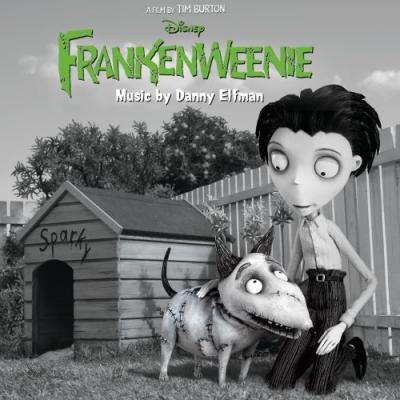
"Frankenweenie" Soundtrack Lyrics
Cartoon • 2012
Track Listing
Karen O
Neon Trees
Mark Foster
Passion Pit
Plain White T's
Kimbra
AWOLNATION
Kerli
Grace Potter, The Flaming Lips
Imagine Dragons
GROUPLOVE
Skylar Grey
Robert Smith
Winona Ryder
"Frankenweenie (Original Motion Picture Soundtrack)" Soundtrack Description

Overview
Can a horror pastiche feel like a lullaby? Danny Elfman’s Frankenweenie score says yes: elegiac strings for a boy and his dog; lightning-bolt brass for the experiments; waltzes that wink at the Universal monsters. Released by Walt Disney Records in 2012, the album anchors Tim Burton’s black-and-white stop-motion film while a separate companion set, Frankenweenie Unleashed!, gathers “music inspired by” contributions.
Functionally, the score is the film’s heartbeat—short motifs glide under dialogue, then bloom into set-pieces (“Re-Animation,” “Final Confrontation”). Two songs surface in-film: Karen O’s end-credits “Strange Love” and Winona Ryder’s diegetic town anthem “Praise Be New Holland.” For basic facts and credits, Wikipedia, Apple Music, and MusicBrainz agree; Pitchfork and NME document Karen O’s track and placement.
Questions & Answers
- How many official soundtrack releases are there?
- Two on the same day (2012-09-25): Elfman’s score album and the companion Frankenweenie Unleashed! compilation by various artists.
- Which non-score songs are actually used in the film?
- Two: Karen O’s “Strange Love” (end credits) and Winona Ryder’s “Praise Be New Holland” (performed in-story).
- What’s unique about Elfman’s approach here?
- He threads a tender boy-and-dog motif through B-movie horror idioms—funeral marches, theremin-like textures—so the scares never eclipse the bond.
- Where was the score recorded/mixed?
- Recorded at AIR Lyndhurst (London); mixed at the Todd-AO Scoring Stage (Los Angeles).
- Is there a regional theme song?
- Yes. Japan’s release used Kaela Kimura’s “Wonder Volt” as a theme for local marketing/editions.
- Who supervised the “inspired by” album?
- Disney’s music team assembled it; artists include Robert Smith, Passion Pit, Imagine Dragons, and more.
Notes & Trivia
- The score album and the “inspired by” compilation dropped the same day—unusual but fitting Burton’s dual target: cinephiles and pop listeners.
- Only two tracks from Unleashed! appear in the movie proper.
- Recording took place at AIR Lyndhurst; mixing at Todd-AO—big, classic rooms that suit orchestral gothics.
- Japanese marketing featured an alternate theme, “Wonder Volt.”
- Elfman and Burton extend a decades-long collaboration here; the tone recalls their early 1990s work, softened by elegy.
Genres & Themes
Gothic orchestral → grief with grandeur. Low strings and muted brass dignify Victor’s loss; the main theme sings like a lullaby in mourning clothes.
Retro sci-fi color → curiosity as danger. Oscillating lines and eerie timbres evoke 1950s lab cinema; they celebrate tinkering while warning of fallout.
Parade & hymn cues → small-town ritual. Marches and chorales frame New Holland’s festivals and moral panic, contrasting community pageant with individual heartbreak.

Tracks & Scenes
Selections pair official cue titles with on-screen moments. Times vary by edition; descriptions reflect documented track names and plot beats.
“Main Titles” — Danny Elfman
Where it plays: Opening credits over black-and-white suburbia; establishes orchestral palette. Non-diegetic.
Why it matters: Introduces the tender, singable motif that will shadow Victor and Sparky.
“Game of Death” — Danny Elfman
Where it plays: The baseball sequence that ends in Sparky’s accident. Non-diegetic.
Why it matters: Punchy ostinatos hard-cut to silence—trauma rendered in rhythm.
“The Funeral” — Danny Elfman
Where it plays: Backyard ceremony; sparse strings and winds. Non-diegetic.
Why it matters: Gives the film its elegiac core before science intrudes.
“Electricity” → “Re-Animation” — Danny Elfman
Where it plays: Attic lab storm—Victor resurrects Sparky. Non-diegetic; classic mad-science flourish.
Why it matters: Swells from tremolo suspense to triumph, then falls back into fragile wonder.
“Sparky’s Day Out” — Danny Elfman
Where it plays: Sparky slips out; playful chase textures. Non-diegetic.
Why it matters: Restores dog-movie joy without dropping the gothic frame.
“Invisible Fish / Search for Sparky” — Danny Elfman
Where it plays: Class experiment gone wrong and nocturnal search. Non-diegetic.
Why it matters: Sci-fi pizzicatos meet small-town suspense.
“Making Monsters” — Danny Elfman
Where it plays: Classmates copy Victor’s experiment with chaos-bound results. Non-diegetic.
Why it matters: Turns the motif feral; complicates the ethics.
“Pool Monsters Attack” — Danny Elfman
Where it plays: Creature mayhem at the school/fair. Non-diegetic.
Why it matters: Comedy-horror scherzo that pays off the movie’s monster-movie love.
“Final Confrontation” — Danny Elfman
Where it plays: Windmill showdown; firelight and decision. Non-diegetic.
Why it matters: The theme grows up—love requires risk.
“Happy Ending” — Danny Elfman
Where it plays: Resolution; tender reprise. Non-diegetic.
Why it matters: Closes the circle without cynicism.
“Praise Be New Holland” — Winona Ryder
Where it plays: Performed in-story during Dutch Day/pageant sequences. Diegetic.
Why it matters: Satirizes civic pride; the melody later reads ironically against mob panic.
“Strange Love” — Karen O
Where it plays: End credits. Non-diegetic song.
Why it matters: Calypso-tinged farewell that reframes the macabre as sweet, per the director’s brief.
Trailer usage
Where it plays: Official trailers cut to Elfman stings and set-piece swells.
Why it matters: Marketing showcased the score’s gothic-tender blend from the start.
Music–Story Links
The lullaby-like main theme lets Victor’s grief stay central even when mayhem erupts—so “Pool Monsters Attack” never flattens into mere parody. Hymn/march writing (“Praise Be New Holland”) frames the town’s rituals; when the crowd turns, that same ceremonial feel curdles into judgment. By the windmill, the theme matures: Elfman leans into warmth, not irony, so the ending feels earned, not engineered.

How It Was Made
Recording took place at AIR Lyndhurst in London, with mixing at the Todd-AO Scoring Stage in Los Angeles. Session footage and interviews show Elfman and Burton shaping themes around specific set-pieces and keeping cues modular for animation timing. Release-day materials split the music into two albums: the orchestral score and the pop-leaning Unleashed! set featuring Robert Smith, Passion Pit, Imagine Dragons, and others.
Reception & Quotes
Coverage highlighted the elegant balance of spooky and sincere, and singled out the Karen O track as a smart tonal send-off.
“The song will be played over the film’s closing credits.” NME
“I went in the direction of exotica and calypso… quirky, good vibes music.” Pitchfork (Karen O)
“Video from the recording sessions… in London earlier this year.” Film Music Reporter
Additional Info
- Score album: 22 tracks (~56 minutes). Companion album: 14 tracks (various artists).
- Only “Strange Love” and “Praise Be New Holland” are used in the film; most Unleashed! cuts are promotional/“inspired by.”
- Japanese territories promoted Kaela Kimura’s “Wonder Volt.”
- Elfman–Burton collaboration continuity helps the score sit alongside their earlier gothic catalog.
- Streaming availability is broad; physical CD editions vary by region.
Technical Info
- Title: Frankenweenie (Original Motion Picture Soundtrack)
- Year: 2012
- Type: Film score (with companion “music inspired by” album)
- Composer: Danny Elfman
- Label: Walt Disney Records
- Recording: AIR Lyndhurst, London; mixed at Todd-AO Scoring Stage, Los Angeles
- Used songs: “Strange Love” (Karen O) — end credits; “Praise Be New Holland” (Winona Ryder) — diegetic pageant
- Release context: US theatrical release October 5, 2012; soundtracks released September 25, 2012
- Chart note: Unleashed! peaked on Billboard’s Soundtrack Albums chart
Canonical Entities & Relations
| Subject | Relation | Object |
|---|---|---|
| Danny Elfman | composed | Frankenweenie (Original Motion Picture Soundtrack) |
| Walt Disney Records | released | Score album & Frankenweenie Unleashed! (2012) |
| Tim Burton | directed | Frankenweenie (film, 2012) |
| Karen O | performed | “Strange Love” (end credits) |
| Winona Ryder | performed | “Praise Be New Holland” (diegetic) |
| AIR Lyndhurst | hosted recording for | Elfman’s score sessions |
| Todd-AO Scoring Stage | mixed | Elfman’s score |
| Kaela Kimura | recorded | “Wonder Volt” (Japan theme usage) |
Sources: Wikipedia; Apple Music; MusicBrainz; Pitchfork; NME; Film Music Reporter.
November, 09th 2025
'Frankenweenie' is an American 3D stop-motion-animated fantasy horror comedy film directed by Tim Burton and produced by Walt Disney Pictures. Learn more on Internet Movie Database and WikipediaA-Z Lyrics Universe
Cynthia Erivo Popular
Ariana Grande Horsepower
Post Malone Ain't No Love in Oklahoma
Luke Combs Good Riddance (Time of Your Life)
Green Day Bye Bye Bye
*NSYNC You're the One That I Wan
John Travolta & Olivia Newton-John I Always Wanted a Brother
Braelyn Rankins, Theo Somolu, Kelvin Harrison Jr. and Aaron Pierre The Power of Love
Frankie Goes to Hollywood Beyond
Auli’i Cravalho feat. Rachel House MORE ›