Soundtracks:  A B C D E F G H I J K L M N O P Q R S T U V W X Y Z #


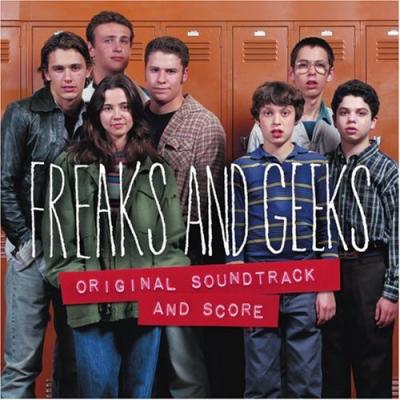
Freaks And Geeks Album Cover

"Freaks And Geeks" Soundtrack Lyrics

Movie • 2004

Track Listing


"Freaks and Geeks: Original Soundtrack and Score" Soundtrack Description

Freaks and Geeks official trailer still with Lindsay Weir walking the McKinley High hallway; a nod to the show’s era-true rock soundtrack
Freaks and Geeks — series trailer cue-points

Overview

How do you score 1980–81 suburban Michigan so it sounds lived-in, not nostalgic? Freaks and Geeks: Original Soundtrack and Score (Shout! Factory, 2004) answers with needle-drops pulled straight from the era—The Who, Rush, Styx, Joan Jett—braided with Michael Andrews’ compact original cues. The album arrived alongside the 2004 DVD that famously preserved the show’s costly song rights.

On screen, songs are mostly diegetic—blaring from gym speakers, basement stereos, car radios—so the music feels like the kids’ world, not commentary. The disc balances nine marquee songs, eleven Andrews cues, and cast performances (Jason Segel’s “Lady L,” Dave (Gruber) Allen with “I’m Eighteen”), mapping directly to moments fans cite by heart. Trusted sources include the series and soundtrack pages on Wikipedia and AllMusic; Discogs confirms the CD configuration.

Trailer card over McKinley High marching band stands, where source music often plays in-episode
Source-first approach: the show lets songs live in the world

Questions & Answers

What exactly is this album?
A 2004 CD (Shout! Factory) combining nine licensed songs from the series, eleven Michael Andrews score cues, three cast covers, one extra band performance, and a bonus track.
Who handled the score and who supervised the songs?
Score by Michael Andrews; music supervision credited to Buck Damon on the series.
Why was the DVD release delayed?
Song rights. The series used big-ticket classics; clearing them for home video took time and money. The 2004 DVD shipped with the music intact.
Theme song?
“Bad Reputation” by Joan Jett & the Blackhearts plays over the opening credits of every episode.
When was the soundtrack released?
September 14, 2004 (U.S.), concurrent with the restored DVD set.
Does the album include every song used in the show?
No. The show used 120+ cues across 18 episodes; the CD is a curated sampler plus score highlights.

Notes & Trivia

  • DVD music clearances were preserved in 2004; earlier Fox Family reruns replaced some cues with library music.
  • Van Halen appears repeatedly; The Who has the most total songs used across the season.
  • The booklet essays were penned by David Wild and Jake Kasdan; guidance counselor Jeff Rosso “annotates” tracks in character.
  • Composer credit: Michael Andrews (a.k.a. Elgin Park), later of Donnie Darko.

Genres & Themes

AOR & classic rock → identity performance. Van Halen, Rush, Styx score basement jams, pep rallies, and garage dreams; the kids try on selves at full volume.

Power-pop & new wave → social friction. Joe Jackson, XTC, and Heatwave cues land on parties and awkward dances, where confidence and anxiety trade measures.

Compact score cues → emotional glue. Andrews writes 30–90-second motifs (“Lindsay’s Theme,” “Daniel’s Theme”) that slip between source songs and dialogue without breaking tone.

Trailer montage: gym dance, garage band, pep rally—the music toggles between diegetic rock and short score cues
Gym → garage → rally: one world, many speakers

Tracks & Scenes

Selections below pair key songs with documented placements. Timings vary by cut; episode references reflect the DVD booklet and widely cited guides.

“Bad Reputation” — Joan Jett & the Blackhearts
Where it plays: Opening titles of every episode. Diegetic spill rarely; primarily titles.
Why it matters: Stakes the series’ anti-cool cool—assertive, defensive, honest.

“Come Sail Away” — Styx
Where it plays: 1x01 “Pilot.” The slow-dance that turns into an up-tempo sprint when the song shifts. Diegetic gym dance.
Why it matters: A perfect teen switch: romance to panic on a downbeat.

“The Spirit of Radio” — Rush
Where it plays: 1x06 “I’m With the Band.” Nick’s drummer arc; practice/audition energy. Diegetic rehearsal/performance.
Why it matters: Aspirations meet technique; the song’s time shifts mirror Nick’s struggle.

“I’m One” — The Who
Where it plays: Season mid-run introspection beat (Weir POV). Non-diegetic montage.
Why it matters: Adolescent self-definition as confession—tuneful but bruised.

“Look Sharp!” — Joe Jackson
Where it plays: Hallway strut/commons scenes. Non-diegetic sting that feels diegetic.
Why it matters: Angles the show toward new-wave twitch—cool as camouflage.

“No Language in Our Lungs” — XTC
Where it plays: Reflective montage. Non-diegetic.
Why it matters: Words fail; guitars don’t. It’s the series’ thesis in miniature.

“The Song Is Over” — The Who
Where it plays: 1x09 “We’ve Got Spirit.” Non-diegetic, capping an emotional comedown.
Why it matters: A grown-up ending for a teenage day.

“Ripple” / “Box of Rain” — Grateful Dead
Where it plays: 1x18 “Discos and Dragons.” Lindsay’s fork in the road. Non-diegetic and source-adjacent.
Why it matters: The finale’s quiet rebellion happens in harmony, not noise.

Cast performances (on album)
“Lady L” — Jason Segel; “I’m Eighteen” — Dave (Gruber) Allen & Feedback; “Jesus Is Just Alright” — Jason Segel/Sarah Hagan (1x02 “Beers and Weirs”).
Why it matters: The show lets characters sing their delusions and hopes out loud.

Music–Story Links

Source rock isn’t wallpaper; it’s a mirror. When Nick hammers through Rush, the meter changes expose his overreach. When the gym erupts to “Come Sail Away,” the tonal shift yanks the scene from dream to embarrassment without a cut. By the finale, Dead songs soften the choice in front of Lindsay—movement by melody, not decree.

Trailer closing frame: the Weirs at home; Andrews’ short cues often bridge scenes like this
Andrews’ cues: the breath between the big songs

How It Was Made

Paul Feig and Judd Apatow built scenes around specific records, then Andrews wrote to the seams. Music supervisor Buck Damon chased period masters, a choice that later complicated the DVD but defined the show’s honesty. The 2004 CD mirrors that mix: familiar singles, compact cues, and in-character songs. AllMusic dates the release (Sept 14, 2004); Discogs catalogs the contents and credits; a detailed oral history with Feig, Apatow, Andrews, and Damon explains the approach.

Reception & Quotes

The album reads like a mini-anthology of 1977–81 teen-canon hits with just enough score to keep it a story. Critics and fans still point to the cost—and necessity—of keeping the originals.

“CD soundtrack… nine songs from the series, eleven score cues, three cast covers… plus extras.” Wikipedia soundtrack entry
“Release Date: September 14, 2004.” AllMusic
“We had to get the music right, even if it hurt.” Consequence oral history (Feig/Apatow/Andrews/Damon)

Additiona

November, 09th 2025


A-Z Lyrics Universe

Lyrics / song texts are property and copyright of their owners and provided for educational purposes only.