Soundtracks:  A B C D E F G H I J K L M N O P Q R S T U V W X Y Z #


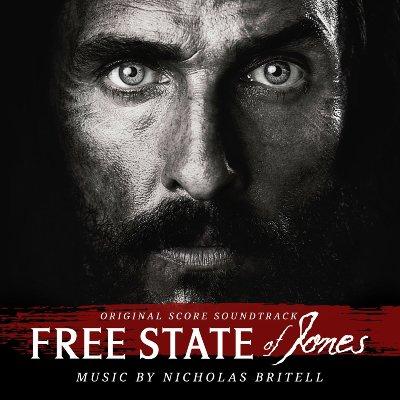
Free State of Jones Album Cover

"Free State of Jones" Soundtrack Lyrics

Movie • 2016

Track Listing


"Free State of Jones (Original Motion Picture Soundtrack)" Soundtrack Description

Free State of Jones official trailer frame with Newt Knight crossing a battlefield as mournful strings suggest the score’s tone
Free State of Jones (2016) — Official trailer frame.

Overview

How do you score a Civil War revolt without romanticizing it? Nicholas Britell answers with a restrained, acoustic language—fiddle, low strings, spare piano—that lets the brutality speak and the community-building breathe. The album runs 18 cues (~35 minutes) and mirrors the film’s march from battle trauma to Reconstruction grief.

The film also weaves in period tunes and a few licensed pieces: 19th-century standards (“Beautiful Dreamer,” “Soldier’s Joy,” “Battle Cry of Freedom”) appear alongside Lucinda Williams’s original end-credits song “I’m Crying,” and—unusually—two cues sourced from other film scores (Nick Cave & Warren Ellis; Dickon Hinchliffe). Release details and credits align across AllMusic, Apple Music, Discogs, and IMDb.

Trailer image: piney swamp refuge; the score’s hushed textures fit the hiding sequences
Muted timbres and close miking keep the story intimate, not triumphalist.

Questions & Answers

Who composed the score?
Nicholas Britell. The album is a concise, 18-track presentation of his music for the film.
Who performs on the soundtrack?
Featured players include Tim Fain (violin), Caitlin Sullivan (cello), Shawn Conley (bass), and Shawn Pelton (percussion), with Britell on piano/synth.
Is there a new original song?
Yes. Lucinda Williams wrote and performs “I’m Crying,” used over the end credits.
Are all the songs on the album period-authentic?
No. Alongside Civil War–era pieces, the film licenses contemporary score tracks by Nick Cave & Warren Ellis (“What Must Be Done”) and Dickon Hinchliffe (“Rodney Prepares for Fight”).
Label and release?
Issued for STX Recordings under exclusive license to Sony Music (marketed via Sony Classical imprint), dated June 24, 2016.
Does the album include every piece heard on screen?
It focuses on Britell’s score and the Williams song; some source/period pieces heard in the film are not on the album.

Notes & Trivia

  • Spotify and Apple Music list 18 tracks (~34–35 minutes); the physical release mirrors this program.
  • Two licensed cues come from other films: Cave/Ellis’s “What Must Be Done” (from The Assassination of Jesse James…) and Hinchliffe’s “Rodney Prepares for Fight” (from Out of the Furnace).
  • Britell’s thematic idea centers on a compact, repeating figure that shifts from distant horn to somber cello later in the film.
  • Period standards (“Beautiful Dreamer,” “Soldier’s Joy,” “Battle Cry of Freedom,” “Napoleon Crossing the Rhine”) anchor diegetic moments.
  • Session credits consistently name Tim Fain and Rob Moose among the string principals.

Genres & Themes

Americana chamber score → Moral gravity. Close-mic’d strings and spare piano keep scenes inward—grief, solidarity, and stubborn resolve—rather than battlefield bombast.

Period folk & parlor songs → Texture of lived time. Fiddle tunes and 19th-century melodies mark campfires, makeshift celebrations, and private rituals without anachronistic gloss.

Licensed minimalist cues → Shock of recognition. Cave/Ellis and Hinchliffe imports add mournful, modern resonance to key turning points.

Trailer beat: town square faces the camera as restrained strings underline the scene
Style map: period diegesis for place; chamber score for conscience.

Tracks & Scenes

Timestamps refer to the ~139-minute cut; diegetic = heard by characters. Song placements verified where noted by reliable listings; otherwise described conservatively.

“Soldier’s Joy” — Traditional; performance credited (film) to Jerry Douglas/Mark O’Connor ensemble
Where it plays: ~1:02:00 Newton fiddles while preparing a roast; diegetic.
Why it matters: Brief normalcy—music as hearth in a war zone.

“The Battle Cry of Freedom” — George F. Root; harmonica performance on screen
Where it plays: ~1:27:00 Victory celebration in Ellisville; diegetic.
Why it matters: A Union anthem in Confederate Mississippi—needle-drop with political bite.

“Rodney Prepares for Fight” — Dickon Hinchliffe
Where it plays: ~1:48:00 Newton helps free Moses’s son from an abusive apprenticeship; non-diegetic.
Why it matters: A licensed modern cue used to tighten suspense and moral urgency.

“I’m Crying” — Lucinda Williams (with Nicholas Britell & ensemble)
Where it plays: ~2:13:00 End credits; non-diegetic.
Why it matters: An unvarnished lament that reframes the film’s coda in grief and endurance.

“Beautiful Dreamer” — Stephen Foster
Where it plays: Heard in-film as period source music; specific scene varies by edition; diegetic.
Why it matters: A parlor-song touchstone that situates the story’s domestic spaces.

“What Must Be Done” — Nick Cave & Warren Ellis
Where it plays: Brief licensed use in a mournful passage; non-diegetic.
Why it matters: A modern elegy repurposed to deepen the film’s meditation on loss.

Key score cues by Nicholas Britellnon-diegetic
“Battle of Corinth” (opening trauma); “Taking Daniel Home” (after the nephew’s death); “They Took Everything” (tax-in-kind raids); “Piney Woods Swamp” (refuge forms); “July 1863 / Loyalty Oath” (allegiance pivot); “Hanging the Deserters” (reprisals); “Killing the Colonel” (uprising strike); “The Free State of Jones” (declaration); “Reconstruction” (postwar reckoning).

Music–Story Links

Diegetic folk marks the arc from survival to proto-citizenship: fiddling around a roast (“Soldier’s Joy”) and a harmonica anthem after Ellisville’s win (“Battle Cry of Freedom”) turn music into community. When the film leaves period source and leans on Hinchliffe’s “Rodney Prepares for Fight,” it signals a rescue-as-mission, not spectacle. Williams’s “I’m Crying” over credits denies neat catharsis—the story spills into Reconstruction, and the music won’t let us look away.

Trailer climax: militia faces down in a field as the score shifts from motif to sustained chords
From revolt to aftermath—the score’s palette narrows as costs mount.

How It Was Made

Britell tracked an intimate ensemble—violin (Tim Fain), cello (Caitlin Sullivan), bass (Shawn Conley), percussion (Shawn Pelton), winds and brass in small forces—then kept the mix close and dry. The label line reads STX Recordings under exclusive license to Sony Music (issued through Sony Classical). AllMusic and Discogs confirm credits; Apple Music notes the performer roster.

Reception & Quotes

Reaction to the music ran from praise for restraint to calls for more dramatic punch. Most outlets agreed the album functions as a somber companion listen.

“The artful music score makes an emotional impact.” Feature review summary
“[The] score does little to punctuate moments that need more heft.” Critical counterpoint
“Features an eleven-note melody for the hero… returning in a crucial scene on cello.” Harvard Magazine

Additional Info

  • Album runtime: ~34:45 (18 tracks).
  • End-credits original: “I’m Crying” by Lucinda Williams, recorded with Britell’s ensemble.
  • Unusual reuse: Cave/Ellis and Hinchliffe cues licensed alongside Britell’s score.
  • Period pieces on screen outnumber those on the album; the disc prioritizes score.
  • Personnel highlights often cited: Tim Fain (violin), Rob Moose (strings), Caitlin Sullivan (cello), Shawn Pelton (percussion).

Technical Info

  • Title: Free State of Jones (Original Motion Picture Soundtrack)
  • Year: 2016
  • Type: Original score with select source songs
  • Composer: Nicholas Britell
  • Featured performers: Tim Fain (violin), Caitlin Sullivan (cello), Shawn Conley (bass), Shawn Pelton (percussion)
  • Notable licensed cues: “What Must Be Done” (Nick Cave & Warren Ellis); “Rodney Prepares for Fight” (Dickon Hinchliffe)
  • Label: STX Recordings under exclusive license to Sony Music (Sony Classical)
  • Release: June 24, 2016; digital/physical
  • Availability: Streaming (Apple Music, Spotify); CD cataloged on Discogs

Canonical Entities & Relations

SubjectRelationObject
Nicholas BritellcomposedFree State of Jones original score
Lucinda Williamswrote & performed“I’m Crying” (end-credits song)
Nick Cave & Warren Elliswrote“What Must Be Done” (licensed for film)
Dickon Hinchliffecomposed“Rodney Prepares for Fight” (licensed for film)
STX EntertainmentdistributedFree State of Jones (feature film)
Sony Music / Sony ClassicalreleasedOriginal soundtrack album (under license from STX Recordings)
Tim Fainperformedviolin on score recordings
Rob Mooseperformedstrings on score recordings

Sources: AllMusic; Apple Music; Discogs; IMDb; Wikipedia; Kinetophone; Presto Music; Soundtrakd; Harvard Magazine.

This film is about a hero, whose very existence is doubtful. Depending on whom you’ll ask about Newton Knight – a captain who fought for civil rights of people of all races – you may hear that he both was a hero and a cheater. And someone (descendants of white confederates) even thing that he was a legend made-up by a Hollywood (‘…we say that based on understanding that Hollywood can produce nothing good’). Ohkay, let’s leave those unbelievers aside of the mills of the history, wishing them oblivion & decline & turn our sight to the film itself. It is a story about a person, who erected himself over the rules of those times, where people were sent to war just to die so others would become richer. He opposed himself to plantation owners & didn’t recognize any other lord that Lord of Heaven. That’s why he rescued black people from being murdered just for a skin color, he fought for civil rights of many & he eventually died knowing that he did everything to defend the right to speak freely, in the age of 84. He had two wives – white & black – whose descendants now alive & were able to tell the details of his life story. Well, no matter what you think of him, this guy was a hero, if speaking of his deeds as he protected the representatives of Human Kind as much as he could. Beautiful Dreamer song is the best to describe his deeds, while Soldier's Joy with other Irish folk song – Napoleon Crossing the Rhine – tells the best of the spirit of this person & his supporters. Band ‘Traditional’ took a couple of songs in the soundtrack with inimitable lyrics. But probably you wouldn’t wanna hear George Frederick Root’s lyrics in his Battle Cry of Freedom, as they nothing but loud-and-shout.

November, 09th 2025

"Free State of Jones" on IMDb, Wikipedia
A-Z Lyrics Universe

Lyrics / song texts are property and copyright of their owners and provided for educational purposes only.