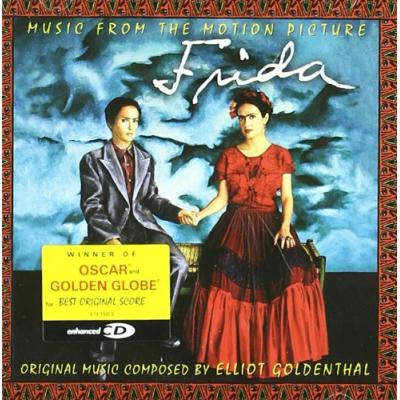
"Frida" Soundtrack Lyrics
Movie • 2002
Track Listing
Lila Downs
Elliot Goldenthal
Caetano Veloso & Lila Dawn
"Frida (Original Motion Picture Soundtrack)" Soundtrack Description
Overview
What do you get when a modernist score collides with ranchera torch songs and son jarocho? Frida builds a mosaic: Elliot Goldenthal’s Oscar-winning score anchors the film while era-true Mexican repertoire and dancehall cues color specific rooms, lovers, and memories. The album assembles Goldenthal’s cues with performances by Chavela Vargas, Lila Downs, Caetano Veloso, and (on screen) Salma Hayek.
The retail soundtrack arrived in 2002 on Deutsche Grammophon/UMG with an “enhanced” CD edition; digital editions credit Various Artists while liner notes highlight Goldenthal’s authorship. The score won the Academy Award and Golden Globe; the original song “Burn It Blue” earned an Oscar nomination. (Trusted sources named on this page: Oscars.org, World Soundtrack Awards, AllMusic, Discogs.)
Questions & Answers
- Who composed the score, and what did it win?
- Elliot Goldenthal composed the score; it won the Academy Award and the Golden Globe for Best Original Score.
- What label released the album?
- Deutsche Grammophon/UMG issued the album in 2002; physical editions are often branded DG/Universal.
- Is “Burn It Blue” an original?
- Yes. Lyrics by Julie Taymor, music by Goldenthal, performed by Caetano Veloso & Lila Downs; it was Oscar-nominated for Best Original Song.
- Does the film feature Chavela Vargas on screen?
- Yes. Vargas appears in a bar scene singing “La Llorona,” written into the narrative as a spectral visitation.
- Who sings on screen from the cast?
- Salma Hayek performs “La Bruja” diegetically with Los Vega in a bar sequence.
- Is there a track tied to the tango scene?
- Lila Downs’s “Alcoba Azul” (The Blue Bedroom) underscores the Modotti–Frida tango centerpiece.
- Is the CD different from the film’s full use list?
- Yes. The OST mixes score and select songs; some source cues heard in-film (e.g., period jazz/cabaret) sit outside the core album.
Notes & Trivia
- The Brothers Quay crafted the stop-motion hospital “Floating Bed” passage; Goldenthal’s cue of the same name scores it.
- Two distinct versions of “La Llorona” appear on the album: Chavela Vargas’s classic take and a Lila Downs arrangement with mariachi.
- The commercial CD was issued as an “enhanced” disc with bonus multimedia (region variants exist).
- Vargas’s “Paloma Negra” is used non-diegetically early, before her physical cameo later in the bar.
- Period needle-drops extend beyond Mexican repertoire (e.g., jazz/cabaret sides for cosmopolitan scenes).
Genres & Themes
Ranchera & bolero (Chavela Vargas; Tomás Méndez repertoire) → heartbreak as self-portrait. These songs frame solitude, jealousy, and resolve that feed Kahlo’s canvases.
Son jarocho / huapango (Lila Downs; Los Vega; regional ensembles) → communal rhythm. Street parties, bars, and family gatherings ground the story in Veracruz and central Mexican idioms.
Modernist score (Goldenthal: hammered dulcimer, guitars, accordions, strings) → interior states. Dissonant tints shift into luminous folk-tinged harmony for memory, pain, and recovery.
Cabaret & swing (period sides) → cosmopolitan detours. New York sojourns and party sequences breathe with era-correct dance music.

Tracks & Scenes
“Alcoba Azul” — Lila Downs
Where it plays: Party tango centerpiece with Frida and Tina Modotti; non-diegetic needle-drop staged as floor performance.
Why it matters: The cue’s slow burn and vocal phrasing let the camera read desire, power, and play without dialogue.
“La Llorona” — Chavela Vargas
Where it plays: A bar scene written as a ghostly visitation; Vargas appears singing at a nearby table (diegetic performance).
Why it matters: Folds biography into myth; the song’s lament maps directly onto Frida’s grief and memory.
“La Bruja” — Salma Hayek & Los Vega
Where it plays: Workers’ bar sequence; Hayek sings on screen, band in frame (diegetic).
Why it matters: Anchors the film’s lived Mexico—vernacular music, no gloss—while deepening Frida’s swagger and social ease.
“Paloma Negra” — Chavela Vargas
Where it plays: Early as non-diegetic heartbreak commentary; later echoes around moments of betrayal and self-redefinition.
Why it matters: Ranchera catharsis—resentment, yearning, steel—mirrors the film’s cut-hair, reforge-the-self beats.
“Benediction and Dream” / “The Floating Bed” — Elliot Goldenthal
Where it plays: Opening benediction and the hospital/bed sequence (non-diegetic score).
Why it matters: Establishes the film’s hybrid grammar: folk color inside a modernist frame; pain presented with ritual calm.
“Coyoacán and Variations” — Elliot Goldenthal
Where it plays: Casa Azul interludes; moving from domestic bustle to private reflection (non-diegetic score).
Why it matters: Motif architecture—home as refuge and stage for creation.
“Burn It Blue” — Caetano Veloso & Lila Downs
Where it plays: End-credits coda after the “Viva la vida” watermelon epilogue (non-diegetic).
Why it matters: The film’s original song; its lyric closes the loop from suffering to insistence on life.
“Viva la vida” — Trio/Marimberos
Where it plays: Late-film “Viva la Vida” (watermelons) imagery; used as celebratory/ironic benediction (non-diegetic/source-adjacent feel).
Why it matters: Direct nod to Kahlo’s final painting and motto, not a Coldplay reference—this one is Mexican folk.
Also heard (not all on the OST): cabaret and jazz sides (e.g., Josephine Baker; Count Basie) for party/New York passages; a brief radio snippet of Gardel’s tango tradition surfaces as period color.
Music–Story Links
Vargas’s songs externalize private rupture (“Paloma Negra” → discovery, defiance; “La Llorona” → grief embodied). Son jarocho numbers turn spaces social—bars and patios where alliances form. The tango to “Alcoba Azul” fuses politics and seduction into one uninterrupted gaze. Goldenthal’s cues (“Floating Bed,” “Coyoacán…”) stitch paintings to bodies; the end passes from diegetic chant of life (“Viva la vida”) to the purpose-built “Burn It Blue.”
How It Was Made
Composer & palette. Goldenthal combines guitars, hammered dulcimer, accordion, low brass, and strings; the concert suite later premiered in Kraków. Orchestration by Robert Elhai and Goldenthal; Stephen Mercurio conducted; recording/mix by Joel Iwataki; music production by Teese (Matthias) Gohl.
Song casting. Julie Taymor and the music team license canonical rancheras and son jarocho, then invite living voices (Lila Downs) and legends (Vargas) into the diegesis. Hayek’s “La Bruja” performance was cut live for the bar sequence.
Editorial design. Stop-motion by the Brothers Quay (hospital “Floating Bed”) let the score speak rhythmically while visual grammar bends toward folk art and Día de Muertos motifs.
Reception & Quotes
“Goldenthal’s Frida is a sultry, dissonant beauty that still sings.” Filmtracks review
“The score… lovely, with piano and a lush string wash.” Contemporary review summary
“Best Original Score — Academy Award winner.” Oscars.org
“Soundtrack Composer of the Year — Frida.” World Soundtrack Awards
Additional Info
- Album credited to Various Artists on most streaming services; physical spine credits emphasize Elliot Goldenthal.
- “Burn It Blue” lyrics by Julie Taymor; single-style edits circulated for awards consideration.
- CD pressings list DG/Universal branding; enhanced CD variants include behind-the-scenes media.
- Not every source cue on film appears on the OST; conversely, some album edits differ from film mixes.
- Period dance cues (cabaret/swing) mark cosmopolitan milieus during the U.S. chapters.
Technical Info
- Title: Frida (Original Motion Picture Soundtrack)
- Year: 2002
- Type: Score + compiled source songs
- Composer: Elliot Goldenthal
- Key performers: Chavela Vargas; Lila Downs; Caetano Veloso; Salma Hayek (on-screen)
- Music production: Teese (Matthias) Gohl; recording/mix Joel Iwataki; orchestrations with Robert Elhai
- Label: Deutsche Grammophon / Universal Music
- Awards: Academy Award & Golden Globe (Best Original Score); Oscar nomination (Best Original Song, “Burn It Blue”)
- Availability: CD (incl. enhanced editions), major streamers (album credited to Various Artists)
- Selected notable placements: “Alcoba Azul” (tango); “La Llorona” (bar, diegetic); “La Bruja” (bar, diegetic); “Viva la vida” (finale); “Burn It Blue” (end credits)
Canonical Entities & Relations
| Subject | Relation | Object |
|---|---|---|
| Elliot Goldenthal | composed | Score for Frida (2002) |
| Julie Taymor | directed | Frida (film) |
| Chavela Vargas | performed | “La Llorona” (on-screen cameo; also on OST) |
| Lila Downs | performed | “Alcoba Azul”; “Benediction and Dream”; duet on “Burn It Blue” |
| Caetano Veloso | performed | “Burn It Blue” (original song) |
| Salma Hayek | performed (diegetic) | “La Bruja” with Los Vega |
| Deutsche Grammophon / UMG | released | Frida Original Motion Picture Soundtrack (2002) |
| Oscars | awarded | Best Original Score — Frida |
| World Soundtrack Awards | awarded | Soundtrack Composer of the Year — Elliot Goldenthal (Frida) |
Sources: Oscars.org; World Soundtrack Awards; AllMusic; Discogs; Apple Music; IMDb; Wikipedia; Filmtracks; AFI Catalog; ExploreDance.
November, 09th 2025
A-Z Lyrics Universe
Cynthia Erivo Popular
Ariana Grande Horsepower
Post Malone Ain't No Love in Oklahoma
Luke Combs Good Riddance (Time of Your Life)
Green Day Bye Bye Bye
*NSYNC You're the One That I Wan
John Travolta & Olivia Newton-John I Always Wanted a Brother
Braelyn Rankins, Theo Somolu, Kelvin Harrison Jr. and Aaron Pierre The Power of Love
Frankie Goes to Hollywood Beyond
Auli’i Cravalho feat. Rachel House MORE ›