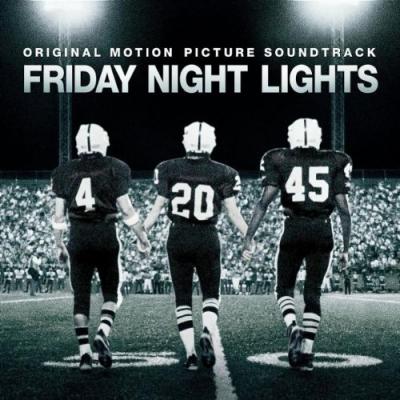
"Friday Night Lights" Soundtrack Lyrics
TV • 2004
Track Listing
Explosions In The Sky
Daniel Lanois
Explosions In The Sky
David Torn
Explosions In The Sky
Bad Company
Explosions In The Sky
"Friday Night Lights (Original Television Soundtrack)" Soundtrack Description
Overview
Does a high-school football drama really need post-rock crescendos and hushed folk? This one does. The TV series premiered in 2006 (the 2004 date belongs to the Billy Bob Thornton film), and its soundtrack balances Texas-rooted guitar ambience with needle-drops that feel lived-in rather than flashy. Instead of stadium anthems, the show leans on aching instrumentals and alt-country confessionals, then spikes big wins with smartly chosen indie and classic cuts.
The first compilation, Friday Night Lights (Original Television Soundtrack) (Adrenaline Records, 2007), set the tone: Tony Lucca’s “Devil Town,” Iron & Wine with Calexico, Spoon, The Killers, José González, and a closer from Explosions in the Sky. A second volume arrived in 2010 (Arrival/Scion), adding Sufjan Stevens, The Avett Brothers, White Rabbits, and W.G. Snuffy Walden’s theme. Core credits and album data line up across trusted sources like AllMusic, Discogs, MusicBrainz, and IMDb.
Questions & Answers
- Who handled the show’s music supervision?
- Liza Richardson was music supervisor across the run; she’s cited for selecting hundreds of placements.
- Who composed the series theme?
- W. G. Snuffy Walden wrote the TV theme; the film’s score was largely Explosions in the Sky.
- How do the TV and 2004 film soundtracks differ?
- The film leans almost entirely on Explosions in the Sky; the series mixes post-rock with Americana, indie, and select pop/R&B cues.
- Are there official soundtrack albums?
- Yes: a 2007 TV soundtrack (Adrenaline) and Vol. 2 in 2010 (Arrival/Scion).
- Why do some songs differ on streaming?
- Licenses were often limited in term/scope; a few broadcast songs were later replaced in streaming releases.
- Which recurring cue defined early seasons?
- Explosions in the Sky motifs (e.g., “Your Hand in Mine”) color montages and big game beats, alongside Walden’s theme.
- Where can I verify episode placements?
- WhatSong/Tunefind-style databases and IMDb episode soundtracks are the quickest cross-checks.
Notes & Trivia
- The TV series started in 2006; “2004” refers to the feature film. (IMDb/Wikipedia confirm dates.)
- Liza Richardson’s team logged 600+ songs across five seasons — unusually dense for a network drama.
- Some broadcast cues later changed online due to term-limited licenses (common in 2000s TV deals).
- “Devil Town” appears in multiple forms; Tony Lucca’s cover became the series’ signature.
- Trusted sources referenced in text: AllMusic, Discogs, MusicBrainz, IMDb.
Genres & Themes
Post-rock & instrumental guitar — Explosions in the Sky–style swells map to grit, injury, and the long march to Friday nights; wordless emotion equals pressure without cliché.
Americana & alt-folk — Iron & Wine, Calexico, José González, Sufjan Stevens: vulnerability, faith, and family reckonings; acoustic textures mirror small-town interiors.
Indie & alt-rock — Spoon, The Killers, The National: attitude, release valves, and modernity pushing against tradition.
Tracks & Scenes
“Devil Town” — Tony Lucca
Where it plays: Season 1 finale parade (“State,” S1E22). Non-diegetic over slow-motion celebration.
Why it matters: A bittersweet Daniel Johnston cover reframes victory as uneasy civic worship rather than pure triumph.
“Dead Man’s Will” — Calexico & Iron & Wine
Where it plays: “Crossing the Line” (S1E8). After conflict, the Riggins brothers share a fragile truce at home. Non-diegetic.
Why it matters: A tender ceasefire; harmony and resignation in equal measure.
“Your Hand in Mine” — Explosions in the Sky
Where it plays: “Pilot” (S1E1). Pre-game prep and hospital uncertainty. Non-diegetic montage.
Why it matters: Establishes the show’s contemplative, unsentimental tone from the outset.
“I Turn My Camera On” — Spoon
Where it plays: “Nevermind” (S1E11). Teen bravado and small rebellions. Non-diegetic needle-drop.
Why it matters: A crisp groove that punctures macho fronts with jittery cool.
“Read My Mind (Like Rebel Diamonds Mix)” — The Killers
Where it plays: “Mud Bowl” (S1E20). The improvised playoff field debut. Non-diegetic during opening beats of the game.
Why it matters: Romance and resolve; the cue mythologizes DIY football into hometown ritual.
“Come Thou Fount of Every Blessing” — Sufjan Stevens
Where it plays: “East of Dillon” (S4E1). Halftime in East Dillon; Coach forfeits. Non-diegetic hymn underscores humility.
Why it matters: Grace in defeat; the music dignifies a painful reset for the program.
“Start a War” — The National
Where it plays: “Keep Looking” (S5E4). Family tensions, recruiting temptations, and private doubts. Non-diegetic closer.
Why it matters: A low-burn reckoning; the lyric mood mirrors characters bracing for fallout.
Also notable across the series/OSTs: José González — “Storm”; Drive-By Truckers — “Goodbye”; OutKast — “Idlewild Blues”; The Avett Brothers — “If It’s The Beaches”. Some tracks appear on official CDs; others are show-only or vary by platform.
Music–Story Links
Victories rarely get triumphant brass here. “Devil Town” turns the S1 title win into a cautionary portrait of idol-making. “Dead Man’s Will” is character therapy for the Riggins brothers without a word spoken. S4’s hymn at halftime sanctifies Coach Taylor’s hardest call. In late-series arcs, “Start a War” shades Vince, Buddy, and Becky with the sense that choices already cost them something. Even when Explosions in the Sky returns, it’s restraint, not fireworks, that sells resilience.
How It Was Made
Music supervisor Liza Richardson coordinated a high volume of licensed songs with showrunners and editors episode by episode. The TV theme is by W. G. Snuffy Walden; Bennett Salvay is also credited as composer. The broader palette (compared with the 2004 film’s Explosions-centric score) let the show match small-town textures — diners, church basements, booster meetings — to distinct musical colors. Interviews and trade profiles document two key realities: budget-driven licensing choices and term-limited contracts that later affected streaming versions.
Reception & Quotes
“Richardson selected over 600 songs in the 5-season run of Friday Night Lights.” Guild of Music Supervisors
“Each episode has a budget, whether it’s $10,000 or $80,000.” Pitchfork — Liza Richardson interview
“This episode is all about living in situations on the verge of breaking apart.” The A.V. Club on S5E8 “Fracture”
The music direction drew sustained praise for avoiding locker-room clichés and for using indie/Americana choices to deepen character work. GQ and other outlets routinely single out “Devil Town,” the Walden theme, and Iron & Wine/Calexico as defining moments.
Additional Info
- Two albums: 2007 (Adrenaline) and 2010 Vol. 2 (Arrival/Scion).
- Licensing quirks: some broadcast cues changed in later streaming editions (common for mid-2000s TV).
- Theme credit: W. G. Snuffy Walden for TV; the film’s 2004 soundtrack is Explosions in the Sky-led.
- Episode anchors: “Mud Bowl” (S1E20) — The Killers; “State” (S1E22) — “Devil Town” cover; “East of Dillon” (S4E1) — Sufjan.
- Texas focus: Richardson often favored regional artists or sounds to keep Dillon grounded.
- Verification tip: IMDb episode soundtracks and WhatSong/Tunefind entries are reliable cross-references.
Technical Info
- Title: Friday Night Lights (Original Television Soundtrack)
- Year: 2007 (Vol. 2 in 2010)
- Type: Television soundtrack (Various Artists)
- Theme/Score (TV): W. G. Snuffy Walden; additional composer Bennett Salvay
- Music Supervision: Liza Richardson
- Labels: Adrenaline Records (2007); Arrival Records/Scion Music Group (2010)
- Selected notable placements: “Devil Town” (S1E22); “Dead Man’s Will” (S1E8); “Your Hand in Mine” (S1E1); “Read My Mind” (S1E20); “Come Thou Fount…” (S4E1); “Start a War” (S5E4).
- Release context: TV series aired 2006–2011 (NBC/DirecTV). Film (2004) has separate OST.
- Availability: Both TV OSTs on major DSPs; some episode streams use substitute songs due to expired terms.
Canonical Entities & Relations
| Friday Night Lights (TV series) | theme composed by | W. G. Snuffy Walden |
| Friday Night Lights (TV series) | music supervised by | Liza Richardson |
| Friday Night Lights (Original Television Soundtrack) | released by | Adrenaline Records |
| Friday Night Lights Vol. 2 (Original Television Soundtrack) | released by | Arrival Records / Scion Music Group |
| Explosions in the Sky — “Your Hand in Mine” | appears in | Friday Night Lights (TV) — multiple early scenes |
| Tony Lucca — “Devil Town” | underscores | Season 1 championship parade (S1E22) |
| Calexico & Iron & Wine — “Dead Man’s Will” | underscores | Riggins brothers’ reconciliation moment (S1E8) |
| The Killers — “Read My Mind (Like Rebel Diamonds Mix)” | underscores | “Mud Bowl” game atmosphere (S1E20) |
| Sufjan Stevens — “Come Thou Fount of Every Blessing” | underscores | East Dillon halftime forfeit (S4E1) |
| The National — “Start a War” | underscores | Late-series familial/recruiting tensions (S5E4) |
Sources: AllMusic; Discogs; MusicBrainz; IMDb; WhatSong; GQ; The A.V. Club; Pitchfork; Wikipedia.
November, 09th 2025
A-Z Lyrics Universe
Cynthia Erivo Popular
Ariana Grande Horsepower
Post Malone Ain't No Love in Oklahoma
Luke Combs Good Riddance (Time of Your Life)
Green Day Bye Bye Bye
*NSYNC You're the One That I Wan
John Travolta & Olivia Newton-John I Always Wanted a Brother
Braelyn Rankins, Theo Somolu, Kelvin Harrison Jr. and Aaron Pierre The Power of Love
Frankie Goes to Hollywood Beyond
Auli’i Cravalho feat. Rachel House MORE ›