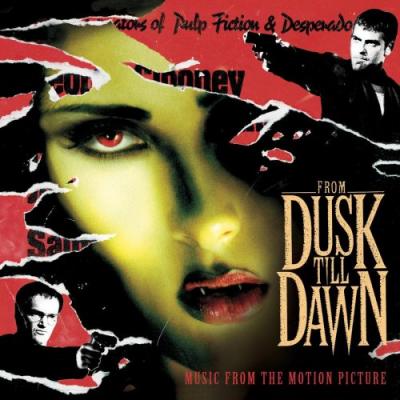
"From Dusk Till Dawn" Soundtrack Lyrics
Movie • 1996
Track Listing
Clooney, George
Blasters
ZZ Top
Wayne, Jon
Mavericks
Lewis, Juliette
Vaughan, Jimmie
Leftovers
ZZ Top
Marin, Cheech
Tito & Tarantula
Vaughan, Stevie Ray
Tito & Tarantula
Vaughan, Stevie Ray
Savini, Tom
Revell, Graeme
Revell, Graeme
"From Dusk Till Dawn: Music from the Motion Picture" Soundtrack Description
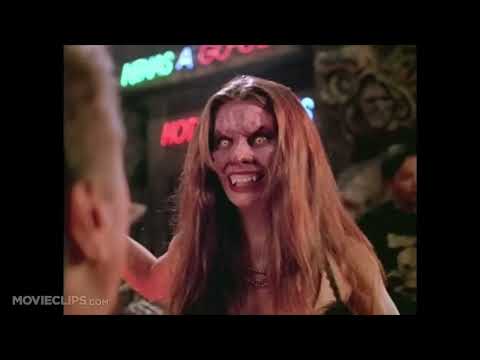
Overview
How do you score a movie that flips from outlaw road thriller to vampire siege at midnight? This album answers with borderland bar-band grit, Texas blues muscle, and a handful of needle-drops that feel lived-in rather than curated. It opens on menace and ends on a devilish wink.
The mix is distinct: swampy rock (“Dark Night”), Lone Star icons (ZZ Top; the Vaughan brothers), Chicano heat from Tito & Tarantula performing in-scene, and lean score cues from Graeme Revell to stitch the carnage. What sets it apart isn’t star power; it’s purpose. Nearly every cue is either source music inside the Titty Twister (so you feel trapped in that bar) or road music that hardens the Gecko brothers’ world before sunrise.
Source: AllMusic
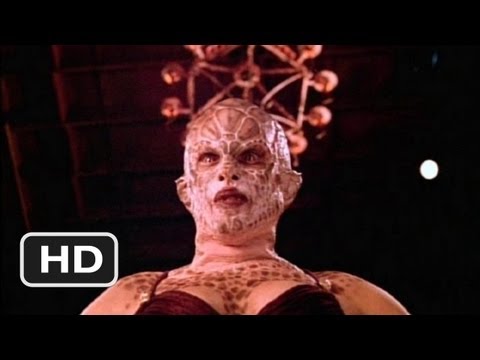
Questions & Answers
- When was the album released, and what’s its core sound?
- January 23, 1996. Core palette: Texas blues, Chicano rock, swamp rock, with short Revell score cues.
- What song opens and closes the film?
- “Dark Night” by The Blasters opens the titles and returns over the end credits.
- What plays during Santanico Pandemonium’s dance?
- “After Dark” by Tito & Tarantula, performed live in-scene by the bar’s house band.
- Did the dance have a different song in the script?
- Yes. The script specified “Down in Mexico” (The Coasters); Rodriguez chose “After Dark” in the final cut.
- Which track promoted the film on rock radio/TV?
- ZZ Top’s single “She’s Just Killing Me,” also used on their album Rhythmeen.
- Is every featured song on the commercial OST?
- No. Example: Tito & Tarantula’s “Opening Boxes” is heard in the film but not on the album.
- Who composed the score cues heard on the album?
- Graeme Revell, whose terse motifs bridge bar-fight mayhem and survivor beats.
Notes & Trivia
- The house band you see on screen is Tito & Tarantula; their songs double as diegetic performance.
- “Dark Night” predates the film by a decade but became synonymous with it after 1996.
- ZZ Top’s “She’s Just Killing Me” was issued as a single tied to the movie’s campaign.
- Two brief Revell score cuts were included on the OST alongside dialogue snippets.
- The album has multiple pressings (US/EU/JP) across Epic Soundtrax/Los Hooligans catalog numbers.
Genres & Themes
- Swamp/roots rock → fatalism and heat haze (The Blasters’ “Dark Night”).
- Texas blues → outlaw bravado, road-wear (Stevie Ray & Jimmie Vaughan cuts).
- Chicano rock/bar-band stomp → seductive threat turning to combat (Tito & Tarantula live).
- Hard boogie (ZZ Top) → swagger on approach to the Titty Twister; later, end-credits release.
- Lean modern score → shock accents and siege momentum (Graeme Revell).
Source: Wikipedia
Tracks & Scenes
(timestamps are approximate runtime positions; diegesis marked where clear)
“Dark Night” — The Blasters
Where it plays: Main titles (~00:09) and again over end credits (~01:37). Non-diegetic.
Why it matters: Sets the sun-blasted dread and bookends the film’s cynical worldview.
“Foolish Heart” — The Mavericks
Where it plays: Diner early on (~00:14). Source music in-location (ambient).
Why it matters: Normalcy on the radio contrasts the Gecko chaos about to spill over.
“Mexican Blackbird” — ZZ Top
Where it plays: At Benny’s World of Liquor/road beats (~00:24). Likely source (radio).
Why it matters: Bridges Tex–Mex swagger with the brothers’ southbound push.
“Texas Funeral” — Jon Wayne
Where it plays: Outside the motel/in the car (~00:29). Source (vehicle).
Why it matters: Gallows humor that fits the film’s grindhouse pulse.
“Dengue Woman Blues” — Jimmie Vaughan
Where it plays: In the RV en route (~00:35). Source (vehicle).
Why it matters: Slithers under a predatory gaze; tension without announcing itself.
“Torquay” — The Leftovers
Where it plays: Crossing into Mexico (~00:41). Source/transition cue.
Why it matters: Surf pulse marks the threshold moment before the bar.
“She’s Just Killing Me” — ZZ Top
Where it plays: Approach to the Titty Twister (~00:42) and later over credits. Non-diegetic/PA bleed.
Why it matters: Marketing cut that telegraphs swagger before the turn.
“Angry Cockroaches (Cucarachas Enojadas)” — Tito & Tarantula
Where it plays: Inside the Titty Twister (~00:45). Diegetic performance.
Why it matters: Establishes the house band’s presence; music the characters hear.
“Mary Had a Little Lamb” — Stevie Ray Vaughan & Double Trouble
Where it plays: Bar ambience (~00:51). Likely diegetic (house system).
Why it matters: Familiar blues lick before everything snaps.
“After Dark” — Tito & Tarantula
Where it plays: Santanico Pandemonium’s dance (~00:53). Diegetic performance.
Why it matters: Hypnotic vamp of desire that flips to predation the instant blood hits the floor.
“Willie the Wimp (and His Cadillac Coffin)” — Stevie Ray Vaughan & Double Trouble
Where it plays: Bar melee aftermath (~01:06). House PA/diegetic.
Why it matters: Darkly comic title underlines the bodies piling up.
Score cues — Graeme Revell (“Mexican Standoff”, “Sex Machine Attacks”)
Where they play: Final siege passages (post-01:15). Non-diegetic score.
Why it matters: Tightens rhythm between gags and gore; cue titles match on-screen beats.
Source: SoundtrackRadar
Trailer songs: Marketing cut relied on in-film tracks (notably “Dark Night”/ZZ Top cue snippets) rather than bespoke trailer music; no officially credited new trailer song is documented across standard soundtrack indices.
Music–Story Links
- When the Fullers and Geckos first share space, radio/source tunes (“Foolish Heart”, “Dengue Woman Blues”) act like white noise—polite on the surface, corrosive underneath.
- “After Dark” weaponizes allure: the band’s live groove seduces the room, then the scene pivots—song unchanged, meaning inverted.
- End-credit reprise (“Dark Night”) reframes survival as luck, not triumph—circular morality rather than closure.
How It Was Made
Score: Graeme Revell supplied punchy, economical cues tailored to bar-fight geography. On-camera music: Tito & Tarantula were written into the film as the Titty Twister band; their tracks were recorded for performance and edited as source.
Music department: documented credits include music consulting (Mary Ramos) and mixing/editing roles around Revell’s score and the licensed tracks. Executive soundtrack producers include Robert Rodriguez, Quentin Tarantino, and Lawrence Bender. The dance was scripted to The Coasters’ “Down in Mexico,” but Rodriguez replaced it with “After Dark.”
Source: Discogs
Reception & Quotes
“Derivative but fun… bold shift in tone—from tense crime to gleeful horror.” The New Yorker
“The script called for ‘Down in Mexico’… Rodriguez instead chose ‘After Dark.’” ScreenRant
Among fans and critics, the album’s identity is the bar itself: songs you could credibly hear in a rough, open-till-dawn roadhouse.
Additional Info
- US CD commonly cataloged as EK 67523 (Epic Soundtrax/Los Hooligans); multiple EU pressings exist.
- Includes dialogue snippets that frame several cues; not all film-heard tracks appear on the OST.
- 2012 vinyl reissue (Music On Vinyl) added packaging extras for collectors.
- ZZ Top’s single tie-in boosted recognition outside the film’s core audience.
- “Dark Night” became a cult signature through the film’s opening/closing use.
- “Opening Boxes” (Tito & Tarantula) is heard in the movie but omitted from the CD.
- Short Revell cues on the album (“Mexican Standoff”, “Sex Machine Attacks”) mirror on-screen action titles.
- Multiple language/localized digital listings exist across stores, but track content aligns with the US edition.
Technical Info
- Title: From Dusk Till Dawn: Music from the Motion Picture
- Year: 1996 (album release: Jan 23, 1996)
- Type: Motion picture soundtrack (various artists + score excerpts)
- Composed by (score): Graeme Revell
- On-camera band: Tito & Tarantula (Tito Larriva et al.)
- Music department credits noted: Music consultant — Mary Ramos; executive soundtrack producers — Robert Rodriguez, Quentin Tarantino, Lawrence Bender
- Labels: Epic Soundtrax / Los Hooligans (Sony Music family); multiple regional catalog numbers
- Selected notable placements: “Dark Night” (titles/credits), “After Dark” (dance), “She’s Just Killing Me” (arrival/credits), “Mary Had a Little Lamb” (bar ambience)
- Release context: US theatrical release Jan 19, 1996; OST issued the same month
- Availability: CD/cassette (1996), digital store/streaming (later), vinyl reissue (2012)
Canonical Entities & Relations
| Subject | Relation | Object |
|---|---|---|
| Robert Rodriguez | directed | From Dusk till Dawn (1996) |
| Quentin Tarantino | wrote | From Dusk till Dawn (screenplay) |
| Graeme Revell | composed | Score cues for the film/album |
| Tito & Tarantula | performed | “After Dark”, “Angry Cockroaches” (in-scene) |
| ZZ Top | contributed | “She’s Just Killing Me”, “Mexican Blackbird” |
| The Blasters | contributed | “Dark Night” (opening/closing) |
| Epic Soundtrax | released | US album (EK 67523) |
| Los Hooligans Productions | co-branded | Album label/copyright line |
| Miramax Films | distributed | From Dusk till Dawn (US) |
| Mary Ramos | credited as | Music consultant (film) |
Sources: AllMusic; Wikipedia; Discogs; SoundtrackRadar; The New Yorker; ScreenRant; MusicBrainz; Apple Music.
November, 09th 2025
A-Z Lyrics Universe
Cynthia Erivo Popular
Ariana Grande Horsepower
Post Malone Ain't No Love in Oklahoma
Luke Combs Good Riddance (Time of Your Life)
Green Day Bye Bye Bye
*NSYNC You're the One That I Wan
John Travolta & Olivia Newton-John I Always Wanted a Brother
Braelyn Rankins, Theo Somolu, Kelvin Harrison Jr. and Aaron Pierre The Power of Love
Frankie Goes to Hollywood Beyond
Auli’i Cravalho feat. Rachel House MORE ›