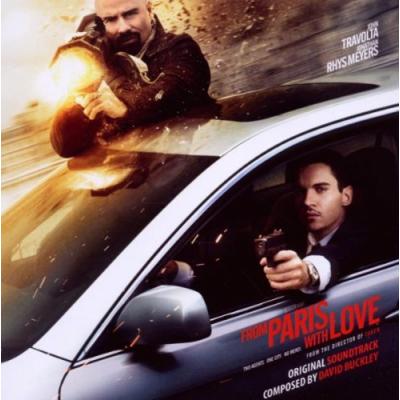
"From Paris With Love" Soundtrack Lyrics
Movie • 2010
Track Listing
Madeleine Peyroux
Vaux
David Buckley
David Buckley
David Buckley
David Buckley
David Buckley
David Buckley
David Buckley
David Buckley
David Buckley
David Buckley
David Buckley
David Buckley
David Buckley
David Buckley
David Buckley
David Buckley
David Buckley
David Buckley
David Buckley
David Buckley
Matt Monro (orig. The Carpenters)
Terry Devine-King
Kenny Gamble, Cary Gilbert and Leon Huff
Imade Saputra
Augustin O Assignies
Sarah Riani and Track Invaders
Toni Sola and Ignasi Terraza Trio
Bruno Bertoli
Hugo Ripoll and Loic Pontieux
Laurent Lombard
Djamal Aladin
Chris Whiteley
Terry Day (orig.Petula Clark)
Franz Joseph Haydn
David Savcic (orig.Potsch Potschka)
Paul Pritchard
Michael Boumendil and Stephane Horeczko
Dan Morrissey
Karl Lundeberg (orig. Ottmar Liebert)
"From Paris with Love (Original Motion Picture Soundtrack)" Soundtrack Description
Overview
How do you score a buddy-spy thriller that ping-pongs from deadpan gags to restaurant shootouts? David Buckley answers with a tight, percussive score that snaps to attention, then relaxes into sly waltzes and moody strings. Around it, supervisors lace the film with French standards, library cues, and a few needle-drops that ground the chaos in actual places—Paris cafés, a Chinatown dining room, a highway at night.
The album released for the film focuses on Buckley’s cues (plus two songs), while the wider movie features additional source tracks—jazz combos, a classic Mandarin folk song, and crooner nostalgia—used diegetically in rooms, radios, and restaurants. That split—score for propulsion, songs for texture—gives the movie its pulse and its accent.
Trusted source: AllMusic.
Questions & Answers
- Who composed the score album?
- David Buckley composed the original score presented on the official soundtrack album.
- Is there music playing in the opening scene?
- Yes. The opening uses a French standard performed by a contemporary jazz vocalist; it’s used as scene-setting source music.
- What song rolls over the end credits?
- “Are You With Me” by Vaux plays during the closing credits.
- Does the film use any classical pieces?
- Yes. A Haydn symphony finale appears as source; it contrasts deliberately with on-screen mayhem.
- Is the Chinese restaurant sequence scored or song-driven?
- Both: a traditional Mandarin folk song is heard diegetically in the room; Buckley’s action cues take over when the shooting starts.
- Was there a separate “songs” compilation?
- Yes. A various-artists digital set circulates with the source songs in addition to the official score album.
Notes & Trivia
- The album’s two non-score inclusions are a 1930s Paris standard (in a modern rendition) and the credits rocker by Vaux.
- Library cues (e.g., Terry Devine-King, Paul Pritchard) are used as in-world background, not as headline “needle-drops.”
- “Mo Li Hua” (“Jasmine Flower”)—a traditional Chinese song—can be heard in the restaurant before the bullets fly.
- Guitar textures in the score reflect Buckley’s action-writing lineage (you may hear kinship with contemporaries from the Remote Control school).
- The trailer marketing leaned on percussion-heavy stingers rather than a branded pop single.
Genres & Themes
- Hybrid action score (strings + percussion + guitar): momentum, tactical urgency, Wax’s shoot-from-the-hip energy.
- French chanson / jazz standards: location color; frames Reese’s “official cover” life with soft elegance.
- Library electronica & lounge: surveillance, late-night interiors; the “spy doing busywork” vibe.
- Classical interludes: ironic counterpoint—surface polish vs. the film’s rough methods.
- Rock closer: Vaux’s track locks the movie out with a modern, slightly abrasive edge—mission done, nerves still humming.
Trusted source: Wikipedia.
Tracks & Scenes
Note: timecodes are approximate scene positions; “diegetic” = heard by characters in the scene.
“J’ai Deux Amours” — Madeleine Peyroux
Where it plays: Early opening sequence (~00:02). Diegetic ambience in Paris; sets a chic-languid tone around Reese’s diplomatic routines.
Why it matters: Locative color—signals we’re in present-day Paris without clichés; softens the film’s immediate pivot to espionage.
“Night City” — Terry Devine-King
Where it plays: Reese at home, studying the microchip (~00:10). Low-volume source in the apartment (diegetic).
Why it matters: Library mood that says “spy homework,” underscoring Reese’s meticulous, desk-bound side.
“Mo Li Hua (Jasmine Flower)” — Traditional
Where it plays: Chinese restaurant before the raid (~00:20). Performed in-room/over system (diegetic).
Why it matters: Calm-before-the-storm irony; Buckley’s cue “Chinese Dessert” smashes in as Wax escalates.
“(They Long to Be) Close to You” — Matt Monro
Where it plays: Briefly as source music in a dining/indoor setting (~midfilm). Diegetic; heard through on-site playback.
Why it matters: Sweet nostalgia that undercuts the scene’s unease and dark revelations.
“Me and Mrs. Jones” — (standard)
Where it plays: Low-key room ambience during a conversational interlude. Diegetic, short excerpt.
Why it matters: Torch-song mood against duplicity and romantic suspicion.
“Another Day” — Sarah Riani & Track Invaders
Where it plays: Building corridor/arrival of a cocaine courier (~00:45). Short, diegetic blast.
Why it matters: Street edge; snaps the film from procedural to combustible.
“Are You With Me” — Vaux
Where it plays: Closing credits (~01:30). Non-diegetic over titles.
Why it matters: Cathartic punch-out; the soundtrack’s lone modern-rock exclamation point.
Score cues — David Buckley
“Parking Lot” (early covert swap); “Chinese Dessert” (restaurant firefight); “Wax’s Waltz” (a sardonic character riff); “Eye in the Sky” (surveillance montage).
Why they matter: These are the film’s propulsion system—drums and ostinatos for kinetics, brief waltz/time-out for personality.
Trusted source: Apple Music.
Music–Story Links
- Reese’s double life: the opening French chanson codes him as polished, even fussy—music that vanishes as he chases “real” spy work.
- Wax’s chaos: Buckley’s percussive figures arrive with Wax and rarely let up—his theme is momentum rather than melody.
- Restaurant turning point: diegetic “Mo Li Hua” presents a “civil” room; the score’s entrance marks the moral line as Wax bulldozes through it.
- Romance vs. suspicion: kitchen-radio oldies (Monro, torch standards) play warmly while the plot freezes them into clues.
- Aftermath & closure: the end-credits rock cue releases the pressure lid after Buckley’s tight final reel.
How It Was Made
Composer David Buckley delivered a 20-track score album; the film’s music department included score mixer Jérôme Devoise and a Head of Music Department (Michael Wijnen). Guitar contributions (e.g., Toby Chu, Costa Kotselas) and solo strings add bite to the action texture. Music supervision is credited to Alexandre Mahout, with library placements chosen to live naturally in cafés, apartments, and the restaurant set.
The two-tier release—score album plus circulating various-artists playlist—reflects the film’s design: composed underscore for propulsion; pre-existing songs to flavor locations and character routines.
Reception & Quotes
Critical response to the film was mixed; the music was generally noted as efficient, pace-keeping action scoring with occasional wit in its lighter cues.
“Intellectually flat but viscerally involving… keeps the pace at a consistently high level.” ReelViews (James Berardinelli)
“John Travolta lets entertainingly loose as a bald-headed, goateed, gonzo CIA agent.” The Hollywood Reporter
“Too muddled and disjointed to satisfy,” yet not without charms. Rotten Tomatoes consensus
“No vital signs at all… crushing dull repetition.” Peter Travers, Rolling Stone
Additional Info
- The score album’s rights credit: ℗ EuropaCorp; distribution by Because Music (regional variations apply).
- A separate “Various Artists” digital set includes additional source songs not on the score album.
- Haydn’s Symphony No. 94 (finale) appears briefly as a classical wink.
- Several cues on the album (“Parking Lot,” “Eye in the Sky”) are near one-to-one with on-screen sequences.
- Trailer audio emphasizes percussion and slam-stingers; no widely credited bespoke trailer song.
Technical Info
- Title: From Paris with Love (Original Motion Picture Soundtrack)
- Year: 2010
- Type: Film score album with two song inclusions
- Composer: David Buckley
- Music Supervision (film): Alexandre Mahout
- Label / Distribution: EuropaCorp / Because Music (album)
- Notable placements: “J’ai Deux Amours” (opening, diegetic), “Mo Li Hua” (restaurant, diegetic), “Are You With Me” (end credits)
- Release context: U.S. theatrical release Feb 5, 2010; score album issued 2010
- Availability: Streaming (album & songs) on major services; CD releases exist regionally
Canonical Entities & Relations
| Subject | Relation | Object |
|---|---|---|
| David Buckley | composed | From Paris with Love (score) |
| Alexandre Mahout | supervised music for | From Paris with Love (film) |
| EuropaCorp | released / owned | From Paris with Love soundtrack masters |
| Because Music | distributed | From Paris with Love (Original Motion Picture Soundtrack) |
| Vaux | performed | “Are You With Me” (end credits) |
| Madeleine Peyroux | performed | “J’ai Deux Amours” (opening) |
| Pierre Morel | directed | From Paris with Love (film) |
Sources: AllMusic; Apple Music; Wikipedia; ReelSoundtrack blog; Ringostrack; MovieMusic Store; ShotOnWhat; Hollywood Reporter; ReelViews.
November, 09th 2025
A-Z Lyrics Universe
Cynthia Erivo Popular
Ariana Grande Horsepower
Post Malone Ain't No Love in Oklahoma
Luke Combs Good Riddance (Time of Your Life)
Green Day Bye Bye Bye
*NSYNC You're the One That I Wan
John Travolta & Olivia Newton-John I Always Wanted a Brother
Braelyn Rankins, Theo Somolu, Kelvin Harrison Jr. and Aaron Pierre The Power of Love
Frankie Goes to Hollywood Beyond
Auli’i Cravalho feat. Rachel House MORE ›