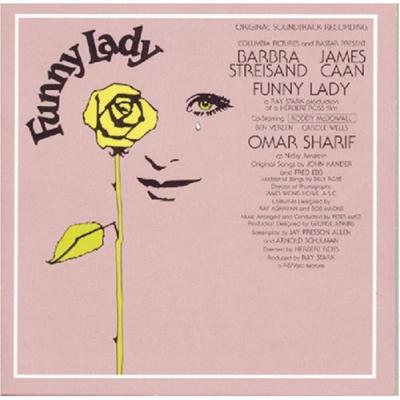
"Funny Lady" Soundtrack Lyrics
Musical • 1975
Track Listing
"Funny Lady (Original Soundtrack Recording)" Soundtrack Description
Overview
Sequel logic rarely yields a stronger soundtrack. Funny Lady (1975) dodges the trap by swapping pastiche for punch: brand-new Kander & Ebb showpieces (“How Lucky Can You Get,” “Let’s Hear It for Me”) stitched to period standards and revue bits Fanny Brice actually sang. Peter Matz’s glossy arrangements keep everything in the same bright marquee light, so character beats survive the spectacle.
Released by Arista on March 15, 1975 and produced/arranged/conducted by Peter Matz, the album foregrounds Barbra Streisand with featured turns from James Caan and Ben Vereen. It became an early Arista success (Clive Davis has written about betting on Streisand here) and went Gold in the U.S. The single “How Lucky Can You Get” earned Oscar and Golden Globe nominations. (Data points confirmed via Wikipedia, Discogs, and AllMusic; discographical details are also preserved by Barbra Archives.)
Questions & Answers
- Who wrote the new songs?
- John Kander & Fred Ebb supplied the major new numbers (“How Lucky Can You Get,” “Let’s Hear It for Me,” “Blind Date,” “So Long, Honey Lamb”).
- Who produced/arranged the album?
- Peter Matz produced, arranged, and conducted.
- Label and release date?
- Arista Records; March 15, 1975.
- Is James Caan’s singing actually on the record?
- Yes—Caan leads “Me and My Shadow” and a “Paper Moon/I Like Her” medley; one of these vocals was trimmed or altered in the final cut of the film but remains on the album.
- Chart/award highlights?
- U.S. Billboard 200 peak inside the Top 10; RIAA Gold. “How Lucky Can You Get” received Oscar and Golden Globe nominations.
- Are there later editions?
- CD issues (1990 Bay Cities; 1998 Arista) and a 2009 Sony/Legacy version; the 1998 reissue reorders tracks closer to film sequence and adds alternates.
Notes & Trivia
- The soundtrack is one of Arista’s early marquee releases; the quadraphonic edition (AQ 9004) exists for collectors.
- “So Long, Honey Lamb” was staged as a knowingly outrageous plantation-era parody number with Streisand and Ben Vereen.
- “Me and My Shadow” appears on the album even though its full performance is not intact in the released film cut.
- “Great Day” was reshaped toward a gospel-rock drive; Streisand tweaked the melody during production.
- Kander & Ebb’s “How Lucky Can You Get” functions as Fanny’s new power anthem—cynical grin instead of innocent bravado.
Genres & Themes
New Broadway writing (Kander & Ebb) → self-aware star power; numbers hinge on wit, not just belt.
Vintage standards & vaudeville → Fanny’s era and Billy Rose’s taste (“More Than You Know,” “I Found a Million Dollar Baby,” “I Got a Code in My Doze”).
Revue/showbiz brio → big choruses and punchy brass (“Let’s Hear It for Me,” “Great Day”).
Character torch songs → interior pivot points (“Isn’t This Better,” “Am I Blue”).
Tracks & Scenes
“How Lucky Can You Get” — Barbra Streisand
Where it plays: Showpiece onstage and through a career-montage pivot; Fanny sizes up fate with a smirk rather than a smile.
Why it matters: The sequel’s signature—Kander & Ebb give Fanny bite without losing glamour.
“Isn’t This Better” — Barbra Streisand
Where it plays: Quiet post-sparring moment as Fanny weighs real companionship with Billy Rose.
Why it matters: Understates the romance; small dynamics, big subtext.
“Blind Date” — Barbra Streisand
Where it plays: Early revue sequence built around mismatched lovers; brisk staging and patter.
Why it matters: Introduces the film’s faster, more contemporary song-craft inside period trappings.
“So Long, Honey Lamb” — Barbra Streisand & Ben Vereen
Where it plays: In-show burlesque/plantation parody number within Billy’s production.
Why it matters: Satirical pastiche; culturally pointed and intentionally gaudy.
“(It’s Gonna Be a) Great Day” — Barbra Streisand
Where it plays: Rehearsal-to-stage build for a revamped show; chorus-driven uplift.
Why it matters: Signals Fanny’s professional recalibration—less romance, more control.
“It’s Only a Paper Moon / I Like Him” — Barbra Streisand
Where it plays: Rehearsal-room banter that turns into a teasing duet structure.
Why it matters: Old standard reframed as character shorthand—Fanny’s eye stays sharper than her heart.
“It’s Only a Paper Moon / I Like Her” — James Caan
Where it plays: Counter-number from Billy’s POV in the same rehearsal stretch.
Why it matters: Shows his charm offensive and the limits of it; a plot barometer more than a vocal showcase.
“More Than You Know” — Barbra Streisand
Where it plays: Late-night torch passage when personal cost breaks the surface.
Why it matters: Classic standard used as pressure-release valve.
“Am I Blue” — Barbra Streisand
Where it plays: After a reversal; intimate staging with camera close enough to hear the breath.
Why it matters: Quietest cut becomes the album’s sleeper highlight.
“Let’s Hear It for Me” — Barbra Streisand
Where it plays: Finale/curtain-call energy—Fanny rewrites the thesis from “Don’t Rain on My Parade” into self-advocacy.
Why it matters: End-stopper that argues for survival over sweetness.
Music–Story Links
First film: innocence and momentum. Sequel: agency and edge. “How Lucky Can You Get” reframes Fanny as a strategist; “Isn’t This Better” admits need without surrender. The rehearsal medleys (“Paper Moon/I Like…”) turn banter into diagnostics on the marriage/business mix. “Let’s Hear It for Me” closes the loop—no parade to chase, just a platform she builds herself.
How It Was Made
Herbert Ross directed; Peter Matz helmed the music. Recording took place in Los Angeles (Record Plant; Sunset Highland). Kander & Ebb wrote the new material to fit Brice’s late-career chapter, while catalog pieces (Billy Rose co-writes; standards by Youmans/Oakland/Arlen et al.) grounded the period feel. Arista issued both stereo and quad LPs; later CD editions shuffle to approximate film order and add alternates.
Reception & Quotes
The album outperformed many sequels in chart terms (Billboard 200 Top 10; RIAA Gold). Critics were mixed on Caan’s vocals but generally praised Streisand’s ballads and the new Kander & Ebb material.
“More satisfying than the film.” AllMusic (on the album’s strengths)
“Early Arista success… Streisand the anchor.” Discogs listings & label histories
“Oscar-nominated single, brassy and sardonic.” Playbill
Additional Info
- Single: “How Lucky Can You Get” b/w “More Than You Know.”
- 1998 Arista CD: alternates for “Let’s Hear It for Me” and “Great Day,” plus the single edit of “How Lucky…”.
- James Caan vocals appear on album even where the film trims the sequences.
- A Bay Cities CD (1990) and a Sony/Legacy reissue (2009) keep the title in print.
- Trailer/library clips widely circulate; full film cues confirm revised staging of some numbers.
Technical Info
- Title: Funny Lady (Original Soundtrack Recording)
- Year: 1975 (album)
- Type: Film soundtrack (songs)
- Primary artist: Barbra Streisand (with James Caan; Ben Vereen)
- Composers/Lyricists (new songs): John Kander & Fred Ebb
- Additional songs from/associated with: Billy Rose; Vincent Youmans; Ben Oakland/Jack Murray; Harold Arlen/E.Y. Harburg; Harry Akst; others
- Producer/Arranger/Conductor: Peter Matz
- Label: Arista Records (stereo & quad LP; later CD reissues)
- Chart/Cert: Billboard 200 Top 10; RIAA Gold (U.S.)
Canonical Entities & Relations
| Subject | Relation | Object |
|---|---|---|
| Arista Records | released | Funny Lady (Original Soundtrack Recording) (1975) |
| Peter Matz | produced/arranged/conducted | Funny Lady soundtrack |
| John Kander & Fred Ebb | wrote | new songs for the film |
| Barbra Streisand | performed | lead vocals on majority of tracks |
| James Caan | performed | “Me and My Shadow”; “It’s Only a Paper Moon / I Like Her” |
| Ben Vereen | performed | “Clap Hands, Here Comes Charley” and duet material |
| Columbia Pictures | distributed | Funny Lady (film) |
Sources: Wikipedia; Barbra Archives; Discogs; AllMusic; IMDb; Columbia/Arista materials.
November, 09th 2025
A-Z Lyrics Universe
Cynthia Erivo Popular
Ariana Grande Horsepower
Post Malone Ain't No Love in Oklahoma
Luke Combs Good Riddance (Time of Your Life)
Green Day Bye Bye Bye
*NSYNC You're the One That I Wan
John Travolta & Olivia Newton-John I Always Wanted a Brother
Braelyn Rankins, Theo Somolu, Kelvin Harrison Jr. and Aaron Pierre The Power of Love
Frankie Goes to Hollywood Beyond
Auli’i Cravalho feat. Rachel House MORE ›