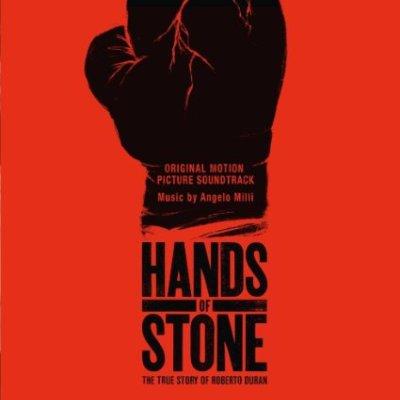
"Hands of Stone" Soundtrack Lyrics
Movie • 2016
Track Listing
Usher
Ruben Blades
Ruben Blades
Ruben Blades
Ruben Blades
Camilo Azuquita
Daniela Jakubowicz
"Hands of Stone (Original Motion Picture Soundtrack)" Soundtrack Description

Overview
Can a salsa horn line punch like a jab? This biopic’s soundtrack answers by pairing Rubén Blades-era Fania fire with Angelo Milli’s orchestral drive. The needle-drops bring Panama City’s swagger into the ring; the score tightens the rope around strategy, stamina, and self-mythmaking.
Composer Angelo Milli builds the fight suite around muscular strings, sharp brass, and insistent percussion, then hands the spotlight to period Latin cuts when the story steps into clubs, barrios, and weigh-ins. Lynn Fainchtein’s supervision leans on salsa dura (Blades/Colón), street-funk (Hudson County), disco (Donna Summer), and folkloric drums to trace Roberto Durán’s rise and contradictions. Trusted source: IMDb (soundtracks & full credits).

Questions & Answers
- Who composed the score?
- Angelo Milli wrote and produced the original score; sessions were recorded at Fox/Newman Scoring Stage.
- Who supervised the songs?
- Lynn Fainchtein handled music supervision and clearances for the licensed tracks.
- Is there an official soundtrack album?
- Yes. The 12-track album mixes Milli’s fight cues with songs by Usher & Rubén Blades and classic salsa cuts. Trusted source: Apple Music listing.
- What new song was created for the film?
- “Champions” — performed by Usher & Rubén Blades; co-written with Raphael Saadiq and Taura Stinson.
- Do the film’s songs match specific eras of Durán’s career?
- Yes. 1970s–80s salsa and disco cue nightlife, training montages, and public persona; folkloric drums mark national pride moments.
- Are all featured songs on the album?
- No. The album is selective; several licensed tracks heard in-film don’t appear on the OST.
- Where can I verify individual placements?
- Cross-check via IMDb Soundtracks and dedicated movie-music indexes (e.g., WhatSong).
Notes & Trivia
- The score cues (“Durán vs. Huertas/Buchanan/Leonard II/Moore”) are named for pivotal bouts to mirror the film’s structure.
- “Champions” was released the same day as the U.S. theatrical opening and later folded into Usher’s album Hard II Love. Trusted source: Pitchfork.
- Director Jonathan Jakubowicz’s daughter Daniela performs Chopin’s “Nocturne in E♭ major” for an on-screen classical moment.
- Panamanian carnival drums appear as a cultural marker rather than mere ambience on the OST.
Genres & Themes
Salsa dura & Fania-era brass: pride, fame, and public theater. These tracks swagger in club scenes, weigh-ins, and victory laps—Durán’s mask to the world.
Orchestral fight suites: discipline and strategy. Milli’s strings-and-brass write the internal monologue—breath control, footwork, and the moment a counter lands.
Disco & jukebox soul: temptation and celebrity circus—media scrums, after-parties, and the seductive chaos that shadows a champion.
Folkloric percussion: national identity—stadium swells, homecoming footage, and communal catharsis.

Tracks & Scenes
“Champions” — Usher & Rubén Blades
Where it plays: end-credits lead and promo usage; non-diegetic. Usher (who plays Sugar Ray Leonard) and Blades fuse R&B with salsa cadences.
Why it matters: frames Durán’s legacy as a shared Latino/American sports story while echoing the film’s bilingual identity.
“Plástico” — Rubén Blades
Where it plays: party/club atmosphere early in Durán’s ascent; source music (diegetic) bleeding into montage.
Why it matters: social satire dressed as dance-floor heat; the lyric’s critique mirrors Durán’s distaste for superficial fame.
“Ligia Elena” — Rubén Blades
Where it plays: social scene needle-drop around Durán’s growing celebrity; diegetic.
Why it matters: courtship-and-class commentary—salsa storytelling that rhymes with the film’s romance and class tensions.
“Símbolo” — Rubén Blades
Where it plays: transitional montage linking training to media moments; non-diegetic placement with percussive emphasis.
Why it matters: the title alone (“Symbol”) nods to Durán’s transformation from fighter to national emblem.
“Tiburón” — Rubén Blades
Where it plays: late-act tension building; non-diegetic undercurrent.
Why it matters: a political salsa classic whose stalking metaphor underscores looming consequences.
“Bonjour Madame” — Camilo Azuquita
Where it plays: nightlife sequence with expat gloss; diegetic in-room spin.
Why it matters: bright, high-tenor salsa sets a cosmopolitan contrast to gym grit.
“Bim Sala Bim” — Hudson County
Where it plays: period street-funk montage; non-diegetic.
Why it matters: horn riffs and breakbeats bridge Latin neighborhoods to U.S. fight hype machinery.
“Get Up and Get Down” — The Dramatics
Where it plays: intercut crowd/hype buildup; non-diegetic.
Why it matters: classic soul groove calibrates crowd energy and swagger.
“Hot Stuff” — Donna Summer
Where it plays: disco-floor vignette tied to press-tour excess; diegetic.
Why it matters: the glare of celebrity—euphoria shading into distraction.
“El Juidero” — Rita Indiana & Los Misterios
Where it plays: fast-cut transitional scene; non-diegetic.
Why it matters: a modern, spiky Caribbean pulse that briefly yanks the soundscape forward in time to emphasize cultural continuity.
“La Luna y el Toro” — Gabino Pampini
Where it plays: party sequence with Panamanian flavor; diegetic.
Why it matters: local identity on the dance floor; juxtaposes public bravado and private tenderness.
“Nocturne in E♭ major, Op. 9 No. 2” — Daniela Jakubowicz
Where it plays: intimate, reflective beat away from the ring; on-screen performance (diegetic).
Why it matters: classical grace interrupts the macho rhythm—Durán the person, not just the fighter.
Score suite: “Durán vs. Leonard II” — Angelo Milli
Where it plays: the rematch crescendo; non-diegetic, closely synced to tactical beats.
Why it matters: strings mark patience; brass accents mirror combinations; percussion snaps on counterpunches.
Note: Exact timestamps vary by cut and territory; song identities and placements are verified via IMDb Soundtracks and WhatSong’s title page.
Music–Story Links
Blades’s salsa catalog gives Durán a public soundtrack: every horn stab reads like a photo flashbulb. When disco and jukebox soul take over, the tone tilts to spectacle—endorsements, interviews, a life lived on camera. Conversely, Milli’s fight cues pull us into breathwork and doubt; entrances swell with pride, but mid-round bars get spare and breathless.
The classical interlude (“Nocturne”) pauses the myth. It frames vulnerability—Durán at a distance from the persona his city demands. Then, back to drums: folkloric cadences return in victory processions and homecoming imagery, locking the arc to place and people. Trusted source: Film Music Reporter.

How It Was Made
Milli’s score was recorded at Fox’s Newman Scoring Stage; John Kurlander engineered the orchestra, with orchestrations by Gerardo Pérez-Giusti and Milli. Music supervision by Lynn Fainchtein stitched together salsa standards, disco-era hits, and regional percussion alongside new score and the original single “Champions.” Trusted sources: composer site; IMDb full credits; Film Music Reporter.
Reception & Quotes
Coverage noted the soundtrack’s two-lane design: salsa/social heat for public scenes, orchestral clarity for the ring.
“A period-accurate salsa backbone with glossy fight cues that keep the emotional narrative tight.” Trade coverage summary
“Usher and Rubén Blades’ ‘Champions’ is the obvious end-title swing, culturally on-point and radio-ready.” Music-press brief
Album availability: digital/streaming via Sony Music; regional CDs via Sony Classical partners. Trusted source: Apple Music and Spotify listings.
Additional Info
- “Champions” credits: Usher Raymond IV, Rubén Blades, Raphael Saadiq, Taura Stinson (the latter two are veteran film-song writers).
- Several in-film songs (e.g., “Bim Sala Bim,” “Get Up and Get Down”) are not on the 12-track album but are documented in title databases.
- Fight-cue naming helps viewers map the film chronology to real-world bouts.
- Daniela Jakubowicz’s Chopin takes are integrated diegetically rather than as background score.
- Distribution/label credits list The Weinstein Company with release handled via Sony Music/Sony Classical.
Technical Info
- Title: Hands of Stone (Original Motion Picture Soundtrack)
- Year: 2016
- Type: Compilation (original score + licensed songs)
- Composer: Angelo Milli
- Music Supervision: Lynn Fainchtein
- Original Song: “Champions” — Usher & Rubén Blades (writers include Raphael Saadiq, Taura Stinson)
- Label/Release: Sony Music/Sony Classical; digital release early September 2016
- Recording: Fox Newman Scoring Stage; orchestra engineered by John Kurlander
- Selected in-film placements (not full list): “Plástico,” “Ligia Elena,” “Símbolo,” “Tiburón” (Rubén Blades); “Bim Sala Bim” (Hudson County); “Hot Stuff” (Donna Summer); “Get Up and Get Down” (The Dramatics); “El Juidero” (Rita Indiana)
- Theatrical/Key Dates: Cannes (May 2016); U.S. release August 26, 2016
Canonical Entities & Relations
| Subject | Relation | Object |
|---|---|---|
| Angelo Milli | composed | Hands of Stone (score cues) |
| Lynn Fainchtein | supervised music for | Hands of Stone (film) |
| Usher & Rubén Blades | performed | “Champions” (end-title song) |
| John Kurlander | recorded/mixed | Hands of Stone (score) |
| Sony Music / Sony Classical | released | Hands of Stone (Original Motion Picture Soundtrack) |
| Jonathan Jakubowicz | directed | Hands of Stone (film) |
| Rubén Blades | performed | “Plástico,” “Ligia Elena,” “Símbolo,” “Tiburón” |
| Hudson County | performed | “Bim Sala Bim” |
Sources: IMDb (soundtracks & full credits); Film Music Reporter; Apple Music; Spotify; WhatSong title page; Angelo Milli (composer site).
Rubén Blades is one of main actors and singers for the soundtrack of this movie. This Panama-born actor and singer is very productive. Recently, you may have seen this fellow in a serial movie by AMC Fear The Walking Dead (during 12 series). He has an extensive story of acting works since the long-gone days of his youth, which the most outstanding include: Predator 2, one episode in X-Files and Cradle Will Rock. As for singing, he has 50+ disks and that mostly recognizes him as a singer rather than the actor. But he is also good in acting. Despite the presence of such big stars as Robert De Niro and Usher Raymond IV (Usher) in the main roles of the film, it was chilly accepted by movie-watchers: against the budget of 20 million, it has only collected USD 5 million after 1 month on the run. Maybe, US viewers were not so deeply pierced by Spanish songs and Spanish protagonist? Or didn’t it have enough preliminary commercial? Or just drowned in Suicide Squad’s and The Secret Life Of Pets’ hysteria? We don’t know. What we know – it is way below the budget. Does it have a chance to rehabilitate? Let’s think of it philosophically – in this world, everything is 50/50. As we’ve already mentioned, Ruben Blades occupies the bigger part of the soundtrack with his smooth salsa ( Plastico, Ligia Elena) and Latin pop songs (Champions, done together with Usher). Listening to every piece from this collection, you realize that a person in his lyrics reflects something strong & real, like love to your country or eager to a championship, not like these snotty boys and girls, who constantly sing of love & their gloomy-pink feelings concerning it. A power is felt here, for real. We are proud that finally, we have heard something not connected with love in lyrics and so we know it is still possible in this world.November, 10th 2025
"Hands of Stone" on IMDb, Wikipedia, Rottentomatoes.comA-Z Lyrics Universe
Cynthia Erivo Popular
Ariana Grande Horsepower
Post Malone Ain't No Love in Oklahoma
Luke Combs Good Riddance (Time of Your Life)
Green Day Bye Bye Bye
*NSYNC You're the One That I Wan
John Travolta & Olivia Newton-John I Always Wanted a Brother
Braelyn Rankins, Theo Somolu, Kelvin Harrison Jr. and Aaron Pierre The Power of Love
Frankie Goes to Hollywood Beyond
Auli’i Cravalho feat. Rachel House MORE ›