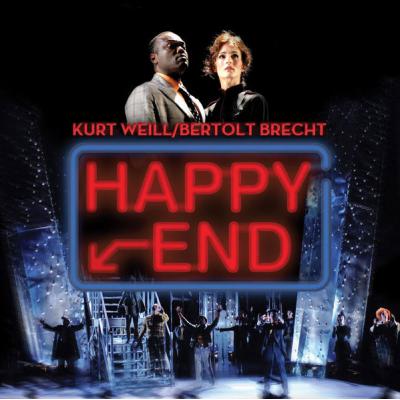
"Happy End" Soundtrack Lyrics
Musical • 2007
Track Listing
"Happy End (2006 ACT Cast) — Original Cast Recording [2007 Release]" Soundtrack Description
Overview
How do you make a 1929 Brecht/Weill gangster-meets-Salvation-Army fable hit the ear like a fresh noir? The American Conservatory Theater’s San Francisco revival did it with a lean pit band, Michael Feingold’s agile English adaptation, and a cast album that finally put the full show into modern circulation. The recording—cut in 2006 and issued wide in early 2007 by Ghostlight—became the most accessible way to hear Happy End straight through without hunting down out-of-print LPs. Trusted source: AllMusic; Apple Music.
The score balances barroom tangos and hymns with acid lullabies and torch songs: “The Bilbao Song,” “Lieutenants of the Lord,” “The Sailors’ Tango,” “Brother, Give Yourself a Shove,” the swaggering “Song of the Big Shot,” and the classic showstopper “Surabaya Johnny.” The album’s flow broadly mirrors stage order and preserves dialogue lead-ins, so you can follow the Chicago-at-Christmas caper end-to-end. Trusted source: Kurt Weill Foundation; Wikipedia (musical page).
Questions & Answers
- What exactly is the 2007 “Happy End” album?
- The American Conservatory Theater (San Francisco) cast recording of Brecht/Weill’s Happy End, recorded in 2006 and released Feb 6, 2007 by Ghostlight Records.
- Is it the same text as Broadway’s 1977 version?
- It uses Michael Feingold’s English adaptation (also used on Broadway and later revivals), keeping the dark comedy bite with singable modern diction.
- Why 2007 for a 1929 musical?
- That’s the commercial release year for the ACT album; it coincided with New York off-off-Broadway revivals in 2007 that used similar materials.
- What are the signature numbers to sample first?
- “The Bilbao Song” (barroom nostalgia turned sour), “The Sailors’ Tango,” “Surabaya Johnny,” and the finale sequence ending in “Hosanna Rockefeller.”
- How faithful is the running order to the stage show?
- Very close. The album keeps prologue/entr’acte cues and reprises, so plot turns (the bank job, the Mission scenes) track cleanly.
- Where can I verify song list and production history?
- Kurt Weill Foundation work page and the Wikipedia entry list numbers, revivals, and recordings; AllMusic/Apple Music confirm release details.
Notes & Trivia
- The ACT album was tracked at Skywalker Sound with Constantine Kitsopoulos conducting—crisp engineering for a pit-sized Weill band.
- Feingold’s translation keeps Brecht’s famous maxim (often paraphrased) about banks and robbery; program notes vary wording by production.
- “Surabaya Johnny” became a cabaret standard far beyond the show; so did “Bilbao.”
- 2007 also saw a New York revival at Theatre 1010—evidence of renewed interest around the Ghostlight release.
Genres & Themes
Cabaret & Weimar grit: smoky tangos and stiff-drink waltzes = cynicism with a grin (“Sailors’ Tango,” “Surabaya Johnny”).
Hymns turned agit-prop: brass-and-chorus numbers sell Salvation-Army zeal with sharp satiric edges (“Lieutenants of the Lord,” “Brother, Give Yourself a Shove”).
Beer-hall nostalgia vs. crime: bar songs wax sentimental then crack into menace (“The Bilbao Song,” “Song of the Big Shot”).
Tracks & Scenes
“The Bilbao Song” — Company
Where it appears: Act I, Bill’s Beer Hall. The Governor toasts a mythic past as the gang sizes up territory.
Why it matters: sentimentality curdles into threat—Brecht’s joke about “respectable” vice.
“Lieutenants of the Lord” — Lillian & Salvationists
Where: The band storms the bar to proselytize.
Why: hymn cadence collides with criminals; sets up the show’s love/ideology clash.
“The Sailors’ Tango” — Lillian (with reprise)
Where: her first soft-shoe with temptation in the bar, later echoed at the Mission.
Why: tango as moral slippage; melody returns when conviction shakes.
“Brother, Give Yourself a Shove” — The Mission
Where: botched sermon after Lillian is disciplined.
Why: pious pep-talk becomes comic chaos—Brecht pokes the pulpit.
“Song of the Big Shot” — The Governor (and reprises)
Where: back-room coaching in gangster posture; reprises during the showdown.
Why: swagger lesson that the finale deconstructs.
“In Our Childhood’s Bright Endeavor” — Hannibal
Where: Mission hymn underscoring late-night reckoning.
Why: faux-innocence used as balm and weapon.
“The Liquor Dealer’s Dream” — Ensemble
Where: Mission sequence just before the offstage brawl.
Why: tipsy parable that lurches toward violence.
“The Mandalay Song” — Sam & Gang
Where: Christmas Eve bank-job prep; gallows humour before the heist.
Why: travelogue fantasy as cover for crime.
“Surabaya Johnny” — Lillian
Where: confrontation with Bill before the heist.
Why: the show’s torch benchmark—love curdled into accusation.
“Ballad of the Lily of Hell” — The Fly
Where: the boss orders the hit and tightens the noose.
Why: villain aria with a smile; Weill’s minor-key glint.
Finale: “Hosanna Rockefeller” → “The Bilbao Song (Reprise)” — Company
Where: reckoning at the Mission and a crooked benediction.
Why: Brecht’s class jab lands as a sing-along.
Music–Story Links
Every number toggles between sermon and swindle. Hymns try to reform the beer-hall; the beer-hall steals hymn structures to look respectable. Lillian’s tango motif charts her back-and-forth between faith and desire; “Big Shot” and “Bilbao” expose crime’s self-mythologizing. The album sequence preserves that pendulum, so the ideological punchlines still land without the blocking. Trusted source: Kurt Weill Foundation work page; Wikipedia synopsis & numbers.
How It Was Made
ACT’s 2006 staging used Feingold’s English text and a compact Weill band under Constantine Kitsopoulos. The cast and orchestra recorded at Skywalker Sound; Ghostlight released the album commercially in February 2007 across CD/digital storefronts. The 2007 New York revival circuit (Theatre 1010) helped keep the title visible. Trusted sources: Playbill release note; MusicBrainz session data; BroadwayWorld review.
Reception & Quotes
Critics welcomed the crisp band and the chance to have a complete modern English recording back in print.
“This indispensable CD will be reprised by its owners more often than a four-letter word in a David Mamet play.” Broadway.com on the ACT cast album
“Musical comedy with a wicked leer … the score is a beauty.” Contemporary press quoted by the Kurt Weill Foundation
Additional Info
- Album rights/issue: Ghostlight Records (℗ 2006; commercial release Feb 6, 2007).
- Track list follows stage order, including prologue, entr’acte, and epilogue.
- Feingold’s translation trims/reshapes some lyric rhymes (“Surabaya Johnny”)—documented in reviews.
- The show’s “bank vs. robbery” line appears in various forms depending on edition/translation.
- Subsequent revivals (e.g., 2022 Victorian Opera) reflect the title’s continuing afterlife.
Technical Info
- Title: Happy End (2006 ACT Cast) — Original Cast Recording
- Year: 2007 commercial release (recorded 2006)
- Type: Original cast recording (English adaptation)
- Music/Lyrics/Book: Kurt Weill; Bertolt Brecht; Elisabeth Hauptmann (as “Dorothy Lane” in early credits)
- English adaptation: Michael Feingold
- Conductor/Orchestra: Constantine Kitsopoulos; ACT Orchestra (pit-size Weill ensemble)
- Label: Ghostlight Records
- Notable numbers: “The Bilbao Song,” “Lieutenants of the Lord,” “The Sailors’ Tango,” “Brother, Give Yourself a Shove,” “Song of the Big Shot,” “The Liquor Dealer’s Dream,” “The Mandalay Song,” “Surabaya Johnny,” “Ballad of the Lily of Hell,” “Hosanna Rockefeller.”
- Recording venue: Skywalker Sound, Nicasio, CA
Canonical Entities & Relations
| Subject | Relation | Object |
|---|---|---|
| Kurt Weill | composed | Happy End (score) |
| Bertolt Brecht | wrote lyrics for | Happy End |
| Elisabeth Hauptmann | wrote book for | Happy End (credited early as “Dorothy Lane”) |
| Michael Feingold | translated/adapted | English performing version |
| American Conservatory Theater | produced | 2006 San Francisco revival |
| Ghostlight Records | released | Happy End (2006 ACT Cast), 2007 |
| Constantine Kitsopoulos | conducted | ACT orchestra; cast recording sessions |
Sources: Kurt Weill Foundation; AllMusic; Apple Music; Spotify; Wikipedia (musical page); Playbill; BroadwayWorld; MusicBrainz.
November, 10th 2025
A-Z Lyrics Universe
Cynthia Erivo Popular
Ariana Grande Horsepower
Post Malone Ain't No Love in Oklahoma
Luke Combs Good Riddance (Time of Your Life)
Green Day Bye Bye Bye
*NSYNC You're the One That I Wan
John Travolta & Olivia Newton-John I Always Wanted a Brother
Braelyn Rankins, Theo Somolu, Kelvin Harrison Jr. and Aaron Pierre The Power of Love
Frankie Goes to Hollywood Beyond
Auli’i Cravalho feat. Rachel House MORE ›