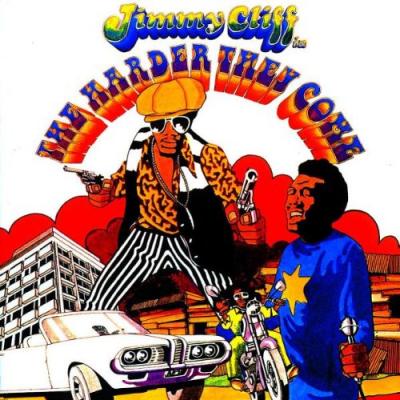
"Harder They Come" Soundtrack Lyrics
Movie • 2001
Track Listing
Jimmy Cliff
Scotty
The Melodians
Jimmy Cliff
Toots And The Maytals
Jimmy Cliff
The Slickers
Desmond Dekker
Toots And The Maytals
Jimmy Cliff
Desmond Dekker & The Aces
The Uniques
Toots And The Maytals
Jimmy Cliff
Johnny Nash
The Ethiopians
Dave & Ansel Collins
Desmond Dekker & The Aces
The Melodians
Jimmy Cliff
Eric Donaldson
Dave & Ansel Collins
The Maytals
The Melodians
Jimmy Cliff
The Maytals
Johnny Nash
Jimmy Cliff
"The Harder They Come" Soundtrack Description
Overview
Did one soundtrack really introduce reggae to the wider world? This one is the usual answer. Perry Henzell’s film arrived in 1972, and its compilation—Jimmy Cliff plus contemporaries from Jamaica’s vibrant singles scene—became a de facto primer for non-Jamaican listeners. The album mixes Cliff’s new title song with late-60s/early-70s rocksteady and early reggae by Toots & The Maytals, Desmond Dekker, The Slickers, The Melodians and DJ Scotty. Trusted source: Wikipedia (film & soundtrack pages); Criterion essay.
About the “2001” you may see in stores: that’s a widely distributed remastered CD reissue (U.S. release 2001) of the original 1972 soundtrack. The film itself is 1972 (U.K.) and 1973 (U.S.)—but the 2001 disc is the version most people bought in the CD era. Trusted source: Discogs (2001 remaster listing).
Questions & Answers
- What’s on the album?
- A curated set of Jamaican singles (1967–1972) plus new material from Jimmy Cliff. Core cuts include “The Harder They Come,” “You Can Get It If You Really Want,” “Many Rivers to Cross,” “Johnny Too Bad,” “Pressure Drop,” “007 (Shanty Town),” “Rivers of Babylon,” “Sitting in Limbo.” (See official album page.)
- When was it released vs. reissued?
- Original LP: 1972 (Island, U.K.) / 1973 (Mango, North America). Remastered CD editions appeared later, including a widely sold 2001 U.S. disc.
- Why is it famous?
- It functioned as reggae’s global calling card and later entered the U.S. National Recording Registry (2021). Trusted source: National Recording Registry note.
- Are all songs by Jimmy Cliff?
- No. Cliff anchors the set, but several tracks are by other major artists (Toots & The Maytals, Desmond Dekker, The Slickers, The Melodians, Scotty).
- How does the music appear in the movie?
- Mostly as source music and montage drivers; the title song is recorded on-screen by the protagonist. The selections recur around turning points (auditions, outlaw fame, fallout).
- Where can I verify credits quickly?
- Wikipedia pages for the film and soundtrack, Discogs release entries, and the Criterion Collection film page.
Notes & Trivia
- The album peaked at #140 on the U.S. Billboard 200 but outlived the box office—sales and influence kept climbing for decades.
- Only the title track was newly recorded by Cliff for the film; other Cliff songs on the album pre-dated the movie.
- Two alternates close the LP: a dubby “You Can Get It If You Really Want” and a second take of “The Harder They Come.”
- Prince Buster appears in the film as a dancehall DJ; record men and producers cameo throughout—another music/film crossover.
Genres & Themes
Rocksteady to early reggae: off-beat guitars, springy bass, and gospel-shaded harmonies frame aspiration and grit (“You Can Get It If You Really Want,” “Sitting in Limbo”).
Rude-boy swagger: street chronicles and minor-key bounce mirror Ivan’s outlaw turn (“Johnny Too Bad,” “007 (Shanty Town)”).
Spiritual ballast: hymnal or psalm-like cuts keep conscience in the frame (“Many Rivers to Cross,” “Rivers of Babylon”).
Pressure valve anthems: crowd-energy songs push the story forward between violent beats (“Pressure Drop,” “Sweet and Dandy”).
Tracks & Scenes
“The Harder They Come” — Jimmy Cliff
Where it plays: recorded to picture in the studio; later heard as a radio hit when Ivan becomes notorious; non-diegetic in montages, diegetic at points via source radios.
Why it matters: Ivan’s theme and the film’s thesis—ambition vs. exploitation, dignity under pressure.
“You Can Get It If You Really Want” — Jimmy Cliff
Where it plays: early scenes as Ivan chases a break in Kingston; source/radio and montage uses.
Why it matters: perseverance anthem that sells the dream before it sours.
“Johnny Too Bad” — The Slickers
Where it plays: city-street montage during Ivan’s slide into outlaw status.
Why it matters: rude-boy balladry that narrates the mask Ivan puts on.
“Pressure Drop” — Toots & The Maytals
Where it plays: tension and chase beats as the net tightens; montage energy.
Why it matters: karmic warning in chorus form; the sound of consequences arriving.
“007 (Shanty Town)” — Desmond Dekker
Where it plays: street-level interludes and crowd movement; source feel.
Why it matters: iconic ska-to-reggae pivot that brands the film’s Kingston underclass.
“Many Rivers to Cross” — Jimmy Cliff
Where it plays: reflective passages after setbacks; non-diegetic emotional weight.
Why it matters: gospel-tinted lament that humanizes Ivan between headlines.
“Rivers of Babylon” — The Melodians
Where it plays: spiritual counterpoint over bleak turns; non-diegetic.
Why it matters: psalm paraphrase that reframes the story as exile at home.
“Sweet and Dandy” — Toots & The Maytals
Where it plays: celebratory dancehall sequences; diegetic source in party scenes.
Why it matters: community release—brief happiness before the wheel turns again.
“Sitting in Limbo” — Jimmy Cliff
Where it plays: late-story liminal moments; non-diegetic.
Why it matters: the waiting room between choices; the hook matches the plot beat by beat.
Timestamps vary by cut; the film’s end-credits list confirms the song roster and on-screen music credits. Trusted sources: film & soundtrack pages; Criterion essay.
Music–Story Links
The soundtrack works like a Greek chorus. Cliff’s hopeful cuts score the grind toward recognition, then the same radio that spreads his single amplifies his infamy. Rude-boy tunes (“Johnny Too Bad,” “007”) mirror the mask; spirituals (“Rivers of Babylon,” “Many Rivers to Cross”) counterweight bravado with doubt. When “Pressure Drop” hits, the tone shifts from rise to reckoning.
How It Was Made
Henzell and collaborators assembled existing Jamaican singles with Cliff’s new title track, creating a narrative out of hits. Recording credits on the film cite Dynamic Sounds (Kingston); Island/Mango handled original LP issues. Later editions (including the popular 2001 U.S. remaster) kept the running order and alternates. Trusted sources: album pages; film credits; Discogs (2001 remaster); Criterion.
Reception & Quotes
Critical consensus treats the album as a landmark compilation as much as a soundtrack.
“Something like the Sgt. Pepper’s of reggae—hip, memorable, and catalytic.” Criterion essay
“Selected to the National Recording Registry for cultural and historical significance.” Library of Congress
Re-evaluations routinely place it among the great film soundtracks, with continued stage adaptations keeping the songbook live. Trusted sources: Pitchfork-style lists; recent theatre coverage (for context).
Additional Info
- Original UK release: Island Records, 1972; North America: Mango, 1973.
- U.S. Billboard 200 peak: #140 (original cycle).
- Registry honor: National Recording Registry, 2021.
- Stage legacy: multiple adaptations, most recently high-profile London and New York productions using the songbook.
- Two alternate mixes close the LP: “You Can Get It If You Really Want” (dub-leaning) and an alternate take of the title song.
Technical Info
- Title: The Harder They Come (Original Soundtrack Recording)
- Film: The Harder They Come (1972; U.S. release 1973)
- Remaster reference: 2001 U.S. CD reissue (remastered)
- Artists: Various; led by Jimmy Cliff
- Key selections: “The Harder They Come”; “You Can Get It If You Really Want”; “Many Rivers to Cross”; “Johnny Too Bad”; “Pressure Drop”; “007 (Shanty Town)”; “Rivers of Babylon”; “Sitting in Limbo”
- Labels: Island / Mango (orig.); later UMG reissues
- Accolades: National Recording Registry (2021)
Canonical Entities & Relations
| Subject | Relation | Object |
|---|---|---|
| Jimmy Cliff | wrote & performed | “The Harder They Come”; “You Can Get It If You Really Want”; “Many Rivers to Cross”; “Sitting in Limbo” |
| Perry Henzell | directed | The Harder They Come (1972 film) |
| Toots & The Maytals | performed | “Pressure Drop”; “Sweet and Dandy” |
| Desmond Dekker | performed | “007 (Shanty Town)” |
| The Slickers | performed | “Johnny Too Bad” |
| The Melodians | performed | “Rivers of Babylon” |
| Island / Mango | released | Original soundtrack LP (1972/1973) |
| UMG | reissued | CD remasters incl. 2001 U.S. edition |
Sources: Wikipedia (film & soundtrack); Criterion (essay & film page); Discogs (2001 remastered CD); Library of Congress (National Recording Registry note); Apple/Spotify listings; industry overviews.
This is a movie from 1972, the whole soundtrack of which consists of reggae (the brightest representative is Jimmy Cliff, who is a singer (The Harder They Come – the movie’s main theme) & the main actor). It is remarkable with huge popularization of the mentioned music genre throughout the world & there are two more issues about it. First – it does not have a trailer. Instead, there are number of separate songs, including frames from film. The second – although it was popular enough in own time, there is no information about box office. Jimmy Cliff possesses here for about a third part of the entire songs list. Besides him, are a few famous singers in the soundtrack and Johnny Nash is one of them with his I Can See Clearly Now. He has pretty imaginable volume of lungs – he stretches a note for 15 seconds in the 1:40 of this song – listen it and wonder. What is the best thing in reggae? No matter how hard the life of the black population is, they input only smile and positive sensations in the lyrics of their reggae songs. So we can say that reggae is a genre of happy Afro-Americans, while rap – is a genre of bad mother***ckers. These two are opposite to each other. And we are happy to hear the collection of 25+ songs exclusively in this direction. Even in the lyrics of a little high Draw Your Brakes, there are only relaxation and smiles, as opposed to pretty gloomy plot of the movie, where there are many negative emotions like hatred, pain, fear for life and for suture. You should definitely watch it, if you are eager to see the love and hope against the backdrop of military coups, where even the right to live is questionable by ones who took firearms in their hands. In 2005, it was a musical after the film. 1 year later, the original shooting was restored using digital technologies to improve quality.November, 10th 2025
A-Z Lyrics Universe
Cynthia Erivo Popular
Ariana Grande Horsepower
Post Malone Ain't No Love in Oklahoma
Luke Combs Good Riddance (Time of Your Life)
Green Day Bye Bye Bye
*NSYNC You're the One That I Wan
John Travolta & Olivia Newton-John I Always Wanted a Brother
Braelyn Rankins, Theo Somolu, Kelvin Harrison Jr. and Aaron Pierre The Power of Love
Frankie Goes to Hollywood Beyond
Auli’i Cravalho feat. Rachel House MORE ›