Soundtracks:  A B C D E F G H I J K L M N O P Q R S T U V W X Y Z #


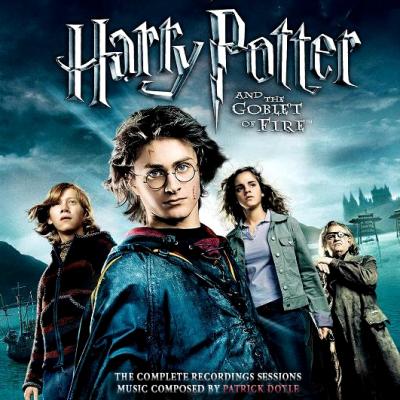
Harry Potter & the Goblet of Fire Album Cover

"Harry Potter & the Goblet of Fire" Soundtrack Lyrics

Movie • 2005

Track Listing


"Harry Potter and the Goblet of Fire (Original Motion Picture Soundtrack)" Soundtrack Description

Goblet of Fire 2005 official trailer frame with Triwizard reveal underscored by new themes
Harry Potter and the Goblet of Fire — official trailer still, 2005

Overview

Can a franchise change musical faces without losing its soul? In 2005, Patrick Doyle answered with a darker, more ceremonial language for Harry Potter and the Goblet of Fire. He preserves franchise DNA by nodding to John Williams’ main motif, then pivots: leaner action writing for the Triwizard set-pieces, a tragic line for Cedric, and ballroom music you can actually dance to.

The album (24 tracks, ~76 minutes) arrived mid-November 2005 on Warner Bros./Warner Sunset, performed by the London Symphony Orchestra under James Shearman at AIR Lyndhurst. Three diegetic Yule Ball songs by a “wizard rock” supergroup—Jarvis Cocker with Radiohead’s Jonny Greenwood & Phil Selway and Pulp’s Steve Mackey—give the film its pop-in-world heartbeat. AllMusic and Filmtracks both underline how Doyle’s palette marks the franchise’s tonal shift while still honoring the series’ core themes.

Trailer moment hinting at Triwizard Tournament scale that Doyle scores with choral power and percussion
Triwizard scale: massed orchestra, choir, and propulsive percussion

Questions & Answers

Who composed the score, and who performed it?
Patrick Doyle composed; the London Symphony Orchestra performed; James Shearman conducted. Sessions were at AIR Lyndhurst, London.
When did the soundtrack release, and on which label?
Mid-November 2005 on Warner Bros./Warner Sunset Records; regional dates vary slightly (e.g., Nov 9–15).
Are Williams’ themes still present?
Briefly. Doyle quotes the franchise motif early (“The Story Continues”/“Foreign Visitors Arrive”) but builds new themes for this film’s characters and events.
Who are “The Weird Sisters” in the film?
A one-off band led by Jarvis Cocker with Jonny Greenwood, Phil Selway (Radiohead) and Steve Mackey (Pulp), performing three original songs for the Yule Ball.
Did the album chart?
Yes. It peaked at No. 80 on the Billboard 200 and No. 4 on Top Soundtracks (week ending Dec 3, 2005).
What’s the love theme everyone cites?
“Harry in Winter” — a lyrical, restrained idea that recurs around the Ball and tender character beats.

Notes & Trivia

  • The Yule Ball set includes three originals: “Do the Hippogriff,” “This Is the Night,” and “Magic Works.”
  • “Hogwarts’ Hymn” and “Hogwarts’ March” frame school identity in more austere, almost Anglican colors than earlier films.
  • Engineer Nick Wollage captured the score at AIR; Doyle’s team credits multiple orchestrators (including Shearman and Lawrence Ashmore).
  • The 2018 Rhino/B&N picture-disc reissue resurfaced the album on vinyl amid a five-score box program.
  • MusicBrainz and Apple Music list 24 tracks with a runtime just under 76 minutes.

Genres & Themes

Pageantry & peril: Mixed chorus, martial drums, and brass blocks signal a tournament that’s equal parts ceremony and danger.

Waltz & salon cues: “Potter Waltz” and “Neville’s Waltz” are fully danceable—music that characters live in, not just background texture.

Elegy & aftermath: “The Death of Cedric” strips back to aching strings and minor-mode choral writing—no melodrama, just weight.

Pop-diegetic color: The Weird Sisters inject garage-glam swagger into the school’s most public teen rite of passage.

Trailer collage pairing waltz elegance and aggressive Triwizard action sonics
Two worlds: ballroom elegance vs. tournament muscle

Tracks & Scenes

Key placements — times vary slightly by cut/home release; diegetic notes included.

“The Story Continues” — Patrick Doyle
Where it plays: Opening; series motif appears in a sober, foreboding frame.
Why it matters: Announces a tonal pivot from wonder to consequence.

“The Quidditch World Cup” — Patrick Doyle
Where it plays: Pre-tournament spectacle and arrival energy (non-diegetic).
Why it matters: Jig-to-action writing with male chorus—Doyle’s most kinetic set-piece.

“The Dark Mark” — Patrick Doyle
Where it plays: After the World Cup chaos, Death Eater raid aftermath (non-diegetic).
Why it matters: Choral menace: the series’ innocence notably recedes.

“Foreign Visitors Arrive” — Patrick Doyle
Where it plays: Beauxbatons and Durmstrang entrances (non-diegetic).
Why it matters: Pageant rhythms sketch school identities in seconds.

“The Goblet of Fire” — Patrick Doyle
Where it plays: Selection ceremony inside the Great Hall (non-diegetic).
Why it matters: Ritual chords + choral glow underscore destiny as spectacle.

“Golden Egg” — Patrick Doyle
Where it plays: Harry tests the clue; water-world sonics preview Task Two (non-diegetic).
Why it matters: Textural sound design meets symphonic writing—curiosity with an edge.

“The Black Lake” — Patrick Doyle
Where it plays: Second Task underwater rescue (non-diegetic).
Why it matters: Rolling strings and choir evoke pressure, depth, and time running out.

“The Maze” — Patrick Doyle
Where it plays: Third Task hedges close in (non-diegetic).
Why it matters: Harmonic claustrophobia preps the graveyard shock.

“Voldemort” — Patrick Doyle
Where it plays: Graveyard resurrection (non-diegetic).
Why it matters: A cold, ritualistic motif for the saga’s true Big Bad.

“The Death of Cedric” — Patrick Doyle
Where it plays: Return to Hogwarts; Cedric’s body (non-diegetic).
Why it matters: The franchise’s first unambiguous tragedy—elegy as turning point.

“Harry in Winter” — Patrick Doyle
Where it plays: Tender interludes around the Ball and reflective beats (non-diegetic).
Why it matters: Humanizes Harry amid escalating stakes.

“Neville’s Waltz” — Patrick Doyle
Where it plays: Ballroom practice/full dance (diegetic-style ballroom underscore).
Why it matters: Character warmth and awkward grace in three-time.

“Potter Waltz” — Patrick Doyle
Where it plays: Formal Ball sequences (diegetic-adjacent).
Why it matters: A courtly signature for Hogwarts tradition.

“Do the Hippogriff” — The Weird Sisters (Jarvis Cocker et al.)
Where it plays: Yule Ball stage performance; kicks off the floor (diegetic).
Why it matters: In-world band gives the series its most extroverted teen moment.

“This Is the Night” — The Weird Sisters
Where it plays: Mid-Ball; couples dance (diegetic).
Why it matters: Bridges spectacle to adolescent romance and tension.

“Magic Works” — The Weird Sisters
Where it plays: Late-Ball slow dance and aftermath (diegetic).
Why it matters: A bittersweet capstone; emotions run higher than the lights suggest.

Trailer music: The film’s marketing used suites of Doyle’s score; fan-edits also circulate, but the official album covers the major cues used.

Music–Story Links

Doyle ties public ritual to private cost. The pageant cues (“Foreign Visitors Arrive,” “The Goblet of Fire”) frame a season of ceremony; the tournament set-pieces translate rules into rhythm. At the Ball, diegetic songs let characters perform who they think they are—then “Magic Works” exposes who they really are. Finally, the graveyard music removes all safety rails: Voldemort’s ritual theme cancels the comfort of school chorales, and Cedric’s elegy tells the audience the saga has changed.

Trailer frame echoing the graveyard turn where Doyle’s score shifts from pageantry to dread
When pageant turns to dread: the score’s tonal pivot

How It Was Made

Credits pinpoint a London-based production: AIR Lyndhurst sessions; Nick Wollage recording/mix; orchestrations by Patrick Doyle, James Shearman, Lawrence Ashmore and others. The album credits the London Symphony Orchestra with Shearman on the podium. Director Mike Newell contributed liner notes; Doyle’s team built new institutional pieces (“Hogwarts’ Hymn,” “Hogwarts’ March”) to replace earlier ceremonial cues, and crafted ballroom tracks to function as genuine diegetic dance music.

Reception & Quotes

Contemporary coverage saw the score as the franchise’s tonal hand-off: more danger, cleaner structures, and a memorable elegy. A few snapshots:

“Broad and magical… brutally highlighting the sinister aspects of the story.” Filmtracks
“Thunderous… jig to action with male choir; dangerously exciting.” Movie Music UK
“Newell drives the action forward; adolescence foregrounded.” The Guardian (film review)

Album availability remained steady on digital services; specialty vinyl reissues (Rhino) kept the title visible for collectors.

Additional Info

  • Album runtime: ~75–76 minutes across 24 tracks (regional timings vary by mastering).
  • Billboard: No. 80 (2005-12-03) and Top Soundtracks No. 4 in the same frame.
  • Three Yule Ball tracks are fully diegetic and credited on the album.
  • Later picture-disc and box-set vinyl editions reissued the program (Rhino/Warner family).
  • Apple Music and MusicBrainz list matching credits, including label and barcode details.

Technical Info

  • Title: Harry Potter and the Goblet of Fire (Original Motion Picture Soundtrack)
  • Year: 2005
  • Type: Symphonic score + diegetic songs
  • Composer: Patrick Doyle
  • Conductor: James Shearman
  • Orchestra: London Symphony Orchestra
  • Studios: AIR Lyndhurst (recording/mix); additional work at Air Edel
  • Label: Warner Bros. Records / Warner Sunset (original CD); later Rhino vinyl issues
  • Notable cues: “The Quidditch World Cup,” “The Dark Mark,” “Harry in Winter,” “The Black Lake,” “The Maze,” “Voldemort,” “The Death of Cedric,” “Hogwarts’ Hymn/March.”
  • Chart notes: Billboard 200 #80; Top Soundtracks #4 (Dec 2005)

Canonical Entities & Relations

SubjectRelationObject
Patrick DoylecomposedHarry Potter and the Goblet of Fire (score)
London Symphony OrchestraperformedHarry Potter and the Goblet of Fire (score)
James ShearmanconductedHarry Potter and the Goblet of Fire (sessions)
Warner Bros./Warner SunsetreleasedOriginal 2005 soundtrack album
Jarvis Cocker, Jonny Greenwood, Phil Selway, Steve Mackeywrote/performed“Do the Hippogriff,” “This Is the Night,” “Magic Works”
“The Death of Cedric”underscoresCedric Diggory’s death aftermath
“Harry in Winter”serves aslove/lyrical theme

Sources: Filmtracks, AllMusic, MusicBrainz, Wikipedia, Movie Music UK, Apple Music, Rhino/Pitchfork coverage.

November, 10th 2025

'Harry Potter and the Goblet of Fire' is a 2005 British-American fantasy film directed by Mike Newell and distributed by Warner Bros. Pictures. Get more info: Internet Movie Database, Wikipedia
A-Z Lyrics Universe

Lyrics / song texts are property and copyright of their owners and provided for educational purposes only.