
"Harry Potter and the Half-Blood Prince" Soundtrack Lyrics
Movie • 2009
Track Listing
Nicholas Hooper
Nicholas Hooper
Nicholas Hooper
Nicholas Hooper
Nicholas Hooper
Nicholas Hooper
Nicholas Hooper
Nicholas Hooper
Nicholas Hooper
Nicholas Hooper
Nicholas Hooper
Nicholas Hooper
Nicholas Hooper
Nicholas Hooper
Nicholas Hooper
Nicholas Hooper
Nicholas Hooper
Nicholas Hooper
Nicholas Hooper
Nicholas Hooper
Nicholas Hooper
Nicholas Hooper
Nicholas Hooper
Nicholas Hooper
Nicholas Hooper
Nicholas Hooper
Nicholas Hooper
Nicholas Hooper
"Harry Potter and the Half-Blood Prince (Original Motion Picture Soundtrack)" Soundtrack Description
Overview
How do you score adolescence turning into consequence? Nicholas Hooper answers with a cooler, more austere color for Harry Potter and the Half-Blood Prince (2009): airy boys’ choir, glassy strings, and a restrained, fatalistic cadence that saves the big catharsis for the shoreline farewell.
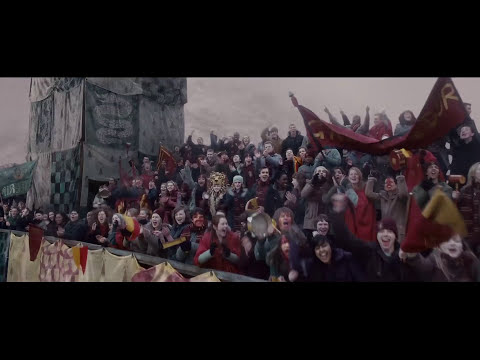
The album arrived July 14, 2009 on New Line Records, recorded at Abbey Road. It runs ~62:40 and foregrounds new material (“In Noctem,” “Dumbledore’s Farewell,” “The Weasley Stomp”) while quoting franchise DNA sparingly (brief “Hedwig’s Theme” at the open; Quidditch fragments in “Ron’s Victory”). A single in-world pop cue—Josh Powell’s “Big Beat Repeat”—shows up at the Gryffindor after-match party; otherwise the film relies on score. Trade charts logged the album’s strong debut for the series, and the set later earned a Grammy nomination for Best Score Soundtrack Album.

Questions & Answers
- Who composed and released the soundtrack?
- Nicholas Hooper composed; New Line Records released the album on July 14, 2009.
- Where was it recorded and who performed?
- Abbey Road Studios, London. The Chamber Orchestra of London performed; Hooper and Alastair King conducted.
- Is “Hedwig’s Theme” still present?
- Yes—heard briefly in the opening cue before Hooper’s new ideas take over.
- What’s the choral piece everyone mentions?
- “In Noctem,” a Latin/English lament associated with Dumbledore and Hogwarts under threat. A choral feature also exists in a deleted-sequence performance.
- Are there any non-score songs in the film?
- One notable example: “Big Beat Repeat” by Josh Powell at the Gryffindor common-room party.
- Did the album chart or receive awards attention?
- It debuted at No. 29 on the Billboard 200, No. 3 Top Soundtracks, and received a Grammy nomination.
Notes & Trivia
- “Ron’s Victory” and “Of Love & War” quote Quidditch writing from earlier films for continuity.
- “In Noctem” was prepared as a Hogwarts choir performance; a fuller staging appears in deleted materials.
- The album program emphasizes set-pieces in story order more than suite-style concert arrangements.
- Several later compilations re-record “Dumbledore’s Farewell,” confirming its popularity beyond the film.
- Choir contributions on the production included English collegiate forces; session work supported the light-chorus color heard across cues.
Genres & Themes
Cool choral + strings → elegy and foreboding. Boys’/light choir and high strings signal Hogwarts under shadow; “In Noctem” threads the mood into key scenes.
Motivic recall → continuity without nostalgia. Hooper nods to Williams (opening hint of “Hedwig’s Theme,” Quidditch figures) then steps back into his own harmonic vocabulary.
Rustle-and-surge action → contained danger. “Into the Rushes,” “Inferi in the Firestorm” use tight rhythms and low-brass punches instead of wall-to-wall bombast.
Warm source texture → student-life realism. The lone party track (“Big Beat Repeat”) contrasts the score’s ice with teen bustle.
Tracks & Scenes
Scene placements follow widely reported usage and official cue titles; home editions may shift timings slightly.
“Opening” — Nicholas Hooper
Where it plays: Studio logos and first scenes. Brief “Hedwig’s Theme” hint, then Hooper’s choral color takes over (non-diegetic).
Why it matters: Signals a tonal turn—familiar world, colder stakes.
“In Noctem” — Nicholas Hooper
Where it plays: Associated with Hogwarts under threat (album feature; a staged choir performance exists in deleted material).
Why it matters: Lament motif for Dumbledore’s arc; the series’ starkest choral color to date.
“Wizard Wheezes” — Nicholas Hooper
Where it plays: Weasley twins’ shop sequences (non-diegetic, comic bustle).
Why it matters: A kinetic identity for Diagon Alley’s prank emporium.
“Ron’s Victory” — Nicholas Hooper
Where it plays: Keeper heroics and aftermath (non-diegetic).
Why it matters: Quotes earlier Quidditch material to connect eras while keeping Hooper’s leaner touch.
“Big Beat Repeat” — Josh Powell
Where it plays: Gryffindor common-room party after the match (diegetic).
Why it matters: The film’s clearest in-world song; underscores teen energy and jealousy beats.
“Harry & Hermione” / “When Ginny Kissed Harry” — Nicholas Hooper
Where it plays: Quiet tent/corridor beats and the Room of Requirement kiss (non-diegetic; later compiled as “Friends and Love” in a promo single).
Why it matters: Small-scale intimacy amid chaos; two sides of one relationship triangle.
“The Slug Party” — Nicholas Hooper
Where it plays: Slughorn’s gathering (source-styled underscore, non-diegetic adjacent).
Why it matters: Salon polish that gently mocks the professor’s vanity.
“Into the Rushes” — Nicholas Hooper
Where it plays: Death Eater pursuit energy (non-diegetic).
Why it matters: Propulsive strings + anvil hits; danger without excess.
“Journey to the Cave” → “The Drink of Despair” → “Inferi in the Firestorm” — Nicholas Hooper
Where it plays: Cave sequence through the fiery escape (non-diegetic).
Why it matters: The album’s action spine—from ritual tension to full panic to release.
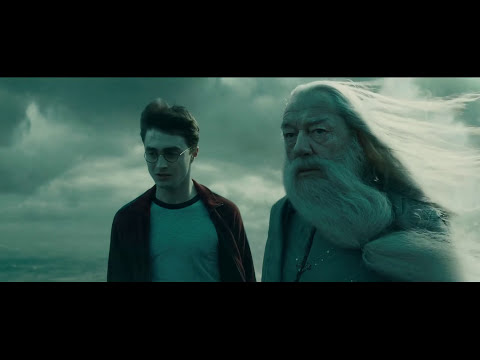
“The Killing of Dumbledore” / “Dumbledore’s Farewell” — Nicholas Hooper
Where it plays: Astronomy Tower and the Great Hall memorial (non-diegetic).
Why it matters: The emotional core. “Farewell” became a franchise touchstone and later reappears thematically in the finale era.
Music–Story Links
Hooper uses scale as meaning. Small ensembles and thin textures track teenage privacy—jealousy, first love, whispered plots. When ceremony returns (tower, memorial), the choir expands and harmony slows; grief becomes public. The single party song isn’t just color—it underlines how loudly teens try to live while the walls close in. And the Cave trip compresses the season’s arc into one movement: duty, despair, then a brief blast of survival before everything breaks.
How It Was Made
Recording took place at Abbey Road. Hooper and Alastair King share conducting duties; orchestrations by King, Jeff Atmajian, Simon Whiteside, Daryl Griffith, and Bradley Farmer. The Chamber Orchestra of London performed, with light choir layered for color. Collegiate choirs were engaged for session work to realize the “In Noctem” sound. The music department intentionally limited overt franchise quotes, letting new motifs and choral texture carry the weight.
Reception & Quotes
Coverage at the time called out the cooler palette and the strength of the memorial writing; fan debates centered on the relative subtlety of the action cues.
“Coolly atmospheric, with standout elegy in the finale.” AllMusic
“Lean sonics; pageantry dialed back, choir used to chilling effect.” Filmtracks
“Trailer reveals a darker, more heroic register—paid off by the album’s tone.” Wired
Additional Info
- Standard album: 28 cues; digital and CD share the core program.
- “Friends and Love” (promo single) compiled two romantic cues for a ticketing tie-in.
- The official soundtrack playlist is maintained on studio channels for reference listening.
- Later reissues appeared on LP; international physical editions carry varying label credits (New Line/Decca regionals).
- The score’s closing elegy is one of the franchise’s most frequently re-recorded cues on compilation albums.
Technical Info
- Title: Harry Potter and the Half-Blood Prince (Original Motion Picture Soundtrack)
- Year: 2009
- Type: Symphonic score + minimal source song
- Composer: Nicholas Hooper
- Conductors: Nicholas Hooper, Alastair King
- Orchestra: Chamber Orchestra of London
- Studio: Abbey Road Studios, London
- Label: New Line Records (primary 2009 digital/CD; some regional Decca listings)
- Key placements: “In Noctem” (Hogwarts lament); “Ron’s Victory” (Quidditch); “The Slug Party”; “Inferi in the Firestorm”; “Dumbledore’s Farewell.”
- Chart/Awards: Billboard 200 #29; Top Soundtracks #3; Grammy nomination (Best Score Soundtrack Album).
Canonical Entities & Relations
| Subject | Relation | Object |
|---|---|---|
| Nicholas Hooper | composed | Harry Potter and the Half-Blood Prince (score) |
| Chamber Orchestra of London | performed | Half-Blood Prince recording sessions |
| New Line Records | released | Original 2009 soundtrack album |
| “In Noctem” | functions as | Hogwarts/Dumbledore lament motif |
| “Big Beat Repeat” | appears in | Gryffindor common-room party (diegetic) |
| “Dumbledore’s Farewell” | underscores | Great Hall memorial |
Sources: Wikipedia (soundtrack & franchise music pages), AllMusic, Filmtracks, MusicBrainz, Discogs, IMDb (Soundtracks), Wired.
November, 10th 2025
A-Z Lyrics Universe
Cynthia Erivo Popular
Ariana Grande Horsepower
Post Malone Ain't No Love in Oklahoma
Luke Combs Good Riddance (Time of Your Life)
Green Day Bye Bye Bye
*NSYNC You're the One That I Wan
John Travolta & Olivia Newton-John I Always Wanted a Brother
Braelyn Rankins, Theo Somolu, Kelvin Harrison Jr. and Aaron Pierre The Power of Love
Frankie Goes to Hollywood Beyond
Auli’i Cravalho feat. Rachel House MORE ›