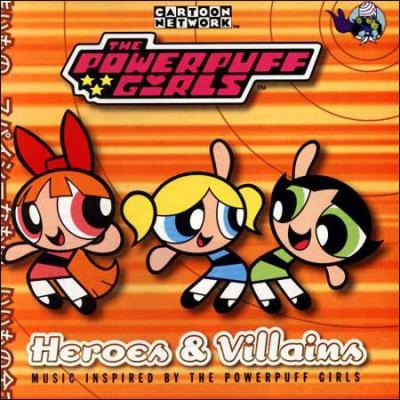
"Heroes and Villains: The Powerpuff Girls" Soundtrack Lyrics
Cartoon • 2000
Track Listing
Devo
Frank Black
The Apples In Stereo
Optiganally Yours
Shonen Knife
Komeda
Dressy Bessy
Bis
The Sugarplastic
Cornelius
The Bill Doss
Bis
Cherish
Leslie Mills
Cherish
"Heroes & Villains: Music Inspired by The Powerpuff Girls" Soundtrack Description
Overview
How do you package a sugar-rush cartoon into a credible indie compilation? Heroes & Villains (2000) answers by recruiting Devo, Frank Black, The Apples in Stereo, Shonen Knife, Komeda, Bis, and more—each assigned a plot beat or character—to stitch a loose radio-play about Townsville under siege. Spoken interludes by the show’s cast glue the songs into a brisk, 40-minute dash that plays like a miniature episode with a touring lineup.
The album’s distinct move: it doesn’t drop needle-drops into episodes; it builds a parallel story world “about” the show—Mojo Jojo gets a chanty anthem, Blossom a Scandi-pop mission statement, Bubbles a sunshine pop cover, Buttercup a fuzz-punk pep talk. Produced by Mark Mothersbaugh and Bob Casale (both of Devo), it sits at the odd, delightful intersection of kids’ TV and college-radio circa 2000.
Questions & Answers
- Is it a “music from the show” soundtrack or something else?
- It’s a concept compilation: original songs inspired by characters/scenes, linked by voice-acted interludes into a simple Mojo-Jojo plotline.
- Who produced it?
- Mark Mothersbaugh and Bob (Robert) Casale of Devo produced; Cartoon Network/Kid Rhino released it.
- When did it come out and how long is it?
- Released July 18, 2000; runtime ~40 minutes.
- Did any tracks cross into the series or movie?
- Yes. The Apples in Stereo’s “Signal in the Sky (Let’s Go)” appears in the episode “Superfriends”; Bis’s end theme and Frank Black’s “Pray for the Girls” roll over The Powerpuff Girls Movie credits.
- How did it perform commercially?
- Reported as topping Billboard’s kids/soundtrack charts for multiple weeks in 2000.
- What makes its sound different from the show’s score?
- The series leans on Thomas Chase/Steve Rucker/James L. Venable’s breakbeat-meets-orchestral cues; this album is indie/alt-pop acts writing character-centric songs.
- Is there an official trailer?
- No film-style trailer, but Cartoon Network aired a CD promo spot (used below for figures).
Notes & Trivia
- The title nods to The Beach Boys’ “Heroes and Villains.”
- Craig McCracken curated indie-leaning acts to mirror the show’s pop-art sensibility.
- Dressy Bessy’s “Bubbles” is a cover of The Free Design’s sunshine-pop tune.
- Komeda later re-cut “B.L.O.S.S.O.M.” as “Blossom (Got to Get It Out)” on their 2003 album.
- The interludes feature the show’s principal cast (Cathy Cavadini, Tara Strong, E.G. Daily, Tom Kane, Tom Kenny).
Genres & Themes
Indie pop & Elephant 6 sparkle for team-ups and friendship beats (“Signal in the Sky”)—bright hooks matching the Girls’ save-the-day momentum.
New wave/post-punk flair (Devo; Bis) underlines Townsville’s kinetic chaos and Mojo’s scheming—jerky rhythms, chant-able hooks, a touch of camp.
Scandi-pop artiness (Komeda) maps to Blossom’s planner-energy: clean lines, moral resolve, forward motion.
Alt-rock grit (Frank Black; Shonen Knife) equals punchline-to-punch-up transitions—power-chord confidence for Buttercup-centric moments.
Tracks & Scenes
Below: compact scene notes, where the songs surface in the series/movie or how they’re framed in the album’s storyline. Times are approximate when known; diegetic = heard by characters.
“Signal in the Sky (Let’s Go)” — The Apples in Stereo
Scene: Featured in the series episode “Superfriends” (Season 4); also circulated as a Cartoon Network music video. Non-diegetic in-episode; montage-like energy over team heroics.
Why it matters: Became the album’s de facto calling card—effervescent indie pop aligning the Girls’ optimism with Elephant 6 sparkle.
“Pray for the Girls” — Frank Black
Scene: Rolls over The Powerpuff Girls Movie (2002) end credits. Non-diegetic; end-cap relief after the climax.
Why it matters: Frank Black’s hooky, propulsive cut reframes the trio as small-scale folk heroes; a rare crossover from the concept album into the feature film.
“The Powerpuff Girls (End Theme)” — Bis
Scene: Series end theme and a punkier rendition in the movie credits stack. Non-diegetic.
Why it matters: Cemented the show’s identity: pogo-beat, chant chorus, and a wink of attitude that defined late-’90s Cartoon Network branding.
“Go Monkey Go” — Devo
Where it plays: As an album beat in the Mojo Jojo chapter (between cast interludes). Non-diegetic within the compilation’s story flow.
Why it matters: New-wave twitch perfectly matches Mojo’s over-explained villain plans; Mothersbaugh/Casale producing elsewhere ties the concept and sonics together.
“B.L.O.S.S.O.M.” — Komeda
Where it plays: Album segment spotlighting Blossom’s leadership. Non-diegetic.
Why it matters: Mantra-like refrain—resolve, order, and action—mirrors Blossom’s plan-first ethos; later re-recorded by the band as “Blossom (Got to Get It Out).”
“Buttercup (I’m a Super Girl)” — Shonen Knife
Where it plays: Album’s Buttercup focus cut. Non-diegetic.
Why it matters: Fuzzy guitars and straight-ahead tempo channel Buttercup’s no-nonsense brawler streak; became a fan-favorite character anthem.
“Bubbles” — Dressy Bessy
Where it plays: Album’s Bubbles chapter. Non-diegetic.
Why it matters: A bright, 1960s-rooted cover (originally by The Free Design) fits Bubbles’ sunshine disposition while nodding to crate-digger pop history.
“Walk & Chew Gum” — Optiganally Yours
Where it plays: Transitional mischief beat in the compilation’s plot.
Why it matters: Tape-loop quirk and Optigan textures echo the show’s retro-future aesthetic.
Trailer/Promo music
Where it plays: Cartoon Network’s 2000 CD promo (TV spot) packaged album hooks and interlude bites.
Why it matters: Functioned as the soundtrack’s “trailer,” seeding recognition beyond the show’s timeslot.
Music–Story Links
Album sequencing mirrors a classic episode arc:
- Alarm: Cast interlude → Devo’s “Go Monkey Go” frames Mojo’s plan (schemer motif).
- Mobilize: Apples in Stereo’s “Signal in the Sky” snaps the team into flight—city-wide response energy.
- Leadership & resolve: Komeda’s “B.L.O.S.S.O.M.” signals strategy; lyrics lean into doing “the right thing.”
- Force: Shonen Knife channels Buttercup’s kinetic punch—momentum into confrontation.
- Heart: Dressy Bessy’s “Bubbles” tempers the set with empathy and brightness before the final push.
- Afterglow: Frank Black and Bis carry victory into credits—celebratory, a little snarky, very Cartoon Network 2000.
How It Was Made
Cartoon Network commissioned indie and alt-pop artists to write character-specific songs; producers Mark Mothersbaugh and Bob Casale steered sessions to keep a unified, radio-friendly punch. Kid Rhino handled manufacture/marketing. The show’s cast recorded connective skits so the disc plays like a continuous audio episode. Credits list Craig McCracken and Phil Baron as executive producers, with editorial/music supervision staff at Cartoon Network overseeing assembly.
Reception & Quotes
Coverage split along two lines: family/children’s charts success and indie-press skepticism. It charted strongly on Billboard’s kids/soundtrack tallies in summer 2000; critics debated whether “inspired by” albums transcend branding. A few snapshots:
“The precocious sound these bands cultivate has never had a more appropriate niche.” —Ann Powers, The New York Times
“Appropriately hip and funny… much more than just a ‘music inspired by’ marketing piece.” —Heather Phares, AllMusic
“Highly indie-friendly… Devo, Apples in Stereo, Shonen Knife, Frank Black.” —Pitchfork (album review)
“At the top of Billboard’s Soundtrack chart for eight weeks last summer.” —The Washington Post
Availability note: the original Kid Rhino CD is long OOP; tracks circulate on digital platforms via artist/label catalogs.
Additional Info
- Release date: July 18, 2000 (US); catalog no. R2 75848 (Kid Rhino).
- Barcode commonly reported: 081227584825 (US CD).
- “Signal in the Sky (Let’s Go)” also appears on The Apples in Stereo’s Let’s Go! EP (2001).
- Some press reported a shelved David Byrne/Malu Byrne contribution during development.
- Komeda’s later studio album re-imagined their Blossom track, showing afterlife beyond the compilation.
- The interludes feature the core voice cast, keeping continuity with the TV series tone.
- Dressy Bessy’s “Bubbles” revived late-’60s Free Design sunshine pop for a new audience.
Technical Info
- Title: The Powerpuff Girls — Heroes & Villains: Music Inspired by The Powerpuff Girls
- Year: 2000
- Type: Compilation/Concept soundtrack (album)
- Producers: Mark Mothersbaugh; Bob (Robert) Casale
- Label/Imprint: Kid Rhino / Rhino (Cartoon Network)
- Runtime: ~40:14
- Notable placements: “Signal in the Sky (Let’s Go)” in TV episode “Superfriends”; “Pray for the Girls” & Bis’s end theme in The Powerpuff Girls Movie credits.
- Format notes: CD & cassette; out of print physically; select tracks available digitally.
Canonical Entities & Relations
| Subject | Relation | Object |
|---|---|---|
| Heroes & Villains (album) | released-by | Kid Rhino / Rhino |
| Mark Mothersbaugh | produced | Heroes & Villains (album) |
| Bob Casale | produced | Heroes & Villains (album) |
| The Apples in Stereo | performed | “Signal in the Sky (Let’s Go)” |
| Frank Black | performed | “Pray for the Girls” |
| Shonen Knife | performed | “Buttercup (I’m a Super Girl)” |
| Komeda | performed | “B.L.O.S.S.O.M.” |
| Dressy Bessy | performed | “Bubbles” (cover of The Free Design) |
| Bis | performed | “The Powerpuff Girls (End Theme)” |
| The Powerpuff Girls (TV series) | features | End theme by Bis; score by Chase/Rucker/Venable |
Sources: AllMusic; Discogs; MusicBrainz; The Washington Post; IMDb; Wikipedia; Powerpuff Girls Fandom Wiki; WhoSampled; Pitchfork.
November, 10th 2025
A-Z Lyrics Universe
Cynthia Erivo Popular
Ariana Grande Horsepower
Post Malone Ain't No Love in Oklahoma
Luke Combs Good Riddance (Time of Your Life)
Green Day Bye Bye Bye
*NSYNC You're the One That I Wan
John Travolta & Olivia Newton-John I Always Wanted a Brother
Braelyn Rankins, Theo Somolu, Kelvin Harrison Jr. and Aaron Pierre The Power of Love
Frankie Goes to Hollywood Beyond
Auli’i Cravalho feat. Rachel House MORE ›