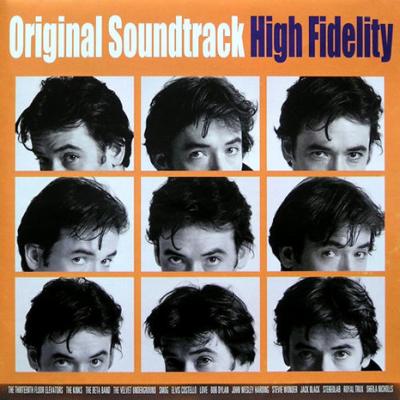
"High Fidelity" Soundtrack Lyrics
Movie • 2000
Track Listing
13th Floor Elevators
The Kinks
John Wesley Harding
The Velvet Underground
Love
Bob Dylan
Shiela Nicholls
The Beta Band
Elvis Costello & The Attractions
Smog
Jack Black
Stereolab
Royal Trux
The Velvet Underground
Stevie Wonde
"High Fidelity (Original Motion Picture Soundtrack)" Soundtrack Description
Overview
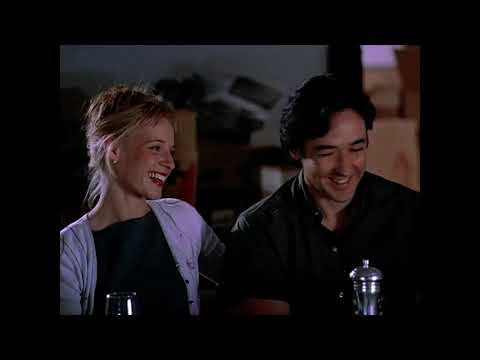
Can a breakup comedy double as a crash course in record-store evangelism? High Fidelity (2000) makes music the bloodstream: a needle-dropped inner monologue where songs sell scenes, worldbuild taste, and turn customers into converts. The official album (Original Motion Picture Soundtrack) distills the film’s crate-dug palette—garage psychedelia, VU melancholia, Kinks bounce, Dylan doubt—into a 65-minute mixtape.
The soundtrack (Hollywood Records) arrived March 28, 2000; runtime ~65:01. It threads signature placements—The Beta Band’s “Dry the Rain,” Love’s “Always See Your Face,” Velvet Underground deep cuts—with originals and a Jack Black cover captured in-film. A separate list of in-movie cues stretches far beyond the album, including end-credit closer “I Believe (When I Fall in Love It Will Be Forever)” by Stevie Wonder. Authoritative references (AllMusic, Apple Music/label metadata, Discogs) align on title, date, label, and key inclusions.
Questions & Answers
- Is the album just a best-of the movie’s music?
- No—the film uses ~70 cues; the album cherry-picks 15 tracks. Several notable in-film songs (e.g., Stevie Wonder’s “I Believe…”) aren’t on the retail OST.
- Who composed the score heard under dialogue?
- Howard Shore wrote the original score; the commercial album focuses on songs.
- Who shaped the song selections?
- Song choices were closely curated by the filmmakers; John Cusack is credited as a co-producer of the soundtrack release, and the team approached the film with obsessive music-head specificity.
- What label released the OST and when?
- Hollywood Records; U.S. release late March 2000 with a ~65-minute program.
- Which single scene best explains the movie’s music philosophy?
- The record-store “Beta Band test”: Rob drops the needle on “Dry the Rain,” then quietly watches customers convert—music as sales pitch and character study.
- Does Jack Black really sing in the film?
- Yes—his character Barry fronts “Let’s Get It On” onstage near the finale.
Notes & Trivia
- The film features a cameo by Bruce Springsteen as himself, advising Rob in a fantasy aside.
- Writers and producers reportedly sifted through ~2,000 songs to land ~70 screen cues.
- The retail album was co-produced on the film side by John Cusack; critics at the time called out the curation as character-driven.
- End credits use Stevie Wonder’s “I Believe (When I Fall in Love It Will Be Forever)”—memorable in theaters, absent from the OST.
- The “Dry the Rain” scene materially boosted interest in The Beta Band’s catalog.
Genres & Themes
Sixties/Seventies soul & R&B: warmth and swagger for romance gambits and public performance (Jack Black’s “Let’s Get It On”).
Indie/alt and art-pop: Stereolab’s motorik cool, Beta Band’s slow-build hypnosis, Love’s baroque pop—used to signal taste, tribe, and mood calibration.
Classic rock & college-radio canon: Kinks bounce for comic beats; VU melancholy for self-pity; Dylan for post-wake clarity—songs as emotional short-hand.
Tracks & Scenes
Key placements below follow reliable scene descriptions; timestamps are approximate in hh:mm.
“You’re Gonna Miss Me” — The 13th Floor Elevators
Where it plays: opening title beat, then over Rob & Laura’s argument (00:00–00:02). Non-diegetic.
Why it matters: kicks the door with garage-psych urgency; the breakup is already a banger’s tempo.
“I Want Candy” — Bow Wow Wow
Where it plays: flashback to Rob’s early heartbreak with Alison (≈00:03). Non-diegetic.
Why it matters: sugary teen lust reframed as the first entry in his lifelong top-five disasters.
“Seymour Stein” — Belle & Sebastian → “Walking on Sunshine” — Katrina & The Waves
Where it plays: shop floor skirmish; Barry kills B&S and hijacks the vibe (≈00:07–00:08). Diegetic (in-store).
Why it matters: aural character clash—taste flex as power move.
“Cold Blooded Old Times” — Smog
Where it plays: Championship Vinyl scene while Rob lists “top five Side-1, Track-1s” (≈00:27). Diegetic.
Why it matters: dense, sardonic; underlines how lists become shields.
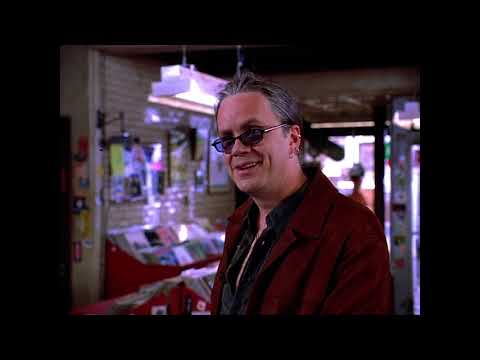
“Dry the Rain” — The Beta Band
Where it plays: record-store “test”; customers nod along; shoplifters bolt; Rob & Barry sprint (≈00:47). Diegetic.
Why it matters: the film’s calling card—taste converted into sales in real time.
“Who Loves the Sun” — The Velvet Underground
Where it plays: Rob flips through memories and numbers an ex (≈00:39). Non-diegetic.
Why it matters: sunny melody, bitter lyric—perfect for cheerful resignation.
“Always See Your Face” — Love
Where it plays: post-blowup reset at the shop; Liz storms in (≈00:33). Diegetic.
Why it matters: gorgeous ache; maturity peeks in.
“Most of the Time” — Bob Dylan
Where it plays: after Laura’s father’s wake, rain-soaked walk to that fence-dive moment (≈01:24). Non-diegetic.
Why it matters: denial as mantra—Dylan’s refrain mirrors Rob’s self-talk.
“Lo Boob Oscillator” — Stereolab
Where it plays: record-store flirt—Caroline asks what’s playing (≈01:31). Diegetic.
Why it matters: cool-kid minimalism; music as meet-cute.
“Let’s Get It On” — Jack Black (as Barry Jive & the Uptown Five)
Where it plays: in-story gig near the end (≈01:40). Diegetic performance.
Why it matters: the punchline becomes payoff; swagger turns sincere.
“I Believe (When I Fall in Love It Will Be Forever)” — Stevie Wonder
Where it plays: closing montage and end credits (≈01:42→). Non-diegetic.
Why it matters: a full-body resolution the album omits—hope without snobbery.
Music–Story Links
- Gatekeeping → generosity: the Beta Band scene literalizes the shift from hoarded taste to shared joy.
- Cheerful melody / bitter truth: VU’s “Who Loves the Sun” and Love’s “Always See Your Face” mirror Rob’s self-aware denial.
- List-making as armor: Smog’s grind and Kinks’ pep score Rob’s ritual arguments with himself and his staff.
- Earnestness wins: the Barry performance drops irony and lands actual connection—music solving what talk couldn’t.
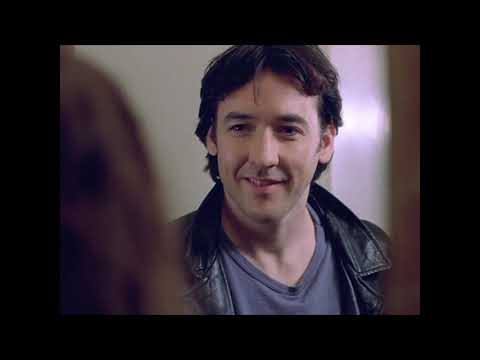
How It Was Made
Music was baked into development: Disney executive Kathy Nelson helped steer the project to John Cusack and his partners, who then curated music with the zeal the film lampoons. Reports and interviews credit the team with listening to ~2,000 songs to land ~70 placements. Howard Shore handled the underscoring; the OST album was released by Hollywood Records, with Cusack credited as a co-producer. The “Beta Band test” and the climactic Jack Black performance were storyboarded as musical set-pieces, not background flavor.
Reception & Quotes
Contemporary reviews treated the album as intentional character work, not random licensing. A few snapshots:
“Cusack and his co-producers take care to choose music that very specifically fits the themes, characters, and situations of the film.” Pitchfork
“A carefully curated mix… standout cuts from the 13th Floor Elevators, Love, Dylan, the Velvet Underground.” AllMusic & contemporary coverage
“The film has 70 song cues… we probably listened to 2,000 songs to get those 70.” John Cusack (press)
Result: a cult-canonical “song score” that still reads like a masterclass in cinematic needle-drops.
Additional Info
- End-credit Stevie Wonder track is not on the OST; fans often go searching for it post-screening.
- Marie DeSalle’s on-screen “Baby, I Love Your Way” (Lisa Bonet) is a plot point and a placement.
- Several hip-hop cues (Eric B. & Rakim, De La Soul) puncture the film’s rock-guy bubble at key beats.
- Album includes Jack Black’s performance version; live scene doubles as character payoff, not just fan service.
- Howard Shore’s score is understated but vital; the album foregrounds songs by design.
Technical Info
- Title: High Fidelity (Original Motion Picture Soundtrack)
- Year: 2000
- Type: Song compilation (film features additional cues beyond album)
- Score: Howard Shore (in-film)
- Album producers (release side): includes John Cusack (co-producer)
- Label: Hollywood Records (U.S.)
- Runtime (album): ~65:01
- Known notable placements: “Dry the Rain” (Beta Band store scene); “Let’s Get It On” (Barry’s stage performance); “Most of the Time” (post-wake); “I Believe (When I Fall in Love…)” (end credits, not on OST)
Canonical Entities & Relations
| Subject | Relation | Object |
|---|---|---|
| High Fidelity (film) | directed-by | Stephen Frears |
| High Fidelity (film) | music-by (score) | Howard Shore |
| High Fidelity (Original Motion Picture Soundtrack) | released-by | Hollywood Records |
| High Fidelity (Original Motion Picture Soundtrack) | co-produced-by | John Cusack |
| The Beta Band | performed | “Dry the Rain” |
| Jack Black (as Barry Jive) | performed | “Let’s Get It On” |
| Stevie Wonder | performed (in-film only) | “I Believe (When I Fall in Love It Will Be Forever)” |
| Love (band) | performed | “Always See Your Face” |
| The Velvet Underground | performed | “Who Loves the Sun”; “Oh! Sweet Nuthin’” |
Sources: AllMusic; Apple Music; Discogs; ScreenRant; SoundtrackRadar; IMDb; Wikipedia.
November, 10th 2025
A-Z Lyrics Universe
Cynthia Erivo Popular
Ariana Grande Horsepower
Post Malone Ain't No Love in Oklahoma
Luke Combs Good Riddance (Time of Your Life)
Green Day Bye Bye Bye
*NSYNC You're the One That I Wan
John Travolta & Olivia Newton-John I Always Wanted a Brother
Braelyn Rankins, Theo Somolu, Kelvin Harrison Jr. and Aaron Pierre The Power of Love
Frankie Goes to Hollywood Beyond
Auli’i Cravalho feat. Rachel House MORE ›