
"Hit the Deck!" Soundtrack Lyrics
Movie • 1955
Track Listing
Hit The Deck ST
Tony Martin/Vic Damone/Rex Dennis
The M-G-M Studio Orchestra
Ann Miller/Tony Martin/Betty Noyes/Gloria Wood/Loulie Jean Norman/Betty Wand
Jane Powell
Debbie Reynolds & Boys Trio
The M-G-M Studio Orchestra
Jane Powell/Debbie Reynolds/Ann Miller
Jane Powell
Jane Powell/Vic Damone
Ann Miller
The M-G-M Studio Orchestra
Kay Armen/Vic Damone
Kay Armen/Vic Damone/Jane Powell/Debbie Reynolds/Rex Dennis
Jane Powell/Debbie Reynolds/Ann Miller
Tony Martin
The M-G-M Studio Orchestra
Jane Powell/Vic Damone
The M-G-M Studio Orchestra
Theatre Stage Chase Number (Medley: Join The Navy/Loo Loo)
Kay Armen/Jane Powell/Debbie Reynolds/Ann Miller/Tony Martin/Vic Damone
The M-G-M Studio Orchestra
"Hit the Deck (Original Soundtrack)" Soundtrack Description
Overview
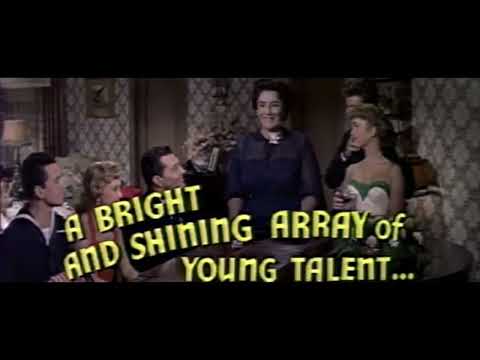
How do Navy blues, big-band brass, and 1920s stage standards feel modern in 1955? Hit the Deck answers with lavish MGM arrangements, star vocals, and Hermes Pan’s athletic staging. The film retools the 1927 Broadway score (Vincent Youmans, with lyrics by Leo Robin and Clifford Grey) into a CinemaScope revue where romance and rank collide, then make up in song.
The soundtrack pairs studio-orchestra sheen (George/“Georgie” Stoll conducting) with marquee turns by Jane Powell, Vic Damone, Tony Martin, Debbie Reynolds, Ann Miller, Kay Armen, and Russ Tamblyn (singing voice dubbed by Rex Dennis). It’s standards-forward: “Hallelujah!,” “Sometimes I’m Happy,” and “I Know That You Know” headline, while novelties like “Chiribiribee (Ciribiribin)” and “Lady from the Bayou” broaden the color palette. For cross-checking titles and who-sings-what, Discogs and Soundtrack Collector remain reliable catalogs; Wikipedia summarizes the film’s song roster concisely.

Questions & Answers
- Who wrote the songs featured in the film?
- Music by Vincent Youmans; primary lyrics by Leo Robin and Clifford Grey, with additional lyric credits on standards such as “Sometimes I’m Happy” (Irving Caesar) and “I Know That You Know” (Edward Eliscu & Billy Rose).
- Who conducts and arranges the film’s orchestral sound?
- The MGM Studio Orchestra under George (Georgie) Stoll; arrangements support large ensemble vocals and dance.
- Is there a dedicated “original score” apart from the songs?
- Incidental scoring is present, but the production is song-led; the commercial LP focuses on vocal numbers and set pieces.
- Was an official soundtrack album released in 1955?
- Yes—MGM Records issued a 12-track album “Recorded Directly From the Sound Track,” later reissued in various territories/formats.
- Which stars handle the key duets?
- Jane Powell & Vic Damone (notably on “Sometimes I’m Happy” and “I Know That You Know”); Tony Martin pairs with Ann Miller on “Keepin’ Myself for You.”
- Is “More Than You Know” in the movie?
- Yes—Tony Martin performs it on screen; the standard (Youmans/Rose/Eliscu) is documented in film-song references.
Notes & Trivia
- The stage source is the 1927 musical Hit the Deck, itself adapted from the 1922 play Shore Leave; MGM reshaped the plot for the 1955 film.
- Russ Tamblyn’s songs are dubbed by Rex Dennis—common practice at MGM then.
- Hermes Pan, famed for work with Fred Astaire, staged the film’s musical numbers.
- Several later LP/CD issues re-sequence tracks; collectors note UK and EU represses from the 1970s onward.
- “Hallelujah!” and “Sometimes I’m Happy” are the film’s best-known standards, anchoring trailer and marketing materials.
Genres & Themes
Broadway-to-Hollywood standards. Youmans’s melodic writing—clean hooks, tidy modulations—lets singers project character quickly (Powell’s clarity vs. Martin’s crooner polish).
Show-band swing & parade brass. Military textures (snare tattoos, brass fanfares) frame sailors’ camaraderie; dance breaks swell to big-band exuberance.
Latin/novelty color. “Chiribiribee (Ciribiribin)” and “Lady from the Bayou” lend travelogue spice—choral refrains, obbligato reeds, tambour accents.
Tracks & Scenes
Notes: sequences below reflect documented film placements and on-screen performers; exact timestamps vary by edition. “Diegetic” means performed within the story world.
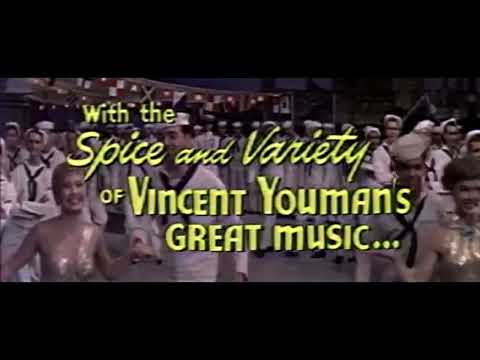
“Hallelujah!” — ensemble (Tony Martin, Vic Damone, Russ Tamblyn/Rex Dennis)
Scene: A show-of-force production number rallying the sailors; staged on a broad set with marching figures; largely diegetic-as-performance.
Why it matters: Signature Youmans uplift; it’s the film’s banner of esprit de corps.
“Sometimes I’m Happy” — Jane Powell & Vic Damone
Scene: Romantic duet, staged as an intimate spotlight moment; diegetic performance within the narrative’s entertainment setting.
Why it matters: Classic standard that cements Powell–Damone chemistry; one of the album’s highlights.
“I Know That You Know” — Jane Powell & Vic Damone
Scene: Playful back-and-forth with dance punctuation; diegetic (stage rehearsal/performance).
Why it matters: Quicksilver melody showcases agility and flirtation.
“Keepin’ Myself for You” — Ann Miller; reprise with Tony Martin
Scene: Solo turn for Miller with tap-forward staging, later answered by Martin; diegetic stage-performance frame.
Why it matters: Mixes comic poise and rhythmic bite—Miller’s precision drives it.
“A Kiss or Two” — Debbie Reynolds
Scene: Light, flirtatious specialty with chorus; diegetic.
Why it matters: Reynolds’s breezy persona softens the film’s more formal set pieces.
“Why, Oh Why?” — Tony Martin, Vic Damone, Russ Tamblyn/Rex Dennis; later female-ensemble reprise
Scene: Call-and-response staging between the gobs and their sweethearts; diegetic.
Why it matters: Narrative hinge for courtship-and-mix-ups humor.
“Chiribiribee (Ciribiribin)” — Kay Armen with principal cast
Scene: Festive ensemble with continental flavor; diegetic show number.
Why it matters: Color piece that widens the film’s musical map.
“Lady from the Bayou” — Ann Miller (with featured vocal by Kitty White in choral textures)
Scene: Sultry production on a swamp-motif set; diegetic.
Why it matters: Dance-forward showcase; timbral contrast to the brassier marches.
“Lucky Bird” — Jane Powell
Scene: Tender solo spotlight; diegetic stage context.
Why it matters: Gives Powell a lyrical centerpiece beyond the well-known standards.
“Join the Navy” — Company; later Debbie Reynolds & chorus
Scene: Recruiting-flavored novelty opener and reprise; diegetic.
Why it matters: Sets tone and stakes—duty, romance, and the show-within-the-show.
“More Than You Know” — Tony Martin
Scene: Torch moment for Martin, framed as a polished ballroom-style interlude; diegetic.
Why it matters: A Great American Songbook evergreen folded neatly into the plot.
Music–Story Links
Every couple gets a signature. Powell/Damone move from coyness (“I Know That You Know”) to assurance (“Sometimes I’m Happy”). Martin’s solos telegraph suavity, offset by Miller’s tap-bright independence (“Keepin’ Myself for You”). Massed numbers—“Hallelujah!,” “Join the Navy”—reset the board, pulling characters back under duty’s banner after romance detours. When the ladies flip “Why, Oh Why?” the perspective shift becomes the scene’s joke and its spine.
How It Was Made
Roy Rowland directs; Joe Pasternak produces; Hermes Pan stages musical numbers. MGM retained Broadway DNA (Youmans/Robin/Grey) but refashioned the narrative for star chemistry. The orchestra’s glossy presence—snare rolls, reed choirs, trumpets in tight harmony—owes to the studio’s late-musicals house sound under George Stoll.
Reception & Quotes
Box-office returns were modest by mid-’50s MGM standards, but the set pieces earned praise for scale and polish. Contemporary catalogs and retrospectives note the soundtrack as a compact showcase for the cast’s strengths.
“Standards-driven and brightly upholstered.” TCM
“A parade of tunes you already know, executed with MGM precision.” Discogs editor notes
Additional Info
- Original 12-track MGM Records album was marketed as “Recorded Directly From the Sound Track.” Several represses appeared in later decades.
- Some modern digital issues expand to 20+ cuts, adding main title and reprises from archival sources.
- Rex Dennis dubs Russ Tamblyn’s vocals; chorus credits include prominent MGM studio singers of the period.
- “Sometimes I’m Happy,” “Hallelujah!,” and “I Know That You Know” predate the film; their inclusion ties the movie to 1920s–30s popular repertory.
- Collectors track differing song orders between U.S. and U.K. LPs.
Technical Info
- Title: Hit the Deck (Original Soundtrack)
- Year: 1955 (film); original LP 1955; multiple later reissues
- Type: Studio-cast soundtrack (song-driven musical)
- Songs by: Vincent Youmans (music); lyrics by Leo Robin & Clifford Grey; additional lyric credits incl. Irving Caesar; Edward Eliscu & Billy Rose; Sidney Clare; Albert Pestalozza (adapted)
- Orchestra/Conductor: MGM Studio Orchestra, conducted by George (Georgie) Stoll
- Featured performers: Jane Powell; Vic Damone; Tony Martin; Debbie Reynolds; Ann Miller; Kay Armen; Russ Tamblyn (vocals dubbed by Rex Dennis)
- Label (original): MGM Records; later reissues in U.K./E.U. markets
- Availability: Vintage LPs on collectors’ markets; curated digital albums (“Songs from the Film Soundtrack”) on major services
Canonical Entities & Relations
| Subject | Relation | Object |
|---|---|---|
| Hit the Deck (1955 film) | directed by | Roy Rowland |
| Hit the Deck (1955 film) | musical numbers staged by | Hermes Pan |
| Hit the Deck (Original Soundtrack) | record label | MGM Records (original issue) |
| MGM Studio Orchestra | conducted by | George (Georgie) Stoll |
| Jane Powell | featured vocalist on | “Sometimes I’m Happy”; “I Know That You Know”; “Lucky Bird” |
| Tony Martin | featured vocalist on | “Keepin’ Myself for You”; “More Than You Know” |
| Vic Damone | featured vocalist on | “Sometimes I’m Happy”; “I Know That You Know”; “Why, Oh Why?” |
| Debbie Reynolds | featured vocalist on | “A Kiss or Two”; “Join the Navy” (reprise) |
| Ann Miller | featured vocalist/dancer on | “Keepin’ Myself for You”; “Lady from the Bayou” |
| Kay Armen | featured vocalist on | “Chiribiribee (Ciribiribin)” |
Sources: Wikipedia; Discogs; Soundtrack Collector; TCM.
November, 10th 2025
A-Z Lyrics Universe
Cynthia Erivo Popular
Ariana Grande Horsepower
Post Malone Ain't No Love in Oklahoma
Luke Combs Good Riddance (Time of Your Life)
Green Day Bye Bye Bye
*NSYNC You're the One That I Wan
John Travolta & Olivia Newton-John I Always Wanted a Brother
Braelyn Rankins, Theo Somolu, Kelvin Harrison Jr. and Aaron Pierre The Power of Love
Frankie Goes to Hollywood Beyond
Auli’i Cravalho feat. Rachel House MORE ›