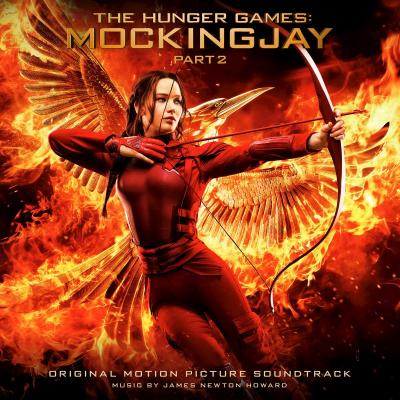
"Hunger Games: Mockingjay - Part 2" Soundtrack Lyrics
Movie • 2015
Track Listing
M83
Twelve Titans Music
CHROMA
Superhuman
Immediate Music
"The Hunger Games: Mockingjay – Part 2 (Original Motion Picture Soundtrack)" – Album Guide to Tracks and Key Scenes
Overview
How do you close a revolution without over-scoring the grief? James Newton Howard’s Mockingjay – Part 2 keeps its grip tight: close-mic’d strings, restrained brass, and long silences that let images breathe. The 19-track album (Republic Records) runs just over an hour and folds the franchise’s identity cues into new, bleaker harmonies. It ends with a nine-minute suite that ties the bow—quietly.
There’s no separate “inspired by” pop compilation for this final chapter; the story stays with score and one end-credits song, “Deep in the Meadow (Lullaby),” performed by Jennifer Lawrence. That choice aligns the film’s last image with its first human promise—family—rather than spectacle (as noted in label and platform listings).

Questions & Answers
- Who composed and released the album?
- James Newton Howard; released by Republic Records in late November 2015.
- Where was it recorded?
- Principal scoring at Abbey Road Studios, London.
- Is there a companion “songs” album like the earlier films?
- No—this installment shipped only the score; no separate various-artists set.
- What plays over the end credits?
- “Deep in the Meadow (Lullaby)”—a new recording featuring Jennifer Lawrence; a Baauer remix was issued separately soon after release.
- Does the Capitol anthem return?
- Yes. “Horn of Plenty” surfaces inside ceremony/crowd material, braided into Howard’s cues.
- What’s the long final track?
- “There Are Worse Games to Play / Deep in the Meadow / The Hunger Games Suite”—a nine-minute farewell medley.
Notes & Trivia
- The album contains 19 cues (~60–73 minutes depending on retailer edition) and no separate “inspired by” release for Part 2.
- Jennifer Lawrence’s “Deep in the Meadow” closes the film; a commercial single and Baauer remix followed within days.
- Track names map directly to key beats: “Sewer Attack,” “Rebels Attack,” “Snow’s Execution,” “Primrose.”
- The finale medley revisits the franchise’s main suite and the lullaby as a single arc.
Genres & Themes
Textural orchestral suspense → breath-close strings and low brass swells; rhythm often implies danger rather than declaring it.
Anthemic propaganda coloration → quotes of the Capitol’s “Horn of Plenty” during pageant and address sequences.
Folk memory → “Deep in the Meadow” reframes victory as survival and parenthood, not conquest.
Tracks & Scenes
Guide: diegetic = heard by characters. Timings vary by edition; placements align with official retailer listings and critical cue logs.
“Prim Visits Peeta” — James Newton Howard
Where it plays: Early reconciliation attempts inside District 13; non-diegetic.
Scene: Quiet, uncertain strings as Prim sits with hijacked Peeta. No “fixing” theme—just room tone and care.
Why it matters: Frames the film’s moral engine: mercy over vengeance.
“Transfer Command” — James Newton Howard
Where it plays: Mission prep and descent toward the Capitol; non-diegetic.
Scene: Pulses tighten; low brass suggests weight without glory. Orders trade hands as the team crosses into the city grid.
Why it matters: Procedure as suspense.
“The Holo” — James Newton Howard
Where it plays: Squad 451 studies the booby-trapped map device; non-diegetic.
Scene: Glassy textures and clipped patterns mirror the device’s cold logic; every block could kill you.
Why it matters: Establishes the arena-without-an-arena idea.
“Sewer Attack” — James Newton Howard
Where it plays: Mutts in the tunnels; non-diegetic.
Scene: Eight minutes of claustrophobia: string clusters, percussive lunges, a brief lull, then crush as bodies hit water and steel.
Why it matters: The franchise’s tensest action cue—visceral but unsentimental.
“Rebels Attack” — James Newton Howard
Where it plays: Street-level push through pods; non-diegetic.
Scene: Brass jabs and treadmill ostinatos; the camera runs on anxiety.
Why it matters: Momentum without triumphalism.
“Snow’s Mansion” — James Newton Howard
Where it plays: Entry toward the final courtyard; non-diegetic.
Scene: Harmonic chill over ornate rooms; the score refuses catharsis before the truth arrives.
Why it matters: Beauty as threat.
“Snow’s Execution” — James Newton Howard
Where it plays: Public reckoning; non-diegetic.
Scene: The cue stays controlled as Katniss alters the script; breath and bow do the talking.
Why it matters: Political clarity rendered as musical restraint.
“Buttercup” / “Primrose” — James Newton Howard
Where they play: Aftermath at home; non-diegetic.
Scene: Small ensemble, open harmony. The cat, the name, the acceptance.
Why it matters: Grief processed, not erased.
End credits
“There Are Worse Games to Play / Deep in the Meadow / The Hunger Games Suite” — James Newton Howard (feat. Jennifer Lawrence)
Where it plays: First and continuing credit blocks; non-diegetic.
Scene: The franchise themes return as a single arc, with the lullaby set into the suite.
Why it matters: A final, human-scale coda.
Music–Story Links
- State vs. citizen: Anthemic flourishes mark pageant; intimate cues cling to faces and choices.
- Procedural tension: Modular tracks (“Transfer Command,” “The Holo”) mirror the pod-by-pod march.
- Lullaby as legacy: The end-credits song shifts the saga’s last word from war to memory.
How It Was Made
Howard recorded with London forces at Abbey Road, keeping the palette consistent with Parts 1–2 while reserving the biggest weight for two set-pieces (“Sewer Attack,” “Rebels Attack”). The album sequence mirrors the operation through the Capitol and then tapers into epilogue cues. According to the album notes and retailer pages, the release includes Jennifer Lawrence’s studio “Deep in the Meadow” plus the closing suite.
Reception & Quotes
Coverage at release called the score “quietly tense, wistful, and explosive” and singled out the sewer sequence as a franchise peak (per album reviews).
“A noble send-off—measured where it counts, gripping when it must.” — film-music press
“Alternately piercing and rousing.” — critic roundups
Additional Info
- Standout cues: “Transfer Command,” “The Holo,” “Sewer Attack,” “Rebels Attack,” “Snow’s Execution,” “Primrose,” closing suite.
- Availability: Digital/streaming across major platforms; standard CD issued via Republic.
- Single: “Deep in the Meadow (Lullaby)” feat. Jennifer Lawrence; Baauer remix issued separately.
- Franchise continuity: Occasional “Horn of Plenty” colors still appear in pageant material.
Technical Info
- Title: The Hunger Games: Mockingjay – Part 2 (Original Motion Picture Soundtrack)
- Year / Type: 2015 / Original score
- Composer & Producer: James Newton Howard
- Recorded: Abbey Road Studios, London
- Label / Date: Republic Records — Nov 23, 2015
- Notable placements in-film: “Sewer Attack”; “Rebels Attack”; “Snow’s Execution”; end-credits “There Are Worse Games to Play / Deep in the Meadow / The Hunger Games Suite”
- End-credits vocal: “Deep in the Meadow” (feat. Jennifer Lawrence)
- Trailer ID (figures): KmYNkasYthg
Canonical Entities & Relations
| Subject | Relation | Object |
|---|---|---|
| James Newton Howard | composed & produced | Mockingjay – Part 2 score album |
| Republic Records | released | Original Motion Picture Soundtrack (2015) |
| Abbey Road Studios | recorded | score sessions |
| Jennifer Lawrence | performed | “Deep in the Meadow (Lullaby)” (end credits) |
| Lionsgate | distributed | Mockingjay – Part 2 (film) |
Sources: Republic/retailer listings; Wikipedia album entry; James Newton Howard’s Bandcamp track list; Apple Music and Spotify album pages; Amazon product notes; press items on Jennifer Lawrence’s “Deep in the Meadow.”
At first, you can think that Jennifer Lawrence, which is starred in the main roles of all series, is a relative to Francis Lawrence, who is director of the last three parts of franchise. Her character has a purring name – Katniss Everdeen and she shows the wonders of endurance, perseverance and physical superiority in this blockbuster, each part of which has collected exciting money. With a total budget for the three previous films of USD 458 million, they grossed over USD 2307 million, covered the spent costs by more than 5 times. The last part hasn’t been released officially yet (it will be 1 day after writing this review), but there are great expectations laid on it – it has the biggest budget among 4 parts, USD 160 million. Excellent, spectacular, monumental film that combines the solidity of durable empire of evil, which is struggling against passionate, fearless, courageous and united with solo aspiration young people, whose storyline develops throughout the 4 films, at least for the 9 main characters. In addition, Jennifer, who became wildly popular thanks to this series of films, starred in X-Men, Serena and several other less notable motion pictures. Along with this, in this part of Hunger Games we see such high-class actors like Donald Sutherland, Woody Harrelson and Julianne Moore (Lenny Kravitz also was, but in 2 first parts). The collection only one melody isn’t instrumental – My Tears Are Becoming A Sea. It certainly is not as popular as the one that is still kept at the height – The Hanging Tree by James Newton Howard (unfortunately, he is no longer involved in writing songs for this film). Superhuman are singers, who made an instrumental melody, very rich and full-bodied (Descendants). Among special melodies, Apocalypse is also notable.November, 10th 2025
Movie profile and Full Cast & Crew on IMDb, more info on WikipediaA-Z Lyrics Universe
Cynthia Erivo Popular
Ariana Grande Horsepower
Post Malone Ain't No Love in Oklahoma
Luke Combs Good Riddance (Time of Your Life)
Green Day Bye Bye Bye
*NSYNC You're the One That I Wan
John Travolta & Olivia Newton-John I Always Wanted a Brother
Braelyn Rankins, Theo Somolu, Kelvin Harrison Jr. and Aaron Pierre The Power of Love
Frankie Goes to Hollywood Beyond
Auli’i Cravalho feat. Rachel House MORE ›