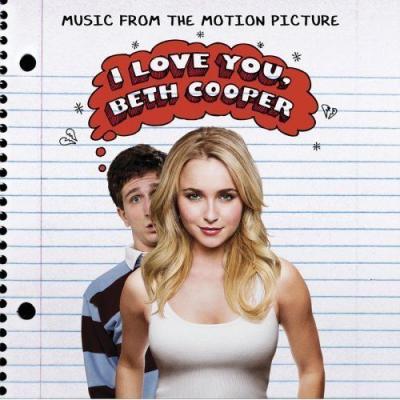
"I Love You Beth Cooper" Soundtrack Lyrics
Movie • 2009
Track Listing
Violet Columbus
The Hives
The Perishers
The Kooks
Christophe Beck
Gym Class Heroes
Airbourne
OK Go
Christophe Beck
Kiss
Smokey Robinson
Christophe Beck
Foreigner
Alice Cooper
Eleni Mandell
"I Know What You Did Last Summer (Soundtrack from the Motion Picture)" – Album Guide to Tracks and Key Scenes
Overview
Can a summer slasher feel like a mixtape of denial? This soundtrack answers with radio-rock confidence — punchy covers, college-rock singles, and one gorgeously haunted trip-hop cue — while John Debney’s orchestral score does the stalking in the shadows. Two commercial releases exist: a various-artists “songs” album on Sony/Columbia and a separate score album of Debney cues.
The songs compilation (Oct 7, 1997) skews alt-rock: Kula Shaker, Type O Negative, The Offspring, L7, Our Lady Peace, Toad the Wet Sprocket. Debney’s score (released on CD in 1997, widely circulated via composer promo/label pressings) supplies the film’s chase architecture — notably the Croaker Queen sequence and boat-deck finale. As a package, the music sells glossy youth invincibility… then undercuts it.

Questions & Answers
- Who composed the score?
- John Debney composed the original score; it won an ASCAP Top Box Office Films award the following year.
- Is there an official songs album?
- Yes. The Sony/Columbia various-artists album (1997) compiles 10 prominent cuts; the film also uses additional songs not on that disc.
- Which label handled the releases?
- The songs compilation came via Sony Music/Columbia. The score circulated on CD in 1997 (commercial and composer-promo pressings documented in discographies).
- Is Hooverphonic’s “2Wicky” actually in the movie?
- Yes — it underscores the Shivers store sequence; it’s not on the standard U.S. retail CD.
- What track opens the film?
- Type O Negative’s cover of “Summer Breeze” plays over the opening credits and coastal shots.
- Does the album include Debney’s chase cues?
- Those are on the separate score album (e.g., “In Pursuit of Helen,” “No Escape for Helen”).
Notes & Trivia
- The songs CD clocks ≈37 minutes (10 tracks); AllMusic lists total runtime ~53:43 when including variants/editions.
- “Hush” (Kula Shaker) is the disc’s marquee single; the film’s marketing leaned on its swaggering intro riff.
- Debney’s cue titles map scenes cleanly — helpful for collectors (“In Pursuit of Helen,” “Hiding the Body”).
- “2Wicky” became a franchise echo: Hooverphonic returns in the 1998 sequel with “Eden.”
- The soundtrack’s rock tilt mirrors the Columbia teen-horror wave that followed Scream.
Genres & Themes
Alt-rock & post-grunge → youthful invincibility: big choruses (“Clumsy,” “Losin’ It”) score late-90s bravado — the mask before guilt.
Gothic cover art → creeping fatalism: Type O Negative’s “Summer Breeze” reframes July 4th glow as doom, right from the credits.
Trip-hop minimalism → urban-night fear: Hooverphonic’s “2Wicky” turns aisles and plate glass into a slow-motion panic room.
Orchestral suspense → consequence: Debney’s brass and string runs are the film’s moral undertow; the hook lands when guitars fall away.
Tracks & Scenes
“Summer Breeze” — Type O Negative
Where it plays: Opening credits and coastal prologue (non-diegetic).
Why it matters: A soft-rock staple turned foreboding dirge; the lyric “blowin’ through the jasmine in my mind” becomes a warning that summer’s warmth is a lie.
“Hush” — Kula Shaker
Where it plays: Prominent in marketing; used to juice early montage energy and end-title rotation (non-diegetic).
Why it matters: Handclaps and Hammond organ swagger signal teen-movie cool — right before the film wipes that smile off.
“2Wicky” — Hooverphonic
Where it plays: Helen reaches the Shivers store; aisles, keys, locked doors; the sequence with Elsa behind the glass (diegetic ambience shifting to non-diegetic mood bed).
Why it matters: The whisper-low groove slows time as the geography traps Helen; the beat seems to count down.
“D.U.I.” — The Offspring
Where it plays: Party-adjacent beats and rowdy intercuts (non-diegetic).
Why it matters: Ironic needle-drop — drunk bravado woven into a film about one very bad drive.
“This Ain’t the Summer of Love” — L7
Where it plays: Harder-edged transitions around post-pageant fallout (non-diegetic).
Why it matters: Title as thesis; the American summer pageant turns into a manhunt.
“Clumsy” — Our Lady Peace
Where it plays: Melancholy connective tissue for Julie’s guilt and distance (non-diegetic).
Why it matters: Alt-rock ache that humanizes the quartet after the bravado burns off.
“My Baby’s Got the Strangest Ways” — Southern Culture on the Skids
Where it plays: Small-town texture cues — diners, porches, daylight normalcy (source/background).
Why it matters: A sly wink at the film’s Southern-coastal setting before the storm.
Score cues — John Debney
Where they play: “In Pursuit of Helen,” “No Escape for Helen” (parade alley chase); “Hiding the Body” (dockside pact); “Julie Discovers the Truth” (board-to-boat reveal) — all non-diegetic.
Why they matter: Brass stabs and string ostinatos deliver the film’s real scares; editing rides the music’s breath between shock beats.
Also heard in-film (not always on the U.S. retail CD): Adam Cohen’s “Don’t Mean Anything” (car radio sing-along mood), The Mighty Mighty Bosstones’ “Wake Up Call,” Lead Belly’s “Where Did You Sleep Last Night,” and period standards used as pageant/parade source.
Music–Story Links
Bright songs paper over guilt: July 4th pageants, beach parties, romance talk. As the letters and bodies appear, the needle-drops thin out and Debney’s orchestra takes over. The swap is thematic: public performance (songs you know) to private consequence (strings you feel). “2Wicky” sits exactly on that hinge — a pop track used like score to turn a store into a mausoleum.
How It Was Made
Debney’s sessions aimed big and orchestral for a teen slasher — fewer synth stings, more symphonic muscle. The music editorial strategy is blunt on purpose: familiar alt-rock to sell “normal summer,” then an aggressive hand-off to score that corrals the chases. The songs album arrived via Sony/Columbia (10 cuts), while the score appeared on CD the same year; collectors note a composer-promo pressing alongside commercial editions.
Reception & Quotes
The movie split critics, but the opening credits song choice and the Croaker Queen chase — powered by Debney — are still cited as high-craft set-pieces.
“A whopper of a horror score — muscular orchestration that actually drives the edit.” Filmtracks review
“Type O Negative turning ‘Summer Breeze’ into a funeral march is the perfect mission statement.” Contemporary coverage
“When the movie stops grinning and lets the score breathe, it works.” Album/film retrospectives
Additional Info
- The franchise returned in 2025 with a legacy sequel; the 1997 music choices are referenced and echoed.
- Retail song tracklists vary by territory/pressing; some cues heard on screen aren’t on the U.S. CD.
- A vinyl reissue of the songs album arrived years later, riding late-90s nostalgia.
- Debney’s cue names are reliable scene signposts for collectors and editors studying sequence design.
- Hooverphonic’s placement bridges diegetic ambience and non-diegetic dread — a template many slashers copied afterward.
Technical Info
- Title: I Know What You Did Last Summer (Soundtrack from the Motion Picture)
- Year: 1997
- Type: Feature film soundtrack (Various Artists) + separate Original Score (John Debney)
- Label(s): Sony Music/Columbia (songs album); 1997 score CD release documented in soundtrack discographies
- Key songs on retail CD: “Hush,” “Summer Breeze,” “D.U.I.,” “This Ain’t the Summer of Love,” “Clumsy,” “Hey Bulldog,” “My Baby’s Got the Strangest Ways,” “Waterfall,” “Losin’ It,” “Kid.”
- Notable in-film songs beyond CD: “2Wicky” (Hooverphonic), “Don’t Mean Anything” (Adam Cohen), “Wake Up Call” (The Mighty Mighty Bosstones), traditional/pageant sources.
- Composer: John Debney (score)
- Film: Directed by Jim Gillespie; distributed by Columbia Pictures (1997)
Canonical Entities & Relations
| Subject | Relation | Object |
|---|---|---|
| I Know What You Did Last Summer (film, 1997) | directed by | Jim Gillespie |
| I Know What You Did Last Summer (film, 1997) | music by | John Debney |
| I Know What You Did Last Summer (Soundtrack from the Motion Picture) | released by | Sony Music / Columbia |
| John Debney | composed | I Know What You Did Last Summer (Original Motion Picture Score) |
| Kula Shaker | performed | “Hush” |
| Type O Negative | performed | “Summer Breeze” (cover) |
| Hooverphonic | performed | “2Wicky” |
| Our Lady Peace | performed | “Clumsy” |
Sources: AllMusic (album runtime & date); Apple Music (retail song lineup); SoundtrackCollector / MovieMusic & SoundtrackInfo (score track list, label/catalog; scene song Q&A); Wikipedia (film & music overview); Filmtracks (score commentary); YouTube trailer (Video ID).
November, 11th 2025
'I Love You, Beth Cooper': read user reviews on Rotten Tomatoes and IMDbA-Z Lyrics Universe
Cynthia Erivo Popular
Ariana Grande Horsepower
Post Malone Ain't No Love in Oklahoma
Luke Combs Good Riddance (Time of Your Life)
Green Day Bye Bye Bye
*NSYNC You're the One That I Wan
John Travolta & Olivia Newton-John I Always Wanted a Brother
Braelyn Rankins, Theo Somolu, Kelvin Harrison Jr. and Aaron Pierre The Power of Love
Frankie Goes to Hollywood Beyond
Auli’i Cravalho feat. Rachel House MORE ›