Soundtracks:  A B C D E F G H I J K L M N O P Q R S T U V W X Y Z #


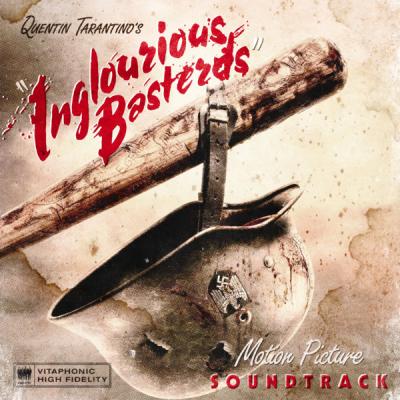
Inglourious Basterds Album Cover

"Inglourious Basterds" Soundtrack Lyrics

Movie • 2009

Track Listing


"Quentin Tarantino’s Inglourious Basterds: Motion Picture Soundtrack" – Album Guide to Tracks and Key Scenes

Inglourious Basterds official trailer still: Shosanna’s red dress and marquee lights foreshadowing a climactic needle-drop
Spaghetti-western swagger, cabaret ghosts, and one immortal Bowie cue.

Overview

How do you score an alternate-history WWII film without writing a “score”? Tarantino raids cinema’s record bins. The album stitches together Ennio Morricone revenge arias, Lalo Schifrin action stabs, Jacques Loussier tension cues, 1930s German schlager, and David Bowie’s “Cat People (Putting Out Fire).” It plays like a radio from another timeline—stylized, anachronistic, and surgically right.

Released August 18, 2009, the 14-track set runs 37:14 on Warner/Reprise in partnership with A Band Apart/Maverick; it earned a Grammy nomination for Best Compilation Soundtrack. Music supervision is by Mary Ramos, whose long collaboration with Tarantino anchors the curation (as profiled in Variety). The album omits dialogue snippets—unusual for Tarantino—and foregrounds film-to-film quotations: Morricone and Ferrio from Italian westerns, Bernstein from 1970s thrillers, Zarah Leander from UFA cabaret. According to the official track notes and credits, several pieces originate in earlier films, then are repurposed here for ironic or explosive effect.

Trailer frame: Chapter title card energy—bold fonts over big Morricone brass
Not a score album—an edit suite of cinema history.

Questions & Answers

Who supervised and produced the soundtrack album?
Music Supervisor: Mary Ramos. Soundtrack producers: Lawrence Bender, Pilar Savone, Holly Adams.
Which labels released it and when?
Warner/Reprise with A Band Apart/Maverick; street date August 18, 2009. Digital and CD editions followed regional schedules.
Is there original scoring written for the film?
No traditional commissioned score is credited; Tarantino deploys pre-existing recordings (largely Morricone et al.) as needle-drops.
Why use Bowie’s “Cat People” in a 1944 setting?
It’s deliberate anachronism for dramatic charge; Tarantino has said the lyric matches Shosanna’s arc with uncanny accuracy.
Did the album get awards attention?
Yes—nominated for the Grammy for Best Compilation Soundtrack. Reviews (e.g., Pitchfork) singled out the B-movie cue archaeology.
Are all film-used tracks on the retail album?
No. Several cues heard in the film (e.g., additional Morricone, Loussier) are documented but not on the 14-track disc.

Notes & Trivia

  • First Tarantino soundtrack without dialogue snippets between tracks.
  • “The Man with the Big Sombrero” was specially re-recorded in French for this film (voice: Samantha Shelton).
  • Opening credit song “The Green Leaves of Summer” is Nick Perito’s version of the Tiomkin/Webster theme from The Alamo (1960).
  • Album credits list three labels: A Band Apart, Maverick, and Warner Bros./Reprise; Apple Music credits Warner Records/L Driver Productions.
  • Rhino reissued the soundtrack on vinyl as part of a Tarantino catalog campaign.

Genres & Themes

Spaghetti-western cues → duel ethics. Morricone and Ferrio paint scenes as face-offs: patience, stare-downs, ritual violence.

Schlager & cabaret → ideological theater. Zarah Leander and 1930s film songs sell the propaganda bubble as seductive surface.

’70s funk/rock & action cues → pulp voltage. Billy Preston’s “Slaughter,” Bernstein’s White Lightning and Schifrin’s “Tiger Tank” juice the set-pieces.

Trailer collage: La Louisiane tavern, nitrate film canisters, and a close-up on eyes—music toggles menace and myth
Menace, myth, and the needle-drop that lights the fuse.

Tracks & Scenes

Representative cues with placements; time marks vary by cut. Where clear, diegetic status is noted. Cross-checked with album credits, IMDb listings, and scene guides.

“The Green Leaves of Summer” — Nick Perito & His Orchestra
Where it plays: Opening credits roll over Chapter 1 (non-diegetic).
Why it matters: A romantic Western overture that frames occupied France like frontier myth.

“The Verdict (La condanna)” — Ennio Morricone
Where it plays: Early cat-and-mouse tension cue underscoring standoffs (non-diegetic).
Why it matters: Courtroom gravity repurposed as moral pressure cooker.

“Un Amico” — Ennio Morricone
Where it plays: Shosanna’s climactic confrontation with Zoller in the projection booth (non-diegetic).
Why it matters: Strings tighten like a noose; compassion and resolve clash in one cue.

“Cat People (Putting Out Fire)” — David Bowie
Where it plays: Preparation montage before the premiere—Shosanna suits up; flashbacks of the plan (non-diegetic).
Why it matters: Anachronism by design: lyric and drum thud fuse identity, rage, and intent.

“Slaughter” — Billy Preston
Where it plays: Hype-charge for a late action beat (non-diegetic).
Why it matters: Blaxploitation brass reframes Nazis as pulp villains fit for dispatch.

“White Lightning (Main Title)” — Charles Bernstein
Where it plays: Transitional grit around Basterd operations (non-diegetic).
Why it matters: Southern-fried tension gives the guerrilla beats grim swagger.

“Tiger Tank” — Lalo Schifrin
Where it plays: Militarized build before the finale (non-diegetic).
Why it matters: Percussive economy; the floor drops an inch with every hit.

“Davon geht die Welt nicht unter” — Zarah Leander
Where it plays: Diegetic period source near propaganda spaces (diegetic).
Why it matters: A perfectly poised smile over a collapsing world.

“Ich wollt’ ich wär’ ein Huhn” — Lilian Harvey & Willy Fritsch
Where it plays: Vintage on-screen source—radio/gramophone ambiance (diegetic).
Why it matters: Feather-light irony in a film obsessed with performance.

“The Man with the Big Sombrero (French version)” — Samantha Shelton & Michael Andrew
Where it plays: On-screen performance inside the cinema program (diegetic, in-universe recording).
Why it matters: A 1943 novelty song re-imagined to mirror the film’s masquerades.

“Rabbia e Tarantella” — Ennio Morricone
Where it plays: End titles (non-diegetic).
Why it matters: Triumphal sting with a wink—the victory is pure cinema.

Also heard in-film but not on the retail album: additional Morricone (“L’incontro Con La Figlia,” “Il Mercenario (ripresa)”), Loussier’s “Claire’s First Appearance/The Fight,” Lavagnino’s “Titoli” (as the opening of the film-within-the-film, Nation’s Pride), and more.

Music–Story Links

Western cues make every room a duel: farmhouse, tavern, box seats. Schlager and cabaret mark the propaganda bubble—pretty melodies as armor. When Bowie lands, the anachronism signals authorship: Shosanna writes the ending. The album’s last Morricone blast closes the book like a gunslinger’s flourish.

Trailer close-up: nitrate reels and a match; Bowie’s drum thud as metronome
A match, nitrate film, and a chorus you can’t put back.

How It Was Made

Tarantino and Mary Ramos pulled cues from earlier films (Morricone, Ferrio, Bernstein, Schifrin, Loussier) and period songs (Leander; Harvey/Fritsch). “The Man with the Big Sombrero” was re-cut in French for an in-universe performance. The album sequencing favors cinematic lineage over chronology. Rhino/Warner later spotlighted the title in a reissue campaign with Tarantino and Ramos in conversation about the choices.

Reception & Quotes

Contemporary reviews praised the mix-tape methodology and the audacity of the Bowie needle-drop; the album drew a Grammy nod.

“A spaghetti-western brain in a WWII body; the cues are cinephile punchlines that land.” Pitchfork review
“You’re shocked how well the ‘Cat People’ lyrics fit her story.” director remarks via coverage
“The music turns the climax into an interior monologue and a torch song.” essay coverage

Additional Info

  • Album: 14 tracks, 37:14; released Aug 18, 2009.
  • Labels/credits: A Band Apart, Maverick, Warner Bros./Reprise; Producers: Bender, Savone, Adams.
  • Grammy nomination: Best Compilation Soundtrack.
  • Reissues: Rhino/Warner campaign featured a Tarantino–Ramos conversation.
  • Not on album: multiple additional Morricone/Loussier cues documented in credits.

Technical Info

  • Title: Quentin Tarantino’s Inglourious Basterds: Motion Picture Soundtrack
  • Year: 2009
  • Type: Curated soundtrack (no commissioned score)
  • Music Supervisor: Mary Ramos
  • Producers (album): Lawrence Bender; Pilar Savone; Holly Adams
  • Labels: Warner Bros./Reprise with A Band Apart & Maverick
  • Awards: Grammy nominee (Compilation Soundtrack)
  • Selected placements: “The Green Leaves of Summer” (main titles); “Un Amico” (projection-booth showdown); “Cat People” (premiere prep); “Rabbia e Tarantella” (end titles); “Slaughter,” “White Lightning,” “Tiger Tank” (action beats); German schlager pieces as diegetic source.

Canonical Entities & Relations

SubjectRelationObject
Inglourious Basterds (film, 2009)directed byQuentin Tarantino
Quentin Tarantino’s Inglourious Basterds: Motion Picture Soundtrackrecord labelWarner Bros./Reprise; A Band Apart; Maverick
Mary Ramosmusic supervisedInglourious Basterds (film)
Ennio Morriconemusic featured“The Verdict,” “Un Amico,” “Rabbia e Tarantella,” etc. (from earlier films)
Lalo Schifrinmusic featured“Tiger Tank” (from Kelly’s Heroes)
Charles Bernsteinmusic featured“White Lightning (Main Title)”
Zarah Leanderperforms“Davon geht die Welt nicht unter”
Lilian Harvey & Willy Fritschperform“Ich wollt’ ich wär’ ein Huhn”
David Bowieperforms“Cat People (Putting Out Fire)”
Samantha Shelton & Michael Andrewperform“The Man with the Big Sombrero” (French version)
Lawrence Bender; Pilar Savone; Holly Adamsproducedsoundtrack album

Sources: Wikipedia album page (track list, labels, Grammy); Apple Music listing; Discogs release credits; Variety interview with Mary Ramos; Pitchfork review; GQ Cannes report on “Cat People”; The New Yorker commentary on the Bowie cue; ScreenRant scene-by-scene list; IMDb soundtrack credits.

November, 11th 2025


A-Z Lyrics Universe

Lyrics / song texts are property and copyright of their owners and provided for educational purposes only.