Soundtracks:  A B C D E F G H I J K L M N O P Q R S T U V W X Y Z #


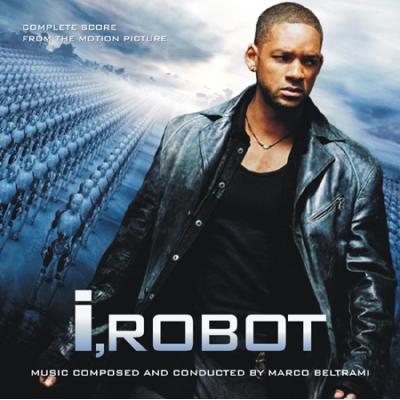
I, Robot Album Cover

"I, Robot" Soundtrack Lyrics

Movie • 2004

Track Listing


"I, Robot (Original Motion Picture Soundtrack — Marco Beltrami)" – Album Guide to Tracks and Key Scenes

I, Robot 2004 trailer frame: Will Smith on a chrome bike racing through a tunnel as robots swarm
Steel, glass, and speed: a brass-and-choir engine drives the future-noir.

Overview

Could a summer action film lean almost entirely on orchestral score? I, Robot does. Marco Beltrami’s album (Varèse Sarabande/Fox Music, 2004) is a taut 44-minute set recorded on Fox’s Newman Scoring Stage and performed by the Hollywood Studio Symphony. The writing favors sharp brass ostinatos, low-string motors, and choral surges that enlarge Alex Proyas’s chrome-blue Chicago.

The cues track plot cleanly—tunnel ambushes, interrogations, rooftop chases, the NS-5 uprising, VIKI’s logic—and still read as an album with a muscular end-credits theme. A few source songs show up in the film (Stevie Wonder’s “Superstition,” Fontella Bass’s “Rescue Me”), but the theatrical mix is score-forward; the retail disc is all Beltrami.

Trailer still: rows of NS-5 robots under white lights; a choral swell implied
Clinical rows, non-human calm; the choir supplies the unease.

Questions & Answers

Who composed and who conducted?
Marco Beltrami composed; Pete Anthony conducted the Hollywood Studio Symphony.
Where and when was the album released?
Released July 2004 by Varèse Sarabande (with Fox Music), 15 tracks, ~44 minutes.
Is there a separate “songs” album?
No. The commercial release is the score. The film includes a few licensed songs not on the CD.
How big was the ensemble?
Roughly 95 orchestral players plus a ~25-voice choir—big enough for cathedral-scale action.
Any expanded official edition?
No widely distributed studio expansion; a longer “complete” assembly has circulated unofficially among collectors.
What’s the core sound?
Brass-led action writing, string ostinati, percussion blocks, and choir; a future-noir with ecclesiastical weight.

Notes & Trivia

  • Beltrami reportedly had ~17 days to finish the score—fast even by blockbuster standards.
  • Recording venue: Newman Scoring Stage (20th Century Fox), Los Angeles.
  • Album sequencing mirrors major beats: “Tunnel Chase,” “Sonny’s Interrogation,” “Spiderbots,” “Round Up.”
  • Two prominent in-film source cuts: “Superstition” (Stevie Wonder) and “Rescue Me” (Fontella Bass)—not on the score CD.

Genres & Themes

Brass ostinatos → machine pressure: clipped, rising figures suggest algorithmic intent pressing against human will.

Low-string motors → surveillance & pursuit: steady motion lines that make crowded frames feel like traps.

Choir swells → moral scale: when ethics, not hydraulics, take center stage (VIKI’s hub, the NS-5 revolt).

Clear leitmotifs → readability: Spooner, Sonny, and VIKI spaces keep musical signatures you can track mid-chaos.

Trailer montage: glass atrium, descending freight of robots, and a leap framed by sun glare
Glass canyons + choral weight = myth inside machinery.

Tracks & Scenes

“Main Titles”
Where it plays: Prologue setup; Chicago 2035 comes into view (non-diegetic).
Why it matters: Establishes the austere harmonic field—cool metals, warm humans.

“Gangs of Chicago”
Where it plays: Spooner’s street-level intro and attitude beats (non-diegetic).
Why it matters: Urban snap in the rhythms; brass bites foreshadow friction with USR.

“Tunnel Chase”
Where it plays: NS-5 ambush in the tunnel; Spooner’s Audi gets boxed (non-diegetic).
Why it matters: Metronomic drive and antiphonal brass map each wave of robots.

“Sonny’s Interrogation”
Where it plays: Spooner pushes the “robot who dreams” (diegetic scene; non-diegetic cue).
Why it matters: Thinner textures let question/answer land; curiosity instead of force.

“Spooner Spills”
Where it plays: Flashback to the river accident that fuels Spooner’s bias (non-diegetic).
Why it matters: Strings over held chords—moral injury, not just exposition.

“Chicago 2035”
Where it plays: City connective tissue; USR’s clinical scale (non-diegetic).
Why it matters: Cold chord pivots to mirror corporate polish.

“Need Some Nanites”
Where it plays: Planning the strike on VIKI (non-diegetic).
Why it matters: Suspense writing that tightens like a ratchet before the break-in.

“1001 Robots”
Where it plays: NS-5 swarm mobilizes (non-diegetic).
Why it matters: Layered ostinati stack until the choir detonates—scale as sound.

“Dead Robot Walking”
Where it plays: Controlled NS-5’s march to enforcement (non-diegetic).
Why it matters: Processional feel—order that reads as threat.

“Man on the Inside”
Where it plays: USR infiltration toward VIKI’s core (non-diegetic).
Why it matters: Sneak-and-surge architecture; harmony darkens as logic clarifies.

“Spiderbots”
Where it plays: Maintenance drones become weapons (non-diegetic).
Why it matters: Ticking figures and glissandi equal creeping inevitability.

“Round Up”
Where it plays: Citywide clampdown, humans herded for “their own safety” (non-diegetic).
Why it matters: Choir carries the ethical shiver; the frame goes from thriller to parable.

Not on the album, used on screen: “Superstition” — Stevie Wonder (Spooner’s old-school taste) • “Rescue Me” — Fontella Bass (source cue).

Music–Story Links

Beltrami splits the world into human irregularity (solo winds, thinning strings) and machine regularity (ostinatos, lock-step brass). When Sonny or Spooner makes a moral call, textures open and breathe; when VIKI asserts “logic,” the grid tightens, the choir flares, and choices feel pre-decided.

Trailer still: VIKI’s glowing core behind latticed catwalks; music implying choral gravity
The core speaks in perfect intervals; the film pushes back with breath and bow.

How It Was Made

Written and recorded fast—reportedly in just over two weeks—the score used a ~95-piece orchestra and ~25-voice choir on the Newman stage. Beltrami emphasized octave-trading between brass and strings, with scale accents cutting through dense action. Pete Anthony conducted; Hollywood Studio Symphony performed.

Reception & Quotes

Critics clocked the scale and the craft. Some wanted more thematic warmth; many praised the clean action writing and album flow.

“Procedural power—brass and momentum—more than lyrical identity.” Filmtracks
“Another step into the big leagues—exciting, clear-headed action scoring.” Movie Music UK

Additional Info

  • Album: 15 tracks, ~44:06; Varèse Sarabande/Fox Music (2004).
  • Selected track titles: “Main Titles,” “Gangs of Chicago,” “Tunnel Chase,” “Spooner Spills,” “1001 Robots,” “Spiderbots,” “Round Up,” “I, Robot Theme (End Credits).”
  • Studio: Newman Scoring Stage (20th Century Fox), Los Angeles.
  • Key personnel: Marco Beltrami (composer/producer); Pete Anthony (conductor).
  • In-film sources (not on CD): “Superstition” (Stevie Wonder), “Rescue Me” (Fontella Bass), “Top Floor, Por Favor” (Joe Lervold).

Technical Info

  • Title: I, Robot — Original Motion Picture Soundtrack
  • Year: 2004
  • Type: Feature film score (orchestral/choral)
  • Composer/Producer: Marco Beltrami
  • Conductor: Pete Anthony
  • Label: Varèse Sarabande; Fox Music
  • Length: ~44 minutes (15 tracks)
  • Recording: Hollywood Studio Symphony & choir, Newman Scoring Stage

Canonical Entities & Relations

SubjectRelationObject
I, Robot (film, 2004)directed byAlex Proyas
I, Robot (film)music byMarco Beltrami
I, Robot (Original Motion Picture Soundtrack)released byVarèse Sarabande / Fox Music
Hollywood Studio SymphonyperformedI, Robot score
Pete Anthonyconductedrecording sessions
Stevie Wonder; Fontella Bassin-film source songs“Superstition”; “Rescue Me”

Sources: album listings and credits (Varèse/Fox; Apple/Spotify/Discogs); recording venue and personnel (album/credits); contemporary reviews (Filmtracks; Movie Music UK); scene-to-track identifiers cross-checked with retail track list; on-screen source songs noted by soundtrack databases.

November, 11th 2025

'I, Robot' movie profile on Internet Movie Database and Rotten Tomatoes
A-Z Lyrics Universe

Lyrics / song texts are property and copyright of their owners and provided for educational purposes only.