
"James and the Giant Peach" Soundtrack Lyrics
Cartoon • 2002
Track Listing
Randy Newman
Randy Newman
"James and the Giant Peach (An Original Walt Disney Records Soundtrack) — 2002 Digital Edition" – Album Guide to Tracks and Key Scenes
Overview
How do you score a stop-motion odyssey so that songs feel like story beats, not interludes? Randy Newman threads brief character numbers (“My Name Is James,” “That’s the Life,” “Family”) into a largely orchestral score that punches action—the roll to the sea, the seagull air-lift, the New York landing—without losing the fairy-tale lilt.
The core album first appeared in 1996 (23 tracks, Walt Disney Records) and circulates widely as a 2002 digital edition. According to Apple Music, the program runs ~55 minutes with cast vocals by Paul Terry and the insect ensemble; Discogs confirms Newman’s orchestration team (Chris Boardman, Don Davis, Steve Bramson) and Chris Montan’s executive production for the album.

Questions & Answers
- Is the 2002 edition a new recording?
- No. It’s the 1996 soundtrack program in a later digital issue; content and sequencing match the original release.
- How many original songs are in the film?
- Five principal songs (“My Name Is James,” “That’s the Life,” “Eating the Peach,” “Family,” and end-credits “Good News”), supported by score cues.
- Who sings on the album?
- Paul Terry (James) and the insect cast (Susan Sarandon, Jane Leeves, Richard Dreyfuss, Miriam Margolyes, David Thewlis, Jeff Bennett), with Newman’s orchestra.
- Did any non-Newman pieces appear in the film?
- Yes—brief source/classical excerpts (e.g., Bach’s “Gavotte en Rondeau”) appear alongside the original score.
- Was the score recognized during awards season?
- Yes—Newman’s work received an Academy Award nomination (Original Musical or Comedy Score) for the 1996 release.
- Are there region variations?
- Japan/EU listings sometimes note local imprint differences; the track roster aligns with the U.S. Walt Disney Records program.
Notes & Trivia
- “Eating the Peach” reportedly adapts Roald Dahl’s playful food rhymes into Newman’s melody.
- End credits roll under “Good News,” a buoyant summation after the Empire State climax.
- Orchestration bench: Chris Boardman, Don Davis, and Steve Bramson, frequent Newman collaborators of the era.
- Select digital listings carry a ℗ 2002 line; others retain the original 1996 imprint.
- Bach’s “Gavotte en Rondeau” and Noel Coward’s “Sail Away” appear as brief source cues in listings.
Genres & Themes
Story-songs (music hall/vaudeville DNA) → character exposition that moves plot (“My Name Is James,” “That’s the Life”).
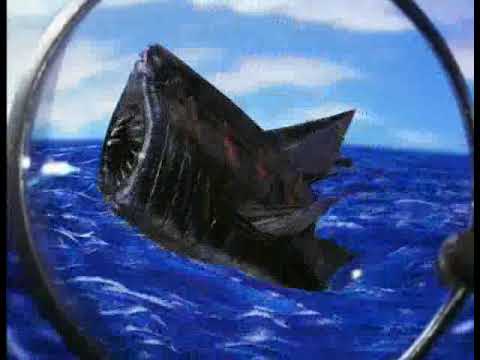
Lyrical adventure score → maritime sway, airborne fanfares, and comic stingers for the shark and the rhino.
Ensemble chorales → chosen-family motif (“Family”) anchors the crew’s bond.
Tracks & Scenes
“My Name Is James” — Paul Terry
Where it plays: Early first act (~00:07). James introduces himself and conjures a far-off city, simple melody over small ensemble (diegetic-feeling solo).
Why it matters: Establishes James’s POV and longing in under three minutes; the tune becomes his quiet inner meter.
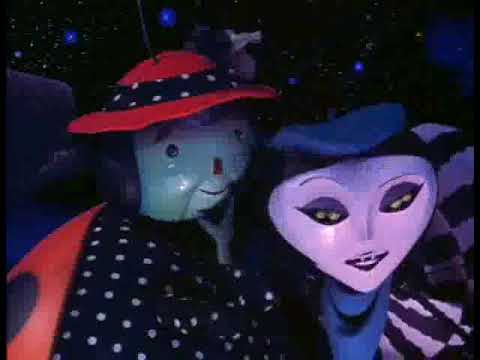
“That’s the Life” — Insect Ensemble
Where it plays: First act aboard/inside the peach (~00:25). The bugs banter-sing about the bright lights and big city; later returns as a reprise at sea (diegetic within the group).
Why it matters: Comic aspiration song that foreshadows New York and bonds the crew through shared fantasy.
“Eating the Peach” — Ensemble
Where it plays: Mid-voyage (~00:33). A call-and-response catalogue of flavors as they realize the peach itself is food and water (diegetic).
Why it matters: Survival reframed as celebration; the lyric imagery turns resource management into joy.
“Family” — Ensemble & James
Where it plays: Mid-late (~00:45). After James explains the aunts and the rhino, the bugs close ranks around him (non-diegetic to montage feel, sung on screen).
Why it matters: The emotional hinge: strangers become a household; the film’s clearest statement of found-family.
“All At Sea / That’s the Life (Reprise)” — Orchestra & Ensemble
Where it plays: During the calm before the shark attack (~00:50). The reprise peeks through wave-music (mixed diegetic/non-diegetic).
Why it matters: Motif-as-compass—hope persists even as stakes rise.
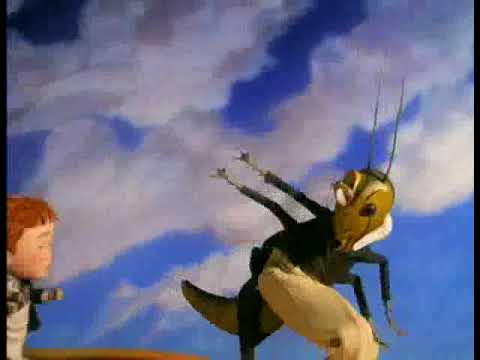
“100 Seagulls and One Shark” — Score cue
Where it plays: Set-piece action (~00:55). The gull-lasso plan and shark pursuit (non-diegetic).
Why it matters: Rhythmic ostinatos sell physics and peril in stop-motion scale.
“Good News” — Randy Newman
Where it plays: End credits (~01:17). Newspaper headlines trumpet the Central Park peach and James’s new life (non-diegetic).
Why it matters: A curtain-call epilogue; the album’s clean capstone.
Also heard (album instrumentals tied to key beats): “Main Title,” “Into the Peach,” “James Makes Some Friends,” “The Peach Rolls,” “Lullaby” (quiet interlude before New York), “Giant Peach.”
Music–Story Links
- Identity motif: James’s simple solo number prefaces every brave choice; later cues echo its contour.
- Team cohesion: Group songs happen at decisions (sail, eat, persevere), not afterthoughts—music is the plan.
- Tone management: Up-tempo catalogues (“Eating the Peach”) soften darker lore (rhino, aunts) without erasing stakes.
How It Was Made
Composer/lyricist: Randy Newman. Orchestrations: Chris Boardman, Don Davis, Steve Bramson. Executive album production: Chris Montan. Newman threads compact songs into a classic adventure score; region releases document the same 23-track program. According to Wikipedia’s production history, Henry Selick considered other songwriters (e.g., Elvis Costello; early contributions by Andy Partridge) before Disney steered the project to Newman, aligning with the studio’s mid-90s scoring strategy.
Reception & Quotes
Contemporary reviews split on the songs while praising the craft; the score earned an Oscar nomination.
“The songs and music have the inimitable signature of Randy Newman.” Time Out
“A terrible Randy Newman song about love and families but a wonderful Randy Newman song about food.” The New Yorker
Additional Info
- Album: 23 tracks; ~55 minutes; Walt Disney Records (1996); widely available as a 2002 digital issue.
- Cast vocals include Susan Sarandon, Jane Leeves, Richard Dreyfuss, Miriam Margolyes, David Thewlis, Jeff Bennett, and Paul Terry.
- Instrumental cues map set-pieces: roll-to-sea, gull air-lift, New York landing.
- Some listings show Bach’s “Gavotte en Rondeau” and Noel Coward’s “Sail Away” among ancillary cues.
- Japanese/EU pressings mirror the U.S. track order; catalog metadata may vary by distributor.
Technical Info
- Title: James and the Giant Peach (An Original Walt Disney Records Soundtrack)
- Year / Type: 1996 film soundtrack; 2002 digital edition noted in some listings
- Composer / Lyricist: Randy Newman
- Album production: Executive producer Chris Montan; orchestrations by Chris Boardman, Don Davis, Steve Bramson
- Label: Walt Disney Records
- Key songs: “My Name Is James”; “That’s the Life” (+ reprise); “Eating the Peach”; “Family”; “Good News” (end credits)
- Notable cues: “Into the Peach”; “The Peach Rolls”; “100 Seagulls and One Shark”; “Lullaby”; “Giant Peach”
- Availability: Streaming on major platforms; CD and regional variants documented.
Canonical Entities & Relations
| Subject | Relation | Object |
|---|---|---|
| Randy Newman | composed & wrote songs for | James and the Giant Peach (1996 film) |
| Chris Montan | executive-produced | Original soundtrack album |
| Chris Boardman / Don Davis / Steve Bramson | orchestrated | Score cues |
| Paul Terry | performed | “My Name Is James” |
| Insect ensemble cast | performed | “That’s the Life,” “Eating the Peach,” “Family” |
| Walt Disney Records | released | 1996 album (later digital editions) |
| Henry Selick | directed | Feature film |
Sources: Apple Music album page; Discogs album credits; Wikipedia (film & production notes); Disney/Tim Burton/Roald Dahl Wikis (song pages); Time Out review; The New Yorker review; IMDb Soundtracks.
November, 12th 2025
A-Z Lyrics Universe
Cynthia Erivo Popular
Ariana Grande Horsepower
Post Malone Ain't No Love in Oklahoma
Luke Combs Good Riddance (Time of Your Life)
Green Day Bye Bye Bye
*NSYNC You're the One That I Wan
John Travolta & Olivia Newton-John I Always Wanted a Brother
Braelyn Rankins, Theo Somolu, Kelvin Harrison Jr. and Aaron Pierre The Power of Love
Frankie Goes to Hollywood Beyond
Auli’i Cravalho feat. Rachel House MORE ›