
"Jarhead" Soundtrack Lyrics
Movie • 2005
Track Listing
Thomas Newman
Thomas Newman
Thomas Newman
Bobby McFerrin
Thomas Newman
Thomas Newman
Thomas Newman
Thomas Newman
Thomas Newman
T-Rex
Thomas Newman
Thomas Newman
Thomas Newman
Thomas Newman
Thomas Newman
Thomas Newman
Naughty by Nature
Thomas Newman
Thomas Newman
Thomas Newman
Thomas Newman
Thomas Newman
Public Enemy
Tom Waits
Nirvana
Kanye West
The Doors
Richard Wagner
"Jarhead (Original Motion Picture Soundtrack)" – Album Guide to Tracks and Key Scenes
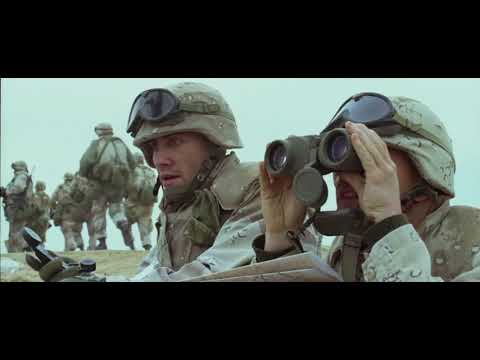
Overview
How do you score a war film where almost no shots are fired? Jarhead (2005) answers with Thomas Newman’s spare, sand-dry motifs punctured by brutally era-specific hip-hop and alt-rock. The result is a soundtrack that captures boredom, bravado, and the surreal poetry of oil-black skies.
Newman’s cues (“Welcome to the Suck,” “Raining Oil”) move like heat shimmer—short, percussive ideas that leave space for the landscape. Licensed cuts—Nirvana’s “Something in the Way,” Naughty by Nature’s “O.P.P.,” Public Enemy’s “Fight the Power,” C+C Music Factory’s “Gonna Make You Sweat,” T. Rex’s “Bang a Gong (Get It On),” The Doors’ “Break On Through”—arrive as lived-in textures of 1990–91 Marine life. As reported in industry coverage at the time, music supervisor Randall Poster leaned into tracks that Marines actually blasted, even when those picks exposed ironic timeline quirks.

Questions & Answers
- Is the album mostly score or songs?
- Mostly Thomas Newman’s score; a handful of needle-drops are in the film but not on the original CD/download album.
- Why does the music feel “small” against huge images?
- Newman writes tight, motif-driven cues that underline isolation and waiting, letting the desert and oil fires do the heavy lifting.
- What’s the Nirvana track during the nightmare?
- “Something in the Way” underscores Swofford’s sand-vomit dream, a subdued, interior break from military noise.
- Which cues are most associated with the war’s visuals?
- “Raining Oil” and “Desert Storm”: metallic percussion, low pulses, and tremolo textures that mirror burning well imagery.
- Did the film use anachronistic songs?
- Yes—“O.P.P.” plays at a stateside Christmas party dated 1990, though the track released in late 1991.
- Who handled licensing and song curation?
- Music supervision was led by Randall Poster; Kathy Nelson served as executive in charge of music.
- Are trailer songs different from the movie?
- Trailers relied on high-impact cuts and sound design distinct from Newman’s cues; the film blend is more restrained.
Notes & Trivia
- Director Sam Mendes insisted on using Nirvana’s “Something in the Way,” and clearance was a talking point during post-production.
- “O.P.P.” at the raucous Christmas party became the film’s most quoted needle-drop despite its release after the scene’s onscreen date.
- Several beloved songs heard in the movie (“Fight the Power,” “O.P.P.,” “Gonna Make You Sweat”) are not on the original score album.
- The score album’s short cues mirror the film’s jump-cut rhythm—few tracks pass the two-minute mark.
- Fans often cite the sand-vomit nightmare as one of the most effective Nirvana uses in cinema.
Genres & Themes
Minimalist score textures → psychic drought. Hand percussion, tremolo strings, and processed guitars sketch the mental “waiting room” Marines occupy.
Golden-age hip-hop → group identity and swagger. Public Enemy, Naughty by Nature, Black Sheep, C+C Music Factory cue rituals—locker-room chants, party bravado, release.
Classic/alt-rock → melancholy and memory. Nirvana’s austere ballad and The Doors’ churn evoke interiority and the ghost of Vietnam-era cinema echoing into Desert Storm.

Tracks & Scenes
“Something in the Way” — Nirvana
Scene: Swofford’s nightmare in a base bathroom; he stares at his reflection and retches sand into the sink. The song seeps in like a memory—nearly diegetic in feel though it plays non-diegetically—then fades as he jolts awake. Moment length ~1–2 minutes, mid-film.
Why it matters: The most inward beat of the movie. The track’s hollow resonance maps directly onto Swofford’s alienation and sleep-deprived drift.
“O.P.P.” — Naughty by Nature
Scene: A stateside Christmas party where Marines let loose; Swofford strips down to a Santa hat while the room chants along. Diegetic, loud, bodies in a circle, boombox/radio blasting. Early act sequence.
Why it matters: A communal pressure valve—swagger, sex jokes, and peer hype collapse loneliness into a single rowdy chant.
“Fight the Power” — Public Enemy
Scene: Near the end, after word comes they’re heading home, Marines fire into the night sky in cathartic celebration; the track punches in as a hype engine (diegetic, played over speakers/PA).
Why it matters: A political anthem reframed as release, stitching frustration, missed action, and unresolved anger into one explosive coda.
“Gonna Make You Sweat (Everybody Dance Now)” — C+C Music Factory
Scene: Post-football-in-the-desert hijinks; impromptu strip-tease energy spikes as the beat hits. Diegetic, quick-cut montage vibe.
Why it matters: Switches the film from slow burn to pop-video brashness—brief joy before the desert’s silence returns.
“The Choice Is Yours” — Black Sheep
Scene: After the sand-lot scrimmage, Marines pose and bark call-and-response to the song’s signature hook. Diegetic; short, swaggering snippet.
Why it matters: A thesis for group dynamics—individuals subsumed by the chant, then spit back out as the beat drops.
“Bang a Gong (Get It On)” — T. Rex
Scene: Training punishment run in full chemical gear after a readiness failure. Diegetic source bleeding from a nearby radio/gym space as they suffer the heat.
Why it matters: Irony stings—the strutting glam riff undercuts the misery of rubber suits and punishing sun.
“Break On Through (To the Other Side)” — The Doors
Scene: Helicopters roar past; over speakers the Vietnam-era staple blares. Diegetic, pointedly “old war movie” in a new theater of war.
Why it matters: Consciously invokes cinema’s Vietnam iconography, reminding Marines (and us) what they expected war to feel like.
Score cues by Thomas Newman
Scene: “Welcome to the Suck” (opening Marine indoctrination montage); “Raining Oil” (black-sky oil fires and convoy); “Full Chemical Gear” (MOPP drills); “Desert Storm” (combat readiness under orange haze). Non-diegetic, terse, motif-driven.
Why it matters: These cues give Jarhead its signature sonic dryness—the opposite of triumphalism, all nerves and sand.
Trailer material: Marketing spots leaned less on Newman and more on percussive hits and licensed cues for impact cuts; they differ from the album presentation.
Music–Story Links
When Swofford tries to manufacture meaning in emptiness, “Something in the Way” becomes his private weather—sound as isolation chamber. Group tracks (“O.P.P.,” “The Choice Is Yours,” “Gonna Make You Sweat”) fuse Marines into one ritual body; notice how dialogue drops and chant takes over. The Doors needle-drop frames their desire to live out inherited myths of war, while Newman’s “Raining Oil” and “Desert Storm” remind us that the myth never arrives—only smoke and vigilance do.
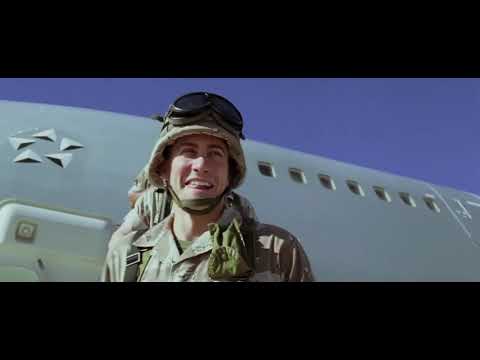
How It Was Made
Score by Thomas Newman; recorded and mixed in short, percussive cues to mirror the film’s clipped rhythms. Music supervision was steered by Randall Poster with Kathy Nelson overseeing studio music operations. According to trade and database credits, additional music/editorial support covered orchestration, cue mixing, and music prep to accommodate the film’s fragmentary structure.
Clearance notes worth flagging: Mendes pushed for Nirvana; the licensing climate was delicate, but the track made it in. Hip-hop placements came from Poster’s ethos of cultural realism rather than neat period bookkeeping.
Reception & Quotes
Critical response to the film was mixed-positive; reactions to Newman’s score were notably respectful even from detractors of the movie’s narrative detachment. Fans have since championed the soundtrack as a study in anti-bombast.
“This first-person account scores with performances and cinematography but lacks an emotional thrust.” Rotten Tomatoes consensus
“Three and a half stars… unique portrait of Marines who battle boredom and isolation.” Roger Ebert
“Soldiers in the desert, antsy and apolitical.” A. O. Scott, NYT
“A platoon full of sand and grit.” Stephen Hunter, Washington Post
Album availability: Decca released the score album in 2005 on CD and digital; streaming versions mirror the compact cue set.
Additional Info
- Label release carried both Newman cues and a few featured songs; most party/hip-hop cuts remain film-only.
- “O.P.P.” anachronism is intentional flavor, not documentary precision.
- Public Enemy tracks used as celebratory fuel rather than direct political commentary inside scenes.
- Newman’s cue titles (“Welcome to the Suck,” “Full Chemical Gear”) echo Marine slang and training routines.
- Some regions list the album under Universal/Decca imprints; metadata varies slightly across stores.
- Several later trailers and TV spots syndicated with alternate music edits distinct from the theatrical trailer.
- Post-release discourse often singles out the sand-vomit nightmare as the film’s defining music moment.
Technical Info
- Title: Jarhead (Original Motion Picture Soundtrack)
- Year: 2005
- Type: Film score with featured songs
- Composer: Thomas Newman
- Music Supervision: Randall Poster (executive in charge of music: Kathy Nelson)
- Notable Placements (film only): Nirvana “Something in the Way”; Naughty by Nature “O.P.P.”; Public Enemy “Fight the Power”; C+C Music Factory “Gonna Make You Sweat”; Black Sheep “The Choice Is Yours”; T. Rex “Bang a Gong (Get It On)”; The Doors “Break On Through.”
- Release Context: Universal Pictures theatrical release on November 4, 2005
- Label / Album Status: Decca (score album); widely available on digital/streaming
- Availability / Chart Notes: Score widely streamable; needle-drops appear on artist catalogs, not the score album.
Canonical Entities & Relations
| Subject | Relation | Object |
|---|---|---|
| Sam Mendes | directed | Jarhead (2005) |
| Thomas Newman | composed score for | Jarhead (2005) |
| Randall Poster | served as | Music Supervisor on Jarhead |
| Kathy Nelson | served as | Executive in charge of music |
| Universal Pictures | distributed | Jarhead (2005) |
| Decca Records | released | Jarhead – Original Motion Picture Soundtrack (2005) |
| Nirvana | performed | “Something in the Way” (used in Jarhead) |
| Naughty by Nature | performed | “O.P.P.” (used in Jarhead) |
| Public Enemy | performed | “Fight the Power” (used in Jarhead) |
Sources: Wikipedia; SoundtrackINFO; Discogs; Apple Music; Metacritic credits; The Spokesman-Review; Rotten Tomatoes; Chicago Sun-Times; The New York Times.
As reported by Wikipedia and trade summaries, Mendes pressed for Nirvana’s placement; as per SoundtrackINFO, the “O.P.P.” party scene is anachronistic; according to Apple Music/Discogs, Decca issued the 2005 score album; according to Rotten Tomatoes/Ebert/NYT, reception centered on strong craft and emotional distance.
November, 12th 2025
A-Z Lyrics Universe
Cynthia Erivo Popular
Ariana Grande Horsepower
Post Malone Ain't No Love in Oklahoma
Luke Combs Good Riddance (Time of Your Life)
Green Day Bye Bye Bye
*NSYNC You're the One That I Wan
John Travolta & Olivia Newton-John I Always Wanted a Brother
Braelyn Rankins, Theo Somolu, Kelvin Harrison Jr. and Aaron Pierre The Power of Love
Frankie Goes to Hollywood Beyond
Auli’i Cravalho feat. Rachel House MORE ›