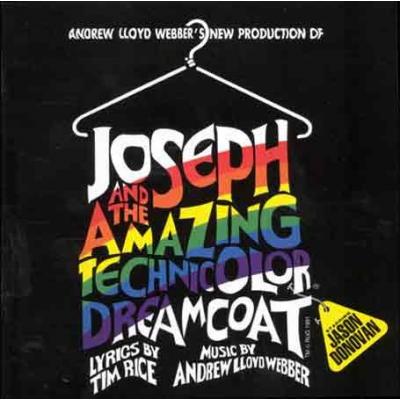
"Joseph And The Amazing Technicolor Dreamcoat" Soundtrack Lyrics
Musical • 1994
Track Listing
Narrator
Joseph & Children
"Joseph and the Amazing Technicolor Dreamcoat (1994 Studio/Broadway-Era Recordings)" – Album Guide to Tracks and Key Scenes
Overview
Why does a short Bible tale sing like a greatest-hits revue? Because this score is built from style pastiche—country, calypso, Elvis rock, French chanson—wrapped around a clean melodic core. In 1994 the property sat at a peak: the 1993–94 Broadway revival closed in May 1994, while labels circulated fresh recordings (a 1994 English “Studio Cast” set and still-current North American cast discs). Together they preserve the high-gloss 1990s staging vocabulary: brisk tempos, kids’ choir sparkle, and the now-standard opening “Prologue” → “Any Dream Will Do.”
For collecting, two threads cover this year: (1) the 1993 Los Angeles/Broadway-era cast album (with the revival’s ordering) and (2) a 1994 Studio Cast album that mirrors the hit UK/London-Palladium expansion. Both include the full sung-through sequence and, in most editions, the curtain-call “Joseph Megamix.” According to reference discographies and the IBDB dates, this is the configuration audiences heard on U.S. stages through spring 1994.
Questions & Answers
- What counts as the “1994” album?
- An English-language Studio Cast released in 1994; collectors also file the 1993 Los Angeles/Broadway-era cast next to it because the revival ran into 1994.
- How is the 1990s order different from earlier LPs?
- It opens with “Prologue” then “Any Dream Will Do,” a sequence codified on the 1982 Broadway production and kept for the 1991 West End/1993–94 Broadway era.
- Which revival was on Broadway in 1993–94?
- The Minskoff Theatre revival (opened Nov 10, 1993; closed May 29, 1994) starring Michael Damian (Joseph) and Kelli Rabke (Narrator).
- Are the 1994 discs complete?
- Yes—full sung-through show. Some editions add the “Joseph Megamix” during bows.
- Where do the big hits sit in the running order?
- “Any Dream Will Do” (opening and reprise), “Close Every Door” (end of Act I arc for Joseph), “Song of the King” (Act II Elvis pastiche), “Benjamin Calypso,” then redemption and the megamix.
- Is there a filmed version tied to this era?
- Yes—the Donny Osmond video arrived later (1999), but its track order/performance style reflects this 1990s staging.
Notes & Trivia
- The 1991 London Palladium revival locked in the modern arrangement; the 1993–94 Broadway run used the same blueprint.
- Discographies show a 1994 English Studio Cast with full number list, alongside North American cast albums from 1992–94 (Toronto/LA/Broadway era).
- “Prologue” became standard from the 1982 Broadway production onward.
- Many 1990s albums include the curtain-call “Joseph Megamix.”
Genres & Themes
Style pastiche as storytelling — each family of songs signals a plot function:
- Country-Western (“One More Angel in Heaven”) → brothers’ tall-tale swagger.
- Elvis rock & roll (“Song of the King”) → Pharaoh as a star CEO selling a dream.
- French chanson (“Those Canaan Days”) → famine nostalgia played for humor and ache.
- Calypso (“Benjamin Calypso”) → comic relief before reconciliation.
- Power ballad (“Close Every Door”) → Joseph’s lowest point, literal plea.
- Go-go/70s pop (“Go, Go, Go Joseph”) → Act I release valve; optimism reset.
Tracks & Scenes
"Prologue" → "Any Dream Will Do"
Where it plays: Opening narration and Joseph’s theme. A simple melody over children’s chorus sets the show’s fable tone (diegetic-as-storytelling).
Why it matters: Establishes motif and frame; the closing reprise completes the circle.
"Jacob & Sons / Joseph’s Coat"
Where it plays: Family roll call and the famous garment presentation; color list becomes rhythm.
Why it matters: Character map + visual hook in one cue.
"Poor, Poor Joseph" → "One More Angel in Heaven"
Where it plays: Brothers cover their tracks, pivoting to a hoedown at Jacob’s house.
Why it matters: Country pastiche lets the lie masquerade as entertainment.
"Potiphar"
Where it plays: 1920s-flavored bustle as Joseph rises—and is framed—under Potiphar’s roof; Mrs. Potiphar’s vamp drives the comic fall.
Why it matters: Style signals status games and scandal.
"Close Every Door"
Where it plays: Prison soliloquy with kids’ chorus response.
Why it matters: The show’s emotional spine; minimal orchestration focuses text.
"Go, Go, Go Joseph"
Where it plays: Act I closer; dream optimism returns with brass and choir.
Why it matters: Chart-friendly energy before intermission.
"Pharaoh Story" → "Song of the King" → "Pharaoh’s Dreams Explained"
Where it plays: Act II star turn; the Elvis send-up lands laughs and exposition.
Why it matters: Comic sugar that moves the plot quickly.
"Those Canaan Days" → "The Brothers Come to Egypt / Grovel, Grovel"
Where it plays: Famine lament into stylized supplication.
Why it matters: Contrast (chanson → mock-oratorio) highlights power shift.
"Benjamin Calypso"
Where it plays: Plea to spare the youngest; calypso sway eases tension before reveal.
Why it matters: Warmth before catharsis.
"Any Dream Will Do (Reprise) / Give Me My Coloured Coat" + "Joseph Megamix"
Where it plays: Family reunion, then a hits medley during bows.
Why it matters: Theme fulfillment; album-ending party for listeners.
Music–Story Links
Because each number is a genre, audiences know who holds power by sound alone: Joseph’s plain-spoken motif vs. the brothers’ flashy detours; Pharaoh’s rock spectacle vs. Joseph’s clean explanation cadence. Repetition of the “Any Dream Will Do” theme ties early naïveté to earned resolution.
How It Was Made
The 1990s configuration builds on the 1982 Broadway expansion (first to add the “Prologue”) and the 1991 London Palladium restaging that set tempos/orchestrations many 1993–94 U.S. companies adopted. Studio-cast and North American cast albums tracked that standardized order; revival documentation confirms the Broadway run through May 29, 1994. (according to IBDB and production histories)
Reception & Quotes
Press in 1993–94 called the revival a bright, family-forward crowd-pleaser; album buyers got the same polish.
“All grown up… remembers the only really useful commandment: have fun.” Los Angeles Times (revival road to Broadway)
“Style-hopping score that still reads like one story.” album reviews/liner summaries
Additional Info
- Standard 1990s running order: “Prologue” → “Any Dream Will Do” → full book; megamix often appended.
- 1994 releases include an English Studio Cast (full show); adjacent catalog: 1992–94 Toronto/LA/Broadway-era casts.
- Key singles on compilations: “Any Dream Will Do,” “Close Every Door,” “Song of the King (Seven Fat Cows).”
- Later video (1999) reflects the same staging grammar; useful cross-reference for arrangements.
Technical Info
- Title: Joseph and the Amazing Technicolor Dreamcoat — 1994 Studio Cast / Broadway-era cast recordings
- Year: 1994 (focus); adjacent 1993–94 revival context
- Type: Musical theatre cast recordings (studio + stage casts)
- Music/Lyrics: Andrew Lloyd Webber / Tim Rice
- Notable numbers: “Any Dream Will Do”; “Close Every Door”; “Song of the King”; “Those Canaan Days”; “Benjamin Calypso”; “Joseph Megamix”
- Broadway revival window: Nov 10, 1993 – May 29, 1994 (Minskoff Theatre)
Canonical Entities & Relations
| Subject | Relation | Object |
|---|---|---|
| Andrew Lloyd Webber | composed | Joseph and the Amazing Technicolor Dreamcoat |
| Tim Rice | wrote lyrics/book for | Joseph and the Amazing Technicolor Dreamcoat |
| 1994 Studio Cast (English) | recorded | full show (audio) |
| Michael Damian / Kelli Rabke | starred in | 1993–94 Broadway revival |
| Really Useful Theatre Company | produced | 1991–1994 UK/US revivals |
Sources: production histories and principal cast lists; IBDB revival dates; cast-album discographies; 1990s cast/Studio Cast album listings.
November, 12th 2025
A-Z Lyrics Universe
Cynthia Erivo Popular
Ariana Grande Horsepower
Post Malone Ain't No Love in Oklahoma
Luke Combs Good Riddance (Time of Your Life)
Green Day Bye Bye Bye
*NSYNC You're the One That I Wan
John Travolta & Olivia Newton-John I Always Wanted a Brother
Braelyn Rankins, Theo Somolu, Kelvin Harrison Jr. and Aaron Pierre The Power of Love
Frankie Goes to Hollywood Beyond
Auli’i Cravalho feat. Rachel House MORE ›