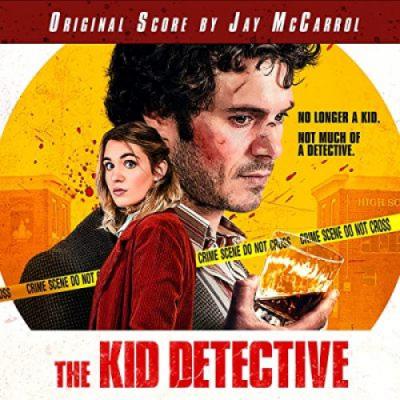
"Kid Detective" Soundtrack Lyrics
Movie • 2020
Track Listing
Nancy Sinatra
Jamie Horton
Kandle
The Clickettes
Dschinn
Nancy Sinatra
Air
"The Kid Detective (Original Score & Songs)" – Album Guide to Tracks and Key Scenes
Overview
How do you score a comedy-noir that starts like a sunny teen caper and ends like a gut punch? The Kid Detective answers with a split personality: a nimble original score by Jay McCarrol and a handful of vintage needle-drops that tilt smiles into shivers. The music keeps pace with Abe Applebaum’s arrested-development sleuthing, then slips a darker undertow beneath the quips.
The album’s spine is McCarrol’s concise, motif-driven cues—wry “detective” figures, brushed-kit shuffle, and low-key suspense—punctured by songs that sound innocent until you clock what they’re sitting on top of. The film famously bookends itself with Nancy Sinatra’s “Sugar Town,” the sugar-coating that lets the bitterness in.
Questions & Answers
- Is there an official score release?
- Yes. A digital score album credited to Jay McCarrol appeared alongside the film’s rollout in late 2020.
- Who composed the music?
- Jay McCarrol, whose compact cues carry the film’s deadpan tone and slow-burn dread.
- Does the movie use recognizable songs?
- Yes—most memorably Nancy Sinatra’s “Sugar Town” in the opening and again over the closing stretch; additional vintage cuts surface in-world.
- What’s distinctive about the score?
- Economy. Tracks are short, motif-led, and pivot from lightly jazzy sleuthing to hush-tense textures without telegraphing punchlines.
- Is the soundtrack mostly diegetic or non-diegetic?
- The score is non-diegetic; several period-leaning songs appear diegetically (radios, rooms) to color place and mood.
- Any release-date landmarks?
- The film premiered at TIFF in September 2020 and opened in U.S. theaters October 16, 2020; the score album followed during the initial release window.
Notes & Trivia
- Jay McCarrol’s theme for Abe plays like a weary nursery rhyme—childhood logic with adult consequences.
- “Sugar Town” frames the film twice; the second time it hits, the lyrics curdle against what we now know.
- Several vintage tracks (doo-wop, early-’60s pop) are used sparingly—tone setters, not wall-to-wall wallpaper.
- The score album keeps cues short; even set-pieces like “Car Chase” are under a minute.
- TIFF premiere in 2020; four Canadian Screen Award nominations included Best Original Score.
Genres & Themes
- Low-key detective jazz & combo swing → shabby competence, the PI as a guy who peaked early and knows it.
- Ambient noir textures → unease in broad daylight; the town’s niceness feels off.
- ’60s pop & doo-wop → innocence as camouflage; when these songs appear, the scene’s morality usually tilts.
Tracks & Scenes
Timestamps are approximate and may vary slightly by edition/stream.
"Sugar Town" — Nancy Sinatra
Scene: Prologue and reprise (open ~00:01; end credits ~01:35). Non-diegetic over a bright, tree-lined street as a girl strolls; the same tune later returns against the film’s final reckoning. The juxtaposition turns a breezy hook into a haunting refrain.
Why it matters: Sets the thesis—suburban sweetness masking rot; the reprise stings because we finally see what the sugar hid.
"Opening Titles" — Jay McCarrol
Scene: Title card (~00:03). Non-diegetic wry motif, brushed drums and piano figure that tags Abe’s brand of half-slick detection.
Why it matters: Establishes the film’s comic cadence without undercutting the mystery frame.
"Willowbrook Then" — Jay McCarrol
Scene: Early flashback montage (~00:05–00:08). Non-diegetic, bittersweet; catalogues the small-town myth of Abe’s kid-sleuth glory days.
Why it matters: Nostalgia with an asterisk. The harmony glows while details already feel… too neat.
"Ice Cream Walk" — Jay McCarrol
Scene: Abe on the move through town (~00:15). Non-diegetic, light on its feet; storefronts, side-glances, and the detective routine as habit.
Why it matters: Locates rhythm—this case will be solved on foot, in daylight, with the town watching.
"Melody Interview" — Jay McCarrol
Scene: The client’s sit-down (~00:20). Non-diegetic hush that lets dialogue breathe; tension comes from pauses, not stings.
Why it matters: Humanizes the “case” and reveals the film’s real stakes.
"Car Chase" — Jay McCarrol
Scene: Brief scramble (~00:50). Non-diegetic, under-a-minute burst that refuses to glamorize action; we’re in awkward reality, not blockbuster land.
Why it matters: A stylistic boundary: danger spikes, tone stays dry.
"Constable Cleary" — Jay McCarrol
Scene: Police-station exchange (~00:55). Non-diegetic cue with officious pulse; authority is present but not reassuring.
Why it matters: Signals institutions as part of the town’s performance, not its protection.
"Knew You’d Never" — Kandle
Scene: Needle-drop during a late-night interlude (~01:00, diegetic). A wistful, modern torch-glow colors private reflection.
Why it matters: A rare contemporary voice among retro cuts—Abe’s present tense intruding on his nostalgia.
"Oh Love (Stop Knockin’ on My Door)" — Jamie Horton (Gayla Peevey)
Scene: Vintage pop drifting from a radio at a quiet beat (~00:25, diegetic). Sweetness with sharp edges; the lyric’s persistence mirrors a case that won’t let go.
Why it matters: The film keeps using cheerful textures to make unease bloom.
"Outro" — Jay McCarrol
Scene: Final aftermath (~01:33–01:36). Non-diegetic coda that doesn’t chase catharsis; then “Sugar Town” returns to rub salt in the wound.
Why it matters: The case is solved; the cost remains.
Trailer note: Marketing leans on suspenseful score swells and rhythm accents; it avoids spoiling the late tonal shift.
Music–Story Links
- When Abe slips into old routines (“Ice Cream Walk”), the light swing sells competence; when the case darkens, the same palette goes hushed—habit no longer helps.
- “Sugar Town” reframes the entire story: carefree pop → proof that this town prefers denial set to a catchy hook.
- Short cues (e.g., “Car Chase”) keep events mundane, making the final revelations land harder—no musical catharsis to hide behind.
- Diegetic oldies make rooms feel safe; the plot keeps proving otherwise.
How It Was Made
Composer Jay McCarrol threads a simple, slightly weary motif through compact cues—detective jazz brushed with unease. The score album mirrors the film’s restraint: 15 tracks, many under two minutes, covering flashbacks, interviews, a blink-and-you’ll-miss-it chase, and a quiet comedown.
Music editorial keeps needle-drops minimal and pointed. One well-chosen standard opens and closes the film; a few other retro cuts slip in as room tone or radio, preserving the small-town texture without turning the film into a jukebox.
Reception & Quotes
Critics praised the film’s tonal control and the way cheerful music sharpens its darker edges. Two snapshots:
“It opens and closes with Nancy Sinatra’s ‘Sugar Town,’ the sweetness making the sting worse.” — RogerEbert.com
“A breezy pop cue over an idyllic block, and you feel the dread anyway.” — Defector
The film earned a Best Original Score nomination at the Canadian Screen Awards; the score album remains accessible on major platforms.
Additional Info
- Score album: 15 tracks, ~29 minutes; designed for quick scene memory rather than long symphonic arcs.
- Key song roster beyond the score includes cuts by Nancy Sinatra, Jamie Horton (Gayla Peevey), Kandle, and period doo-wop selections.
- End-title transition: sober score coda into “Sugar Town”—a deliberate emotional clash.
- Trailer ID used in figures: KEyiKNXsVGo (official studio upload).
- Festival/Release: TIFF industry program (Sept 2020); U.S. theatrical (Oct 16, 2020).
Technical Info
- Title: The Kid Detective — Original Score & Songs
- Year: 2020
- Type: Feature film soundtrack (original score with selected licensed songs)
- Composer: Jay McCarrol
- Notable licensed tracks: Nancy Sinatra “Sugar Town”; Jamie Horton “Oh Love (Stop Knockin’ on My Door)”; Kandle “Knew You’d Never”; selected early-’60s pop/doo-wop cues.
- Release context: TIFF September 2020; U.S. theatrical October 16, 2020.
- Album availability: Digital score streaming/download; widely available on major DSPs.
Canonical Entities & Relations
| Subject | Relation | Object |
|---|---|---|
| Evan Morgan | wrote & directed | The Kid Detective (2020) film |
| Adam Brody | starred as | Abe Applebaum |
| Sophie Nélisse | starred as | Caroline (client) |
| Jay McCarrol | composed score for | The Kid Detective (2020) |
| Nancy Sinatra | performed | “Sugar Town” (opening & closing usage) |
| Jamie Horton (Gayla Peevey) | performed | “Oh Love (Stop Knockin’ on My Door)” |
| Kandle | performed | “Knew You’d Never” |
Sources: Film Music Reporter; Wikipedia; RogerEbert.com; Defector; official trailer (Sony Pictures YouTube).
November, 12th 2025
A-Z Lyrics Universe
Cynthia Erivo Popular
Ariana Grande Horsepower
Post Malone Ain't No Love in Oklahoma
Luke Combs Good Riddance (Time of Your Life)
Green Day Bye Bye Bye
*NSYNC You're the One That I Wan
John Travolta & Olivia Newton-John I Always Wanted a Brother
Braelyn Rankins, Theo Somolu, Kelvin Harrison Jr. and Aaron Pierre The Power of Love
Frankie Goes to Hollywood Beyond
Auli’i Cravalho feat. Rachel House MORE ›