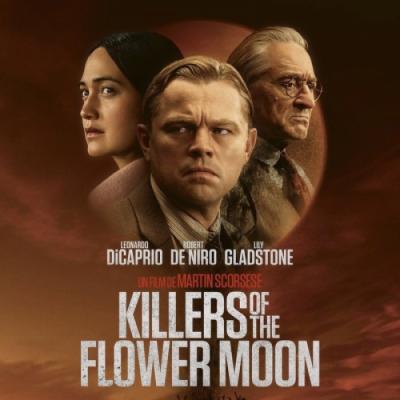
"Killers of the Flower Moon"Soundtrack Lyrics
Movie • 2023
Track Listing
Henry Thomas
The Carter Family
Milton Brown And The Brownies
Mamie Smith
Emmet Miller
Henry Thomas
Roy Acuff
The Chuck Wagon Gang
Ma Rainey
Blind Willie Johnson
"Killers of the Flower Moon (Soundtrack from the Apple Original Film)" – Album Guide to Tracks and Key Scenes
Overview
How do you score a tragedy that keeps breathing in daylight? The film answers with Robbie Robertson’s lean, blues-forward score and a lattice of 1910s–20s recordings, capped by an original Osage song written and performed by tribal singers. The sound is purposeful: skin-drum pulses, slide guitar, mandolin and harmonica for the score; brittle shellac for the source music; a final communal chorus that refuses erasure.
Robertson’s album (Killers of the Flower Moon — Soundtrack from the Apple Original Film) runs just under an hour and favors riff-driven cues over orchestral swell. The licensed songs stitch place and power—string-band laments, early blues shouts, hillbilly yelps—while the closing “Wahzhazhe (A Song for My People)” returns authorship to the Osage themselves.
Questions & Answers
- Is there an official album?
- Yes. Killers of the Flower Moon (Soundtrack from the Apple Original Film) by Robbie Robertson was released October 20, 2023 on Sony Masterworks; 21 tracks, ~53 minutes.
- Who composed the score?
- Robbie Robertson. It was his final completed film score; the film is dedicated to his memory.
- What is the Osage song at the end?
- “Wahzhazhe (A Song for My People)”—written by Osage Nation members Scott George, Kenny Bighorse, and Vann Bighorse; performed by the Osage Tribal Singers.
- Are the vintage recordings on the commercial album?
- No. The retail album is Robertson’s score. The period recordings are heard in the film and are collected in studio-curated playlists.
- Any awards attention?
- The score was nominated for Best Original Score at the 96th Academy Awards; “Wahzhazhe (A Song for My People)” was nominated for Best Original Song.
- When did the film release?
- U.S. theatrical opening October 20, 2023; Apple TV+ streaming followed the theatrical run.
Notes & Trivia
- Robertson’s palette leans guitars, hand percussion, harmonica, mandolin/mandocello—minimal ensemble, big presence.
- The commercial score album arrived day-and-date with the U.S. theatrical opening and later on CD/vinyl.
- “Wahzhazhe (A Song for My People)” was composed new for the film rather than using an archival ceremonial song.
- Studio-curated playlists gather the period 78s heard in-film (Henry Thomas, the Carter Family, Mamie Smith, Emmett Miller, and more).
Genres & Themes
- Blues pulse & plains-motor → inevitability, debt coming due (score cues like “Reign of Terror,” “Insulin Train”).
- Hillbilly string-band & early country → domestic front, radio kitchens, and rough comfort (“Single Girl, Married Girl,” “Poor Orphan Child”).
- Classic blues & race records → commerce and exploitation in the oil boom town (“Crazy Blues”).
- Osage choral/drum → continuity and survival; the coda re-centers authorship (“Wahzhazhe”).
Tracks & Scenes
Timestamps are approximate and can vary slightly by edition/stream.
"(Intro) The Sacred Pipe" — Robbie Robertson
Scene: Opening titles (~00:01). Non-diegetic; a low drum-and-string figure frames the land before names and dates.
Why it matters: Announces the score’s spine: heartbeat over horizon.
"Osage Oil Boom" — Robbie Robertson
Scene: Photo montage and oil-well rise (~00:06). Non-diegetic, riff-forward rhythm.
Why it matters: Prosperity scored like a machine starting—promise with friction.
"Crazy Blues" — Mamie Smith & Her Jazz Hounds
Scene: Main-street interiors in Fairfax (early reels). Diegetic, spilling from a Victrola/cafe system as money and gossip churn.
Why it matters: The first mass-market Black blues hit underlines how commerce packages pain.
"Bull Doze Blues" — Henry Thomas
Scene: Daytime town ambience (~00:20). Diegetic; fife-and-guitar lilt in a doorway radio, the street idling around it.
Why it matters: Rural modernity: an old sound in a new-money town.
"Single Girl, Married Girl" — The Carter Family
Scene: Domestic interlude as Mollie’s health wanes (~01:00). Diegetic needle-drop; lyrics about constraint and cost.
Why it matters: Irony with bite—marriage used as a lever in the plot.
"Indian War Whoop" — Floyd Ming & His Pep Steppers
Scene: Boisterous gathering/strip of storefronts (~01:15). Diegetic, rough fiddle whoops over clatter.
Why it matters: A period novelty tune whose cartoon title jars against the real violence off-screen—editorial contrast.
"Lovesick Blues" — Emmett Miller
Scene: Radio-at-home scene (~01:25). Diegetic, yodeling through static while plots thicken.
Why it matters: Sentimentality masking predation.
"Henry Whitter’s Fox Chase" — Henry Whitter
Scene: Country errand drive (~01:40). Diegetic harmonica figure, rhythm of wheels and scheming.
Why it matters: Folkloric bustle as alibi soundtrack.
"Metropolis (A Blue Fantasie)" — Vince Giordano & The Nighthawks
Scene: Late radio program recalling the case outcomes (~03:14). Diegetic period broadcast; the band’s polished swing contrasts with tidy, self-serving narration.
Why it matters: A manufactured public memory scored like entertainment.
"Wahzhazhe (A Song for My People)" — Osage Tribal Singers
Scene: Final remembrance sequence and closing movement (~03:18 →). Non-diegetic choral/drum performance composed for the film.
Why it matters: The story returns to the people it belongs to.
Also heard around town: “The Poor Orphan Child” (The Carter Family), “The Fox and the Hounds” (Henry Thomas), selections by Roy Acuff & His Crazy Tennesseans and Long “Cleve” Reed & Little Harvey Hull—typically as in-room phonograph/radio sources in shops, kitchens, and gatherings.
Music–Story Links
- Robertson’s cues use heartbeat and breath sounds as rhythm—land and body tied to each decision.
- Shellac-era sides mark power spaces: who owns the store, the radio, the party. Cheerful records sit beside funerals.
- The last cue (“Wahzhazhe”) inverts authorship: not commentary on the Osage but voice from the Osage.
How It Was Made
Robertson built a small, flexible band (guitars, mandolin/mandocello, harmonica, hand percussion, keys, cello and more) and avoided “traditional movie music” in favor of motifs that feel breathed-in. The score sessions paralleled Scorsese’s usual practice of shunning temp tracks. The end-credits song originated when Scorsese asked for a new Osage composition; Scott George, with Kenny and Vann Bighorse, wrote “Wahzhazhe,” performed by the Osage Tribal Singers.
Reception & Quotes
Coverage consistently praised the music’s lived-in feel and the closing song’s significance.
“A lively musical ecosystem that gives immediate authenticity… and the best music Robertson ever wrote for the screen.” — L.A. Times
“The Smiths of the prairie? No—Robertson’s score is heartbeat and dust.” — album-release press summary
“‘Wahzhazhe’ is a call to stand up—our people still here.” — Osage composer commentary
Additional Info
- Official score album: 21 tracks, 53 minutes, Sony Masterworks (digital Oct 20, 2023; later CD/LP).
- Playlist companions gather ~30–40 film-used score and period tracks for reference (non-official V/A bundles).
- The Oscars featured a live performance of “Wahzhazhe (A Song for My People).”
- Score and film both memorialize Robbie Robertson, who died in August 2023.
- Production consulted Osage musicians/dancers during development and post.
Technical Info
- Title: Killers of the Flower Moon (Soundtrack from the Apple Original Film)
- Year: 2023
- Type: Feature film soundtrack (original score) + period recordings (in film)
- Composer/Producer: Robbie Robertson
- Key licensed recordings (in film): Henry Thomas (“Bull Doze Blues”), The Carter Family (“Single Girl, Married Girl”; “The Poor Orphan Child”), Mamie Smith (“Crazy Blues”), Floyd Ming & His Pep Steppers (“Indian War Whoop”), Emmett Miller (“Lovesick Blues”), Henry Whitter (“Fox Chase”), Vince Giordano & The Nighthawks (“Metropolis — A Blue Fantasie”), Osage Tribal Singers (“Wahzhazhe”).
- Label (score): Sony Masterworks
- Release context: U.S. theatrical Oct 20, 2023; score album same day; subsequent physical editions in Dec 2023.
Canonical Entities & Relations
| Subject | Relation | Object |
|---|---|---|
| Martin Scorsese | wrote & directed | Killers of the Flower Moon (2023) |
| Robbie Robertson | composed & produced | Killers of the Flower Moon score album |
| Sony Masterworks | released | official score album (digital/physical) |
| Scott George | wrote & led | “Wahzhazhe (A Song for My People)” |
| Osage Tribal Singers | performed | “Wahzhazhe (A Song for My People)” |
| Henry Thomas / The Carter Family / Mamie Smith / Emmett Miller / Floyd Ming & His Pep Steppers | recordings featured in | film diegesis (radios/players) |
| Vince Giordano & The Nighthawks | performed | “Metropolis (A Blue Fantasie)” (broadcast scene) |
Sources: album listings (score) and official playlists; soundtrack press and reviews; interviews and award records; trailer IDs from the studio channel.
November, 12th 2025
A-Z Lyrics Universe
Cynthia Erivo Popular
Ariana Grande Horsepower
Post Malone Ain't No Love in Oklahoma
Luke Combs Good Riddance (Time of Your Life)
Green Day Bye Bye Bye
*NSYNC You're the One That I Wan
John Travolta & Olivia Newton-John I Always Wanted a Brother
Braelyn Rankins, Theo Somolu, Kelvin Harrison Jr. and Aaron Pierre The Power of Love
Frankie Goes to Hollywood Beyond
Auli’i Cravalho feat. Rachel House MORE ›