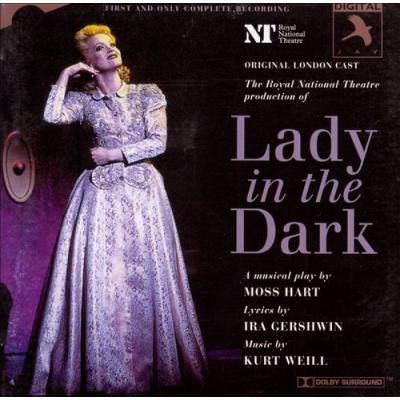
"Lady in the Dark" Soundtrack Lyrics
Musical • 1998
Track Listing
"Lady in the Dark (Original London Cast, Royal National Theatre) – Album Guide to Tracks and Key Scenes
Overview
What if most of a musical’s score lives inside a psychoanalytic dream? Kurt Weill, Ira Gershwin, and Moss Hart’s Lady in the Dark answers with three operetta-sized dream sequences—Glamour, Wedding, Circus—intercut with spoken scenes in 1940 New York. The 1997 Royal National Theatre revival (Maria Friedman as Liza Elliott) finally received a complete cast recording in 1998, restoring the work’s original musical architecture.
The JAY Records album documents the production that won the Evening Standard Award for Best Musical (1997) and earned multiple Olivier nominations (1998). The set runs ~79 minutes and, for the first time on disc, preserves all the major numbers (“One Life to Live,” “This Is New,” “The Saga of Jenny,” “Tschaikowsky (and Other Russians)”) with full scene underscores and reprises. According to the label’s notes and retail/discographic entries, this was marketed as the first complete recording of the score.
Questions & Answers
- So, is “1998” the show or the album?
- The National Theatre production opened in London in 1997; the complete cast recording was released in 1998.
- What makes this album significant?
- It’s the first complete recording of the Weill–Gershwin score—earlier albums were highlights or studio abridgements.
- Who headlines the London cast?
- Maria Friedman (Liza Elliott) leads the Royal National Theatre company.
- Where do the songs sit in the story?
- Almost all numbers occur inside Liza’s three dream sequences. Only “My Ship” resolves in the final scene, un-dreamt.
- Signature numbers I should sample?
- “One Life to Live,” “This Is New,” “The Saga of Jenny,” “My Ship,” and the patter tour-de-force “Tschaikowsky (and Other Russians).”
- Is there a modern synopsis source?
- The Kurt Weill Foundation maintains a concise plot overview and song context.
Notes & Trivia
- The production received five Olivier nominations and won two awards across the 1998 ceremony’s tallies.
- “My Ship” functions as a leitmotif for Liza’s unresolved memory and only appears complete at the end.
- The London revival was directed by Francesca Zambello; the cast album credits JAY Records’ Masterworks Edition imprint.
- Earlier complete attempts did not exist on stage-cast disc; the famous 1963 Columbia set is abridged.
Genres & Themes
Weill’s late-Broadway idiom — cabaret color inside American song forms. Gershwin’s lyric wit — comic patter vs. torch sincerity. Through-composed dream suites — the Glamour, Wedding, and Circus sequences act like mini-operettas. Psychological motif — “My Ship” as therapy in melody: fragments in dreams, full song in waking clarity.
Tracks & Scenes
Numbers grouped by sequence; diegetic = within Liza’s dream-world “stage,” non-diegetic = album/underscoring perspective. Scene windows follow standard synopses of the show.
“One Life to Live” — Liza Elliott & Russell
Where it plays: Glamour Dream (diegetic-in-dream). Liza, reimagined as the world’s inamorata, argues for appetite over inhibition; brassy orchestration underlines the fantasy of ease.
Why it matters: Sets the first dream’s thesis—confidence as costume.
“Girl of the Moment” — Ensemble
Where it plays: Glamour Dream (diegetic-in-dream). A magazine-cover chorus crowns Liza with fashion-mag spectacle.
Why it matters: Satirizes celebrity mechanics while flattering the dreamer.
“This Is New” — Randy & Liza
Where it plays: Wedding Dream (diegetic-in-dream). Movie-star Randy sweeps Liza into an operetta waltz of discovery.
Why it matters: The album’s lyrical heart; it foreshadows the final clarity without resolving it.
“The Princess of Pure Delight” — Liza & Children
Where it plays: Wedding Dream (pageant within the dream). A fairy-tale insert punctures the bridal fantasy with nursery innocence.
Why it matters: Childlike rhyme hides adult doubt.
“Tschaikowsky (and Other Russians)” — Ringmaster & Ensemble
Where it plays: Circus Dream (diegetic-in-dream). A patter list-song of composers, spat at tongue-twister speed in a big-top frame.
Why it matters: Comic bravura, and a pressure valve before Liza’s crisis.
“The Saga of Jenny” — Liza
Where it plays: Circus Dream (spotlit confession). Liza sells a cautionary ballad about a girl who made up her mind—then didn’t.
Why it matters: The showstopper that translates indecision into fable; Friedman’s version lands with cabaret steel.
“My Ship” — Liza
Where it plays: Final scene (non-dream, diegetic). The melody that haunted every dream finally gains words; harmony simplifies as the orchestra yields to voice.
Why it matters: The psychological click—the song resolves, so does Liza.
Music–Story Links
Each dream is a thesis draft. Glamour asks who Liza could be, Wedding asks who she should marry, Circus prosecutes who she really is. The album’s sequencing lets you hear “My Ship” crumbs across the suites; once the full melody appears in waking life, the plot’s therapy arc ends—song as diagnosis, completion as cure.
How It Was Made
The National Theatre staging (director Francesca Zambello) sparked renewed attention and cleared the way for a full-score recording. JAY’s 1998 release—billed as “at last a complete recording”—captures the revival’s orchestration and placement, not a studio reduction. According to JAY’s album page and discographic listings, Maria Friedman leads, with the recording issued under the Masterworks Edition.
Reception & Quotes
“At last a complete recording of this classic score.” Label note
“The revival netted Evening Standard honors and multiple Olivier nods.” Theatre records
“‘My Ship’ anchors the psychology; ‘Jenny’ steals the ovation.” Album commentary
Additional Info
- Original Broadway run: 1941 (Alvin Theatre, 467 performances).
- 1997 London revival: Royal National Theatre; Maria Friedman as Liza Elliott.
- 1998 album: JAY Records, ~79 minutes; marketed as the first complete score recording.
- Key dream structure: Glamour → Wedding → Circus; “My Ship” concludes outside the dream.
- Later concert revivals kept the psychology-first framing, often highlighting “Jenny” and “Tschaikowsky.”
Technical Info
- Title: Lady in the Dark (Original London Cast – Royal National Theatre)
- Year: 1998 album (1997 production)
- Type: Stage musical cast recording (complete score)
- Music/Lyrics/Book: Kurt Weill / Ira Gershwin / Moss Hart
- Lead: Maria Friedman (Liza Elliott)
- Label: JAY Records (Masterworks Edition)
- Notable numbers: “One Life to Live,” “This Is New,” “The Saga of Jenny,” “Tschaikowsky (and Other Russians),” “My Ship”
- Awards context: Evening Standard Award (Best Musical, 1997); multiple 1998 Olivier nominations
- Availability: CD/digital (Apple Music, Spotify); widely cataloged on JAY/retail sites
Canonical Entities & Relations
| Subject | Relation | Object |
|---|---|---|
| Kurt Weill | composed | Lady in the Dark (score) |
| Ira Gershwin | wrote lyrics for | Lady in the Dark |
| Moss Hart | wrote book for | Lady in the Dark |
| Royal National Theatre | staged | 1997 London revival |
| Maria Friedman | starred as | Liza Elliott (1997) |
| JAY Records | released | 1998 complete cast recording |
Sources: label/retail listings; Kurt Weill Foundation work page; streaming catalog entries; awards records.
November, 12th 2025
A-Z Lyrics Universe
Cynthia Erivo Popular
Ariana Grande Horsepower
Post Malone Ain't No Love in Oklahoma
Luke Combs Good Riddance (Time of Your Life)
Green Day Bye Bye Bye
*NSYNC You're the One That I Wan
John Travolta & Olivia Newton-John I Always Wanted a Brother
Braelyn Rankins, Theo Somolu, Kelvin Harrison Jr. and Aaron Pierre The Power of Love
Frankie Goes to Hollywood Beyond
Auli’i Cravalho feat. Rachel House MORE ›