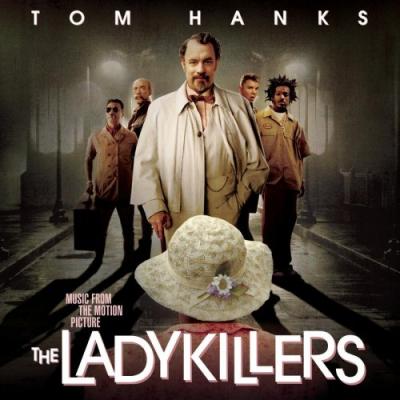
"Ladykillers" Soundtrack Lyrics
Movie • 2004
Track Listing
The Soul Stirrers
Nappy Roots
The Venice Four With Rose Stone And The Abbot Kinney Lighthouse Choir
Nappy Roots
The Soul Stirrers
Nappy Roots
Bill Landford & The Landfordaires
Rosewell Sacred Harp Quartet
Little Brother
Bill Landford & The Landfordaires
Donnie Mc Clurkin
The Soul Stirrers
Rose Stone With The Venice Four And The Abbot Kinney Lighthouse Choir
Claude Jeter And The Swan Silvertones
Blind Willie Johnson
The Venice Four With Rose Stone and the Abbot Kinney Lighthouse
The Abbot Kinney Lighthouse Choir feat. Kristle Murden
"The Ladykillers (Music from the Motion Picture)" – Album Guide to Tracks and Key Scenes
Overview
Can a heist movie run on hymns? The Coens’ 2004 remake says yes: the soundtrack is a gospel-forward compilation overseen by T Bone Burnett with Carter Burwell’s score tucked around it. The album blends archival gospel sides (The Soul Stirrers, Swan Silvertones, Blind Willie Johnson; Bill Landford & The Landfordaires) with newly recorded choir performances led by Rose Stone and the Abbot Kinney Lighthouse Choir, plus a few hip-hop turns (Nappy Roots, Little Brother).
The commercial release arrived in March 2004 and plays like the film’s conscience: church voices float down from Mrs. Munson’s sanctuary while the would-be musicians dig a tunnel below. Tracklist staples include “Come, Let Us Go Back to God,” two versions of “Let Your Light Shine on Me,” “You Can’t Hurry God,” “Any Day Now,” and multiple treatments of “Trouble of This World.”
Questions & Answers
- Who produced the soundtrack and who composed the score?
- T Bone Burnett executed the gospel-centered soundtrack; Carter Burwell composed the original score.
- What’s on the album?
- 18 cuts: vintage gospel (e.g., The Soul Stirrers, Swan Silvertones, Blind Willie Johnson), newly recorded choir performances with Rose Stone, and hip-hop selections by Nappy Roots and Little Brother.
- Release details?
- Issued March 2004; typical editions run ~61 minutes with 18 tracks.
- Is any “classical rehearsal” music on the CD?
- No. The gang pretends to play Boccherini in the film; the soundtrack album focuses on gospel/hip-hop.
- One song to sample for the film’s thesis?
- “Let Your Light Shine on Me” (new choir take) — the lyric mirrors the plot’s moral spotlight.
- How much of the movie’s tone comes from songs vs. score?
- Songs do the heavy lifting scene-to-scene; Burwell’s cues stitch transitions, suspense, and blackly comic beats.
Notes & Trivia
- The album interleaves archival cuts with newly recorded choir sessions produced for the film.
- Two different “Let Your Light Shine on Me” versions appear (Blind Willie Johnson’s classic and a newly cut choral performance).
- “Trouble of This World” recurs in multiple treatments: archival Landfordaires, a choral setting, and a hip-hop spin (“Coming Home”).
- Burwell’s own page notes the score largely yields the foreground to the gospel selections.
- The fake “early-music ensemble” gag nods to Boccherini; that minuet sits outside the album program.
Genres & Themes
Traditional & quartet gospel — moral ground, community witness (The Soul Stirrers; Swan Silvertones). Sanctified choir — roof-lifting congregational energy (Rose Stone with the Abbot Kinney Lighthouse Choir). Gospel-leaning hip-hop — modern commentary and momentum (Nappy Roots, Little Brother). Score (Burwell) — sly suspense, connective tissue between hallelujahs and heist beats.
Tracks & Scenes
Descriptive scene windows from the 2004 cut; diegetic = in-world performance. Not a full tracklist.
“Come, Let Us Go Back to God” — The Soul Stirrers
Where it plays: Early church framing and Sunday moments around Mrs. Munson (non-diegetic foreground with source bleed). The lyric sits like a mission statement over small-town rituals.
Why it matters: It draws a bright moral line before the caper even starts.
“Let Your Light Shine on Me” — Rose Stone with The Venice Four & the Abbot Kinney Lighthouse Choir
Where it plays: Full-throated church service/rehearsal above the cellar (diegetic). Dorr’s “string quartet” shenanigans cut against clapping and call-and-response upstairs.
Why it matters: Irony with teeth—the song begs for illumination while the thieves hide in shadow.
“Trouble of This World (Coming Home)” — Nappy Roots (feat. Stone family chorus)
Where it plays: Heist-prep and tunnel-dig montage (non-diegetic). Beat, shovels, jump cuts; the chorus keeps pointing homeward as the crew burrows deeper.
Why it matters: Old hymn, new engine—the caper moves on a spiritual cadence.
“Jesus I’ll Never Forget” — The Soul Stirrers
Where it plays: Interludes around Mrs. Munson’s steadfast routines (non-diegetic to light source). The quartet’s rolling rhythm threads domestic scenes and church steps.
Why it matters: Affirms the character who won’t bend—musically and morally.
“You Can’t Hurry God” — Donnie McClurkin
Where it plays: A patience-testing passage as the plan wobbles (non-diegetic). The lyric underlines waiting while the crew’s nerves fray.
Why it matters: Counter-programs the thieves’ haste; timing becomes a theme.
“Sinners” — Little Brother
Where it plays: Street/transition energy near the casino arc (non-diegetic). Verses throw side-eye at motives while the plot resets.
Why it matters: A modern voice puts the sermon in contemporary terms.
“Yes” — Abbot Kinney Lighthouse Choir feat. Kristle Murden
Where it plays: Closing uplift as consequences land (non-diegetic). Voices crest; the camera finds grace where the plan finds gravity.
Why it matters: The album’s benediction—answering the film’s moral question with a simple word.
Music–Story Links
Every hymn doubles as commentary. “Light” vs. “cellar,” “Trouble” vs. “tunnel,” “You Can’t Hurry God” vs. rushed schemes—the film keeps pairing songs with the crew’s mistakes. When the choir swells, intention meets consequence; when the beat takes over, motion outruns judgment.
How It Was Made
Burnett curated period gospel and commissioned new sessions with Rose Stone as featured vocalist/choir leader; Bill Maxwell handled associate gospel production and Keefus Ciancia assisted on the hip-hop side. Burwell wrote a sly, supportive score that mostly yields the foreground to source-styled cues.
Reception & Quotes
“A surprisingly cohesive fusion of hand-clappin’ traditional gospel, southern gospel, and even hip-hop.” Album review
“Burwell’s original score takes a back seat to the extensive gospel selections.” Score notes
“The soundtrack sets the tone and distances the remake from the 1955 original.” Overview
Additional Info
- Album program typically lists 18 tracks (~61 minutes) including multiple “Trouble of This World” treatments.
- Both Blind Willie Johnson’s classic and a newly recorded choir version of “Let Your Light Shine on Me” appear.
- Retail/streaming metadata credit Sony/DMZ/Hollywood Records for the 2004 release.
- A Boccherini minuet is mimed in-film by the “ensemble” but not included on the album.
- The film’s church sequences use newly cut choral takes to match picture timing.
Technical Info
- Title: The Ladykillers — Music from the Motion Picture
- Year: 2004 (album & film)
- Type: Feature film soundtrack (gospel/hip-hop selections; original score in film)
- Executive Music Producer: T Bone Burnett
- Composer (score): Carter Burwell
- Key titles: “Come, Let Us Go Back to God,” “Let Your Light Shine on Me” (new choir & Blind Willie Johnson versions), “Trouble of This World” (three treatments), “You Can’t Hurry God,” “Any Day Now,” “Sinners,” “Yes.”
- Label attribution: Sony Music/DMZ/Hollywood Records (2004 retail/streaming editions)
- Availability: CD and major streaming platforms (standard 18-track program)
Canonical Entities & Relations
| Subject | Relation | Object |
|---|---|---|
| Joel & Ethan Coen | executive produced soundtrack | The Ladykillers (album) |
| T Bone Burnett | produced | Soundtrack compilation & new sessions |
| Carter Burwell | composed | Original score for The Ladykillers |
| Rose Stone | featured & led | Abbot Kinney Lighthouse Choir sessions |
| The Soul Stirrers; Swan Silvertones; Blind Willie Johnson | performed | Archival gospel recordings on album |
| Nappy Roots; Little Brother | performed | Hip-hop tracks on album |
| Sony Music / DMZ / Hollywood Records | released | 2004 soundtrack editions |
Sources: AllMusic album entry (date/length/styles), Discogs (full program & credits), Wikipedia (soundtrack overview & track list), Apple/Spotify retail pages (label, runtime), Carter Burwell’s notes (score context), Christianity Today (contemporary review of album approach).
November, 12th 2025
A-Z Lyrics Universe
Cynthia Erivo Popular
Ariana Grande Horsepower
Post Malone Ain't No Love in Oklahoma
Luke Combs Good Riddance (Time of Your Life)
Green Day Bye Bye Bye
*NSYNC You're the One That I Wan
John Travolta & Olivia Newton-John I Always Wanted a Brother
Braelyn Rankins, Theo Somolu, Kelvin Harrison Jr. and Aaron Pierre The Power of Love
Frankie Goes to Hollywood Beyond
Auli’i Cravalho feat. Rachel House MORE ›