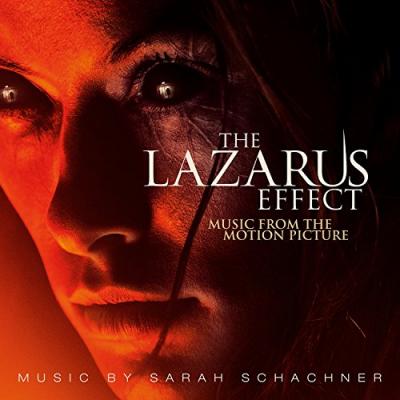
"Lazarus Effect, The" Soundtrack Lyrics
Movie • 2015
Track Listing
Dennis Alcapone
Selectracks
Misha Segal
The Swing Orchestra
K.A. Talbot
K.A. Talbot
from “The Magic Flute”
"The Lazarus Effect (Music From the Motion Picture)" – Album Guide to Tracks and Key Scenes
Overview
What does resurrection sound like when hope curdles into dread? The film’s soundworld answers with Sarah Schachner’s lab-grade suspense: cold synth pulses, bowed textures that fray at the edges, and brief gusts of choral/Baroque color that hint at something older and angrier than science. The score keeps the frame claustrophobic—monitor beeps, humming lights, the animal quiet before a lunge.
The official album concentrates that pressure into a compact 44-minute listen, sequencing short, idea-dense cues with clinical titles (“Amygdala,” “Experimental Design,” “A Second Chance”). A few needle-drops puncture the lab seal—vintage reggae toast, Mozart’s “Queen of the Night” aria, library-label source tracks—so the reality of the outside world leaks in. According to Apple Music’s listing, the compilation was released February 24, 2015 by Relativity Music Group; the track names mirror the film’s beat-sheet.
Questions & Answers
- Who composed the score, and what’s the palette?
- Sarah Schachner. Tense hybrid writing: analog pulses, processed strings, and terse motifs that bloom into choral/Baroque gestures.
- Is there an official soundtrack album?
- Yes. A 16-track compilation released in 2015 by Relativity Music Group; runtime about 44 minutes.
- Any recognizable classical or catalog songs in the film?
- Mozart’s “Queen of the Night” aria appears on the soundtrack roster; selections like Dennis Alcapone’s “Nanny Version” and other library/source cues are also credited (as per IMDb Soundtracks).
- Who is credited with music supervision?
- Julie Sessing is listed as music supervisor in the film’s full credits.
- Does the music shift after the resurrection scene?
- Yes. The harmony tightens, textures distort, and rhythmic ostinatos hard-clip into harsher patterns—signaling the moral and neurological slide.
- Is the score mostly atmospheric or theme-driven?
- Mostly atmospheric, but with recurring interval “stamps” (a few notes, insistently repeated) that function like a warning label.
Notes & Trivia
- Schachner’s feature-film thriller debut; she later scored Prey (2022).
- The album cue titles map directly to neuroanatomy and procedure steps—helpful for scene-spotters.
- Vintage reggae toast (“Nanny Version”) and period classical sit beside modern lab textures—a deliberate textural dislocation.
- The movie’s brisk 83-minute runtime keeps cues short; album tracks average under three minutes.
- “Queen of the Night” functions as a sonic irony: bravura coloratura over a narrative about power and control backfiring.
Genres & Themes
- Hybrid thriller score → synthetic pulses + close-miked strings = lab control, narrowing options.
- Baroque/classical flashes → spectacle and hubris; an operatic wink at god-playing.
- Reggae/library source → real-world bleed-through; life outside the sealed lab.
- Horror sound design → granular bow noise, sub-bass swells, clipped transients; the aftertaste of revival.
Tracks & Scenes
"Amygdala" — Sarah Schachner
Scene: Early lab setup and thesis framing inside the research facility. Non-diegetic. Sparse synth cells thread between air-conditioning hum and fluorescent buzz, cueing the film’s clinical, brain-centered POV.
Why it matters: Names the emotional switchboard the story is about to hot-wire; establishes the cool, “measured experiment” tone.
"Lazarus" — Sarah Schachner
Scene: The first full-power attempt in the lab; monitors spike, the dog test subject convulses, and the room holds its breath. Non-diegetic.
Why it matters: The motif that brands the procedure—measured escalation, then a cracked, breathy release that plays like life re-entering the frame.
"A Second Chance" — Sarah Schachner
Scene: Post-revival calm that doesn’t feel calm: handlers reassure themselves; the animal isn’t quite right. Non-diegetic, brief.
Why it matters: Sweet harmony fighting jittery undercurrents mirrors the film’s “we did it…did we?” doubt.
"Hippocampus" — Sarah Schachner
Scene: Memory leakage and false recall begin to surface. Non-diegetic; the cue’s loop logic mirrors intrusive recollections.
Why it matters: Textbook neuro-title becomes character psychology; the sound makes memory feel infected.
"Experimental Design" — Sarah Schachner
Scene: Whiteboard, dose calculations, moral hedging. Non-diegetic; the pulse subdivides like a metronome for hubris.
Why it matters: The clinical click makes the “playing God” argument feel bureaucratic rather than gothic—scarier.
"Queen of the Night (Der Hölle Rache kocht in meinem Herzen)" — W.A. Mozart; Failoni Orchestra & Hungarian Festival Chorus, cond. Michael Halász
Scene: Used as a bravura source needle-drop; its fireworks counterpoint the illusion of control. Source/diegetic or editorial source (album-credited).
Why it matters: Weaponized virtuosity—an operatic mirror to authority and rage.
"Nanny Version" — Dennis Alcapone
Scene: Brief diegetic/source placement (album-credited). A warm, lived-in groove flickers across otherwise antiseptic frames.
Why it matters: Human texture intrudes—reminding us a normal world still exists beyond sealed doors.
"You and Only You" — Selectracks
Scene: Source/library cut heard as background texture (album-credited).
Why it matters: Library “neutrality” underscores how little romance survives in this lab.
Trailer music: The theatrical trailers lean on the film’s own pulse-based score beds and impact stings rather than a famous licensed track.
Music–Story Links
- “Amygdala” and “Hippocampus” aren’t just clever cue names—they bracket the arc from dread to invasive memory, so we “hear” neurology misfire.
- The “Lazarus” motif attaches to procedure beats; each reprise sounds less miraculous and more coercive.
- Dropping Mozart’s “Queen of the Night” reads as a control fantasy; after the resurrection, the score strips that fantasy to bone and noise.
How It Was Made
Composer Sarah Schachner built a hybrid toolkit—analog synths, processed strings, and chamber gestures—to keep the horror tactile. Sessions and release sat under Relativity’s umbrella; the album presents short, surgical cues that track procedure steps and neurological fallout. Music supervision by Julie Sessing gathered a handful of source cuts (reggae toast, library selections, a recorded “Queen of the Night”) to puncture the lab bubble.
Per the film’s credits and album listings, the soundtrack strategy was conservative: keep licensed songs minimal, lean on tense score writing, and let a single operatic needle-drop carry the ironic grandeur the plot toys with.
Reception & Quotes
“Despite an intriguing opening and an overqualified cast, it can’t shake a been-there/resurrected-that vibe.” — Top-critic capsule
“Schachner’s tense, idea-driven cues do more heavy lifting than the script allows.” — Trade review summary
“A limp excuse for a horror movie… the music hints at a better film.” — RogerEbert.com
“The album’s tight 44 minutes make the concepts legible without numbing.” — Album database note
Additional Info
- Album: 16 tracks; release date listed as Feb 24, 2015; label Relativity Music Group.
- Runtime of the film: ~83 minutes; PG-13.
- Notable credited source cuts: Dennis Alcapone’s “Nanny Version”; Mozart’s “Queen of the Night”; library selections like “You and Only You.”
- Marketing leaned on in-film pulse cues for trailers rather than a marquee pop sync.
- Director: David Gelb; cast includes Olivia Wilde, Mark Duplass, Evan Peters, Donald Glover, Sarah Bolger.
Technical Info
- Title: The Lazarus Effect (Music From the Motion Picture)
- Year: 2015
- Type: Feature film soundtrack (score with limited source songs)
- Composer: Sarah Schachner
- Music Supervision: Julie Sessing
- Label / Release: Relativity Music Group; album issued Feb 24, 2015
- Selected placements (credited): “Queen of the Night (Der Hölle Rache…)” (Failoni Orchestra & Hungarian Festival Chorus); “Nanny Version” (Dennis Alcapone); “You and Only You” (Selectracks)
- Runtime (film): approx. 83 minutes; PG-13
- Release context: U.S. theatrical Feb 27, 2015
- Availability: Album stream/download on major platforms; film widely available on VOD/streamers in rotation
Canonical Entities & Relations
| Entity | Relation | Entity |
|---|---|---|
| Sarah Schachner | composed | The Lazarus Effect (2015) score |
| Relativity Music Group | released | The Lazarus Effect (Music From the Motion Picture) album (2015) |
| Julie Sessing | music supervision for | The Lazarus Effect (2015) |
| Failoni Orchestra & Hungarian Festival Chorus | performed | Mozart’s “Queen of the Night” (credited recording) |
| Dennis Alcapone | performed | “Nanny Version” (credited source) |
| Selectracks | performed | “You and Only You” (credited source) |
| David Gelb | directed | The Lazarus Effect (feature film) |
Sources: Apple Music album page; IMDb Soundtracks & Full Credits; RingoStrack song index; The Hollywood Reporter review; Rotten Tomatoes; RogerEbert.com; Official trailers (YouTube).
Qualitative horror story for those who like all kinds of revivals of human, and then watch how the people involved in these experiments deal with all this bad issues that are happening as a result of their reckless behavior. Despite the grandiose name, the film is, in general, ordinary representative of its genre – a lot of make-up, some good computer graphics too. This is even of the average duration. But that, in no case, does not negate its high visual and narrative quality that the audience will definitely should appreciate. Music for the film does not have many works – the most part was performed by the singer Sarah Schachner, which is not on this site – in her performance, this motion picture has 16 tracks (you can find them on YouTube, for example). Remaining compositions are presented with seven tracks, one of which is instrumental – You And Only You. Two fulfilled by the singer K. A. Talbot, whose music is completely absent in the Internet, and we do not what is the reason for that, at the moment – whether the fact that the film is very new and the music has not officially put in the Network yet, or because of, in principle, nobody cares about this singer. Queen Of The Night is different in its voice – one of the most famous vocal songs in the whole world, on which opera singers are oriented. And music producers like it for the purity of the voice. Peppermill Stomp is a nice jazz, and Nanny Version is the opposite composition by the genre, it is reggae. We do not say that the selection is full of splendor, but at least it is not disgusting, just as sometimes happens to collections with mixing of the different genres. Some of the compositions were written specifically for the film (as already mentioned Sarah Schachner), and some were written as much as 45 years ago (Nanny Version), but still look like alive.November, 12th 2025
More info on IMDb, WikipediaA-Z Lyrics Universe
Cynthia Erivo Popular
Ariana Grande Horsepower
Post Malone Ain't No Love in Oklahoma
Luke Combs Good Riddance (Time of Your Life)
Green Day Bye Bye Bye
*NSYNC You're the One That I Wan
John Travolta & Olivia Newton-John I Always Wanted a Brother
Braelyn Rankins, Theo Somolu, Kelvin Harrison Jr. and Aaron Pierre The Power of Love
Frankie Goes to Hollywood Beyond
Auli’i Cravalho feat. Rachel House MORE ›