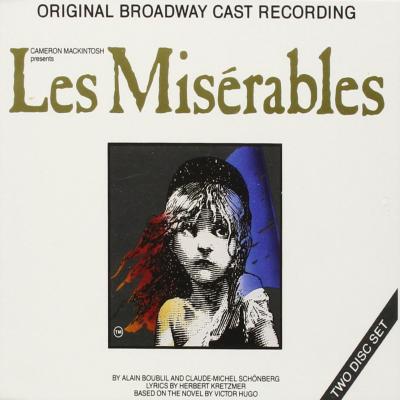
"Les Miserables" Soundtrack Lyrics
Musical • 1987
Track Listing
Les Miserables Cast
"Les Misérables (Original Broadway Cast Recording)" – Album Guide to Tracks and Key Scenes
Overview
Can a sung-through epic make a double LP feel like a novel? The 1987 Original Broadway Cast Recording of Les Misérables answers with through-composed storytelling, leitmotifs tied to each character, and choral weight that turns Paris into an echo chamber of fate. It compresses Victor Hugo’s sweep into set pieces that play like cinematic reels—factory to courtroom, barricade to sewers—yet holds onto intimate confessions.
Captured to coincide with the Broadway premiere at the Broadway Theatre (opening March 12, 1987), the album crystallizes the American company’s sound—Colm Wilkinson’s searing Valjean, Terrence Mann’s implacable Javert, Patti LuPone’s bruised Fantine, and a young ensemble that drives the barricade choruses. Released on Geffen Records in 1987, it became a reference point for later revivals and sold well over a million copies in the U.S., even though—like the London set before it—it trims a few brief narrative links to fit an album arc (as noted by cast-album and show histories).
Questions & Answers
- What’s unique about the Broadway cast album compared to the London one?
- Rebalances a few tempos/edits and reflects Broadway orchestral/choral blend; some narrative bridges are shortened while headline numbers remain intact.
- How “complete” is it?
- It’s a substantial but not complete document; brief connective scenes (e.g., short arrests, cart sequence, battle fragments) are condensed for album flow.
- Who are the principal voices?
- Colm Wilkinson (Jean Valjean), Terrence Mann (Javert), Patti LuPone (Fantine), Randy Graff (Éponine), Michael Ball’s role is on later recordings; Broadway’s Marius is David Bryant; Rebecca Caine sings Cosette.
- What label released it and when?
- Geffen Records, 1987, first issued as a 2-LP/cassette and later on CD and streaming.
- Did it win major awards?
- Yes. The album took the GRAMMY for Best Musical Cast Show Album at the 30th GRAMMY Awards (1988).
- When did Broadway open?
- March 12, 1987, at The Broadway Theatre, after a Kennedy Center tryout; it ultimately ran 6,680 performances.
Notes & Trivia
- It’s the U.S. counterpart to the 1985 London album; both omit some underscored transitions, while the 1988 Complete Symphonic Recording documents the score end-to-end.
- Early U.S. pressings carried Geffen catalog numbers (including GHS 24151 for LP configurations).
- Sales milestones for the Broadway set outpaced the London disc in the U.S., helped by touring and broadcast performances.
- Many later productions adopt this album’s key tempi and ensemble balances as a baseline.
Genres & Themes
Through-composed pop-opera → recurring motifs (Valjean’s prayer line; Javert’s dotted-rhythm pursuit) glue scenes and timeskips.
Revolutionary choral writing → men’s chorus and counter-melodies (students vs. army) harden into percussive blocks; “One Day More” braids motif counterpoint like a finale before the finale.
Confessional ballads → plain diction over pedal tones—Fantine’s aria, Éponine’s torch, Valjean’s midnight soliloquy—keep private stakes audible within spectacle.
Tracks & Scenes
“At the End of the Day” — Company
Where it plays: Act I, after the prologue’s time jump to Montreuil-sur-Mer; factory and town chorus drive the class grind.
Why it matters: Establishes social pressure that will snap Fantine’s storyline and shadow Valjean’s reform (diegetic within the musical world; staged as public bustle).
“I Dreamed a Dream” — Fantine
Where it plays: Act I, immediately after Fantine’s dismissal; a private aria on a public street corner.
Why it matters: Personalizes the economic cruelty we just heard in chorus; the Broadway cut favors a steady, unhurried climb.
“The Confrontation” — Valjean & Javert
Where it plays: Act I, police station aftermath; two vocal lines collide over martial ostinati.
Why it matters: States the moral argument—law vs. grace—that the album revisits at the barricade and in Javert’s crisis.
“Master of the House” — Thénardier, Madame Thénardier & Company
Where it plays: Act I, Montfermeil inn; comic relief with acidic bite.
Why it matters: Satire as survival manual; the Broadway album’s crowd mics make the pub feel packed.
“Stars” — Javert
Where it plays: Act I night watch.
Why it matters: Javert’s creed pinned to celestial order; the steady 12/8 makes inevitability feel like prayer.
“Red and Black” / “Do You Hear the People Sing?” — Students
Where it plays: Act I, ABC Café to street.
Why it matters: Private debate flips to public anthem; Enjolras’s rhetoric gains a march the whole city can hear.
“In My Life” / “A Heart Full of Love” — Cosette, Marius, Éponine
Where it plays: Act I, Rue Plumet garden vigil.
Why it matters: The love triangle locks in; countermelodies foreshadow Act II’s heartbreak.
“One Day More” — Company
Where it plays: Act I finale; seven threads interleave.
Why it matters: Cast-album apotheosis—counterpoint summarizing everyone’s motive in one harmonic engine.
“On My Own” — Éponine
Where it plays: Act II, night rain before the barricade fully rises.
Why it matters: A torch song that resets the triangle from Éponine’s view; the Broadway phrasing leans conversational over belted peaks.
“A Little Fall of Rain” — Éponine & Marius
Where it plays: Act II, under fire at the barricade.
Why it matters: Intimacy at war-scale; orchestration thins so breath and tremor carry.
“Bring Him Home” — Valjean
Where it plays: Act II midnight prayer above sleeping students.
Why it matters: Falsetto plea over sustained strings; the album preserves the held-note hush that audiences remember.
“Javert’s Suicide” — Javert
Where it plays: Act II bridge.
Why it matters: Motif inversion: the lawman’s certainty collapses into off-kilter harmonies and a final plunge.
“Empty Chairs at Empty Tables” — Marius
Where it plays: Act II aftermath in the café.
Why it matters: Survivor’s guilt as chamber ballad; the MIC mix keeps consonants crisp over hushed piano.
“Finale” — Company
Where it plays: Cemetery vision to epilogue chorus.
Why it matters: Reprises “Do You Hear the People Sing?” as moral epilogue—mercy outlives the barricade.
Music–Story Links
- Law vs. grace: Valjean’s prayer motif softens harmonically across acts; Javert’s dotted pursuit line refuses to bend—until it breaks.
- Private hope vs. public cause: love-theme counterpoint weaves into choral marches, fusing domestic desire with civic urgency.
- Memory as chorus: the finale reframes individual losses inside a communal voice, turning grief into promise.
How It Was Made
Music by Claude-Michel Schönberg; original French lyrics by Alain Boublil & Jean-Marc Natel; English libretto and lyrics by Herbert Kretzmer; produced on Broadway by Cameron Mackintosh. The Broadway cast album was issued by Geffen in 1987, with subsequent CD and digital editions. For a fully uncut document of the score, producers later assembled the Complete Symphonic Recording (1988/89) with an international cast.
As per production records, Broadway followed a late-1986 Kennedy Center run; opening night landed March 12, 1987. The recording reflects that staging’s balances—bigger brass in crowd scenes, close-mic intimacy in the arias—as carried in the pit and company vocals.
Reception & Quotes
The album rode the show’s momentum to strong U.S. sales and awards; it remains a go-to reference for performers and fans, even after newer cast recordings.
“A sung-through juggernaut whose recording plays like a film soundtrack.” AllMusic summary
“GRAMMY-winning cast album that helped cement Broadway’s late-’80s mega-musical era.” Recording Academy
Additional Info
- Common U.S. LP catalog reference: Geffen GHS 24151 (gatefold 2-LP).
- Streaming editions list ~1h 30m of material; some connective recitatives are omitted by design.
- For complete score study, compare this album to the 1989 Complete Symphonic Recording (entire score, different cast).
- The Broadway production became one of the longest-running shows; later revivals and tours often keep this album’s keys and tempos.
- Signature numbers frequently used in auditions: “On My Own,” “Stars,” “Bring Him Home,” “Empty Chairs at Empty Tables.”
Technical Info
- Title: Les Misérables (Original Broadway Cast Recording)
- Year: 1987 (album); Broadway opening March 12, 1987
- Type: Stage musical cast recording
- Music: Claude-Michel Schönberg
- Lyrics/Book (English): Herbert Kretzmer (lyrics); adaptation from Boublil & Natel’s French text
- Producers (stage): Cameron Mackintosh (lead producer)
- Label (album): Geffen Records
- Notable placements (by scene): “I Dreamed a Dream” (Fantine’s fallout), “One Day More” (Act I finale), “On My Own” (night rain), “Bring Him Home” (midnight prayer), “Empty Chairs at Empty Tables” (after the barricade)
- Awards: GRAMMY — Best Musical Cast Show Album (1988)
Canonical Entities & Relations
| Subject | Relation | Object |
|---|---|---|
| Les Misérables (1987 Broadway production) | opened at | The Broadway Theatre (New York), March 12, 1987 |
| Les Misérables (Original Broadway Cast Recording) | released by | Geffen Records (1987) |
| Claude-Michel Schönberg | composed | Les Misérables (score) |
| Alain Boublil & Jean-Marc Natel | wrote | original French lyrics/libretto |
| Herbert Kretzmer | adapted lyrics for | English version |
| Cameron Mackintosh | produced | 1987 Broadway production |
| Recording Academy | awarded | Best Musical Cast Show Album (1988) to the Broadway cast album |
Sources: AllMusic (album overview); Recording Academy/GRAMMYs; IBDB (opening/run); Wikipedia (musical & song order); Spotify & castalbums.org (timings/label); Discogs (LP catalog).
This soundtrack includes over 45 songs, some of which are additional to the main queue. This is not a movie, but a musical, which is the first long-running in the history of London’s West End and the second longest in the history of all times, if to consider out-of-Broadway ones too (if not – it is the #1 longest). There were over 25000 exhibitions all over the world of this histrionics. Les Misérables cast is the only performer of every song. ‘Empty Chairs at Empty Tables’ is one of the best-known performances in its body with very heart-touching lyrics. By the way, there is no such thing as a libretto here, there is only a plot, because the English version that is the most well-known to the audience is a sing-through and never spoken. This piece has been staged at 30+ countries and more than 220 cities on the globe. An interesting fact that at the opening, critics considered this piece unworthy at all, but the audience considered otherwise, all the time filling the halls tightly. This has left critics no other option but to change their thoughts for the better. The story is tearing the heart – we see France in its worst embodiment, where people suffer, starve and die for nothing (this overall gloomy mood is perfectly submitted in a song Dog Eats Dog). Where the person has no basic rights and must gnaw through his path in life just to be with a piece of food and rigid underlay to sleep. A person even asks numerous questions in ‘Who Am I?’, receiving no answer. But characters stay afloat and even try to love with all hearts in this extra-cruel world (‘A Heart Full of Love’). That is why it has become so popular amongst the audience and that is why people’s interest to most of CD recordings with inimitably heart-tearing lyrics of almost every song doesn’t cease for decades.November, 12th 2025
A-Z Lyrics Universe
Cynthia Erivo Popular
Ariana Grande Horsepower
Post Malone Ain't No Love in Oklahoma
Luke Combs Good Riddance (Time of Your Life)
Green Day Bye Bye Bye
*NSYNC You're the One That I Wan
John Travolta & Olivia Newton-John I Always Wanted a Brother
Braelyn Rankins, Theo Somolu, Kelvin Harrison Jr. and Aaron Pierre The Power of Love
Frankie Goes to Hollywood Beyond
Auli’i Cravalho feat. Rachel House MORE ›