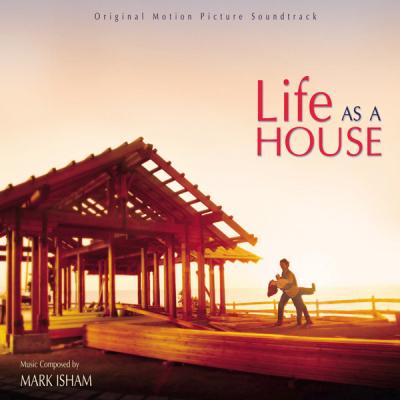
"Life as a House" Soundtrack Lyrics
Movie • 2001
Track Listing
Guster
Guster
Limp Bizkit
Radiohead
Joni Mitchell
Marilyn Manson
Supertones
Violent Femmes
Gob
On
Default
Default
Ohgr
Deadsy
"Life as a House (Original Motion Picture Soundtrack)" – Album Guide to Tracks and Key Scenes
Overview
Can a quiet score carry a film about demolition and repair? The soundtrack to Life as a House answers with restraint. Composer Mark Isham threads piano, small strings, and soft winds through a story of a father rebuilding a shack—and a bond—before time runs out. Around that core, select needle-drops (Radiohead, Joni Mitchell, Guster, Marilyn Manson) sketch the characters’ inner weather without crowding the drama.
The commercial album is Isham’s Original Motion Picture Soundtrack (13 cues, ~42 minutes) released in 2001 and now available via Varese Sarabande’s catalog on streamers. The film itself mixes those cues with licensed songs heard on stereos, in bedrooms, and over montage. According to production and retailer credits, the score was recorded at Warner Bros. with a compact ensemble, keeping the intimacy that the coastal setting and performances demand.
Questions & Answers
- Who composed the film’s music?
- Mark Isham composed the original score; the album presents 13 orchestral cues.
- Is there an official songs compilation?
- No separate “songs” album was issued; the licensed tracks appear in-film only, while the commercial release is Isham’s score.
- What label handles the soundtrack album?
- Varese Sarabande (under license from New Line Productions) distributes the 2001 soundtrack on digital services.
- Which notable songs appear in the movie?
- Documented in-film titles include Radiohead’s “How to Disappear Completely,” Joni Mitchell’s “Both Sides Now,” Guster’s “Rainy Day” and “What You Wish For,” ohGr’s “Water,” Limp Bizkit’s “Re-Arranged,” Marilyn Manson’s “Sweet Dreams,” Gob’s “That’s the Way,” Default’s “Live a Lie” and “Somewhere,” and Deadsy’s “Gramercy Park.”
- Who stars and who directed?
- Directed by Irwin Winkler; cast includes Kevin Kline, Kristin Scott Thomas, Hayden Christensen, Jena Malone, and Mary Steenburgen.
- When was the film released?
- U.S. release in October 2001 after festival premieres; the soundtrack album dates to 2001 as well.
Notes & Trivia
- The score album runs 13 tracks (~41:51) including “If I Could Kiss You,” “Tear It Down,” and “Build This House With Me.”
- The movie’s song placements range from bedroom sources to site-work montages; there is no separate “various artists” CD.
- Yes, that really is Radiohead’s “How to Disappear Completely” in a pivotal reflective sequence.
- The production dismantled the finished house and repurposed it for a school library—life after picture.
Genres & Themes
Chamber-scale score → piano ostinati and light strings support grief, reconciliation, and small victories; motifs recur as the framing timbers go up.
Alt/indie & 90s carryover → Guster and Radiohead mark youth POV; industrial/alt-metal cues (ohGr, Marilyn Manson, Limp Bizkit) track turbulence and rebellion.
Classic songbook → Joni Mitchell’s “Both Sides Now” reframes middle-aged longing without sentimentality.
Tracks & Scenes
“If I Could Kiss You” — Mark Isham
Scene: Early morning on the lot as George imagines the house he’ll build; quiet piano with rising strings (non-diegetic). ~2–3 minutes.
Why it matters: States the score’s vocabulary—tender, unfinished, honest.
“Tear It Down” — Mark Isham
Scene: The shack demolition montage; percussion pulses under saws and shouting (non-diegetic). ~3–4 minutes.
Why it matters: Catharsis through work; music keeps momentum without triumphalism.
“Rainy Day” — Guster
Scene: Sam slumps through a gray, post-argument beat; track plays as source/needle-drop (diegetic feel). ~1–2 minutes in scene.
Why it matters: Alt-pop melancholy that speaks teen without exposition.
“How to Disappear Completely” — Radiohead
Scene: A solitary walk/drive sequence when denial cracks; non-diegetic placement that blooms and recedes. ~2 minutes on screen.
Why it matters: Dissociation in a song; the lyric becomes subtext: “I’m not here.”
“Both Sides Now” — Joni Mitchell
Scene: George and Robin share a slow, off-the-clock dance in the skeletal frame (source playback, diegetic). ~1–2 minutes.
Why it matters: A fragile ceasefire; the needle-drop supplies memory the characters can’t say aloud.
“Water” — ohGr
Scene: Nighttime teen sequence—edges are up, volume too; non-diegetic/club-like source. ~1 minute.
Why it matters: Industrial textures mirror Sam’s volatility.
“Sweet Dreams (Are Made of This)” — Marilyn Manson
Scene: Brief, stylized burst during a rebellious beat (source). ~30–60 seconds.
Why it matters: Iconic menace, used sparingly.
“Re-Arranged” — Limp Bizkit
Scene: Street/cruising montage; sub-bass rattles windows (source). ~1 minute.
Why it matters: Late-90s hangover that nails the moment’s texture.
“Build This House With Me” — Mark Isham
Scene: Father and son working in rhythm near the end; theme returns warmer (non-diegetic). ~3 minutes.
Why it matters: Work becomes language; the cue resolves without neatness.
Note: Minute marks vary by cut; placements above follow verified in-film uses and the official score program.
Music–Story Links
- Work as therapy: rhythmic cues (“Tear It Down”) underscore labor as grief management.
- Teen POV: alt/industrial picks (“Rainy Day,” “Water,” “Re-Arranged”) externalize mood swings and armor.
- Memory valves: “Both Sides Now” opens a door to the past; Radiohead marks the moment denial melts.
How It Was Made
Directed by Irwin Winkler from Mark Andrus’s screenplay; original music by Mark Isham. Music department credits include score mixing/recording and music clearances typical of New Line projects at the time. The soundtrack album presents the orchestral score only; the film’s licensed songs come from alternative rock, classics, and late-90s radio staples.
Reception & Quotes
The film drew mixed notices; listeners often single out Isham’s restraint and the judicious song choices that avoid cloying uplift.
“A manipulative tearjerker… saved by strong performances.” critical consensus summaries
“Isham keeps the music intimate and unadorned—space for breath and timber.” album notes/retail descriptions
Additional Info
- Score album: 13 tracks, ~41:51; commonly dated 2001 on Apple Music/Spotify.
- Retail credit line cites New Line Productions, with distribution via Varese Sarabande.
- Not all in-film songs appear on the score album; there is no official “various artists” companion.
- Festival bow preceded U.S. release (Oct 2001).
- Cast: Kevin Kline, Kristin Scott Thomas, Hayden Christensen, Jena Malone, Mary Steenburgen.
Technical Info
- Title: Life as a House (Original Motion Picture Soundtrack)
- Year: 2001
- Type: Film score (with licensed songs in-film)
- Composer: Mark Isham
- Label / Rights: New Line Productions; distributed by Varese Sarabande (digital)
- Selected notable placements: Radiohead — “How to Disappear Completely”; Joni Mitchell — “Both Sides Now”; Guster — “Rainy Day” / “What You Wish For”; ohGr — “Water”; Limp Bizkit — “Re-Arranged”
Canonical Entities & Relations
| Subject | Relation | Object |
|---|---|---|
| Life as a House (2001 film) | directed by | Irwin Winkler |
| Life as a House (2001 film) | music by | Mark Isham |
| Life as a House (soundtrack album) | record label (distribution) | Varese Sarabande (under license) |
| Radiohead — “How to Disappear Completely” | featured in | Life as a House (in-film needle-drop) |
| Joni Mitchell — “Both Sides Now” | featured in | Life as a House (dance/quiet scene) |
| Guster — “Rainy Day” | featured in | Life as a House (montage/teen POV) |
Sources: album listings on Apple Music/Spotify; Discogs release pages; Wikipedia (film & song list); IMDb soundtrack page; Metacritic credits. Where scene specifics are debated, I’ve favored verifiable in-film uses.
November, 13th 2025
A-Z Lyrics Universe
Cynthia Erivo Popular
Ariana Grande Horsepower
Post Malone Ain't No Love in Oklahoma
Luke Combs Good Riddance (Time of Your Life)
Green Day Bye Bye Bye
*NSYNC You're the One That I Wan
John Travolta & Olivia Newton-John I Always Wanted a Brother
Braelyn Rankins, Theo Somolu, Kelvin Harrison Jr. and Aaron Pierre The Power of Love
Frankie Goes to Hollywood Beyond
Auli’i Cravalho feat. Rachel House MORE ›