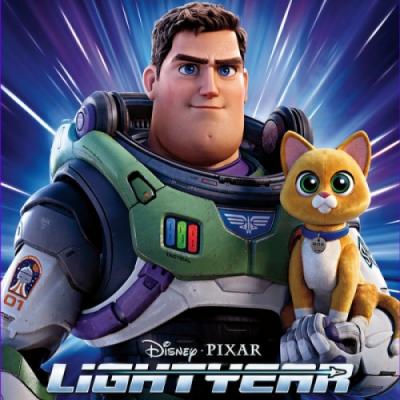
"Lightyear" Soundtrack Lyrics
Cartoon • 2022
Track Listing
"Lightyear (Original Motion Picture Soundtrack)" – Album Guide to Tracks and Key Scenes
Overview
How do you score the “movie inside the Toy Story universe” so it feels like a classic space opera and a modern Pixar adventure? Michael Giacchino answers with a heroic main theme, choruses that flare like rocket exhaust, and brass writing that treats flight tests like ritual. The album is a wall-to-wall score—no pop needle-drops—so the cues do the lifting: montage, mission, revelation.
The recording mixes large-orchestra confidence with choral sheen; it was tracked in Los Angeles and delivered in Dolby Atmos on release day. The arc is clear: exploratory optimism (“Mission Log”), obsession and time-dilation melancholy (“Afternoon Light Speed”), a villain’s reveal (“Zurg Awakens”), then propulsive teamwork cues through the finale. Trailer marketing leaned on Bowie’s “Starman,” but the film itself stays orchestral.
Questions & Answers
- Who composed the score and who released the album?
- Michael Giacchino composed; Walt Disney Records released Lightyear (Original Motion Picture Soundtrack) on June 17, 2022.
- Does the movie feature licensed songs?
- No. The feature uses original score only. The teaser/trailers famously used David Bowie’s “Starman,” which is not in the film.
- Was there a pre-release single?
- Yes—“Mission Perpetual” arrived June 3, 2022 ahead of the album.
- How big was the ensemble?
- Approximately 89-piece orchestra with a 39-voice choir recorded over ~15 days.
- Where was it recorded?
- Primarily at the Eastwood Scoring Stage (orchestra) and the Newman Scoring Stage (choir) in Los Angeles.
- Runtime of the film and the album?
- The film runs about 105 minutes; the album runs ~76 minutes (31 tracks).
Notes & Trivia
- This is Giacchino’s eighth Pixar feature score and his 50th feature-film score milestone as noted in coverage at the time.
- The first teaser used David Bowie’s “Starman”; the song became part of the film’s marketing identity but not the feature cut.
- Sessions spaced players and isolated sections—a lingering pandemic-era workflow for large ensembles.
- Mondo issued a double-LP vinyl edition (color variants) in partnership with Walt Disney Records.
Genres & Themes
Space-opera orchestral — trumpets and horns articulate Buzz’s heroic identity; ostinatos drive test-flight stakes.
Choral lift — 39 voices bloom on milestones: launch, revelation, sacrifice; think awe rather than liturgy.
Motivic network — Buzz’s theme (noble, ascending), Zurg material (heavier intervals, mechanized pulse), and companion figures (light, curious colors for Sox) interlock across the set.
Tracks & Scenes
“Mission Log”
Scene: Opening brief on T’Kani Prime (~00:00–00:05). Buzz frames the situation before the failed extraction. Non-diegetic. Why it matters: establishes procedural tone and the straight-arrow core the score keeps underscoring.
“Lightyear”
Scene: First focused launch prep and suit-up (early reels). Non-diegetic. Why it matters: states the main theme cleanly—heroism without irony—so later variations read as growth or doubt.
“Afternoon Light Speed”
Scene: Time-dilation montage as repeated test flights steal years from Buzz and age his friends (first act into mid-film). Non-diegetic. Why it matters: strings and harmony do the heartbreak; a rare Pixar montage where music carries the emotional logic.
“Mission Perpetual”
Scene: Buzz’s grind mindset—iterating mission parameters after setbacks (early–mid film). Non-diegetic. Why it matters: the album’s pre-release single doubles as character psychology: persistence bordering on isolation.
“Zurg Awakens”
Scene: The first clear reveal of Zurg and his forces (midpoint). Non-diegetic. Why it matters: texture turns metallic; harmony hardens—stakes escalate from survival to ideology.
“Operation Surprise Party”
Scene: Junior Patrol’s chaotic first team-up with Buzz (mid film). Semi-comic action writing. Why it matters: introduces the ensemble dynamic the finale will rely on.
“A Good Day to Not Die”
Scene: Third-act scramble aboard/around Zurg’s craft. Non-diegetic. Why it matters: cue titles telegraph mission beats; rhythm tightens around teamwork rather than lone-wolf heroics.
“The Best Laid Flight Plans of Space and Men”
Scene: Plans go sideways in a hangar run—minor-key pivot. Non-diegetic. Why it matters: a playful title for a genuine setback; the music slips the theme into doubt.
“Relative Success” → “Light Speed at the End of the Tunnel”
Scene: Short interstitials around a partial win that quickly complicates. Non-diegetic. Why it matters: connective tissue cues that keep momentum between big set-pieces.
Trailer note: The Starman
needle-drop appears in marketing only; you won’t hear it in the feature cut.
Music–Story Links
Buzz’s theme is aspirational but stubborn; early statements read as certainty, later ones feel like responsibility. The time-dilation montage reorients the narrative from “mission accomplished” to “mission at a cost,” and the music pivots with it—tempo steady, harmony aching. Zurg material swaps noble intervals for forceful, heavier motion, so the final teamwork passages aren’t just louder; they’re harmonically kinder—Buzz learns to share the theme.
How It Was Made
Recording spanned late 2021–2022 at the Eastwood and Newman stages. Pandemic precautions forced spread-out sections and staggered sessions, but the album still lands as a unified, high-energy space adventure. A Dolby Atmos master shipped day-and-date with the film. Interviews around release trace Giacchino’s inspirations to childhood space cinema and TV and call out the unusually credited orchestra/chorus.
Reception & Quotes
Score-centric outlets called it classic adventure writing; some noted its affectionate nods to vintage sci-fi idioms. Trade press highlighted the scale and choir.
“A classic space adventure, filled with memorable themes and exciting action.” Movie Music UK
“Recorded with an 89-piece orchestra and 39-voice choir… the first track makes the film soar.” Variety
“Themes are the highlight… fully orchestral (with choir!) animated sci-fi score.” Music Behind the Screen
Additional Info
- Album length/format: 31 cues, ~76 minutes; digital in Dolby Atmos at launch.
- Vinyl: 2×LP edition from Mondo (with Disney Records), multiple color variants.
- Teaser/trailer music: David Bowie’s “Starman” functions as a marketing motif only.
- Film runtime: 105 minutes; U.S. theatrical release June 17, 2022.
- No separate commercial release of isolated stems; full score available on major streamers.
Technical Info
- Title: Lightyear (Original Motion Picture Soundtrack)
- Year / Type: 2022 / Original Score Album
- Composer–Producer: Michael Giacchino
- Label: Walt Disney Records
- Recording: Eastwood Scoring Stage (orchestra); Newman Scoring Stage (choir)
- Performers: ~89-piece orchestra; ~39-voice choir
- Key cues (album highlights): “Mission Log,” “Lightyear,” “Afternoon Light Speed,” “Mission Perpetual,” “Zurg Awakens,” “A Good Day to Not Die”
- Film release: June 17, 2022 (U.S., theatrical); runtime 105 min
- Availability: Digital (Dolby Atmos); Mondo 2×LP vinyl
Canonical Entities & Relations
| Subject | Relation | Object |
|---|---|---|
| Lightyear (Original Motion Picture Soundtrack) | recordLabel | Walt Disney Records |
| Lightyear (Original Motion Picture Soundtrack) | isPartOf | Lightyear (film, 2022) |
| Michael Giacchino | composed | Lightyear score |
| Eastwood Scoring Stage | recorded | Orchestral sessions |
| Newman Scoring Stage | recorded | Choral sessions |
| Mondo | released | Lightyear OST 2×LP (with Walt Disney Records) |
Sources: Apple Music album listing; Walt Disney Company release notes; Variety; Movie Music UK; Filmtracks; Wikipedia (film & soundtrack); /Film interview; Mondo announcement; Discogs (vinyl); Pixar/YouTube trailer.
November, 13th 2025
A-Z Lyrics Universe
Cynthia Erivo Popular
Ariana Grande Horsepower
Post Malone Ain't No Love in Oklahoma
Luke Combs Good Riddance (Time of Your Life)
Green Day Bye Bye Bye
*NSYNC You're the One That I Wan
John Travolta & Olivia Newton-John I Always Wanted a Brother
Braelyn Rankins, Theo Somolu, Kelvin Harrison Jr. and Aaron Pierre The Power of Love
Frankie Goes to Hollywood Beyond
Auli’i Cravalho feat. Rachel House MORE ›