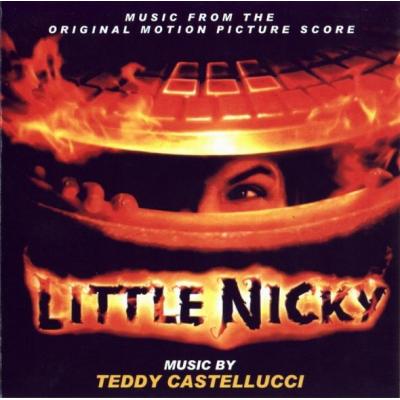
"Little Nicky" Soundtrack Lyrics
Movie • 2000
Track Listing
P.O.D.
Incubus
Deftones
Cypress Hill
Insolence
Linking Park
Disturbed
Unloco
Powerman 5000
Muse
Filter
Deftones
"Little Nicky (Music From the Motion Picture)" – Album Guide to Tracks and Key Scenes
Overview
How do you make a devil-on-earth comedy feel like a nu-metal block party? Little Nicky answers by leaning hard on late-90s/2000 alt-metal and rap-rock—then seasoning it with classic-rock gags. The commercial album, released by Maverick Records on October 31, 2000, packs P.O.D., Incubus, Deftones, Cypress Hill, Linkin Park, Disturbed, Muse, Filter, Powerman 5000 and more, while the film itself quotes Chicago, Van Halen, AC/DC and Ozzy Osbourne in key jokes and needle-drops.
On screen, Teddy Castellucci’s score handles supernatural stingers and chase beats; the record supplies attitude. The movie’s most quoted music moment isn’t even heavy: Nicky plays a Chicago LP backwards to “prove” subliminal devil talk—one of several music-culture riffs the film trades on.
Questions & Answers
- Who composed the score?
- Teddy Castellucci composed the original score for the film.
- What label released the soundtrack album?
- Maverick Records released Little Nicky (Music From the Motion Picture) on October 31, 2000.
- Are all songs on the album used in the film?
- No. Two album cuts were not in the movie, and several songs heard in the film (e.g., Van Halen, AC/DC, Ozzy, Chicago) are not on the album.
- Which metal legend appears in the film?
- Ozzy Osbourne makes a cameo; his solo tracks are also heard in the film.
- Is there an official list of cue titles for the score?
- Yes—collector listings document Castellucci’s score cues (e.g., “Grand Central Showdown,” “Basketball Battle”).
- What’s the Chicago song used for the “reverse” gag?
- “Does Anybody Really Know What Time It Is?”—played backwards in the apartment scene as a joke.
Notes & Trivia
- The film’s soundtrack album leans heavily on Maverick-signed artists (Deftones, Insolence, Muse, Ünloco) by design.
- Two album tracks do not appear in the final cut; conversely, many famous songs used in the film are absent from the album.
- The DVD’s “metal edge” extras include P.O.D.’s “School of Hard Knocks” music video.
- Ozzy Osbourne’s cameo caps the finale; his catalog is also excerpted on the soundtrack used in the film.
Genres & Themes
Nu-metal/rap-rock (P.O.D., Linkin Park, Disturbed, Cypress Hill) sells Nicky’s fish-out-of-hell chaos with chugging guitars and big drums. Alt-metal/industrial pulse (Deftones, Powerman 5000) underlines supernatural skirmishes. Classic-rock needle-drops (Chicago, Van Halen, AC/DC) fuel jokes about “devil music” and fan culture. Castellucci’s comic-fantasy score bridges scenes with brass stabs, string riffs and choir pads.
Tracks & Scenes
Selections combine on-album cuts and notable film-only cues/needle-drops. Scene descriptions match widely documented beats; where albums differ from the film, that status is noted.
"School of Hard Knocks" — P.O.D.
Scene: Used prominently in marketing and featured in the film’s music featurette; the track embodies Nicky’s rough-and-tumble New York acclimation (non-diegetic in promos; source/bed in film snippets).
Why it matters: Became the project’s calling-card single; its video appears in the official home-video extras.
"Pardon Me" — Incubus
Scene: Contemporary-rock bed during city montage moments as Nicky stumbles through mortal life (non-diegetic).
Why it matters: Places the film squarely in 2000’s alt-radio soundscape.
"Change (In the House of Flies)" — Deftones
Scene: Mood-builder over darker street interludes; guitar wash and drum weight sell creeping stakes (non-diegetic).
Why it matters: Gives the comedy a heavier edge without derailing it.
"(Rock) Superstar" — Cypress Hill
Scene: Hype cut for swagger beats around the brothers’ earthly power plays (non-diegetic).
Why it matters: Rap-rock crossover energy mirrors the movie’s “power trip” bits.
"Points of Authority" — Linkin Park
Scene: Aggressive montage underscoring chaos in mid-film city business (non-diegetic).
Why it matters: Early LP catalog placement that cements the soundtrack’s era-defining tone.
"Stupify (Fu’s Forbidden Little Nicky Remix)" — Disturbed
Scene: Fight-ready needle-drop for a burst of demonic action (non-diegetic).
Why it matters: A custom remix ties a radio hit directly to the film’s branding.
"When Worlds Collide" — Powerman 5000
Scene: High-energy cue for confrontational beats between Nicky and his brothers (non-diegetic).
Why it matters: Title doubles as plot summary: Hell vs. Earth, literally.
"Does Anybody Really Know What Time It Is?" — Chicago
Scene: In the apartment, Nicky spins the Chicago LP backwards to “find” a satanic message; the joke lands because the song is famously not that (diegetic gag).
Why it matters: The film’s most-shared music bit; flips 1970s back-masking myths into a punchline.
"Mama, I’m Coming Home" — Ozzy Osbourne
Scene: Heard on the film soundtrack during earthbound stretches; later echoed by Ozzy’s own cameo in the finale (non-diegetic; cameo separate).
Why it matters: Tethers the movie’s devil shtick to the actual Prince of Darkness—then brings him on screen.
"Runnin’ with the Devil" — Van Halen
Scene: Employed as an on-the-nose punchline in earthly mischief sequences (non-diegetic).
Why it matters: Title-as-joke usage that fits the movie’s sense of humor.
"Highway to Hell" — AC/DC
Scene: Brief, high-recognition needle-drop linking transit shots and underworld gags (non-diegetic).
Why it matters: Iconic riff equals instant context; no exposition needed.
"Bohemian Like You" — The Dandy Warhols
Scene: Source-style flavor in a city scene to underline downtown cool (diegetic/ambient).
Why it matters: Indie gloss among the metal; era-accurate placement.
Album vs. film: The Maverick CD contains 12 tracks; two of them are not used in the film. Conversely, many famous cues heard in the movie (Chicago, Ozzy, Van Halen, AC/DC, Kool & the Gang, Foo Fighters, Stacey Q, Scorpions, P.O.D.’s “Southtown” and “Rock the Party”) are not on the commercial album.
Music–Story Links
Rap-rock and nu-metal translate Nicky’s infernal heritage into earth noise—chugs and breakbeats punch up fish-out-of-water slapstick. The classic-rock drops work as punchlines: “Runnin’ with the Devil” and “Highway to Hell” literalize the gag, and the Chicago reverse-play flips Satanic-panic lore into a deflation joke. When Ozzy appears, the film cashes in the setup—myth becomes cameo.
How It Was Made
The soundtrack strategy mixes label synergy (Maverick’s roster fills much of the disc) with recognizable radio staples for mass appeal. Production notes and platform listings confirm the October 31, 2000 release, with the film itself using additional classics that couldn’t all clear for the album. The DVD’s extras underline the marketing plan: a metal-leaning feature and P.O.D.’s video placed the music up front for the home-video push.
Reception & Quotes
“A time-capsule of turn-of-the-millennium alt-metal—blunt, catchy, effective.” Album guide note
“The Chicago reverse-play joke is still the music-nerd moment everyone remembers.” Fan recollection
“Label-forward compilation, movie-forward cues—that split explains the album/film differences.” Reviewer summary
Additional Info
- Album release: Oct 31, 2000 (Maverick); 12 tracks, ~33–48 minutes depending on edition/platform.
- Film-only notable songs not on album: “Runnin’ with the Devil” (Van Halen), “Highway to Hell” (AC/DC), “Does Anybody Really Know What Time It Is?” (Chicago), multiple Ozzy Osbourne tracks, “Ladies’ Night” (Kool & the Gang), Foo Fighters “Everlong,” Stacey Q “Two of Hearts.”
- Score cue listings circulate among collectors (e.g., “Grand Central Showdown,” “Basketball Battle”).
- Home-video extras include P.O.D.’s “School of Hard Knocks” music video.
- Trailer/TV spots also leaned on P.O.D. (“Southtown”) beyond the album sequence.
Technical Info
- Title: Little Nicky — Music From the Motion Picture
- Year: 2000
- Type: Various Artists soundtrack + original score
- Score Composer: Teddy Castellucci
- Label (album): Maverick Records
- Album highlights: P.O.D. “School of Hard Knocks”; Incubus “Pardon Me”; Deftones “Change”; Cypress Hill “(Rock) Superstar”; Linkin Park “Points of Authority”; Disturbed “Stupify (Little Nicky Remix)”
- Notable film-only drops: Chicago “Does Anybody Really Know What Time It Is?”; Ozzy Osbourne selections; Van Halen “Runnin’ with the Devil”; AC/DC “Highway to Hell”
- Availability: Streaming (Spotify/Apple Music); physical CD/cassette/vinyl pressings documented by Discogs
Canonical Entities & Relations
| Subject | Verb | Object |
|---|---|---|
| Little Nicky (2000 film) | features score by | Teddy Castellucci |
| Little Nicky (Music From the Motion Picture) | released by | Maverick Records |
| Soundtrack album | includes | P.O.D., Incubus, Deftones, Cypress Hill, Linkin Park, Disturbed, Muse, Filter, Powerman 5000 |
| Film (not album) | includes | Chicago; Van Halen; AC/DC; Ozzy Osbourne |
| Ozzy Osbourne | appears as | Cameo in the finale |
Sources: Wikipedia film entry & soundtrack section; Apple Music album page; Spotify album page; Discogs master/release pages; IMDb Soundtracks & credits; SoundtrackINFO Q&A; DVD review notes for P.O.D. video.
November, 13th 2025
A-Z Lyrics Universe
Cynthia Erivo Popular
Ariana Grande Horsepower
Post Malone Ain't No Love in Oklahoma
Luke Combs Good Riddance (Time of Your Life)
Green Day Bye Bye Bye
*NSYNC You're the One That I Wan
John Travolta & Olivia Newton-John I Always Wanted a Brother
Braelyn Rankins, Theo Somolu, Kelvin Harrison Jr. and Aaron Pierre The Power of Love
Frankie Goes to Hollywood Beyond
Auli’i Cravalho feat. Rachel House MORE ›