Soundtracks:  A B C D E F G H I J K L M N O P Q R S T U V W X Y Z #


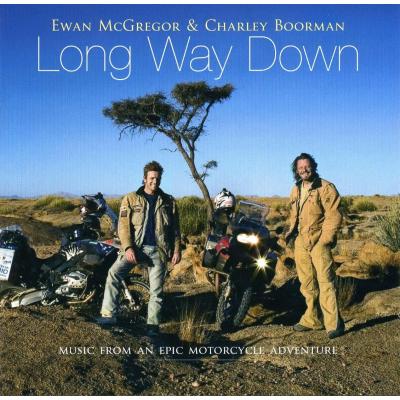
Long Way Down Album Cover

"Long Way Down" Soundtrack Lyrics

TV • 2008

Track Listing


"Long Way Down – Music from the Television Series" – Album Guide to Tracks and Key Scenes

Long Way Down TV documentary trailer thumbnail with Ewan McGregor and Charley Boorman on motorbikes
Long Way Down documentary series trailer still, BBC / 2007–2008

Overview

How do you score a journey that never really stops – a line on a map that runs from John o’ Groats all the way down to Cape Town? The soundtrack for the BBC documentary series Long Way Down answers that by treating music like a second road: every border crossing, every emotional spike, every quiet campsite gets its own sonic terrain.

"Long Way Down – Music from the Television Series" (often marketed as "Long Way Down (Music From The TV Series)") is a double-CD compilation built around Ewan McGregor and Charley Boorman’s 2007 ride through Europe and Africa. Real World Records curates material from its catalog plus a handful of new tracks, then ties it to the images of sand, tarmac, and checkpoint queues that define the show. Instead of generic “epic” underscore, you get songs that are rooted in the regions they ride through – Somali pop, East African acoustic music, Southern African guitar bands, and a thread of British and European artists that echo the riders’ own backgrounds.

The mood is less “adrenaline sports highlight reel” and more “on-the-road diary”. Downtempo electronica and ambient textures cover long stretches of highway. Acoustic pieces and vocal laments sit under UNICEF visits, memorials, and small village encounters. When the bikes hammer through mud or desert, the music leans into polyrhythmic percussion and driving basslines; when the crew reaches a lodge at dusk, acoustic guitars and choral lines slow the pulse.

Stylistically, the album jumps between world music, folk, soft rock, dub-inflected electronica and cinematic soundscape. That diversity is deliberate. Where Western rock and indie colours Ewan and Charley’s perspective, the African tracks centre the places and people they move through. Indie grit signals the riders’ vulnerability; East African acoustic pieces carry memory and grief; Nigerian and Tanzanian grooves turn border chaos into something like celebration. The result is a soundtrack that doesn’t just decorate the trip – it argues that the journey belongs to everyone they meet on the way.

How It Was Made

The TV series itself is produced by Big Earth, with Ewan McGregor, Charley Boorman, David Alexanian and Russ Malkin as creators. For the music, the key figure is Jimmy Simak, who doubles as co-director of photography and music supervisor / soundtrack producer. That means the same person framing the shots is also picking the tracks that sit under them – one reason picture and music feel tightly locked together.

Real World Records (the label co-founded by Peter Gabriel) partners with the production, opening its catalog for use in the show and building a standalone album. The label’s own description frames the record as an “epic motorbike adventure” in music form and highlights that it draws on artists like Geoffrey Oryema, Ayub Ogada, Joseph Arthur, Sheila Chandra, Adrian Sherwood, plus new material from projects such as Big Blue Ball and BT & Sasha, alongside a specially recorded title theme by Stereophonics.

The CD soundtrack is compiled by Amanda Jones from the tracks actually used in the series, plus a few that appear in alternate or extended edits. It was released on 3 December 2007 as a double CD through Real World Records in partnership with Virgin/EMI, with later pressings and digital versions sometimes simplifying the packaging or truncating the running time. AllMusic lists a 71-minute edition, while streaming versions commonly carry the full 30-track program.

Because much of the music predates the series (some tracks date back to the late 1980s and 1990s), this is less a bespoke, one-off film score and more a curated journey through Real World’s world-music roster. A German review on laut.de even calls it, half-critically, a Real World label sampler in disguise – a fair observation, but that “sampler” is exactly what gives the series its geographic breadth.

Long Way Down trailer frame showing adventure motorcycles on an African road
Production still from the Long Way Down TV trailer – the music follows the road as closely as the cameras

Tracks & Scenes

Below are some of the key musical moments across the six main broadcast episodes. Time markers are approximate (the episodes run around an hour each), but the scene beats are consistent across DVD and streaming cuts.

"Long Way Down" — Stereophonics
Where it plays: Main title theme across the series. It kicks in over the opening credits with fast intercut shots of maps, load-outs, and the bikes rolling through Scottish and African landscapes. Variations and reprises appear at the top or tail of episodes, especially the first and last, usually non-diegetic over montage.
Why it matters: The song is essentially the Long Way Round theme with “round” swapped for “down”, so it acts as a musical bridge between the two journeys. It gives the show a recognisable “brand jingle” – roots in British rock, but pared down enough to sit next to world-music cuts without clashing.

"Ever So Lonely/Eyes/Ocean" — Sheila Chandra
Where it plays: Episode 1, early on, when Ewan and Charley finally leave John o’ Groats and thread their way through dramatic Scottish mountain scenery. The track is non-diegetic, riding on top of long lens shots of the bikes carving through mist and valleys.
Why it matters: Chandra’s layered vocal textures and drones turn those first real riding shots into something almost meditative. Lyrically and harmonically, it hints at India rather than Africa, but emotionally it signals the idea that the “world” is already present before they ever leave Britain.

"Move" — Martyn Bennett
Where it plays: Episode 1, during the high-energy training sequence at Silverstone. The riders push the BMWs around the wet circuit, practice emergency stops, and test their limits while the tune surges underneath, purely non-diegetic.
Why it matters: The hyperactive fiddle and beat-driven production turn a safety exercise into a preview of later risk. It’s one of the few cues that channels pure speed and adrenaline, and it quickly re-centres the viewer after quieter planning scenes.

"Somali Udiida Ceb (Somalia, Don’t Shame Yourself)" — Maryam Mursal
Where it plays: Episode 2, once the team has left Europe, heading into North Africa. The Real World episode guide places Mursal’s music around their visit to the Roman ruins of Leptis Magna in Libya and early stretches of African riding. The song appears non-diegetically over sweeping terrain and architectural shots rather than live performance.
Why it matters: The track’s refrain and driving rhythm announce that the journey has truly left the riders’ cultural comfort zone. Mursal’s history as a Somali refugee adds an unspoken layer; the bikes glide through ancient ruins while a modern Somali voice talks, implicitly, about dignity and shame – a sharp counterpoint to tourist-style travelogue.

"O’ Mare" / "Santa Notte" — Spaccanapoli
Where it plays: Episode 2, during the descent through Italy and the ride along the Amalfi Coast. Jo Arthur’s “road traffic madness” in Rome and the winding coastal roads are underpinned by the Neapolitan band’s street-band brass and hand percussion, again in non-diegetic fashion.
Why it matters: This pairing is clever: before Africa, the soundtrack lets southern Europe feel almost like a different continent. The rough, celebratory energy of Spaccanapoli makes the ride through Italian chaos feel alive rather than merely stressful, and it marks the last “European” musical stop before the African-heavy tracklists kick in.

"Shadowman" — Afro Celt Sound System
Where it plays: Episode 3, as the group heads south to the pyramids of Giza. The Real World notes describe Afro Celt Sound System underscoring that approach; the track runs under wide shots of desert roads and the surreal sight of the pyramids rising out of the haze.
Why it matters: Afro Celt Sound System mix Irish and West African traditions with club-ready production, and that hybrid is a neat stand-in for the series itself – Western travellers moving through African spaces, with the camera (and music) trying to hold both viewpoints at once.

"Whole Thing (Original Mix)" — Big Blue Ball
Where it plays: Two key placements. Episode 3 uses it as the journey “takes on a more positive note” after hard desert days; Episode 6 brings it back as the team charges through the volcanic moonscapes and open spaces of southern Africa. Both are non-diegetic montage sequences, roughly mid-episode.
Why it matters: The track was an early teaser for the Big Blue Ball project, a long-gestating Peter Gabriel world-collaboration album. Here it becomes a statement about community; musically you can hear musicians from multiple countries, mirroring the parade of people the crew meets as they head south.

"Kothbiro" — Ayub Ogada
Where it plays: Episode 4, at the Kenyan school massacre memorial, and again in later episodes as a recurring motif around more reflective scenes. The cue sits under slow, respectful camera moves and interviews, entirely non-diegetic and mixed quite prominently.

Why it matters: This is one of the emotional centrepieces of the entire series. Ogada’s voice, the plucked nyatiti, and the song’s title (“it is going to rain”) give weight to what could easily have been a brief “issues” detour. Instead, the show lingers, and the music tells you to stay in that discomfort.

"Dodoma" — Remmy Ongala & Orchestre Super Matimila
Where it plays: Episode 4, as the team emerges from hard riding and reaches a lodge complete with elephants roaming nearby. The Real World episode summary explicitly mentions Dodoma here. It plays over evening sequences around the lodge, non-diegetic but synced to the relaxed pacing of the edit.
Why it matters: Ongala’s warm guitar and horns feel like a reward, a musical exhale after technical riding and tense bandit-country camping. It’s the series reminding you that not every African scene is about hardship; sometimes it is simply about being somewhere beautiful.

"Da-ka-ne" — BT & Sasha (feat. Ayub Ogada, B’Net Houariyat, Hukwe Zawose, others)
Where it plays: Episode 5, when the group crosses from Uganda into Rwanda, according to the Real World guide. The cue lifts off as the border crossing succeeds and the bikes flow into new scenery, non-diegetically, with edits timed to the rhythm changes.
Why it matters: This is the soundtrack at its most “fusion”: a dance producer duo folding in multiple African vocal and instrumental textures. It mirrors the border itself – music and riders both crossing lines and recombining.

"The River" — Geoffrey Oryema
Where it plays: Episode 5, around the Rwanda genocide memorial and again over the end credits. The Real World notes emphasise that Rwanda’s massacres are remembered, followed by Oryema’s “The River”; the song acts like an elegiac commentary on the images.
Why it matters: Oryema himself was exiled from Uganda, and his calm but haunted delivery gives the sequence a moral centre. It’s one of the most overtly grief-stricken cues, and reusing it for the credits keeps Rwanda in your mind after the episode ends.

"Ntambalize Lijenje / Pumpkin Life" — Zawose & Brook
Where it plays: Episode 6, when Ewan’s wife Eve flies in and joins the journey through Tanzania towards the Malawi border. The episode guide notes that Zawose & Brook’s eerie track scores her arrival, over footage of greetings and the slightly nervous first kilometres riding together.
Why it matters: Sonically, it’s more mysterious and less triumphant than you might expect for a reunion. That choice underlines just how risky this feels – new rider, harsh terrain – while still honouring the excitement of having family literally on the back seat of the adventure.

"Blink" — Ben Onono
Where it plays: Most memorably in Episode 6 as the journey reaches its close in Cape Town. The cue swells over the final approach shots and the celebration in the city, serving as non-diegetic wrap-up music.
Why it matters: After dozens of tracks rooted in specific African locales, “Blink” is more of a cosmopolitan, singer–songwriter track. That shift fits the arrival in Cape Town – a globalised city at the literal end of the road – and it leaves the series on a note that feels neither purely African nor purely British, but somewhere in between.

Montage-style Long Way Down trailer image of riders crossing African landscapes
Key soundtrack moments are tied tightly to visual set-pieces – border crossings, memorials, mountain passes.

Notes & Trivia

  • Jimmy Simak is credited both as a cameraman / co-director of photography and as music supervisor and soundtrack producer. That dual role is unusual and goes a long way toward explaining how tightly the edits hug the music.
  • Real World describes the album as drawing on releases from roughly 1989–2007, which makes the soundtrack a retrospective of the label’s world-music output as much as a document of a single TV series.
  • The title theme by Stereophonics is effectively recycled from Long Way Round, with a key lyric swapped, so fans hear continuity between the two trips the second the guitars start.
  • A German review on laut.de explicitly calls Long Way Down a Real World label sampler disguised as a soundtrack, pointing out how starkly Stereophonics’ campfire-country opener contrasts with Maryam Mursal’s Somali pop.
  • Physical editions differ slightly; some early buyers complained in user reviews that their copy omitted the Stereophonics title track, despite Real World’s own track list including it.
  • A number of pieces appear in special “Long Way Down edits” (for instance Ghorwane’s “Majurugenta” or Hassan Hakmoun’s “Soudan Minitara”), trimming or reshaping longer album cuts to better fit TV dramatic beats.

Music–Story Links

The series doesn’t just drop world-music tracks onto random scenery; specific songs shadow specific narrative arcs. The early episodes use British or European artists (Stereophonics, Martyn Bennett, Spaccanapoli) to track the European leg, then pivot decisively into African material once the wheels hit Libya and beyond. You can almost feel the border crossings in the playlist.

Once they reach North and East Africa, the soundtrack leans heavily on artists like Maryam Mursal, Ayub Ogada, Abdelli, Remmy Ongala, Bernard Kabanda and Zawose & Brook. That choice matters when the story turns toward UNICEF visits and genocide memorials. “Kothbiro” under the Kenyan school massacre site, and “The River” at the Rwandan memorial, mean those scenes are sonically voiced by East African artists rather than imported Western cues.

On a character level, the more hybrid tracks tend to appear when Ewan and Charley themselves are processing or re-framing the journey. Big Blue Ball’s “Whole Thing”, BT & Sasha’s “Da-ka-ne”, and Afro Celt Sound System’s “Shadowman” all show up around points where the mood lifts after hardship or where the visual storytelling needs to say, “we’re in several worlds at once now”. The music’s mixture – club, rock, and folk elements – mirrors the riders’ mental shift from “trip” to “life experience”.

By the time they roll into southern Africa and towards Cape Agulhas, the soundtrack starts to alternate between rooted, traditional-sounding pieces (Imbizo, Farafina, Thomas Mapfumo) and more obviously “produced” cuts like “Blink”. That alternation reflects the editing: the show jumps from small villages and homestays to big roads and tourist-friendly lodges. The music keeps you aware that both realities coexist on the same map.

Reception & Quotes

Critical reaction to the album has been broadly positive but slightly split on how to categorise it. Some listeners treat it as a travelogue in sound; others hear a label sampler with pictures attached.

“The musical travel diary ultimately feels more like a Real World label sampler than a survey of contemporary African music.”

Kai Kopp, laut.de

“Great set of tracks… shame the main theme isn’t on my CD pressing, but it’s still a fantastic companion to the series.”

User review, retail listing

“Music from Libya, Ethiopia, Sudan, Rwanda, Zambia, Botswana and South Africa sits alongside rock and country-tinged songs; stylistic monotony is never a problem.”

Adapted from a European review

AllMusic classifies the release under “Stage & Screen / Soundtracks” and notes the original 3 December 2007 release date with a 71-minute running time on at least one edition. Real World emphasises that the CD mirrors the six-part BBC series and the DVD cut, and later press materials for Long Way Up explicitly point back to the Long Way Down collaboration as the template for using Real World artists in the franchise’s soundtracks.

Availability today is mixed: the 2-CD physical edition is long out of print but turns up on the second-hand market at collector prices. Digital versions and streaming listings on major platforms generally carry the full 30-track program, although region locks and metadata quirks (for example, artist name ordering) vary.

Cape Town arrival shot suggested by Long Way Down trailer thumbnail
End-of-the-road images around Cape Town are closely tied to Ben Onono’s “Blink” on the soundtrack.

Interesting Facts

  • The Real World album art and liner notes frame the disc as “music from an epic motorcycle adventure”, mirroring the way the show itself is sold – the music is part of the brand, not an afterthought.
  • Real World later highlighted Long Way Down as the precedent when announcing that its artists would again feature heavily in Apple TV+’s Long Way Up, effectively making this soundtrack the middle chapter in a loose musical trilogy.
  • The double CD mixes previously released tracks with pieces debuting here in specific edits (several are tagged “Long Way Down Edit” in external discographies).
  • Streaming versions usually present the album as a single 30-track release running roughly 2 hours 15 minutes, while some early physical and database listings only show a shorter, ~71-minute configuration.
  • Because many tracks come from existing Real World albums, diving into the artists’ own records (for example Maryam Mursal’s solo releases or Ayub Ogada’s albums) is an easy way to “extend” the soundtrack beyond the 30 tracks.
  • The soundtrack’s core role is strongly underscored by the fact that Jimmy Simak, who supervised it, is also one of the main camera operators in the new Apple TV+ follow-up series Long Way Home, keeping continuity of visual and musical taste across decades.
  • Long Way Down (the TV series) joined Apple TV+ in 2020 alongside Long Way Round and later Long Way Up, making it easier to watch the footage and cross-check songs directly with the album.
  • Some songs that fans associate strongly with specific shots in the show are only present on the album in edited or remixed form; that’s why a few cues feel slightly different when you listen without the pictures.

Technical Info

  • Title: Long Way Down – Music from the Television Series (a.k.a. Long Way Down (Music From The TV Series))
  • Year of album release: 2007 (main physical release dated 3 December 2007; wider availability through 2008)
  • Type: Compilation soundtrack album for the BBC documentary TV series Long Way Down
  • TV series: Long Way Down (BBC Two, 6×60 min, first broadcast 28 October – 2 December 2007)
  • Primary labels: Real World Records (curation and original catalog); co-branded with Virgin / EMI on CD editions
  • Music supervision / production: Jimmy Simak (music supervisor & soundtrack producer); CD soundtrack compiled by Amanda Jones
  • Core artists featured: Stereophonics, Maryam Mursal, Geoffrey Oryema, Afro Celt Sound System, Joseph Arthur, Ben Onono, Sheila Chandra, Ayub Ogada, Dub Colossus, Big Blue Ball, Bernard Kabanda, Remmy Ongala, Zawose & Brook, Musicians of the Nile, Thomas Mapfumo & others from the Real World roster
  • Format / length: Double CD (approx. 30 tracks); streaming editions commonly list 30 tracks running around 2 hours 15 minutes; at least one listing shows a 71-minute configuration
  • Key placements (example highlights): “Long Way Down” (Stereophonics) – main title; “Ever So Lonely/Eyes/Ocean” (Sheila Chandra) – Scottish mountain riding; “Move” (Martyn Bennett) – Silverstone training; “Somali Udiida Ceb” (Maryam Mursal) – first African sections; “Kothbiro” (Ayub Ogada) – Kenyan massacre site; “The River” (Geoffrey Oryema) – Rwanda genocide memorial and credits; “Blink” (Ben Onono) – Cape Town arrival.
  • Distribution: Originally issued on CD; later available on digital download and major streaming services. The show and its Real World soundtracks are now promoted alongside the newer Long Way Up and Long Way Home series on Apple TV+–adjacent materials.
  • Rights & licensing: Tracks licensed from individual Real World artist albums and compilations; several include “Long Way Down”–specific edit credits in discographies, indicating bespoke TV versions created for the series.

Canonical Entities & Relations

Subject Relation Object
Ewan McGregor co-created and stars in Long Way Down (TV series)
Charley Boorman co-created and stars in Long Way Down (TV series)
Jimmy Simak served as co-director of photography and music supervisor on Long Way Down
Amanda Jones compiled Long Way Down – Music from the Television Series (CD soundtrack)
Stereophonics performed the title song “Long Way Down” for the TV series
Maryam Mursal performed “Somali Udiida Ceb (Somalia, Don’t Shame Yourself)” on the soundtrack
Geoffrey Oryema performed “Ye Ye Ye” and “The River” on the soundtrack
Afro Celt Sound System contributed the track “Shadowman” to the album
Ayub Ogada contributed the track “Kothbiro” to the album and series
Big Blue Ball contributed “Whole Thing (Original Mix)” as a featured soundtrack track
Real World Records released Long Way Down – Music from the Television Series
Virgin / EMI co-distributed the physical CD editions of the soundtrack
BBC Two broadcast Long Way Down (TV series) in 2007
Apple TV+ hosts Long Way Round, Long Way Down and Long Way Up for streaming
Long Way Down (TV series) is scored by music drawn largely from the Real World Records catalog
Long Way Down – Music from the Television Series is based on music used in the Long Way Down TV series and DVD
John o’ Groats serves as the northern starting point of the journey
Cape Town / Cape Agulhas serve as the final destinations at the southern tip of Africa

Questions & Answers

Is the Long Way Down soundtrack basically a Real World label sampler?
Yes and no. It is built almost entirely from Real World releases, but the track choices and edits are tightly matched to specific scenes and episodes, so it functions as a genuine soundtrack as well as a label showcase.
Does the album include every piece of music heard in the TV series?
No. It covers the major recurring cues and many memorable placements, but some background cues, library pieces and short stings were never released, and several album tracks appear in slightly edited “Long Way Down” versions compared with their original artist albums.
Where can I listen to Long Way Down – Music from the Television Series today?
The original double CD is out of print but often available second-hand. Digital download and streaming editions exist on the major platforms, though availability and track ordering can vary by region.
How is this soundtrack related to Long Way Round and Long Way Up?
All three series share a similar musical philosophy: a mix of rock or indie material for the riders’ perspective and world-music artists from the regions they cross. Long Way Down is the most overtly tied to Real World Records, and that partnership later continued on Long Way Up.
Who actually produced and supervised the music for Long Way Down?
Jimmy Simak served as music supervisor and soundtrack producer while also working behind the camera; Amanda Jones compiled the CD; Real World Records curated and licensed the catalog material in cooperation with the TV producers.

Sources: Real World Records (official soundtrack & episode guide); Wikipedia (Long Way Down); AllMusic; laut.de album review; Discogs & retail listings; Spotify and other streaming metadata; press pieces on Long Way Up / Long Way Home and Real World’s ongoing collaboration.

November, 13th 2025


A-Z Lyrics Universe

Lyrics / song texts are property and copyright of their owners and provided for educational purposes only.