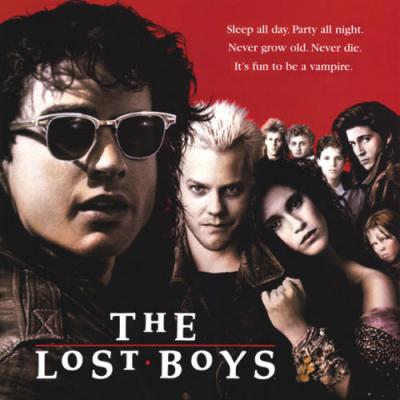
"Lost Boys" Soundtrack Lyrics
Movie • 1990
Track Listing
Jimmy Barnes
Lou Gramm
Roger Daltrey
Jimmy Barnes
Echo & the Bunnymen
Gerard McMann
Eddie and the Tide
Tim Capello
Mummy Calls
Thomas Newman
"The Lost Boys (Original Motion Picture Soundtrack)" – Album Guide to Tracks and Key Scenes
Overview
How do you make teenage vampires feel both dangerous and weirdly glamorous? In Joel Schumacher’s The Lost Boys (released in 1987, not 1990), the answer is a tight collision of gothic rock, slick 80s pop, and a haunted carousel score. The official The Lost Boys (Original Motion Picture Soundtrack) album pulls together ten key songs, while Thomas Newman’s organ-heavy score haunts the film itself, mostly unreleased except for one track.
The story follows brothers Michael and Sam Emerson as they move to the California boardwalk town of Santa Carla and get tangled up with a gang of vampire “lost boys.” The soundtrack becomes a second script: INXS and Jimmy Barnes drive the boardwalk energy, Echo & the Bunnymen’s “People Are Strange” turns the town into a freakshow, and Gerard McMahon’s “Cry Little Sister” wraps everything in a choral, slightly religious dread. Underneath the songs, Newman’s score mixes church organ, synths and small orchestra so the film always feels two steps from a funeral.
On album, the mood is more “late-night mixtape” than pure horror. The songs swing between glossy rock (“Good Times”, “Lost in the Shadows”), post-punk sheen (“People Are Strange”), and cult pop (Mummy Calls’ “Beauty Has Her Way”), with the theme song sitting dead center as a gothic anchor. The running time is short – about 36 minutes on the core Atlantic release – but it’s dense with hooks, which is why people still treat it like a mini time capsule of 80s dark-pop.
Genre-wise, you get a mash-up of hard rock and hair metal (Lou Gramm, INXS/Barnes), new wave/post-punk (Echo & the Bunnymen), gothic rock (the “Cry Little Sister” theme), plus hints of hip hop (Run-DMC & Aerosmith’s “Walk This Way” in the bonfire massacre) and R&B/oldies (“Groovin’”, “Ain’t Got No Home”). In the film’s logic, hard rock = the vampires’ reckless swagger, goth and choir textures = destiny and curse, post-punk = outsider anxiety, and oldies/soft rock = the human family trying to stay normal while the town rots around them.
How It Was Made
The score is by Thomas Newman, very early in his career. Later he would become known for American Beauty, Shawshank, Bond scores and more, but here he leans into eerie organ chords, synth beds and small orchestral bursts instead of the more delicate textures he’s famous for. The aim was an “eerie blend of orchestra and organ”, and you can hear that clearly in cues like “To the Shock of Miss Louise”, which fuses carousel music with something quietly menacing.
The songs side came out through Atlantic Records as a various-artists compilation. The label anchored the album with two INXS/Jimmy Barnes duets (“Good Times” and “Laying Down the Law”), a Roger Daltrey cover of “Don’t Let the Sun Go Down on Me”, and Lou Gramm’s “Lost in the Shadows”. According to several discography and label notes, the soundtrack was released in 1987 on Atlantic with ten songs, then widely reissued on CD and digital through Rhino/Warner later.
Newman’s full score never got a standard commercial release, which is why fans still hunt down bootlegs and fan compilations. “To the Shock of Miss Louise” appears as the final track on the official album, but the rest of his cues – “Closing Time”, “Back to the Carnival”, “Drinking Blood” and so on – live only in film mixes and unofficial sets. That imbalance is why the album feels so song-heavy compared to the actual film, where the score quietly fills a lot of space between needle-drops.
The songs were chosen to feel like they’re blasting from car stereos and boardwalk speakers, not like a separate jukebox. A fan site breakdown of the soundtrack even maps each track to its scene placement, pointing out that a lot of the rock music is diegetic – it’s actually playing in the world when guns, fangs or motorcycles come out. That approach lets Newman keep the more supernatural moments for his own sound palette.
Tracks & Scenes
This section focuses on how individual songs and key score cues line up with specific scenes. Time markers are approximate but the placements follow documented breakdowns from dedicated soundtrack sites.
"Cry Little Sister (Theme from ‘The Lost Boys’)" — Gerard McMann
Where it plays: The film’s main theme. It appears over the foggy opening credits with shots of Santa Carla’s boardwalk and carousel, returns when Michael fully rides with David’s gang, and surfaces again over the sex scene between Michael and Star and in later flying/vampire montages. The choral “thou shalt not…” hook floats over slow aerial shots and close-ups of the gang, sometimes bleeding into Newman’s score.
Why it matters: This is the sonic identity of the movie. It’s gothic rock with a choir, half pop single and half cursed hymn. The track frames the vampires less as monsters and more as doomed, seductive figures, which fits the whole “forever teenage” idea.
"People Are Strange" — Echo & the Bunnymen
Where it plays: Over the early montage as the Emerson family arrives in Santa Carla. We see missing-person posters, weird boardwalk crowds, punks, vagrants, neon signs and the general “murder capital of the world” vibe, all cut to this Doors cover. A shortened version returns over the end credits after Grandpa’s final line about “all the damn vampires.”
Why it matters: It’s the town’s anthem. The lyrics about faces looking ugly and streets running “when you’re strange” reframe Santa Carla as a place that’s already sick before you even see a fang. The new wave arrangement also sets the film’s cool, slightly detached tone.
"Good Times" — INXS & Jimmy Barnes
Where it plays: During the main boardwalk montage when Michael heads out searching for Star. The song kicks in as he moves through the crowd, buys the leather jacket, and passes stalls and rides; later, it returns briefly when Dwayne gets his “death by stereo” during the climax. It’s diegetic the first time, pumping out of boardwalk speakers and blending with ride noise.
Why it matters: This cue sells the boardwalk as a place you want to be: loud, sweaty, overstuffed with teens. The big, shiny rock sound makes Michael’s crush on Star feel like part of a wider rush – not just love at first sight, but a hit of this whole new scene.
"I Still Believe" — Tim Cappello
Where it plays: At the open-air concert the first time Sam and Michael visit the boardwalk. We get a full performance by Tim Cappello onstage: shirtless, oiled, chains around his neck, wailing on sax while the crowd dances. Michael spots Star in the audience and starts pushing toward her through the bodies as the song peaks.
Why it matters: This is one of the most iconic moments in the film. The song is diegetic performance, so the band and crowd are sharing the same energy we feel as viewers. It’s pure 80s excess – muscles, sax, big chorus – and it fixes the moment Michael falls for Star in a very specific cultural time.
"Lost in the Shadows (The Lost Boys)" — Lou Gramm
Where it plays: When David dares Michael to “keep up” and Michael rides with the gang along the coastal roads and out to the foggy cliffs. The track powers the motorcycle chase and the leap from the bridge; its stop-start dynamics match the kids’ dangerous stunts.
Why it matters: The title is literal: Michael is literally getting lost in the vampires’ world. The big Foreigner-style vocals and guitars make the sequence feel huge and reckless, and the song becomes Michael’s “joining the wrong crowd” theme.
"Beauty Has Her Way" — Mummy Calls
Where it plays: In the background as Michael watches Star dodge him and then ride off on David’s bike, after some back-and-forth flirting. It also underscores shots of the boardwalk at night, with David’s gang hovering on the edges of the frame.
Why it matters: The track’s slightly romantic, slightly uneasy mood mirrors Michael’s attraction to Star and his sense that following her pulls him somewhere dangerous. It’s also the song that gave British band Mummy Calls their long-term cult fame, thanks to the soundtrack.
"Power Play" — Eddie & the Tide
Where it plays: Inside Max’s video store. Lucy is browsing, Sam is wandering the aisles, and the Lost Boys pass through, ogling Maria and crowding the space. The song plays over the shop’s sound system – glossy rock drifting through shelves of VHS tapes and horror posters.
Why it matters: The lyrics about “good and evil” and “just a power play” fit the low-key battle starting here: Max, the “respectable” vampire boss, versus Lucy and her family. Musically it keeps the scene lively while setting up Max as someone deeply plugged into the town’s youth culture.
"Laying Down the Law" — INXS & Jimmy Barnes
Where it plays: On the boardwalk around the comic shop, when Sam first bumps into the Frog brothers among the racks. The track is lower in the mix, but it’s present as kids drift in and out, and the Frogs introduce Sam to their vampire-hunter paranoia.
Why it matters: It ties the Emersons’ “normal” kid, Sam, to the same musical world as Michael and the vampires. Everyone here is sharing the same sonic environment; they just interpret it differently.
"To the Shock of Miss Louise" — Thomas Newman
Where it plays: The calliope / carousel music heard constantly on the boardwalk, especially in the intro when David and the boys harass the surf Nazis on the carousel horses, and again when Michael later confronts them and their true nature starts to show. Variants of the cue appear in other carnival shots.
Why it matters: It’s a perfect example of “creepy circus music”: on the surface just carnival organ, underneath slightly off and dissonant. As several commentators have pointed out, it’s an odd but fitting way to close the album, because the boardwalk itself is the film’s real monster.
"Walk This Way" — Run-DMC & Aerosmith (non-album)
Where it plays: At the bonfire party where David’s gang massacres the surf Nazis. The song blasts from a boombox as kids drink and dance around the fire. As the track hits its groove, the vampires descend from the sky and rip into the crowd; Michael watches in horror as David finishes the feeding and snarls “Initiation’s over, Michael”.
Why it matters: This is the film’s big horror set-piece, and the choice of a then-recent crossover hip-hop/rock hit keeps it very contemporary. The track didn’t make the official album, which makes the scene feel even more like something you had to be there for.
"Ain’t Got No Home" — Clarence “Frogman” Henry (non-album)
Where it plays: When Sam sings along in the bath, goofing around with a shampoo mohawk while his dog Nanook pads around the bathroom. The song plays on a little radio, cheerful and bouncy, until the vampire attack jumpscare crashes the moment.
Why it matters: It’s one of the most effective tonal whiplashes in the movie. The cozy oldies track makes Sam feel completely safe; when the attack hits, the music snaps off and the film reminds you that nowhere in this house is actually secure.
"Groovin’" — The Young Rascals (non-album)
Where it plays: On Lucy’s car radio as she drives toward Santa Carla the first time, singing softly along. It’s a bright, nostalgic 60s pop track over shots of the coastline and the “Murder Capital of the World” billboard buried in missing-person posters.
Why it matters: The contrast between Lucy’s hopeful, post-divorce road-trip mood and the grim billboard is sharp. The song becomes a small symbol of her determination to build a normal life in a very abnormal town.
"Good Times" (reprise) — INXS & Jimmy Barnes
Where it plays: Briefly during the “death by stereo” gag, when vampire Dwayne is impaled on a stereo system and explodes in sparks. The song stutters in and out around the action, turning the moment into a twisted music-video payoff.
Why it matters: It’s a neat self-quotation: the same song that sold the boardwalk as paradise comes back in miniature to score a vampire’s messy exit. Irony fully intended.
"Don’t Let the Sun Go Down on Me" — Roger Daltrey
Where it plays: Over the end credits after the final family scene and Grandpa’s last line. The film is done; we’re back to pure soundtrack. Daltrey’s arena-scale vocal rides out as the names roll and viewers decompress.
Why it matters: Using a song literally about the sun going down to close a vampire film is basic symbolism, but the arrangement works. It gives the ending a big, melancholy rock finish rather than a pure horror sting.
Notes & Trivia
- The film’s score is by Thomas Newman; only “To the Shock of Miss Louise” appears on the original song album, the rest stayed unreleased for decades.
- The Atlantic soundtrack runs about 36 minutes with 10 songs, while the film uses roughly 20 music cues when you count non-album tracks and repeated uses.
- The soundtrack album was certified Gold by the RIAA in 1987, a few months after release, off the back of the film’s box-office success.
- Echo & the Bunnymen’s cover of “People Are Strange” later charted on its own; it was produced by Doors keyboardist Ray Manzarek.
- “Good Times” by INXS and Jimmy Barnes first existed to promote the Australian Made tour; the film more or less imported a pre-existing hit into Santa Carla.
Music–Story Links
The soundtrack carefully separates human and vampire perspectives. Lucy’s world gets “Groovin’” and easy listening, Sam’s gets oldies and comic-shop rock, while Michael’s slide into the gang is charted by “Good Times”, “Lost in the Shadows” and finally “Cry Little Sister” when he fully crosses the line. The same boardwalk speakers feed all those tracks; the meaning shifts depending on who’s listening.
Newman’s score handles the supernatural and the town’s physical spaces. The carousel cue “To the Shock of Miss Louise” makes the boardwalk a literal haunted carnival, and variants of the theme reappear when the vampires’ real nature slips out. When the gang flies or feeds, the songs often drop out and Newman’s organ-and-choir textures take over, so you feel the difference between partying with vampires and dying because of them.
Michael and Star’s relationship sits on top of this hybrid structure. Their first connection happens under “I Still Believe”; their deeper entanglement plays out under the “Cry Little Sister” theme and score fragments. Human attraction gets live rock; cursed intimacy gets choirs and synth drones. Sam’s arc with the Frog brothers, by contrast, is scored with more playful rock cues (INXS, comic-shop ambience), signalling that his fight against vampires is half pulp fantasy, half real danger.
Finally, Grandpa’s punchline and the Daltrey end-credits track together say what the whole soundtrack has been hinting: the town has always belonged to the vampires. The music we’ve been enjoying all along was part of that trap.
Reception & Quotes
The film became a cult hit, and the soundtrack quickly picked up its own reputation. Contemporary and later reviews often treat it as one of the defining 80s horror-compilation albums, alongside things like The Crow years later. The mix of mainstream rock, goth-leaning pop and an unusually strong original theme keeps it from feeling like random licensing.
“The Lost Boys soundtrack walked awkwardly between worlds, but that’s why it works – half club playlist, half vampire requiem.” — AV Club retrospective
“INXS and Jimmy Barnes bring the party, but it’s ‘Cry Little Sister’ that sends you home with chills.” — album review summary
“Lou Gramm’s ‘Lost in the Shadows’ and ‘Good Times’ tap into hairspray-heavy metal, while Echo & the Bunnymen’s ‘People Are Strange’ lends angular new wave.” — long-form soundtrack essay
The album remains available on streaming under various “Original Motion Picture Soundtrack” editions, mostly mirroring the original ten-track sequence. Expanded playlists on services like Spotify add non-album cuts (“Groovin’”, “Walk This Way”, “Ain’t Got No Home”) and Newman’s score pieces when they can be licensed. Meanwhile, the movie’s “Cry Little Sister” continues to get new covers and remixes, including for the direct-to-video sequels.
There is also a new wave: an upcoming Broadway musical adaptation, The Lost Boys: A New Musical, is in development with an original score by The Rescues. Producers have explicitly said they want the stage show’s songs to stand alongside the film’s “legendary soundtrack,” which tells you how strong that 1987 template still looks from 2025.
Interesting Facts
- The soundtrack album is often catalogued with Thomas Newman listed as primary artist, even though only one of his cues appears on it.
- Mummy Calls effectively became a one-hit cult band because “Beauty Has Her Way” landed on this multi-million-selling album.
- Eddie & the Tide, who perform “Power Play,” were a Bay Area band that used to gig in real Santa Cruz venues not far from the boardwalk used as Santa Carla.
- “Cry Little Sister” was written before Gerard McMahon saw any footage; Schumacher later told him he’d somehow nailed the film’s theme without images.
- The Doors themselves never appear on the soundtrack; all “People Are Strange” you hear in the movie is the Echo & the Bunnymen cover.
- The hip-hop crossover “Walk This Way” is one of the most remembered moments in the film but was left off the original album, a choice fans still grumble about.
- Newer deluxe playlists sometimes tack on Newman’s score cues and alternate “Cry Little Sister” versions, approximating the complete musical experience for the first time.
- The soundtrack has been called “The Crow soundtrack before The Crow soundtrack” by Gen X fans looking back on their teenage goth phase.
- 35+ years later, the original “Cry Little Sister” is still being used in trailers, series homages, and even live convention performances by McMahon/G Tom Mac.
Technical Info
- Film: The Lost Boys (1987, US horror-comedy)
- Album title: The Lost Boys (Original Motion Picture Soundtrack)
- Year of album release: 1987 (Atlantic Records; later CD pressings into 1990s)
- Type: Various-artists song compilation with one score cue
- Original score composer: Thomas Newman
- Core featured artists: INXS & Jimmy Barnes, Lou Gramm, Roger Daltrey, Echo & the Bunnymen, Gerard McMann, Eddie & the Tide, Tim Cappello, Mummy Calls
- Label / catalogue: Atlantic Records, later Rhino/Warner catalogue; typical CD issue around 43:45 with 10 main tracks
- Notable non-album cues: “Walk This Way” (Run-DMC & Aerosmith), “Groovin’” (The Young Rascals), “Ain’t Got No Home” (Clarence “Frogman” Henry), additional Newman score pieces
- Certification: RIAA Gold (US), 1987
- Recent context: The Broadway-bound The Lost Boys: A New Musical (opening planned for 2026) is explicitly positioning its new songs in conversation with the original film soundtrack.
Canonical Entities & Relations
| Subject | Relation | Object |
|---|---|---|
| Joel Schumacher | directs | The Lost Boys (1987 film) |
| Thomas Newman | composes score for | The Lost Boys (1987 film) |
| Gerard McMann (G Tom Mac) | performs | “Cry Little Sister (Theme from ‘The Lost Boys’)” |
| INXS & Jimmy Barnes | perform | “Good Times” and “Laying Down the Law” on the soundtrack |
| Echo & the Bunnymen | perform cover of | “People Are Strange” for the film soundtrack |
| Tim Cappello | performs | “I Still Believe” diegetically on the Santa Carla boardwalk |
| Mummy Calls | contribute | “Beauty Has Her Way” to the soundtrack album |
| Atlantic Records | releases | The Lost Boys (Original Motion Picture Soundtrack) |
| Warner Bros. | distributes | The Lost Boys (film) and controls soundtrack catalogue rights |
| The Lost Boys (Original Motion Picture Soundtrack) | is soundtrack to | The Lost Boys (1987 film) |
Questions & Answers
- Who composed the score for The Lost Boys and what’s distinctive about it?
- Thomas Newman composed the score. It stands out for its eerie blend of church organ, synths and small orchestra, plus the creepy carousel cue “To the Shock of Miss Louise.”
- Is the complete Thomas Newman score officially available?
- Not in full. Only “To the Shock of Miss Louise” appears on the original Atlantic album; the rest of the score has surfaced only on unofficial or limited releases and fan compilations.
- Which songs are most closely tied to Michael’s transformation?
- “Good Times” scores his entry into the boardwalk scene, “Lost in the Shadows” backs his ride with David’s gang, and “Cry Little Sister” underlines his deeper entanglement with Star and the vampires.
- What’s the song playing at the beach bonfire massacre?
- That’s the Run-DMC & Aerosmith version of “Walk This Way.” It’s heard in the film but was left off the original soundtrack album.
- Why is “I Still Believe” so iconic from this movie?
- Tim Cappello’s live, shirtless sax performance on the boardwalk is shot like a full concert, and the song becomes the audiovisual moment when Michael first locks onto Star in the crowd.
Sources: official film and soundtrack entries; Lost Boys fan site “The Lost Cave” scene breakdown; MoviesOST cue descriptions; RIAA and label catalog data; soundtrack retrospectives and essays; recent coverage of the upcoming Lost Boys Broadway musical.
November, 13th 2025
A-Z Lyrics Universe
Cynthia Erivo Popular
Ariana Grande Horsepower
Post Malone Ain't No Love in Oklahoma
Luke Combs Good Riddance (Time of Your Life)
Green Day Bye Bye Bye
*NSYNC You're the One That I Wan
John Travolta & Olivia Newton-John I Always Wanted a Brother
Braelyn Rankins, Theo Somolu, Kelvin Harrison Jr. and Aaron Pierre The Power of Love
Frankie Goes to Hollywood Beyond
Auli’i Cravalho feat. Rachel House MORE ›