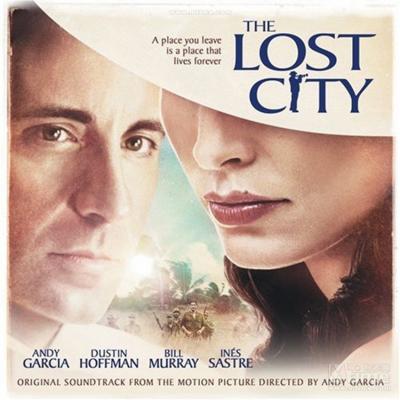
"Lost City" Soundtrack Lyrics
Movie • 2007
Track Listing
Chocolate Armenteros
Cachao / CineSon All-Stars
Lost City Orchestra / Ernesto Lecuona
Orquesta Sensacion / Abelardo Barroso
Grupo Guaguanco Matancero
Lost City Orchestra / Andy Garcia
Ruben Gonzalez
Lost City Orchestra / Andy Garcia
Lazaro Galarraga / CineSon All-Stars
Cachao / CineSon All-Stars
Andy Garcia / CineSon All-Stars
Chappottin Y Sus Estrellas / Miguelito Cuni
Lazaro Galarraga / CineSon All-Stars / Andy Garcia
Andy Garcia / CineSon All-Stars
Lazaro Galarraga / CineSon All-Stars
Cachao / CineSon All-Stars
Omar Sosa
Cachao / CineSon All-Stars
Nohema Fernandez
Benny More
Septeto Nacional De Ignacio Pineiro
Cachao / CineSon All-Stars
Rolando LaSerie
Rolando LaSerie
Lazaro Galarraga / CineSon All-Stars
Cachao / CineSon All-Stars
Lazaro Galarraga / CineSon All-Stars
Andy Garcia / Lost City Orchestra
Lazaro Galarraga / CineSon All-Stars
Lost City Orchestra / Jose White
Trio Matamoros
Andy Garcia / Lost City Orchestra
Cachao / CineSon All-Stars
Maria Teresa Vera
Justo Almario
Lost City Orchestra / Andy Garcia (instrumental)
Bola De Nieve
Marco Rizo / Lost City Orchestra / Justo Almario
Duke Ellington / Coleman Hawkins
Andy Garcia / Danilo Lozano
Cachao / CineSon All-Stars
Andy Garcia / CineSon All-Stars
"The Lost City (Original Soundtrack From the Motion Picture)" – Album Guide to Tracks and Key Scenes
Overview
What if the main character in a political melodrama is not the hero, not the city, but the music in the club they lose? Andy García’s The Lost City (film from 2005, widely circulated on home video around 2006–2007) answers that with a two-disc compilation of classic Cuban recordings plus newly recorded cues, released as The Lost City (Original Soundtrack From the Motion Picture). The album runs well over two hours and plays like an encyclopedic tour of pre-revolution Havana – danzón, mambo, son, bolero, descarga – stitched together with García’s own orchestral themes.
The film follows Fico Fellove, owner of the El Trópico nightclub in 1958 Havana, as the Cuban Revolution tears through his family, business and city. He tries to remain apolitical while his brothers join different strands of the opposition, and eventually he’s pushed into exile. The soundtrack mirrors that arc: golden-age club music at the start, more fractured and mournful pieces as politics harden, then songs of memory and longing once Fico reaches New York. As one DVD review notes, the movie sometimes feels like “Cliffs Notes of Cuban history and culture”; the album is the concentrated cultural half of that equation.
On disc, you get an intense blend of archival and newly recorded material. There are tracks from masters like Cachao, Benny Moré, Orquesta Sensación, Chappottín y Sus Estrellas, Bola de Nieve and Omara Portuondo, alongside “Lost City Orchestra” cues written or supervised by García. According to a product description for the CD, the set was curated deliberately to evoke “Cuba’s golden era” through familiar standards and new score pieces that bleed into one another. The result is not a casual background album; it’s closer to a love letter disguised as a survey of mid-century Havana music.
Stylistically, almost every major stream of Cuban popular music before 1959 shows up. Danzón and comparsa pieces (Ernesto Lecuona themes, “La Comparsa”, “A La Antigua”) carry the elegance and ritual of upper-class dances; mambo and descarga cuts from Cachao and others drive the energy on El Trópico’s stage; son and guaguancó (Chappottín, Grupo Guaguancó Matancero) represent the streets and working-class neighborhoods; bolero and filin ballads (Bola de Nieve’s “Si Me Pudieras Querer”) mark private heartbreak. The new orchestral cues tie those traditions together into one continuous memory, so that by the end, the soundtrack itself feels like Fico’s mental mixtape of the city he lost.
How It Was Made
García spent more than a decade trying to get The Lost City made, and he didn’t just direct and star; he also composed the score and produced the soundtrack. A press-kit biography and later program notes describe him as a working pianist and bandleader who had already produced Grammy-winning Cuban records with Cachao before turning that experience toward the film. He recorded new material with the CineSon / Lost City Orchestra and folded it around existing classics. Academic and press materials around the film stress that the soundtrack was central to his vision, not an afterthought.
The commercial album, released by Univision Records as a two-disc set around 2005–2007, runs roughly 148 minutes and contains about forty-five tracks. Discography entries and retailer listings agree that it’s a multi-artist compilation produced by García, packaged both under English and Spanish titles (The Lost City / La ciudad perdida). The sequencing groups material into two broad halves: club and Havana life on disc one, more politically charged and exile-tinted material—plus reprises of key themes—on disc two.
The production blends original studio recordings from the 1950s and 60s with new sessions. For example, “Mambo”, “Es Diferente” and “A Gozar con Mi Combo” showcase Cachao’s work, while other pieces credit the Lost City Orchestra or CineSon All Stars for newly recorded arrangements. One background note on García emphasizes that the soundtrack features “several legends from the Cuban music world” alongside his own score. The recording and licensing process effectively turned the film into a small museum of Cuban music, something several reviewers pointed out even when they were lukewarm on the movie itself.
Tracks & Scenes
Exact timestamps vary between releases, but the film’s structure and cue titles make the key placements fairly clear. Below are some of the most important songs and score cues, and how they interact with specific scenes.
“Beautiful Cuba (Cuba Linda)” — Alfredo “Chocolate” Armenteros / Lost City Orchestra
Where it plays: The melody appears both as an instrumental (“Beautiful Cuba”) and as the song “Cuba Linda”. Instrumental statements bookend the movie’s vision of pre-revolution Havana, playing under wide shots of the city and El Trópico’s exterior, while the vocal version surfaces near the finale as Fico reflects on the Cuba he’s lost. In some releases you hear it over the closing montage and final scenes, almost like a curtain call for the island itself.
Why it matters: This is the emotional thesis statement. The lyric “Cuba linda de mi vida” (“beautiful Cuba of my life”) and its instantly recognizable melody turn the city into a person Fico is mourning. A 2007 article on the film’s music notes that the tune recalls an idyllic, conflict-free Cuba every time it appears, which is exactly how Fico wants to remember his home.
“Mambo” — Cachao
Where it plays: Heard during early El Trópico floor-show scenes, particularly the anniversary celebration for Fico’s parents. The camera roams across the crowded club, dancers sweep past tables, and the band onstage locks into Cachao’s groove while the Fellove family laughs and argues under the music.
Why it matters: The track sells the club as a living organism: sophisticated, loud, packed with bodies and money. By tying this kind of mambo so closely to Fico’s status quo, the film makes the later silencing of saxophones and club closures feel physically painful, not just political.
“La Comparsa” — The Lost City Orchestra (after Ernesto Lecuona)
Where it plays: Used for more formal dance sequences and processions—women in evening dress, men in suits, slow camera moves through polished interiors. In at least one scene, the comparsa rhythm underlines the disconnect between the refined world inside El Trópico and the unrest outside its doors.
Why it matters: The piece is culturally loaded in Cuba, associated with carnival parades and a certain nostalgic elegance. In this context, it’s also a status marker: the sound of a class that believes its rituals will outlast any government, even as the film quietly proves them wrong.
“Macorina” — Abelardo Barroso / Orquesta Sensación
Where it plays: Over intimate club moments, when the energy dips from full show to something more inward: couples slow-dancing in half-light, Aurora moving through the crowd, Fico watching her from the wings while pretending to focus on the band.
Why it matters: The song has a sultry, slightly decadent tone that fits the club’s mix of romance and compromise. It also anchors Aurora’s presence in the nightclub world, making her feel like part of the city’s sensual life, not just a political symbol.
“Los Munequitos” — Grupo Guaguancó Matancero
Where it plays: In street and back-room rumba scenes: musicians crowding together, dancers improvising, sweat and cigarette smoke hanging in the air. These sequences usually cross-cut with more polished action at El Trópico, so the viewer feels the gap between elite entertainment and popular culture closing as the revolution advances.
Why it matters: The guaguancó drum patterns bring in Afro-Cuban religious and neighborhood flavors that the posh club scenes can’t express. When the revolution gains momentum, this kind of music feels closer to the ground truth than any ballroom tune.
“Ricardo’s Theme” — Andy García & The Lost City Orchestra
Where it plays: Associated with Fico’s brother Ricardo, who joins Castro’s rebel army. The theme plays under scenes of him slipping into clandestine meetings, arguing with Fico about the need for armed struggle, and later during the emotional fallout after his suicide.
Why it matters: The motif is lighter and more lyrical than you might expect for a revolutionary; it emphasizes that Ricardo isn’t a villain, but someone driven by genuine ideals. The music softens political divides into familial ones, just as the film wants viewers to feel the revolution from inside Fico’s home.
“Fico Meets Che” — Andy García & The Lost City Orchestra
Where it plays: As the title suggests, this cue scores Fico’s encounter with Che Guevara. The scene itself is tense and formal: Che is already an icon, Fico is wary and mourning his own losses. The music mixes a solemn, almost processional feel with undercurrents of dread.
Why it matters: This is one of the few cues where the score leans more toward filmic underscore than club source. It signals that Fico has stepped out of his musical comfort zone into the cold machinery of history, and it frames Che less as a romantic hero and more as a force that can’t see Fico’s world as anything but collateral.
“Si Me Pudieras Querer” — Bola de Nieve (Ignacio Villa)
Where it plays: Heard in scenes that underline Fico and Aurora’s impossible relationship: quiet conversations after funerals, moments where she wavers between old loyalties and her new identity as a “revolutionary widow.” The track may also appear in a New York sequence, as Fico remembers her from exile.
Why it matters: Bola de Nieve’s voice and piano embody a very specific Cuban melancholy. The lyrics about “if you could love me” echo Fico’s realization that he cannot have both Aurora and his Cuba back; one or both will remain out of reach.
“Yo Si Como Candela” — Chappottín y Sus Estrellas
Where it plays: Over rougher, more boisterous scenes—crowded bars, street parties, or transitional sequences where political tensions spike but people still dance. Its presence has been noted in film music databases as one of the more energetic needle-drops.
Why it matters: The title (“I really eat fire”) and the track’s punchy horns fit the sense that Havana is feeding on volatility. Even as bombs go off and allegiances shift, everyday Cubans still grab whatever joy they can; the song captures that stubborn vitality.
“Attack of the Palace” — Lázaro Galarraga & The Cineson All Stars
Where it plays: During the failed presidential palace assault, when Luis and other rebels attempt to assassinate Batista. Gunfire, chaotic movement and the shock of watching friends die are overlaid with a furious Afro-Cuban rhythm and chant-like vocals.
Why it matters: The cue uses religious and percussive elements (the track is linked in some releases to Ochosi, a warrior orisha), turning the attack into something between a ritual and a doomed sacrifice. It’s one of the few moments where the film lets the soundtrack become outright brutal rather than nostalgic.
“Sugar Cane Fields” — Rolando Laserie & The Cineson All Stars
Where it plays: Around scenes set on Donoso’s tobacco and sugar lands, and later when state appropriation and collectivization tear apart that world. Shots of fields, workers and the older generation’s confidence that “the land endures” are underscored by the track’s bittersweet sway.
Why it matters: The music turns the countryside into a character: patient, cyclical, apparently immune to politics. When the revolution finally reaches these fields, the cue’s return underlines what’s at stake beyond Fico’s club – whole ways of life, not just nightlife.
“Adios a Cuba” — Marco Rizo
Where it plays: Near the end of the film, as Fico prepares to leave Havana, says goodbye to his parents, and suffers the indignity of having most of his possessions seized at the airport. The piece continues over images of planes, docks or New York, depending on cut.
Why it matters: The title says it all. It’s a farewell, played with enough restraint that it never tips into cheap sentimentality. It bridges the diegetic world of Havana with the memory-space of exile that takes over the final reel.
“The Lost City Theme (La ciudad perdida)” — Andy García & Danilo Lozano
Where it plays: Used multiple times in instrumental and vocal versions. The theme first appears in Havana as a kind of bittersweet nightclub melody, then resurfaces in New York, when Fico plays piano in a small Cuban club and finally opens his new “El Trópico”.
Why it matters: It’s the score’s spine. Every time it comes back, the context has shifted: from confidence to loss to fragile hope in exile. By the time the vocal version plays, the phrase “lost city” no longer only refers to Havana; it’s also Fico’s interior landscape, and by extension, the memory of Cuba carried by exiles.
Non-album or alternate-source cues
The film also uses additional recordings not always clearly separated on the official 2-CD set – for example “Limbo Jazz” (Duke Ellington / Coleman Hawkins) and alternate performances of “Si Me Pudieras Querer” and “Cuba Linda” sourced from historical catalogues. Track-indexing on streaming playlists and cue lists shows these sitting alongside the main album tracks rather than being strictly segregated. They help connect El Trópico to a wider jazz world, reminding us that Havana in the 1950s was plugged into global music, not an isolated island.
Notes & Trivia
- The album is a two-disc set, produced by Andy García, with a total running time listed around 148 minutes and roughly forty-five tracks.
- Label credits point to Univision Records for the original CD release, though some sources date it 2005 and others 2007 depending on territory and repressings.
- García had already produced award-winning albums for Cachao before this film; several of those collaborators appear on the soundtrack.
- A scholarly article on the film’s music reads “Cuba Linda” as a recurring exile motif – every reprise pulls the viewer back to a pre-revolution dream of the island.
- In some markets the soundtrack was issued with Spanish packaging as La ciudad perdida – Banda Sonora Original, but the content is the same compilation.
Music–Story Links
The soundtrack doesn’t just decorate the story; it is the story in another register. El Trópico is a club built on music, and García structures the film so we keep returning to that stage as politics tighten. Early on, mambos and danzones show a city comfortable with its own contradictions: a dictatorship outside, but inside the club, glamorous arrangements and perfect horn lines. As the script shifts toward bombings and executions, those same grooves start to feel like denial.
Fico himself is defined by what he’s willing to play. When the new regime bans “imperialist” instruments like the saxophone and starts dictating song choices, you can feel his identity being squeezed. Tracks like “La Comparsa” and “Mambo” are not just entertainment; they are how he understands Cuba. Each new restriction on repertoire is a political insult and a personal wound, and the score leans into that by letting certain themes drop out completely once the club is shuttered.
The brothers’ arcs are mapped onto different musical worlds. Ricardo’s theme is lyrical but increasingly minor; it shades every scene he’s in with fatalism, so that his eventual suicide fits the harmonic trajectory the film has already drawn. Luis’s student radicalism, by contrast, is wrapped in more percussive, chaotic cues like “Attack of the Palace”, where chanting and drums overwhelm melody. Fico stands between them in the score, surrounded by elegant pieces that the revolution claims to have no use for.
Exile doesn’t end the music; it reframes it. In New York, Fico plays piano in a smaller Cuban club where fragments of “The Lost City Theme” and “Cuba Linda” appear again, but now the acoustics are different: no grand stage, no tropical decor, just memory and survival. The album’s sequencing reflects that by revisiting key motifs late in disc two in slightly altered arrangements, suggesting that the “lost city” lives on in recordings and recollections even when the geography is gone.
Reception & Quotes
Critical response to the film was mixed to negative; several reviewers loved the music while questioning the politics. The New York Times called the movie an “elegy for old Havana” and focused heavily on its musical atmosphere, even while criticizing the dialogue. Some commentators saw the whole project as an unapologetic love letter from García to a vanished Cuba. According to one Washington Times piece, critics literally labeled it that way: “a love letter to Cuba.”
Among film-music fans, the soundtrack has a stronger reputation than the movie. Collectors and Cuban-music devotees praise the album as an unusually rich document of mid-century styles, and it’s often recommended alongside records like Cachao: Master Sessions and the Calle 54 soundtrack as an entry point into classic Cuban recordings.
“The soundtrack is out-of-this-world terrific. You can’t second-guess Andy Garcia’s taste in Cuban music.” — user review, IMDb
“If you want to see (and hear) a crash course in Cuba’s history and culture, this film hits that mark with precision.” — DVD review, IonCinema
“Garcia’s melancholic ode to his native Cuba is an all-singing, all-dancing version of the Cuban Revolution.” — critic summary, UK press
The album itself never became a mainstream chart hit, but within its niche it’s remained in print or easily obtainable via CD and digital storefronts. Streaming playlists under titles like “The Lost City Soundtrack – Andy Garcia” reconstruct the two discs with a mixture of official tracks and equivalent catalog recordings, which keeps the music circulating even where physical copies are scarce.
Interesting Facts
- Because the film was financed outside the big-studio system, García had unusual freedom to stack the soundtrack with long, uninterrupted music sequences inside El Trópico.
- The two-disc set mixes archival recordings with new sessions so smoothly that casual listeners sometimes assume everything was recorded fresh for the film.
- Omar Sosa contributed music excerpts to the movie’s soundscape, extending the conversation between classic Cuban sounds and contemporary jazz.
- Some retailers list the soundtrack as a 2005 release (matching the film’s festival run), while others give a 2007 street date tied to broader home-video distribution.
- Several tracks (“Attack of the Palace”, “Sugar Cane Fields”, “Rumba for Luis”) are basically miniature tone poems for single plot beats, acting like chapter titles for the revolution’s progress.
- “Limbo Jazz” by Duke Ellington and Coleman Hawkins underscores parts of the New York material, quietly linking Havana’s lost scene to a wider mid-century jazz world.
- The Spanish-language CD issue La ciudad perdida carries a dedication to writer Guillermo Cabrera Infante, whose script forms the film’s backbone.
- At least one fan playlist combines album tracks with additional period songs referenced in scholarship and criticism, turning the soundtrack into a three-hour Cuba mixtape.
Technical Info
- Film: The Lost City (2005 drama about pre-revolutionary Havana, directed by Andy García)
- Album title: The Lost City (Original Soundtrack From the Motion Picture) / La ciudad perdida – Banda Sonora Original
- Album type: Two-disc soundtrack – various artists plus original score
- Approx. running time: ~148 minutes, ~45 tracks over 2 CDs
- Primary producer: Andy García
- Key performers: Cachao, Alfredo “Chocolate” Armenteros, Benny Moré, Chappottín y Sus Estrellas, Orquesta Sensación, Grupo Guaguancó Matancero, Bola de Nieve, Omara Portuondo, Lost City Orchestra / CineSon All Stars, Marco Rizo, Duke Ellington & Coleman Hawkins, Rolando Laserie
- Original score credit: Andy García (themes and orchestral cues performed by The Lost City Orchestra, often in collaboration with Danilo Lozano and CineSon players)
- Label / catalogue: Univision Records (2×CD), later reissues and region-specific pressings; some discographies date the issue 2005, others 2007
- Notable cue titles: “Beautiful Cuba (Instrumental)”, “Mambo”, “La Antigua”, “Danza Lucumí”, “La Comparsa”, “Ricardo’s Theme”, “Fico Meets Che”, “Solitude/Leonela’s Death”, “Attack of the Palace”, “Sugar Cane Fields”, “The Lost City Theme”
- Availability: Physical CDs via specialist retailers and second-hand markets; digital availability varies by region but many tracks appear on streaming in playlists tied to the film
Canonical Entities & Relations
| Subject | Relation | Object |
|---|---|---|
| Andy García | directs | The Lost City (2005 film) |
| Andy García | composes score for | The Lost City (2005 film) |
| Andy García | produces | The Lost City (Original Soundtrack From the Motion Picture) |
| Univision Records | releases | The Lost City (Original Soundtrack From the Motion Picture) |
| Cachao | performs | “Mambo”, “Es Diferente”, “A Gozar con Mi Combo” on the soundtrack |
| Alfredo “Chocolate” Armenteros | performs | “Beautiful Cuba (Cuba Linda)” on the soundtrack |
| Chappottín y Sus Estrellas | perform | “Yo Si Como Candela” in the film and on the album |
| Bola de Nieve (Ignacio Villa) | performs | “Si Me Pudieras Querer” as part of the soundtrack |
| Marco Rizo | performs | “Adios a Cuba” in the film and on the album |
| The Lost City (Original Soundtrack) | is soundtrack to | The Lost City (2005 film) |
| El Trópico (fictional nightclub) | is primary setting of | many musical scenes in The Lost City |
Questions & Answers
- Is the soundtrack for The Lost City mostly old songs or new score?
- It’s a deliberate mix: classic Cuban recordings (Cachao, Benny Moré, Chappottín, Bola de Nieve, etc.) plus new orchestral and ensemble cues composed and produced by Andy García.
- Why do some sources list the album as 2005 and others as 2007?
- The film premiered in 2005 and early soundtrack editions appear in discographies around that date, but several commercial 2-CD pressings carry a 2007 release year tied to wider home-video rollout.
- What kind of Cuban styles does the album cover?
- You get danzón, comparsa, mambo, son, guaguancó, descarga jams, bolero and filin ballads, plus jazz and new score pieces – essentially a mini-survey of mid-century Havana music.
- Is there a single “main theme” I should listen to first?
- Start with “Beautiful Cuba / Cuba Linda” and “The Lost City Theme (La ciudad perdida)”. Together they carry the film’s nostalgia for Havana and Fico’s exile arc.
- Can I enjoy the soundtrack without seeing the movie?
- Yes. Many listeners treat it as a standalone Cuban-music compilation. Knowing the story deepens specific cues, but the album works purely as a listening experience.
Sources: film and soundtrack entries (IMDb, Wikipedia, Discogs); SoundtrackCollector / MovieMusic and SoundtrackINFO tracklists; retailer metadata from Univision-issued CDs; scholarly article “Viewing History through Exile: Music The Lost City”; press-kit and program notes on Andy García’s work with Cachao and CineSon; DVD and newspaper reviews (NYT, Washington Times, IonCinema) discussing the film’s musical role; online cue lists and playlists mapping key tracks to scenes.
November, 13th 2025
A-Z Lyrics Universe
Cynthia Erivo Popular
Ariana Grande Horsepower
Post Malone Ain't No Love in Oklahoma
Luke Combs Good Riddance (Time of Your Life)
Green Day Bye Bye Bye
*NSYNC You're the One That I Wan
John Travolta & Olivia Newton-John I Always Wanted a Brother
Braelyn Rankins, Theo Somolu, Kelvin Harrison Jr. and Aaron Pierre The Power of Love
Frankie Goes to Hollywood Beyond
Auli’i Cravalho feat. Rachel House MORE ›