Soundtracks:  A B C D E F G H I J K L M N O P Q R S T U V W X Y Z #


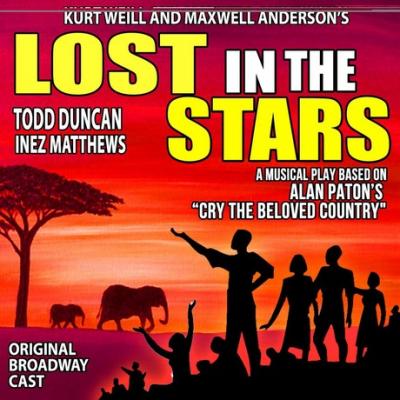
Lost in the Stars Album Cover

"Lost in the Stars" Soundtrack Lyrics

Musical • 1949

Track Listing


"Lost in the Stars (1949 Original Broadway Cast Recording)" – Album Guide to Tracks and Key Scenes

Lost in the Stars 1974 film trailer still, evoking the musical’s themes of faith and injustice
Lost in the Stars musical & film soundtrack imagery, 1949–1974

Overview

What happens when a Broadway “musical” refuses to reassure you? Lost in the Stars answers by wrapping a harsh story about apartheid South Africa in music that sounds devotional, angry, and strangely tender at once. This 1949 original Broadway cast recording preserves Kurt Weill’s last stage score and the first production’s voices – most notably baritone Todd Duncan as Reverend Stephen Kumalo – in a tight 14-track album that plays like a compressed tragic oratorio rather than a feel-good show LP.

The score moves between choral openings, intimate prayers, barroom numbers and children’s songs without ever losing its dramatic focus. Weill writes for chorus like a composer who has lived in both opera houses and jazz clubs: chanted refrains, call-and-response textures, aggressive rhythm sections and, suddenly, bare vocal lines that feel like a confession whispered straight into your ear. The album captures that range cleanly; you can hear the separation between soloists, chorus and orchestra even in the mid-century mono mix, and the balance keeps Duncan’s voice and Inez Matthews’s Irina front and centre.

According to the Kurt Weill Foundation, the show was conceived as a “musical tragedy” rather than a conventional musical, and the recording leans into that identity: tempos are unhurried, climaxes are allowed to bloom, and the orchestrations underline the story’s moral weight rather than punch lines or applause moments. You don’t get throwaway filler tracks; you get a narrative arc that runs from the quiet hills of Ndotsheni to a dawn vigil outside a prison.

Stylistically, the album blends several strands. Hymn-like chorales and Anglican chant colours frame Stephen’s faith; spiritual-inflected melodies connect him to African-American church music; jazz and blues sonorities creep into the bars and townships; and Weill’s European modernist background surfaces in his harmonies and use of dissonance. Dance-band touches and even a polka-like feel in “Big Mole” sit beside stark recitatives. In broad terms: folk and choral textures signal community and landscape, jazz and cabaret idioms mark the city’s temptations, while more chromatic writing tends to appear at points of doubt, violence and moral crisis.

How It Was Made

The musical is based on Alan Paton’s novel Cry, the Beloved Country. Maxwell Anderson adapted the book and wrote the lyrics, while Kurt Weill – already a veteran of both Weimar theatre and Broadway – composed the music. It opened at the Music Box Theatre on Broadway on 30 October 1949 and ran for 281 performances, with legendary director Rouben Mamoulian supervising the production and Maurice Levine conducting.

The original cast album was recorded shortly after the Broadway opening, in early November 1949, for Decca. Todd Duncan leads the cast as Stephen Kumalo, with Inez Matthews as Irina, Sheila Guyse as Linda, Frank Roane as the Leader and Herbert Coleman as the boy Alex. The Playwrights’ Company produced the musical and is prominently credited on the LP artwork; Levine conducts the Decca orchestra and chorus, and the recording compresses a full evening into a 40-odd-minute listening experience while still preserving the essential musical spine of the show, as AllMusic’s discographic entry notes.

Weill had done serious homework for this score. As the Weill Foundation summarizes, he deliberately avoided stereotypical “tom-tom” exoticism and instead studied recordings of Zulu music, while also drawing on African-American spirituals, blues and jazz. The result is a hybrid language: choral writing that can sound like a European passion one moment and like a township choir the next, and rhythmic writing that owes as much to swing and popular song as to church hymnody. Accordion is used in several cues (notably “Train to Johannesburg” and “Big Mole”) as both colour and melodic voice, something musicologist Henry Doktorski has pointed out in his analysis of the score.

It was also, as multiple sources agree, Weill’s final completed stage work: he died of a heart attack in 1950. That knowledge hangs over the album today. You can hear a composer who has spent a career reinventing himself – from Berlin to New York – pouring his experience into one last, highly focused musical argument about justice and compassion.

Lost in the Stars film trailer frame echoing the musical’s prison imagery
Visual language in the 1974 film trailer mirrors the musical’s prison and courtroom scenes.

Tracks & Scenes

This album doesn’t simply collect songs; it preserves key dramatic beats from the stage story. Below are some of the most important numbers and how they play in the narrative.

"The Hills of Ixopo" — Frank Roane & Ensemble
Scene: The opening number in Ndotsheni, a rural South African village. The Leader and chorus paint the physical and spiritual landscape, singing about the hills and valleys while Reverend Stephen Kumalo moves through his daily routine. The music feels like a landscape in sound: broad choral phrases, steady pulse, and a sense that the community is tightly bound to the land.
Why it matters: It fixes the moral and geographical baseline of the story. Every later urban scene is heard against this memory of open space and grounded faith. When you replay the album, those first bars act almost like a recurring motif for “home.”

"Thousands of Miles" — Todd Duncan
Scene: Early in Act I, after Stephen receives a troubling letter from his brother in Johannesburg, he contemplates the journey he must make to find his son Absalom. On stage he often stands alone, while the music stretches out in long vocal lines over a gently rocking accompaniment.
Why it matters: This is Stephen’s first extended solo and a key character portrait. His voice carries calm dignity and undercurrent anxiety; the tune sounds like someone trying to convince himself the road is manageable. On the record, Duncan’s phrasing makes the distance feel psychological as much as physical.

"Train to Johannesburg / Thousands of Miles (Reprise) / The Search" — Ensemble, Todd Duncan
Scene: A multi-part sequence that covers Stephen’s actual journey and his early days in the city. You hear the rhythmic clatter of the train implied in the orchestra, station bustle, and later the sense of wandering through shantytowns and backstreets. Accordion cuts through the texture like an urban street band, particularly in the “Train to Johannesburg” section.
Why it matters: It’s the album’s first big “travel montage”. The reprise of “Thousands of Miles” ties Stephen’s resolve to the reality of the trip, while “The Search” shifts the mood towards unease and disorientation. On record, it’s a miniature tone poem about migration and dislocation.

"The Little Gray House" — Todd Duncan & Company
Scene: Night in Stephen’s shabby Johannesburg hut. He soothes his young nephew Alex, promising a future in Ndotsheni. The orchestration thins out; you mostly hear voice with modest accompaniment and occasional choral comments, like neighbours listening just offstage.
Why it matters: The song shows Stephen as father and storyteller, not just priest. The “little gray house” becomes an image of modest stability, and on the album it offers one of the warmest, most intimate sound-worlds before the plot turns darker.

"Who’ll Buy?" — Sheila Guyse
Scene: In a seedy Johannesburg bar, Linda sings a come-on song to lure customers and entertain the crowd, while Absalom, Matthew and Johannes drink and flirt. The number is fully diegetic: it’s the bar’s floor show, complete with band-style rhythms and a more overt cabaret swing.
Why it matters: Musically, it’s Weill in his element, blending Broadway show-tune craft with the sharper edges of his European cabaret work. Dramatically, it marks the turning point where Absalom drifts from struggling young man into criminal plotter. The album captures the seductive sheen of the bar without hiding the underlying seediness.

"Trouble Man" — Inez Matthews
Scene: Often paired with “Who’ll Buy?” on recordings, this number gives Irina the floor. She warns Absalom about the consequences of his choices, voice cutting across the barroom atmosphere. The accompaniment is sultry but harmonically uneasy, as if the music itself knows where this is heading.
Why it matters: This is Irina’s most substantial musical moment before the trial sequences. Matthews brings a rich, dark colour that contrasts with the brighter bar textures, and the song frames her not as a stock “girlfriend” but as someone who sees danger more clearly than Absalom.

"Murder in Parkwold / Fear" — Ensemble
Scene: The burglary gone wrong and its aftermath. The music lurches between tense, staccato figures and jagged choral shouts as Absalom and his accomplices invade the home of Arthur Jarvis, Stephen’s white benefactor. The gunshot itself is usually underscored; then “Fear” expands the viewpoint to the wider community, black and white, reeling from the killing.
Why it matters: On the album this is the sonic explosion that the previous bar scenes have been leading toward. It’s also where Weill’s film-noir instincts show: sharp orchestral stabs, choral comment, and a sense of panic that doesn’t quite resolve.

"Lost in the Stars" — Todd Duncan & Chorus
Scene: End of Act I. Stephen, faced with his son’s crime, sings a crisis-of-faith soliloquy in his church. The chorus supports and occasionally contradicts him, but the focus is on his voice describing a God who seems to have forgotten His promises. The number is non-diegetic in the sense that it functions as inner monologue, though it’s staged as prayer.
Why it matters: This is the show’s title song and its emotional centre. The melody has since become a standard, recorded by vocalists from Frank Sinatra to Sarah Vaughan, but on this cast album it belongs firmly to Stephen Kumalo. Duncan rides the long phrases without showboating, letting the doubt and grief sit plainly in the sound.

"O Tixo, Tixo, Help Me" — Todd Duncan
Scene: Early in Act II, before Absalom’s trial. Stephen prays for guidance, torn between his love for his son and his sense of justice. The vocal line is more speech-like, with an almost recitative feel; the orchestra comments in short, tense bursts rather than lush accompaniment.
Why it matters: If “Lost in the Stars” is the broad, singable lament, “O Tixo” is the raw soliloquy. Many later critics have singled it out as one of Weill’s most concentrated pieces of musical theatre writing: the album preserves Duncan’s original reading, which combines operatic power with the directness of a sermon.

"Stay Well" — Inez Matthews
Scene: Irina’s farewell song to Absalom, often staged at or near the prison wedding. She asks him to “stay well” in a future she may not share, the melody unfolding over gently rocking accompaniment and soft choral underscoring.
Why it matters: It’s one of the few moments of lyrical tenderness left in the second act. On record, Matthews shapes the line with almost classical poise; the song underlines that this tragedy radiates beyond the father–son axis to touch lovers and future children.

"Cry, the Beloved Country" — Ensemble
Scene: After the trial and sentencing. The Leader and chorus step back from individual characters to address the country itself, echoing the title of Paton’s novel. The music broadens into something like a national lament, merging hymn textures with darker harmonic undercurrents.
Why it matters: It reframes the story from personal tragedy to systemic indictment. On the album, the choir’s blend and the stately tempo give the sense of a nation speaking, not just a chorus of extras.

"Big Mole" — Herbert Coleman
Scene: A children’s game in Ndotsheni. Alex sings about a fantastical mole that tunnels deep into the earth, while white child Edward Jarvis joins the play. The tune is jaunty, almost like a folk-polka, and accordion doubles the melody, giving it a playful bounce.
Why it matters: The scene dramatizes the possibility of a different future: black and white children playing together while adults struggle with guilt and grief. The song’s lightness is deliberate; it’s one of the few fully carefree musical gestures in the show, and on the album it offers a short but crucial breath of hope.

"A Bird of Passage / Thousands of Miles (Reprise)" — Todd Duncan & Ensemble
Scene: Near the end, as Stephen prepares to resign his ministry and then meets Jarvis on the morning of Absalom’s execution. “A Bird of Passage” treats human life as a brief journey through a lamplit room before returning to darkness; the reprise of “Thousands of Miles” quietly recalls the journey that began the story.
Why it matters: The album closes on a blend of resignation, fragile reconciliation and memory. Weill’s decision to reuse themes ties the musical and moral threads together: the miles Stephen travelled were never just physical, and the “bird of passage” idea turns up on Weill’s own grave marker, underscoring how deeply he valued this material.

Lost in the Stars trailer still, emphasizing the story’s courtroom and family drama
Film marketing later reused key musical images: the courtroom, the divided families, and the long night before the execution.

Notes & Trivia

  • Weill and Anderson first drafted the title song years earlier for an unrealised project called Ulysses Africanus; it was reworked and folded into Lost in the Stars.
  • The Broadway creators called the piece a “musical tragedy,” and French-language sources emphasize that it sits closer to opera than to light musical comedy.
  • Todd Duncan had already created Porgy in Gershwin’s Porgy and Bess; his casting linked the new work to the existing tradition of serious Black-led musical drama.
  • The original cast recording has been reissued multiple times, including on Decca Broadway and MCA, often paired with extensive liner notes about Weill’s American period.
  • The Decca cast album received a Grammy Hall of Fame Award decades later, recognizing its historical and artistic significance.

Music–Story Links

Because the cast album preserves a fairly continuous sequence, you can follow the story beat-by-beat just by listening. The opening Ndotsheni sequence (“The Hills of Ixopo” and “Thousands of Miles”) doesn’t just introduce Stephen; it encodes his worldview as steady, grounded and communal. When the same motifs appear later in medleys and reprises, they signal how far he’s travelled from that starting point.

The barroom pair “Who’ll Buy?” and “Trouble Man” dramatise the city’s pull and its dangers in musical terms. Linda’s glossy floor-show rhythm makes the township nightlife sound seductive; Irina’s warning cuts across that groove with uneasy harmonies. Even if you know nothing about Johannesburg, the contrast between these two tracks tells you that the fun and the threat are inseparable.

Stephen’s spiritual crisis unfolds across two major numbers. “Lost in the Stars” lets him articulate doubt in broad, singable phrases – the kind of melody that invites later pop and jazz covers. “O Tixo, Tixo, Help Me” arrives later, stripped of that lyric sheen, as if the earlier eloquence has collapsed into broken speech. The album’s sequencing makes this progression clear, even without stage visuals.

Children’s music marks the possibility of change. “Big Mole” is not filler; it’s the moment when Alex and Edward Jarvis, black and white, share a game and a song. The choice of a playful, almost comic tune for that scene is deliberate. It suggests the next generation might tunnel past the divisions that trapped their parents – a point that becomes even sharper when you remember that Weill himself would not live to see any political progress in South Africa.

Reception & Quotes

On opening, the musical drew strong praise for its score and more mixed feelings about its adaptation of Paton’s novel. Contemporary New York critics called the piece harrowing but musically rich, and several highlighted how the music deepened the emotional impact of the story rather than simply decorating it.

According to the Weill Foundation’s summary of reviews, Brooks Atkinson in The New York Times singled out the score as some of Weill’s most eloquent theatre music, while also noting the difficulty of compressing the novel’s many threads into a single evening. Later writing on Weill’s American work has tended to agree: even critics who question some of the book decisions usually treat the music as the show’s enduring achievement.

Overflowing with compassion, the music gives the theatre its most memorable gifts. — paraphrased from Brooks Atkinson’s 1949 review
A beautifully integrated score, drawing on both solo and ensemble numbers with stern authority. — paraphrased from a contemporaneous Broadway notice

In recording history terms, the 1949 cast album has remained the reference point, even after a complete orchestral recording under Julius Rudel appeared in the early 1990s. The Decca/MCA issues are often the first encounter listeners have with this work, and later film and stage revivals – including the 1974 American Film Theatre adaptation – still echo its tempo choices and vocal inflections.

Availability today is good: the original cast recording is on major streaming services and in several CD editions, sometimes under titles like Lost in the Stars (1949 Original Broadway Cast) or Lost in the Stars – A Decca Broadway Original Cast Album. Vinyl pressings trade in collector circles, with artwork that has become almost as iconic as the music itself.

Lost in the Stars trailer frame focusing on Reverend Kumalo’s inner conflict
Later marketing leans heavily on the image of a pastor torn between faith, justice and love for his son.

November, 13th 2025


A-Z Lyrics Universe

Lyrics / song texts are property and copyright of their owners and provided for educational purposes only.