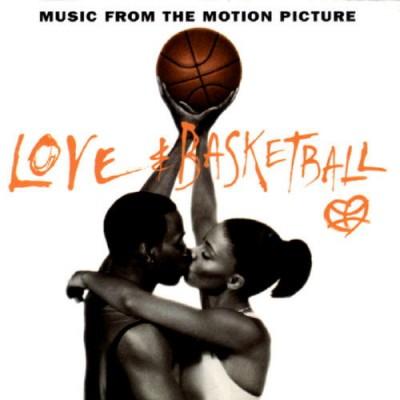
"Love & Basketball" Soundtrack Lyrics
Movie • 2000
Track Listing
Donell Jones
Rob Base & DJ EZ Rock
Lucy Pearl
Black Eyed Peas
Guy
MC Lyte
Angie Stone
Al Green
Bilal
Rufus
Roger
Me'Shell Ndegeocello
Maxwell
Hinda Hicks
"Love & Basketball (Music From The Motion Picture)" – Album Guide to Tracks and Key Scenes
Overview
What happens when a coming-of-age sports romance is scored like a decades-spanning R&B mixtape? Love & Basketball answers that question with a soundtrack that feels less like background music and more like a running commentary on Monica and Quincy’s entire lives. From the first horn stabs of Al Green to the raw ache of Meshell Ndegeocello, the album tracks every pivot in their relationship: childhood rivalry, teenage crush, college heartbreak, and adult compromise.
The official album, "Music From The Motion Picture Love & Basketball", leans heavily on classic and contemporary soul: Al Green, Rufus & Chaka Khan, Roger Troutman, Angie Stone, Bilal, Donell Jones, MC Lyte and more. It plays like a guided tour through Black popular music from the 1970s into the neo-soul era, while Terence Blanchard’s score quietly stitches scenes together underneath. On disc it peaked mid-chart, but on screen the selections punch far above their commercial weight, turning small glances and court sequences into set-pieces defined by the songs that sit under them.
Over time the soundtrack has been treated as part of the film’s legacy: singled out in lists of essential Black movie soundtracks and even ranked among the great film albums of all time. Critics tend to agree on two things: the needle-drops are unusually well chosen for character and period, and the final stretch of the film simply does not work without “Fool of Me”, “I’ll Go”, and “This Woman’s Work” doing emotional heavy lifting around the dialogue.
Musically, the palette is tightly focused but thematically precise. Seventies soul and quiet-storm cues bring warmth and adult desire; golden-age hip-hop and party rap score competitive swagger; late-’80s and ’90s R&B mark out school dances and dorm rooms; neo-soul tracks like Bilal’s “Soul Sista” and Meshell’s closer sketch a more complicated, interior kind of love. Stylistically it is R&B/hip-hop on paper, but dramatically it works like four different “quarters” of musical language that track the story’s structure.
How It Was Made
The film itself is written and directed by Gina Prince-Bythewood, with composer Terence Blanchard handling the original score and Melodee Sutton credited as music supervisor. Blanchard has described using his jazz band plus string orchestra on the movie, leaning more into groove and melody than the dense harmonic writing of his Spike Lee scores, so the cues could sit under songs without feeling like a separate universe.
The commercial soundtrack album arrives via Overbrook Music / Interscope Records, released on 18 April 2000. It is officially billed as a various-artists R&B and hip-hop compilation recorded in 1999–2000, with production from Ali Shaheed Muhammad, Raphael Saadiq, Angie Stone, Steve “Silk” Hurley, will.i.am, Spike Lee, Jake & the Phatman and others. The record runs just over fifty-two minutes and uses studio work from Chicago, Los Angeles, San Francisco and North Hollywood to cover everything from vintage-sounding soul to late-’90s neo-soul sheen.
Behind the scenes, Sutton and Prince-Bythewood had to balance three things: songs that fit the specific years (the story moves from 1981 to the late ’90s), songs that matched who Monica and Quincy are at each stage, and songs they could actually clear. That is why some key cues appear in the film but not on the CD: Maxwell’s cover of “This Woman’s Work”, Hinda Hicks’ “Our Destiny”, New Edition’s “Candy Girl”, Herb Alpert’s “Making Love In The Rain”, Kool Moe Dee’s “I Go To Work” and Johnny Kemp’s “Just Got Paid” all play memorable roles in scenes but live elsewhere in the discography.
Tracks & Scenes
Below are some of the key music moments in Love & Basketball, including several songs that do not appear on the official soundtrack album but are crucial on screen.
"Love and Happiness" — Al Green
Where it plays: Over the very beginning of the film, before we even see the kids on the court. As studio logos and the opening shot of the tree-lined L.A. street come up, Al Green’s groove rolls in non-diegetically (roughly 00:00–00:02). It carries through into the kids’ first pickup game, bathing the neighborhood in warm, analog soul.
Why it matters: It sets the tone: this is going to be a love story as much as a sports movie, grounded in Black middle-class life and older musical traditions even when the characters are children.
"Candy Girl" — New Edition
Where it plays: Early in the first quarter, when young Monica walks over to the driveway to join Quincy and his friends. After they see she is a girl and try to dismiss her, the track bumps from the boombox as she schools them during the pickup game (around 00:05–00:10). It is diegetic: the kids are literally playing with New Edition blasting in the back.
Why it matters: The sugar-rush bubblegum R&B mirrors how young they are and how quickly gender expectations snap into place. It is also the first time the film lets music cheer Monica on as she proves she belongs on the court.
"Lyte as a Rock" — MC Lyte
Where it plays: At the start of the second quarter, during a high-school game where teenage Monica dominates on the girls’ team. The song rides over a montage of her locking down defense, talking trash and refusing to smile for anyone (approx. 00:26–00:30). It is non-diegetic but cut tightly to ball movement and whistles.
Why it matters: Golden-age hip-hop over a girls’ game was still unusual on film in 2000. Pairing Lyte’s “hard as a rock” mantra with Monica’s physicality underlines that she is not just Quincy's love interest — she is her own kind of star.
"Just Got Paid" — Johnny Kemp
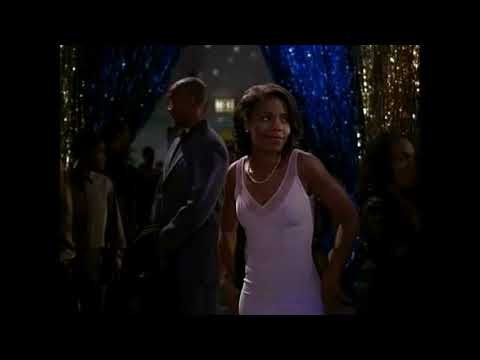
Where it plays: During the school dance / prom sequence, when Monica and the other students first walk into the gym (around the late-’80s high-school section). The track is blasting from the DJ booth, completely diegetic as couples awkwardly start to move toward the floor.
Why it matters: The song instantly timestamps the moment as late-’80s Black teenage life, full of confidence and cheap prom decorations. It frames Monica and Quincy’s budding romance as something happening inside a very specific era of R&B party culture.
"I Want to Be Your Man" — Roger Troutman
Where it plays: At the same dance, when the fast songs slow down and Monica ends up in a slow dance, trying to enjoy herself even while she is painfully aware of Quincy across the room. The vocoder-soaked ballad fills the gym as a slow-jam standard, again diegetic from the DJ’s speakers.
Why it matters: Lyrically it says everything the characters cannot yet say out loud. The song’s pleading title turns the scene into a kind of emotional foreshadowing for Monica and Quincy’s eventual relationship, even as they pair off with other partners.
"Making Love in the Rain" — Herb Alpert feat. Lisa Keith & Janet Jackson
Where it plays: In a quiet domestic moment when Monica’s sister is doing her hair in their bedroom. The song plays softly in the background, more like a radio or stereo choice than a grand cue — calm, mid-tempo, and deeply adult compared with the teen drama elsewhere.
Why it matters: It gives us a glimpse of sensual, grown-up Black love that Monica has not yet reached. The lush, jazz-leaning production contrasts with the competitive noise of the court, hinting at another kind of intimacy she will eventually navigate.
"Our Destiny" — Hinda Hicks
Where it plays: Twice: first when Monica is alone in the university gym, grinding through drills and feeling shut out by her coach and teammates, and later when Quincy plays a bad game after finding out about his father’s affair. In both cases, the song plays over images of them fighting frustration on the court, largely non-diegetic but mixed loud enough to feel like the soundtrack in their heads.
Why it matters: This is one of the film’s secret weapons: a non-album cut that quietly becomes a theme for their parallel struggles. The lyrics about destiny and separation underline that their career choices are pulling them away from each other.
"This Woman’s Work" — Maxwell
Where it plays: During Monica and Quincy’s first time together in his USC dorm room, after the dance and after both have been accepted to college. The scene cross-cuts between their nervous intimacy and a college-age version of themselves trying to move carefully, with the song playing non-diegetically from start to finish (roughly a three- to four-minute stretch in the middle of the film).
Why it matters: The tension and falsetto of Maxwell’s Kate Bush cover make the scene feel tentative and fragile instead of voyeuristic. It signals that their relationship has stepped into truly adult stakes, not just teenage crush territory.
"Baila Mi Cha-Cha" — Abraxas Pool
Where it plays: In the third quarter when Monica is playing professionally in Spain. The track flows through the arena and surrounding nightlife as she navigates a new country, different teammates and a language barrier.
Why it matters: It is one of the few cues that takes us outside African-American musical traditions, reminding us that Monica’s dream of going pro means leaving home entirely — and that Quincy is no longer in every scene with her.
"After the Dance" — Marvin Gaye
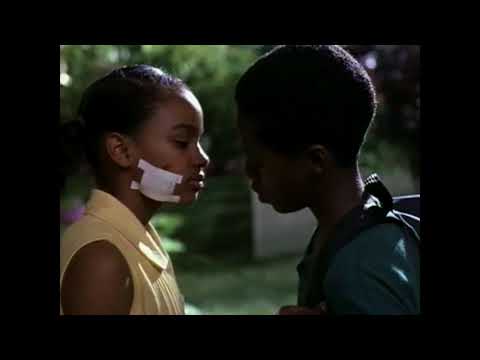
Where it plays: During a small but crucial moment when young Quincy writes a “sorry” letter to young Monica at his house. The song floats in from the stereo, smooth and regretful, while he wrestles with his pride and finally writes the apology.
Why it matters: Marvin Gaye gives their childhood spat grown-up emotional weight. The choice quietly connects Quincy to an older generation of flawed Black men whose love lives are complicated, foreshadowing his adult struggles with his father.
"Fool of Me" — Meshell Ndegeocello
Where it plays: Late in the fourth quarter, when Monica challenges Quincy to one last game of one-on-one “for his heart”. After she loses and walks away, the song comes in over images of her heartbreak and his conflicted reaction, running non-diegetically into the transition toward the film’s resolution.
Why it matters: Sparse bass, drums, and Meshell’s almost whispered vocal turn the scene into pure emotional fallout. The lyric “I remember when you filled my heart with joy” feels like Monica’s inner monologue, explaining her devastation more clearly than any line of dialogue.
"I’ll Go" — Donell Jones
Where it plays: Over the final epilogue and the end credits. After the “double or nothing” rematch and the reveal that Monica is now playing pro ball while Quincy cheers from the stands with their child, “I’ll Go” takes over as the first credits song and keeps rolling (roughly 02:05 onward).
Why it matters: Where “Fool of Me” lives in heartbreak, “I’ll Go” is about commitment and staying put. It completes the character arc sonically: these two people finally choose each other and the life they want, not the versions scripted by parents, scouts or fans.
Other key cues & trailer-adjacent tracks
The film also deploys Angie Stone’s cover of “Holding Back the Years”, Bilal’s neo-soul single “Soul Sista”, Rufus & Chaka Khan’s “Sweet Thing”, and high-energy hip-hop like “It Takes Two”, “I Like”, and “I Go To Work” around practices, locker-room moments and time-jump montages. The marketing leaned on the more upbeat cuts — the kind of songs you hear over quick flashes of dunks, kisses and arguments in the trailer — while quieter tracks like “Fool of Me” and Maxwell’s ballad are saved for the film’s heaviest scenes.
Notes & Trivia
- The soundtrack album hit No. 45 on the Billboard 200, No. 15 on Top R&B/Hip-Hop Albums and No. 1 on the Independent Albums chart, a strong showing for a largely mid-tempo set.
- Love & Basketball won the Black Reel Award for Outstanding Original Soundtrack, beating out other early-2000s Black-led films with high-profile albums.
- Meshell Ndegeocello’s “Fool of Me” won a Black Reel Award for Outstanding Original or Adapted Song, while Donell Jones’ “I’ll Go” and Lucy Pearl’s “Dance Tonight” were nominated the same year.
- Several fan-favorite cues — “Our Destiny”, “This Woman’s Work”, “Candy Girl”, “Making Love In The Rain”, “I Go To Work” and “Just Got Paid” — are absent from the official soundtrack CD and vinyl, which is why fan playlists and unofficial mixes are so common.
- Bilal’s “Soul Sista” doubled as his debut single and was promoted alongside both his own album and the film, eventually becoming a Top-20 R&B hit in the U.S.
- Angie Stone’s “Holding Back the Years” is a cover of the Simply Red ballad; its presence here helped cement her reputation as one of neo-soul’s premier interpreters of pop and soul standards.
- In 2023, the film itself was selected for preservation in the U.S. National Film Registry, a nod that also implicitly canonizes its soundtrack as part of modern Black film history.
Music–Story Links
Prince-Bythewood structures the film in four quarters, and the musical choices follow that playbook. The first quarter leans on early-’80s R&B like “Candy Girl” and Al Green’s classic groove to paint a warm, slightly idealized childhood where gender expectations are already present but still negotiable. By the second quarter, high-school Monica has her own sonic identity: aggressive hip-hop, especially “Lyte as a Rock”, announces that she is tougher and more emotionally volatile than the girls around her.
College and early-pro life bring in smoother, more introspective textures. Maxwell’s “This Woman’s Work” scores the shift from crush to sexual relationship; Hinda Hicks’ “Our Destiny” underlines that pursuing separate careers may fracture that bond. When Monica plays in Spain, the use of “Baila Mi Cha-Cha” tells us she is no longer just the girl on Quincy’s driveway court — she is a global pro, but one who feels unmoored.
The final quarter is all about contrast. The tenderness of “Fool of Me” and the promise in “I’ll Go” sit next to each other as Quincy and Monica renegotiate their lives, choosing love without abandoning Monica’s professional ambitions. In other words, the soundtrack mirrors the story’s thesis: real partnership means letting each person keep their rhythm instead of asking them to mute it.
Reception & Quotes
On release the album received solid but not ecstatic reviews. AllMusic’s review highlighted Meshell Ndegeocello’s “Fool of Me” as a key emotional anchor and pointed to appearances by MC Lyte, Al Green and Rufus & Chaka Khan as core strengths. Entertainment Weekly graded the record a respectable B, framing it as an unusually coherent various-artists set tied closely to the film’s emotional beats.
Later retrospectives have been kinder. Vibe has listed the album among the essential Black movie soundtracks, noting how it compresses roughly thirty years of soul and R&B styles into a single narrative arc. Consequence’s poll of the “100 Greatest Movie Soundtracks” includes Love & Basketball, praising how the music tracks the romance “from Zapp and Chaka Khan to contemporary R&B jams like Bilal’s ‘Soul Sista’” while keeping the emotional through-line intact.
“An eclectic R&B soundtrack that moves with the characters, not just the plot.” AllMusic, review summary
“Thirty years of Black love songs in one movie, from first crush to grown-folks apologies.” Vibe, Black movie soundtracks feature
“One of the rare sports romances where the soundtrack is as beloved as the couple.” Consequence, greatest movie soundtracks list
With the Criterion Blu-ray release using a fresh 5.1 mix, the songs and score now sit more cleanly in the surround field. The album itself remains widely available on streaming services and through reissue-minded physical releases, often bundled with neo-soul playlists and “classic Black cinema” collections.
Interesting Facts
- Terence Blanchard and Gina Prince-Bythewood have continued to collaborate; his later score for The Woman King picks up threads of rhythmic, big-orchestra writing he first explored here.
- The official album credits the South Central Chamber Orchestra, reflecting how seriously the team took the string arrangements even though most attention goes to the vocal tracks.
- Rahsaan Patterson originally wrote and recorded “I’ll Go”; Donell Jones’ version is the one on the soundtrack, while Patterson’s take appears on the compilation Soul Togetherness 2001.
- “Soul Sista” gave Bilal a charting single off the back of the movie; it later appeared on his debut album 1st Born Second, effectively blurring the line between soundtrack song and artist launchpad.
- The soundtrack’s producers form a kind of mini-hall-of-fame for turn-of-the-millennium R&B and hip-hop production, connecting this film indirectly to work with D’Angelo, Erykah Badu, Dr. Dre’s camp, and more.
- Because several crucial cues are missing from the official album, fan-made Spotify and YouTube playlists often run longer than the commercial release and include non-album tracks in scene order.
- The Criterion release’s supplements feature commentary tracks with Blanchard and Prince-Bythewood discussing how specific cues were chosen and how they timed cuts to match drum fills and chord changes.
- At the 2001 Black Reel Awards, Love & Basketball swept multiple categories, which helped codify the idea that a romantic sports drama could be as musically important as a biopic or concert film.
Technical Info
- Title: Music From The Motion Picture Love & Basketball
- Film: Love & Basketball (2000)
- Year of album release: 2000 (April 18)
- Type: Various-artists soundtrack, primarily R&B and hip-hop
- Composers (score): Terence Blanchard
- Key producers (songs): Ali Shaheed Muhammad, Raphael Saadiq, Angie Stone, Jake & the Phatman, Steve “Silk” Hurley, will.i.am, Spike Lee (executive)
- Music supervision (film): Melodee Sutton
- Label: Overbrook Music / Interscope Records (album); New Line/40 Acres and a Mule as film producers
- Album length: ~52:24, 12 tracks on the standard edition
- Key placements (selected): “Love and Happiness” (main titles), “Candy Girl” (childhood driveway game), “Lyte as a Rock” (high-school game), “This Woman’s Work” (first love scene), “Fool of Me” (late-film heartbreak), “I’ll Go” (final epilogue and credits)
- Release context: Film opened in U.S. cinemas April 21, 2000; soundtrack dropped three days earlier as part of the promotional push.
- Awards: Black Reel Award for Outstanding Original Soundtrack; Black Reel Award for Outstanding Original or Adapted Song (“Fool of Me”).
- Availability: Widely available on major streaming platforms; physical releases on CD, cassette and later vinyl reissues.
Canonical Entities & Relations
| Subject | Relation | Object |
|---|---|---|
| Gina Prince-Bythewood | wrote and directed | Love & Basketball (2000 film) |
| Terence Blanchard | composed score for | Love & Basketball (2000 film) |
| Melodee Sutton | supervised music for | Love & Basketball (2000 film) |
| Various Artists | performed songs on | Music From The Motion Picture Love & Basketball (soundtrack album) |
| Overbrook Music / Interscope Records | released | Music From The Motion Picture Love & Basketball |
| 40 Acres and a Mule Filmworks | produced | Love & Basketball (2000 film) |
| Bilal | performed | “Soul Sista” (song on the soundtrack) |
| Meshell Ndegeocello | performed | “Fool of Me” (song on the soundtrack) |
| Donell Jones | performed | “I’ll Go” (song on the soundtrack) |
| Al Green | performed | “Love and Happiness” (featured in the film) |
| Angie Stone | performed | “Holding Back the Years” (featured on the soundtrack and in the film) |
| Raphael Saadiq | produced | “Soul Sista” (for Bilal and the soundtrack) |
| New Line Cinema | distributed | Love & Basketball (2000 film) |
Questions & Answers
- Which song plays during Monica and Quincy's first time together?
- The dorm-room love scene is scored with Maxwell’s version of “This Woman’s Work”, used as a non-diegetic, full-length needle-drop.
- What song is playing right at the beginning, before we even see the court?
- Al Green’s “Love and Happiness” starts over the opening logos and carries into the first childhood driveway game.
- What track closes the movie and runs over the end credits?
- Donell Jones’ “I’ll Go” is the main end-credits song, coming in after the final one-on-one “double or nothing” and the pro-ball epilogue.
- Why aren’t songs like “This Woman’s Work” and “Candy Girl” on the official soundtrack album?
- The album is a curated selection rather than a complete song dump; rights, label issues and runtime limits kept several prominent cues off the CD.
- Is there a separate commercial release of Terence Blanchard’s score?
- As of now there is no widely released standalone score album. Blanchard’s cues are mainly available within the film and its home-video extras.
Sources: Wikipedia film & soundtrack entries; AllMusic album page; SoundtrackINFO Q&A on scene placements; Black Reel Awards records; Vibe and Consequence soundtrack lists; On Being podcast episode on Love & Basketball; Discogs and chart listings.
November, 13th 2025
A-Z Lyrics Universe
Cynthia Erivo Popular
Ariana Grande Horsepower
Post Malone Ain't No Love in Oklahoma
Luke Combs Good Riddance (Time of Your Life)
Green Day Bye Bye Bye
*NSYNC You're the One That I Wan
John Travolta & Olivia Newton-John I Always Wanted a Brother
Braelyn Rankins, Theo Somolu, Kelvin Harrison Jr. and Aaron Pierre The Power of Love
Frankie Goes to Hollywood Beyond
Auli’i Cravalho feat. Rachel House MORE ›