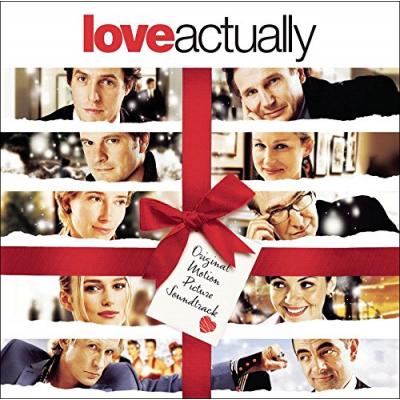
"Love Actually" Soundtrack Lyrics
Movie • 2003
Track Listing
Kelly Clarkson
Dido
Maroon 5
Norah Jones
Wyclef Jean feat. Sharissa
Eva Cassidy
The Calling
The Pointer Sisters
Joni Mitchell
Lynden David Hall
The Beach Boys
Texas
Sugababes
Craig Armstrong
Billy Mack
Mariah Carey
Gabrielle
"Love Actually – The Original Soundtrack" – Album Guide to Tracks and Key Scenes
Overview
Is it really Christmas if you don’t end up humming “God Only Knows” in a crowded airport? Love Actually – The Original Soundtrack takes the film’s sprawling web of romances and compresses them into a 17-track Christmas-adjacent mixtape. It’s less a straightforward holiday album and more a guided tour through pop ballads, soul, soft rock and score cues that track ten interlocking love stories across London, Marseille and Milwaukee.
On screen, the music sits right at the front of the movie’s personality. Billy Mack’s ridiculous “Christmas Is All Around” frames the whole film as a meta-joke about pop singles. “All You Need Is Love” erupts inside a church. “Both Sides Now” quietly detonates a marriage. “All I Want for Christmas Is You” turns a primary school concert into the emotional climax of a kids’ storyline. The songs keep cutting across storylines: the same album has Hugh Grant’s prime minister shaking off cabinet meetings to “Jump (For My Love)” and Laura Linney’s Sarah finally getting Karl back to her flat under the spell of Eva Cassidy.
As an album, it’s consciously crowd-pleasing but surprisingly coherent. The UK and US soundtrack configurations differ slightly, but both anchor themselves in strong, vocal-led tracks: Kelly Clarkson, Dido, Maroon 5, Norah Jones, Wyclef Jean, Texas, Joni Mitchell, The Beach Boys and more. Between them Craig Armstrong’s orchestral score cues (“Glasgow Love Theme”, “Portuguese Love Theme”, “PM’s Love Theme”) act like emotional glue, pulling the film’s separate stories into one continuous emotional arc.
Stylistically, the record jumps between glossy adult-contemporary pop, R&B, soul, soft rock and orchestral score, but the choices are very deliberate. Contemporary pop and R&B underscore flirtation and crushes. Soul and standards (“Songbird”, “White Christmas”, “Both Sides Now”) carry middle-aged regret and loyalty. Guitar-led soft rock (“Wherever You Will Go”) backs the laddish fantasy of the Wisconsin storyline. The score themes sit where characters can’t quite speak, making the album a map of how different musical languages are used to sketch different kinds of love.
How It Was Made
Love Actually was written and directed by Richard Curtis and scored by Scottish composer Craig Armstrong, who had already worked on Moulin Rouge! and would later do The Great Gatsby. The film’s original score was composed, orchestrated and conducted by Armstrong, but a dedicated score album didn’t appear until 2021, when Universal’s Back Lot Music and La-La Land Records finally released it. That late release turned long-bootlegged cues like “Glasgow Love Theme” and “PM’s Love Theme” into official catalogue tracks.
The song side is a joint operation. The UK soundtrack album was issued by Island Records in November 2003, while the US CD came out on J Records a couple of days before the film’s American release. The tracklist leans on big-label material: Kelly Clarkson and Dido from the pop world, Maroon 5 right at the start of their career, established catalog cuts from Otis Redding and The Beach Boys, plus Girls Aloud’s “Jump” on the UK edition. Armstrong’s cues are mostly on the later score album, but “Glasgow Love Theme” makes the cut here because it had already become a cult favourite.
There are also two slightly different audio “cuts” depending on where you watch the film. The UK version scores the office party montage with Sugababes’ “Too Lost in You”, and rolls Girls Aloud’s cover of “Jump (For My Love)” over the credits. The US cut swaps in Kelly Clarkson’s “The Trouble With Love Is” for that montage and uses the original Pointer Sisters version of “Jump” in the credits. On screen, Hugh Grant’s dance through 10 Downing Street actually uses the Pointer Sisters recording; the Girls Aloud cover lives primarily in the UK album and its tie-in music video.
Tracks & Scenes
Below is a selection of key cues and how they’re used in the film. Timings are approximate and based on the theatrical cut.
"Christmas Is All Around" — Bill Nighy (as Billy Mack)
Where it plays: First heard in the opening recording-studio sequence, as washed-up rocker Billy Mack mangles the Troggs’ “Love Is All Around” into a cynical Christmas cash-in (around 00:02:00). Variations then recur in TV spots, chart updates and the final “number one” celebration, usually diegetic via TVs, radios or performances.
Why it matters: It’s the film’s running joke and one of its emotional spines. The song starts as obvious trash and ends up attached to one of the most sincere relationships in the film — Billy and his manager Joe.
"All You Need Is Love" — Lynden David Hall
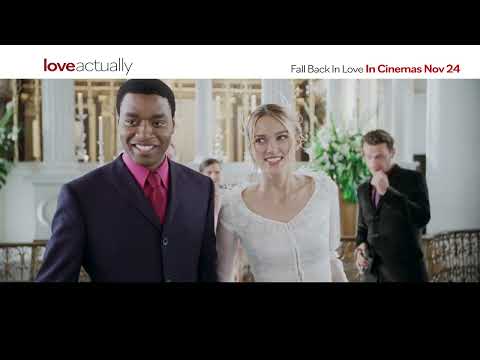
Where it plays: During Juliet and Peter’s wedding, just after the vows. Hidden musicians in the balcony and among the guests start playing the Beatles’ classic live, with brass and strings popping up one by one (around 00:09:00). Entirely diegetic: it’s a surprise performance orchestrated by Mark.
Why it matters: The moment establishes the film’s heightened rom-com reality and quietly underlines Mark’s heartbreak. He stages the perfect romantic gesture, but it’s not for him.
"The Trouble With Love Is" — Kelly Clarkson / "Too Lost in You" — Sugababes
Where it plays: In the UK cut, the office party build-up and early scenes are scored to Sugababes’ “Too Lost in You”; in the US cut, the same montage uses “The Trouble With Love Is” (roughly 00:35:00–00:40:00). Both are non-diegetic, flowing over staff getting ready, drinks being poured and Sarah watching Karl on the dance floor.
Why it matters: The lyrics about being overwhelmed by love frame Sarah’s entire storyline. Either song sets up how much emotional risk she’s about to take when she finally invites Karl home.
"Here With Me" — Dido
Where it plays: After Juliet visits Mark to see his wedding video, discovers it’s essentially a montage of her face and leaves, Mark walks alone through late-night London. “Here With Me” slides in over that walk (around 00:32:00), non-diegetic, echoing his sense of impossible longing.
Why it matters: The song is all about wanting someone you can’t really have. It turns what could be a slightly creepy reveal into something more openly melancholy and conflicted.
"Glasgow Love Theme" — Craig Armstrong
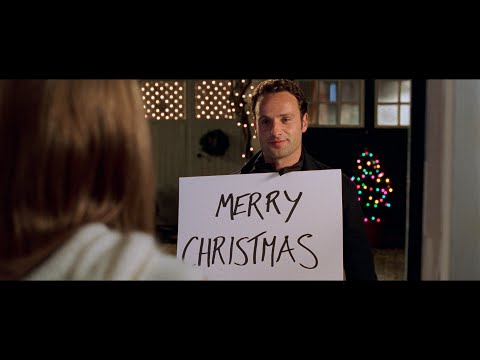
Where it plays: A recurring score cue tied most strongly to the Mark–Juliet–Peter triangle. You hear it in soft focus over the wedding video sequence and again as Mark walks away after the famous cue-card confession, often blending with street ambience (roughly mid-film and again around 01:35:00).
Why it matters: The theme is simple, almost fragile, built around piano and strings. It gives that storyline a tone of wistful, unrequited love rather than triumph, which is crucial for how the film ages.
"Songbird" — Eva Cassidy
Where it plays: In the office Christmas party sequence, just as Sarah and Karl finally leave together and head back to her flat. The song starts as they walk through the corridor and continues into the bedroom as they kiss and begin to undress (around 00:49:00), non-diegetic but mixed as if it’s the sound of the moment itself.
Why it matters: It’s disarmingly gentle. When Sarah’s phone keeps ringing with calls from her brother and she chooses family over sex, “Songbird” keeps playing, underlining that this is love too — just a different, more complicated kind.
"Both Sides Now" (2000 version) — Joni Mitchell
Where it plays: The most devastating music moment in the film. Karen retreats to the bedroom after finding a necklace box in her husband’s coat and then unwrapping a Joni Mitchell CD instead under the tree. She listens to the orchestral 2000 version of “Both Sides Now”, straightening the bed and quietly breaking down before rejoining her family (around 01:27:00).
Why it matters: The re-recorded version of the song sounds older and more wounded. It turns Karen’s private grief into a miniature portrait of long marriages, regret and the way people rebuild their faces before going back into the living room.
"Turn Me On" — Norah Jones
Where it plays: During the same office party, when Sarah and Karl finally dance together. The track glides in as they move a little closer on the floor, trading shy smiles (around 00:44:00). Non-diegetic, but it’s being “played” by the party band/DJ in the world of the film.
Why it matters: The slow, jazz-tinged groove makes the moment feel tentative rather than purely sexy. You can feel Sarah’s mix of excitement and terror in every line.
"Bye Bye Baby (Baby Goodbye)" — Bay City Rollers
Where it plays: At the funeral of Daniel’s wife, when the slideshow of family photos plays in the church. Instead of a hymn, this upbeat ’70s pop song blasts out while mourners watch images of the woman he’s lost (around 00:14:00). Entirely diegetic: it’s the track she requested for her own farewell.
Why it matters: The juxtaposition is brutal and funny in exactly the way grief often is. The choice humanises Daniel’s late wife instantly and gives that storyline a specific sense of shared history.
"All I Want for Christmas Is You" — Olivia Olson (in-film performance)
Where it plays: The school Christmas pageant. Young Joanna steps up to the microphone and performs the Mariah Carey hit live, with Sam on drums, while their families watch from the audience (around 01:35:00). It starts diegetic, then swells into more of a mixed performance as the scene cuts between the stage and reaction shots.
Why it matters: It’s the emotional payoff for Sam’s whole “learn the drums” subplot. The song turns a primary-school crush into a Big Movie Moment without losing the sweetness of the kids’ perspective.
"Jump (For My Love)" — The Pointer Sisters
Where it plays: Hugh Grant’s prime minister dance. After a stressful day, he puts on the track in his private quarters at 10 Downing Street and ends up dancing down the corridor and past staff, only barely composing himself when someone walks in (around 01:02:00). Non-diegetic in the mix but framed as if it’s on his stereo.
Why it matters: This is the film’s purest burst of silly joy. The Pointer Sisters’ original recording gives the scene a slightly retro feel. Girls Aloud’s cover is tied to the UK soundtrack and music video, but it’s the older version that defines the character on screen.
"White Christmas" — Otis Redding
Where it plays: Under a wordless montage of downbeat moments near the middle of the film — characters alone, arguments unresolved, presents being wrapped in uneasy silence. The track drifts in like a slightly frayed Christmas standard (mid-film, around the time several storylines hit low points).
Why it matters: It’s one of the few songs on the album that is explicitly about Christmas, but the gritty, raspy vocal makes the holiday feel heavy, not cosy. It’s the sound of people wondering if they’ve messed everything up.
"Wherever You Will Go" — The Calling
Where it plays: Over the comic fantasy sequence where Colin arrives in Wisconsin and is immediately surrounded by impossibly friendly American women. The song plays in the bar as he “falls in love” with an entire flatshare’s worth of roommates (late in the film, around 01:25:00).
Why it matters: The earnest early-2000s rock ballad gives the joke a surprising feeling of genuine longing. It also underlines how much of Colin’s dream is built out of US pop culture clichés.
"God Only Knows" — The Beach Boys
Where it plays: Over the Heathrow arrivals montage at the very beginning and again for the epilogue a month later, tying together reunions and everyday acts of affection (opening and closing scenes). Fully non-diegetic, functioning as the movie’s framing device.
Why it matters: It’s the closest thing the film has to a thesis statement in song form. The choice says: whatever else you think of people’s decisions in this film, love is the part that makes life worth watching.

Notes & Trivia
- The main soundtrack album hit number one on the UK Official Soundtrack Albums Chart and has spent hundreds of weeks bouncing in and out of the Top 40 every Christmas season.
- The US and UK soundtrack configurations differ: the US CD swaps in a Maroon 5 medley, the Pointer Sisters’ “Jump” and drops Gabrielle’s “Sometimes”.
- Craig Armstrong’s score cues, including “Glasgow Love Theme”, weren’t officially released until 2021, when a dedicated score album appeared after years of fan demand.
- Girls Aloud’s “Jump” was recorded at Richard Curtis’s request; it appears on the UK soundtrack and in their video, even though the film itself uses the Pointer Sisters’ original.
- “Bye Bye Baby (Baby Goodbye)” by Bay City Rollers at the funeral was Jennifer Lawrence’s once-dream funeral song choice — until she realised Love Actually got there first.
- “All I Want for Christmas Is You” is sung in the film by Olivia Olson, but there’s also a more traditional vocal by Tessa Niles buried elsewhere in the mix.
- The “Christmas Is All Around” music video consciously parodies Robert Palmer’s “Addicted to Love”, right down to the expressionless backing band.
Music–Story Links
Because the film juggles ten stories, the soundtrack has to do a lot of structuring. The wedding performance of “All You Need Is Love” doesn’t just sell Juliet and Peter’s romance; it also pulls Mark into focus as someone who will express love in the wrong direction. Later, “Glasgow Love Theme” and “Here With Me” keep following him, turning what could have been a one-note “cue card” gag into a sad little character study.
In the Karen–Harry storyline, Joni Mitchell functions almost like a supporting character. Harry gives Karen the Both Sides Now CD instead of the necklace, and the 2000 recording of the title track then scores the moment she realises the betrayal. That’s not just a random sad song — it’s the sound of someone re-reading her whole life “from both sides now” and wondering what was real.
Sarah’s story gets its own linked set of songs. “Turn Me On” handles the giddy office-party attraction, and “Songbird” carries her up the stairs with Karl and through the moment where she chooses her brother instead. The mood of the music never turns harsh; that’s the point. The soundtrack keeps insisting that her love for her brother is as valid as any of the romances, even if it costs her the night she wants.
Sam’s airport sprint cuts together with Jamie’s race through Marseille under Armstrong’s score, “PM’s Love Theme” and related motifs. Pop would have made it feel like a music video; instead the orchestral cues keep the focus on small acts of courage. Meanwhile “Wherever You Will Go” and “Take Me As I Am” sit under Colin’s and the wedding-reception scenes, gently mocking and celebrating romance clichés at the same time.
Reception & Quotes
At release, reviews treated the soundtrack as a solid, very commercial compilation. Mainstream critics praised the overall warmth and highlighted standout moments like Joni Mitchell’s contribution, Eva Cassidy’s “Songbird” and The Beach Boys bookend. More specialised film-music coverage later singled out Armstrong’s score, especially “Glasgow Love Theme”, as one of the most memorable romantic motifs of the 2000s.
Over time the album has picked up a different kind of respect. Radio features and think-pieces now group it with other “modern Christmas” staples, arguing that its mix of non-holiday songs and a few key seasonal cuts makes it more replayable than traditional Christmas albums. One writer at Bustle flat-out called it “the most underrated Christmas album of all time”, pointing to how every track is tied to a specific emotional beat rather than dropped in at random.
The chart story backs that up: the soundtrack has returned to UK charts regularly since 2003, often climbing back into the Soundtrack Top 10 in December. 20th-anniversary orchestral concerts built entirely around Armstrong’s score and the pop songs underline how deeply this music has sunk into seasonal pop culture.
“A Christmas compilation that works because it remembers people’s breakups and bad decisions as clearly as their first kisses.” Film-music feature
“Glasgow Love Theme might be the decade’s quietest rom-com showstopper.” Score review
“No song is a throwaway — every single one is rife with emotion.” Essay on the soundtrack

Interesting Facts
- Armstrong wrote “Glasgow Love Theme” partly as a love letter to his hometown; it later became a staple of live film-in-concert performances.
- The soundtrack album reached number one on the UK Soundtrack Albums Chart and has logged well over 300 weeks on that chart since 2003.
- The US soundtrack credits J Records, while most UK/European physical editions list Island Records; streaming versions usually sit under “Various Artists – Soundtrack”.
- Armstrong’s score album, released in 2021, restores cues that fans only knew from DVD menus and isolated rips, including “Sam’s Bedroom” and “Portuguese Love Theme”.
- “All You Need Is Love” in the church scene uses live brass players hidden among the congregation on set to get realistic timing and reactions.
- “All I Want for Christmas Is You” had to be rearranged to fit Olivia Olson’s bigger voice; Curtis has joked they toned her down so it still sounded like a child singing.
- Girls Aloud have said that having “Jump” associated with the movie helped convince their label to stick with them after early doubts.
- Because of rights and regional soundtrack differences, fan playlists often add missing cues like “River”, “All Alone on Christmas” and “Smooth” to recreate the full film experience.
Technical Info
- Title: Love Actually – The Original Soundtrack
- Film: Love Actually (2003)
- Year of album release: 2003 (US CD shipped mid-November; UK release November 2003)
- Type: Various-artists film soundtrack (songs) with one key score piece
- Score composer: Craig Armstrong
- Primary labels: Island Records (UK/Europe); J Records (US)
- Key featured artists (songs): Kelly Clarkson, Dido, Maroon 5, Norah Jones, Wyclef Jean feat. Sharissa, Eva Cassidy, Texas, Joni Mitchell, Otis Redding, Lynden David Hall, Girls Aloud / The Pointer Sisters, The Beach Boys, Bill Nighy (as Billy Mack), Olivia Olson
- Notable cues/placements: “All You Need Is Love” (wedding performance), “Songbird” (Sarah and Karl’s near-romance), “Both Sides Now” (Karen’s bedroom), “Jump (For My Love)” (PM dance), “All I Want for Christmas Is You” (school pageant), “God Only Knows” (airport prologue and epilogue), “Christmas Is All Around” (Billy Mack subplot)
- Score album: Love Actually (Original Motion Picture Score), released digitally and on CD in 2021
- Chart notes: Reached No. 1 on the UK Official Soundtrack Albums Chart; re-enters seasonally and has accumulated several hundred weeks in the Top 100.
- Availability: Widely available on major streaming platforms; multiple CD pressings and a 20th-anniversary vinyl reissue exist.
Canonical Entities & Relations
| Subject | Relation | Object |
|---|---|---|
| Richard Curtis | wrote and directed | Love Actually (2003 film) |
| Craig Armstrong | composed score for | Love Actually (2003 film) |
| Working Title Films | produced | Love Actually (2003 film) |
| Universal Pictures | distributed | Love Actually internationally |
| Island Records | released | Love Actually – The Original Soundtrack (UK/Europe editions) |
| J Records | released | Love Actually – The Original Soundtrack (US edition) |
| Kelly Clarkson | performed | “The Trouble With Love Is” (on the soundtrack) |
| Dido | performed | “Here With Me” (on the soundtrack) |
| Norah Jones | performed | “Turn Me On” (on the soundtrack) |
| Eva Cassidy | performed | “Songbird” (used in Sarah and Karl’s storyline) |
| Joni Mitchell | performed | “Both Sides Now” (2000 version, used in Karen’s bedroom scene) |
| The Beach Boys | performed | “God Only Knows” (opening and closing montages) |
| Lynden David Hall | performed | “All You Need Is Love” (wedding performance in the film) |
| The Pointer Sisters | performed | “Jump (For My Love)” (used in the PM dance scene and US credits) |
| Girls Aloud | covered | “Jump” (used on UK soundtrack and in promotional video) |
| Bill Nighy | portrayed | Billy Mack, who performs “Christmas Is All Around” |
| Olivia Olson | performed | “All I Want for Christmas Is You” (in the school concert scene) |
| Craig Armstrong | composed | “Glasgow Love Theme”, “Portuguese Love Theme”, “PM’s Love Theme” |
Questions & Answers
- Which song plays during Hugh Grant’s dance through 10 Downing Street?
- The scene is scored with “Jump (For My Love)” by The Pointer Sisters. Girls Aloud’s cover appears on the UK soundtrack and in their music video, not in that scene.
- What track is used in the heartbreaking bedroom scene with Emma Thompson’s character?
- That moment is underscored by Joni Mitchell’s 2000 orchestral recording of “Both Sides Now”, from her album of the same name.
- Which song closes the film over the airport montage?
- The ending montage at Heathrow is set to “God Only Knows” by The Beach Boys, echoing the film’s opening and tying the stories together.
- What’s the novelty Christmas single Bill Nighy’s character keeps promoting?
- He records a cheesy re-write of The Troggs’ “Love Is All Around” retitled “Christmas Is All Around”, which becomes the film’s fictional Christmas number one.
- Is Craig Armstrong’s Love Actually score available separately from the song compilation?
- Yes. Love Actually (Original Motion Picture Score) was released in 2021 by Back Lot Music and La-La Land Records, collecting his instrumental cues.
Sources: Wikipedia film entry; Radio Times soundtrack feature; SoundtrackINFO tracklist & Q&A; Bustle soundtrack essay; Official Charts Company data; Discogs release notes; Apple Music & Spotify album pages; label and score details from Back Lot Music / La-La Land announcements.
November, 13th 2025
A-Z Lyrics Universe
Cynthia Erivo Popular
Ariana Grande Horsepower
Post Malone Ain't No Love in Oklahoma
Luke Combs Good Riddance (Time of Your Life)
Green Day Bye Bye Bye
*NSYNC You're the One That I Wan
John Travolta & Olivia Newton-John I Always Wanted a Brother
Braelyn Rankins, Theo Somolu, Kelvin Harrison Jr. and Aaron Pierre The Power of Love
Frankie Goes to Hollywood Beyond
Auli’i Cravalho feat. Rachel House MORE ›