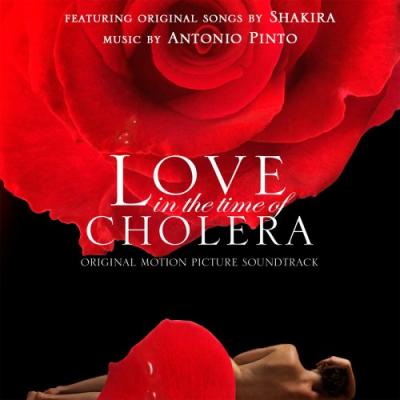
"Love in the Time of Cholera" Soundtrack Lyrics
Movie • 2008
Track Listing
Shakira
Shakira
Shakira
"Love in the Time of Cholera (Original Motion Picture Soundtrack)" – Album Guide to Tracks and Key Scenes
Overview
What does a fifty-year obsession sound like when it has to survive cholera, marriages, and the slow passing of time? The soundtrack to Love in the Time of Cholera turns that question into music: intimate rather than grandiose, more like a memory whispered than an operatic declaration. Brazilian composer Antônio Pinto builds the score around guitars, strings, and light percussion, letting the Colombian setting breathe instead of burying it under huge themes.
The album weaves between Pinto’s cues and three songs sung by Shakira — “Hay Amores,” “Despedida,” and a new version of her earlier ballad “Pienso en Ti.” Her bolero-leaning material gives the soundtrack a vocal spine that the film itself often leans on emotionally, especially in late passages and over the end credits. Several reviewers have pointed out that these songs, together with the understated score, feel more faithful to García Márquez’s tone than parts of the adaptation itself.
As a listening experience, the soundtrack is calm on the surface but restless underneath. The main theme circles around a small guitar figure that never quite resolves, mirroring Florentino’s permanent state of waiting. Pinto’s cues favour warm but slightly dry recording, with orchestral colours that avoid sugar-coated strings in favour of chamber-like transparency. When Shakira enters, the palette shifts into classic Latin romanticism: bolero rhythm, muted trumpets, and a voice recorded very close to the ear.
Genre-wise, the album sits at a three-way crossroads: film score, bolero/Latin folk, and period source music. The orchestral cues paint time and social class — elegant strings for Urbino’s world, more rhythmic guitars and hand percussion for Florentino’s streets and river journeys. Shakira’s boleros stand in for mythic, almost fatalistic love, while the occasional historic or classical track situates everything in turn-of-the-century Cartagena. Indie-score subtlety, old-school bolero drama, and local colour all pull in different directions, which is exactly why the album has such a specific, slightly haunted mood.
How It Was Made
The 2007 film, directed by Mike Newell, adapts Gabriel García Márquez’s novel into an English-language period drama. Producer Scott Steindorff and the team brought in Antônio Pinto, already known for scores like City of God and Central Station, to find a musical voice that could handle both magical realism and old-fashioned melodrama without tipping into kitsch.
García Márquez himself famously asked Shakira, a fellow Colombian from Barranquilla, to be involved. She was first offered an acting role but declined, uncomfortable with the required nude scenes, and instead agreed to contribute original music. Together with Argentine musician Pedro Aznar and Pinto, she wrote and recorded “Hay Amores” and “Despedida,” plus adapted her mid-90s ballad “Pienso en Ti” for the soundtrack. These sessions took place between London and Brazil.
From a production standpoint, the soundtrack is surprisingly high-end. The orchestral and ensemble parts were tracked at Abbey Road Studios in London and at Ambulante Studios in São Paulo, mixing the prestige of a classic British studio with Brazilian players and Latin American rhythms. The score credits list conductor and orchestrator Ed Cortes, engineers like John Kurlander and Robin Baynton, and a sizeable team of Colombian music researchers who helped anchor the arrangements to local idioms rather than generic “Latin” gestures.
Music supervision on the film side involved Hothouse Music Limited, with Stone Village’s producers heavily invested in the soundtrack as a selling point. The result was a hybrid release strategy: an English-market album under titles like Love in the Time of Cholera (Original Motion Picture Soundtrack) and a Spanish-language edition (El Amor en los Tiempos del Cólera) on Epic/Sony BMG and New Line’s label, later reissued digitally by WaterTower Music.
Tracks & Scenes
Below are key songs and cues, with how they function in the film and on the album. Exact timings can vary between cuts and releases, but the dramatic roles stay consistent.
"Hay Amores" — Shakira
Where it plays: Written as the film’s central song, “Hay Amores” acts like the musical emblem of Florentino and Fermina’s bond. In the film and its promotional materials it tends to surface around wide, contemplative images of Cartagena and the Magdalena River, and in some versions it is closely associated with ending passages and credits. Non-diegetic, it floats over images rather than coming from the world of the characters.
Why it matters: As a bolero, the track leans into the idea of love that grows and deepens with time instead of fading. The gentle trumpet lines and old-club atmosphere match García Márquez’s nostalgia for a vanished Caribbean world. For listeners, this is often the “entry point” to the album: a self-contained song that still carries the weight of the story.
"Despedida" — Shakira
Where it plays: “Despedida” is threaded through late-film passages and is used prominently over the end credits, functioning as the last word the movie offers after the final river journey. The track is non-diegetic: a reflective curtain-call rather than something the characters hear.
Why it matters: Lyrically, it deals with the melancholy of losing a love, and critics from Latin American outlets have noted that it captures the novel’s bittersweet tone more directly than some parts of the adaptation. The song’s Golden Globe nomination for Best Original Song made it the soundtrack’s most high-profile calling card and cemented it as the emotional coda to the film.
"Pienso en Ti" — Shakira
Where it plays: Originally released on Shakira’s 1995 album Pies Descalzos, this re-used ballad appears on the soundtrack EP and is tied closely to Florentino’s interior world — his obsessive thinking and longing. On screen it is associated with moments of solitary reflection rather than big plot turns, and it functions mainly as non-diegetic commentary.
Why it matters: Because the song predates the film, its inclusion feels like Florentino’s private playlist breaking through the score. The sparse arrangement and circular melody underline the idea that thinking about someone can become a habit as strong as a disease, echoing the story’s play between love and sickness.
"Love" — Antônio Pinto
Where it plays: On the album, “Love” introduces the main instrumental theme, centred on a small guitar motif doubled by strings. In the movie this material recurs across several points — early infatuation, stolen glances, later-life reconciliations — effectively becoming the score’s answer to a love song.
Why it matters: The cue avoids big climaxes. Instead it loops, adding subtle colours with each repetition, mirroring how Florentino’s feelings never really resolve, only change temperature. It sets the sonic ground rules: restrained tempo, close-mic’d instruments, and a wistful but not saccharine mood.
"In the Time of Cholera" — Antônio Pinto
Where it plays: This is a fuller orchestral version of the main theme, typically heard in sequences that deal with the passing of time and the social sweep of the story: weddings, funerals, and transitions between eras. Non-diegetic, it glides over montage rather than binding to dialogue.
Why it matters: The cue expands the palette with more pronounced strings and low-end, giving us the “novel-sized” view of events. It is one of the few places where the score lets itself sound openly romantic and is often singled out by listeners as the purest expression of the soundtrack’s central melody.
"Florentino" — Antônio Pinto
Where it plays: As the title suggests, this short cue is associated with Florentino Ariza himself, especially his younger days as a shy telegraph clerk and would-be poet. The arrangement keeps close to solo instruments, mirroring his isolation and obsessive focus on Fermina.
Why it matters: “Florentino” sketches character in under a minute. Light, slightly hesitant rhythms and a small ensemble suggest someone out of step with the world around him. It works as a musical character study rather than a theme you hum on the way out.
"The Girls" — Antônio Pinto
Where it plays: On screen, this cue supports scenes focused on Fermina and the women around her — cousins, aunts, society matrons — and the social structures hemming her in. It tends to play under interiors and social gatherings rather than sweeping landscapes.
Why it matters: Reviewers have noted how pieces like “The Girls” keep the album from becoming monotonously lovelorn. There is a hint of playfulness in the rhythm, but the harmony remains slightly unresolved, hinting that the social games around marriage are as constricting as they are glittering.
"The Boat" — Antônio Pinto
Where it plays: This cue is linked to the late-film river voyage that finally allows Florentino and Fermina to exist together in a sealed-off space. The music stays understated: pulses in the low strings, soft figures above, matching the motion of the river and the ship.
Why it matters: Rather than turning the journey into a grand, triumphant set-piece, the cue emphasises fragility. It suggests that this long-deferred romance is still delicate, even when the couple seem to have “won.” The music makes their final gambit feel more human than mythic.
"Cholera" — Antônio Pinto
Where it plays: As implied by the title, this piece is associated with the disease itself and with wider social panic. Musically, it uses more tense harmonies, repetitive figures, and a slightly harsher sound to suggest fever and unrest.
Why it matters: The score rarely underlines the medical side of the story, but when it does, “Cholera” gives a clear contrast: same instrumental family, but colder and more agitated. It makes the metaphor between emotional and physical illness audible without resorting to horror clichés.
"Second Love" — Antônio Pinto
Where it plays: This cue is tied to Fermina’s marriage to Dr. Juvenal Urbino — the “second love” that, in social terms, becomes her first. It tends to underscore domestic scenes, routines, and moments where status and respectability take centre stage.
Why it matters: The music is warmer and more orderly than Florentino’s material, but also more rigid. The sense of comfort wrapped around a small, slightly constrained melody mirrors a relationship built on stability and duty rather than overwhelming passion.
"Los Dos" — Antônio Pinto
Where it plays: “Los Dos” (The Two) appears in contexts where Florentino and Fermina’s paths cross or nearly cross, often during public events or chance encounters rather than private intimacy.
Why it matters: The cue takes fragments of the main theme and twists them into something a little more playful and ironic, as if the music knows how improbable their eventual reunion really is. It acts as a musical wink every time fate puts them in the same frame.
"Realejo" — Antônio Pinto
Where it plays: “Realejo,” named after a kind of street organ, evokes street-level Cartagena — vendors, children, background bustle. On screen, it colours transitional shots and marketplace activity.
Why it matters: Without cues like this, the film might feel like pure aristocratic period romance. “Realejo” brings back the sense of a living port city and reminds us that Florentino’s life is rooted in more modest, crowded spaces than Fermina’s home.
"Le Fiacre" — Yvette Guilbert
Where it plays: This French cabaret song appears as source music, associated with cosmopolitan social scenes and imported European culture. It is heard as something characters could plausibly be listening to in a salon or party setting.
Why it matters: The track situates the story historically and socially — this is a world plugged into late-19th-century fashions, not a timeless fantasy Cartagena. Its presence also contrasts with the more local-sounding score cues, gently underlining class and cultural difference.
"Danza Sara" — Banda Ritmos de Sucre
Where it plays: A regional dance piece used as source music in festive, outdoor moments. It often sits under scenes of crowds, parades, or more extroverted celebrations.
Why it matters: Including a Colombian band track alongside London-recorded orchestral cues gives the soundtrack a needed jolt of local texture. It reminds you that, beneath the refined love story, there is a noisy, rhythmic public life.
"Toccata" — Philip Ledger
Where it plays: A classical organ work credited in the film’s soundtrack list, likely tied to ecclesiastical or ceremonial settings such as church scenes or formal occasions.
Why it matters: When this kind of classical cue appears, it signals institutional weight — church, state, social order — pressing in on the characters. Against Pinto’s more flexible score, it sounds rigid, underlining the tension between personal desire and public expectations.
Notes & Trivia
- Gabriel García Márquez personally encouraged Shakira to write for the film, turning the soundtrack into a small Colombian all-star collaboration rather than a generic Hollywood score.
- Shakira has later referred to “Hay Amores” and “Despedida” among the songs she is proudest of, partly because they allowed her to work in the bolero idiom she grew up with.
- “Despedida” earned a Golden Globe nomination and was also shortlisted in the Academy Awards’ original-song race, even though the film itself received mostly mixed reviews.
- The album exists in slightly different configurations: a Spanish-market physical CD on Epic/Sony BMG and a later digital release under WaterTower Music, both built around the same 22 cues.
- “Hay Amores” won a Premios Nuestra Tierra award for Best Movie Soundtrack, giving the film a notable accolade on the music side even as critical reception of the adaptation stayed lukewarm.
Music–Story Links
The clearest alignment between music and story sits in how the soundtrack splits its emotional labour. Pinto’s score largely takes care of time, place, and social texture, while Shakira’s songs articulate inner states — longing, regret, a love that refuses to age.
Whenever the narrative emphasises Florentino’s obsessive waiting, we tend to hear small-scale cues like “Florentino,” “Love,” or fragments of the main theme. They rarely resolve neatly, mirroring a man who keeps writing letters and building fantasies instead of getting closure. The music underlines his status as both romantic and slightly delusional without mocking him.
Fermina’s life with Dr. Urbino leans on calmer, more structured material: “Second Love,” “The Girls,” and the smoother passages of “In the Time of Cholera.” These cues frame marriage as a kind of social choreography — proper, comfortable, sometimes suffocating. When the music tilts from these orderly patterns into Shakira’s more vocally exposed songs, you feel the difference between life that looks correct and feelings that actually hurt.
Tracks like “Cholera” do double duty. On the surface they refer to the literal epidemic, but the feverish textures also echo Florentino’s “illness” of love — the confusion between symptoms of disease and symptoms of heartbreak that Márquez plays with in the book. The score quietly sustains that metaphor so the script does not have to spell it out.
Finally, the strategic use of period source songs (“Le Fiacre,” “Danza Sara,” organ “Toccata”) helps map class and geography: European salon music for the elite, local dance bands and street-organ colours for the port city’s everyday life. Without any exposition, the soundtrack tells you who belongs where and what kind of world each character moves in.
Reception & Quotes
The film itself divided critics, but the music was frequently singled out as one of its strongest elements. Reviews of the soundtrack album emphasised both Pinto’s subtle score and the way Shakira’s contributions elevate the package beyond a standard background-music release.
“There may be no bombastic themes in this soundtrack, but the mesmerizing strings and guitars are dreamy enough for the romantic die-hards.”
— John Li, MovieXclusive
“The music, by Antonio Pinto, is ardent and expressive and puts a delicate underscore on the tempestuous tale unfolding onscreen.”
— Charleston City Paper review
One AllMusic review went as far as to say Shakira’s three songs make the album “worth paying your hard-earned money for.”
— AllMusic summary
At the awards level, “Despedida” brought the project a Golden Globe nomination for Best Original Song and attention from the World Soundtrack Awards, while “Hay Amores” picked up national Colombian honours. Meanwhile, the full album has since been re-issued on major streaming platforms, where it has quietly built a following among soundtrack listeners and Shakira fans who prefer her more traditional, Spanish-language work.
Interesting Facts
- “Despedida” appears in official award documents specifically as an end-credits song, which is unusual for a piece that also recurs thematically in the film’s body.
- Producer Scott Steindorff’s company not only developed the film but also heavily promoted the Shakira angle, even producing music videos tied to the soundtrack.
- The core score team recorded and mixed much of the album at Abbey Road’s Studio 1, the same room used for numerous classic film scores.
- A Spanish-market CD edition lists detailed credits for the Colombian musicians, including local percussionists and violinists, highlighting how much of the orchestral feel actually rests on regional players.
- Shakira performed all three soundtrack songs live at the film’s Las Vegas premiere, turning what could have been a standard red-carpet event into a mini-concert.
- The Shakira EP Love in the Time of Cholera charted separately on world-music and soundtrack lists, giving these songs a second life outside the film context.
- MusicBrainz and other catalogues treat the album as a joint release by Antônio Pinto and Shakira, a relatively rare “composer plus pop star” co-headlining credit in soundtrack metadata.
- Because the movie under-performed at the box office, the soundtrack arguably has a better reputation than the film itself — a reversal of the usual hierarchy.
Technical Info
- Title (album): Love in the Time of Cholera (Original Motion Picture Soundtrack)
- Title (film): Love in the Time of Cholera
- Year (film): 2007 theatrical release
- Year (main soundtrack release): 2008 (CD and digital editions)
- Type: Feature film soundtrack – score and songs
- Primary composer: Antônio Pinto
- Featured songwriter/artist: Shakira (songs “Hay Amores,” “Despedida,” “Pienso en Ti”)
- Additional songwriter/co-producer: Pedro Aznar (on Shakira tracks)
November, 13th 2025
A-Z Lyrics Universe
Cynthia Erivo Popular
Ariana Grande Horsepower
Post Malone Ain't No Love in Oklahoma
Luke Combs Good Riddance (Time of Your Life)
Green Day Bye Bye Bye
*NSYNC You're the One That I Wan
John Travolta & Olivia Newton-John I Always Wanted a Brother
Braelyn Rankins, Theo Somolu, Kelvin Harrison Jr. and Aaron Pierre The Power of Love
Frankie Goes to Hollywood Beyond
Auli’i Cravalho feat. Rachel House MORE ›