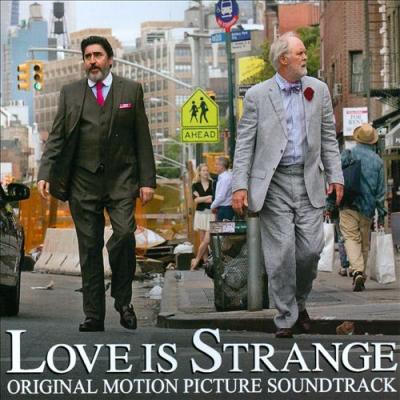
"Love is Strange" Soundtrack Lyrics
Movie • 2014
Track Listing
Nina Simone
Idil Biret
John Lithgow & Darren E. Burrows
Alfred Molina, John Lithgow & Martin Wind
Idil Biret
The Trinity Youth Chorus
Qbanito
Idil Biret
Daniel Indart
Idil Biret
Riko Higuma & Julia Mynert
Idil Biret
Carmen McRae
Adrian Quesada & Skinny Williams
Ralf Gothoni & Mark Lubotsky
Idil Biret
Dovie Curran
Slovak Radio Symphony Orchestra
"Love Is Strange (Original Motion Picture Soundtrack)" – Album Guide to Tracks and Key Scenes
Overview
What happens when a modern New York queer love story is scored almost entirely with 19th-century piano pieces? Love Is Strange answers by trusting Frédéric Chopin more than any contemporary pop or commissioned score. Instead of a traditional composer credit, Ira Sachs builds the soundtrack from existing recordings of Chopin, Beethoven, Schnittke, Wieniawski and a handful of songs by Nina Simone, Daniel Indart and others, turning pre-existing music into a very deliberate “original” sound world.
The album, released as Love Is Strange (Original Motion Picture Soundtrack) on Madison Gate Records, collects twelve of those pieces, dominated by Chopin performances from pianist Idil Biret and others, plus a modern orchestral arrangement of Chopin’s “Berceuse” and small but decisive appearances by Nina Simone and Daniel Indart. A Sony Pictures press release describes the concept plainly: the score is “a delicate collection of piano pieces” by Chopin, framed by a few other classical works and contemporary tracks used prominently in the film, rather than a separate, composed-from-scratch score.
On screen, the music feels intimate and domestic. The Chopin cues rarely swell to big Hollywood climaxes; they drift in under conversations, frame subway rides and stairwells, and quietly explode in private moments, like George coaching a young student until the music overwhelms him. When Simone’s voice enters or Latin rhythm cuts through, the contrast is sharp. This restraint means that when the orchestral Berceuse returns in the final stretch, it lands with the weight of a life looked back on rather than a romance “won.”
Stylistically, the soundtrack sits at the intersection of Romantic piano repertoire, chamber-like classical recordings, and select jazz/Latin vocal tracks. Chopin waltzes and nocturnes carry vulnerability and interiority; Beethoven’s Sonata No. 28 adds a touch of intellectual discipline; Wieniawski’s “Legende” pushes into unabashed lyricism. Nina Simone’s jazz balladry stands in for the couple’s lived-in ease, while cues like Indart’s “Coco y Ron” and Qbanito’s “Fiesta Latina” mark out party spaces and shared social worlds. Classical equals memory and inner life; jazz and Latin tracks mark the here-and-now of New York apartments and gatherings.
How It Was Made
Director Ira Sachs, co-writer Mauricio Zacharias and producers at Parts & Labor decided early that they did not want a conventional orchestral score. Instead, they mined the Naxos classical catalogue and other recordings, licensing a set of Chopin performances (mostly by Idil Biret) along with Beethoven, Schnittke and Wieniawski tracks. Madison Gate Records then assembled these into an official soundtrack album, supervised at the studio side by executive producer Susan Jacobs and released digitally in August 2014, later as a download album via Presto and other platforms.
Sachs has said in interviews and in the soundtrack press material that he sees film-score history as running directly out of classical music, and that in Chopin “you can hear all the tones and all the emotions” he wants for cinema. He explicitly cites Simon & Garfunkel’s role in The Graduate as a model: using one musical voice repeatedly so the songs and pieces create an emotional “world” without losing their own integrity as standalone works. A dedicated feature on the film’s music notes that six Chopin pieces form the backbone of the soundtrack, with everything else orbiting around them.
The recordings themselves are not new recordings made for the film. The Chopin, Beethoven and Wieniawski tracks are drawn from existing albums, with pianist Idil Biret, violinist Marat Bisengaliev, the Slovak Radio Symphony Orchestra under Peter Breiner and others already in the catalogue before the movie. The only “adaptation” in a strict sense is the orchestral arrangement of “Berceuse in D-Flat Major,” which reshapes one of Biret’s signature Chopin pieces into a fuller, film-closing curtain. The soundtrack has no credited original score composer; instead, music editing and supervision stitch these pre-existing pieces into something that behaves like a carefully scored film.
Tracks & Scenes
Below are the most important cues and songs, with how they play against specific scenes. Timings are approximate and refer to the feature film, not the trailer.
"Berceuse in D-Flat Major, Op. 57" — Frédéric Chopin, performed by Idil Biret
Where it plays: In the opening sequence, as Ben and George dress for their Manhattan wedding, this solo piano lullaby flows under shots of them moving around their apartment. The camera watches them like old friends while the music rocks gently in the background, completely non-diegetic. Early on, it also surfaces around quiet domestic moments that frame their long history together rather than any single dramatic beat.
Why it matters: This is the film’s first musical statement and sets the template: classical, intimate, a little fragile. As one essay on the film’s music points out, starting with a lullaby about rest and tenderness is ironic for a story where a wedding triggers upheaval, but that irony is exactly the point.
"Berceuse in D-Flat Major, Op. 57 (Arranged for Piano and Orchestra)" — Chopin, Slovak Radio Symphony Orchestra / Peter Breiner / Silvia Capova
Where it plays: Near the end of the film, the Berceuse returns in a fuller orchestral guise, over closing scenes and the final montage that looks back on what Ben and George have shared and what their family has absorbed. The piece is non-diegetic, playing over images as an emotional bookend to the earlier solo version.
Why it matters: By this point, the audience knows the melody. Orchestrating it widens the frame from a private apartment to a whole web of relationships and memories, like the story itself zooming out. According to Madison Gate’s soundtrack notes, this orchestral arrangement was created specifically to anchor the album’s finale and the film’s closing tone.
"Waltz No. 7 in C-Sharp Minor, Op. 64 No. 2" — Chopin, performed by Idil Biret
Where it plays: Early in the story, when Ben and George have to consider leaving New York for Poughkeepsie to live with more distant relatives, this waltz drifts in. The scene is mostly talk — no montage, no chase — but the music gently amplifies how wrong the idea feels, waltzing them toward a future they plainly don’t want.
Why it matters: The piece is elegant but restless, with its repeated figures circling back on themselves. As one critic writing about the film’s music notes, it makes the couple’s “uncomfortable thought” of moving play like a dance step they just cannot bring themselves to learn.
"Ballade No. 3 in A-Flat Major, Op. 47" — Chopin, performed by Idil Biret
Where it plays: The Ballade slides in when Ben has moved into his teenage great-nephew Joey’s lower bunk in the cramped Brooklyn apartment. The camera lingers on him settling into this childlike space, reading and listening while the family life of the apartment thumps around him.
Why it matters: There is real drama in this cue, but Sachs keeps the images small: one man, one bunk, one cramped room. The Ballade, with its switches between storytelling tones, turns that crampedness into an epic of dignity. A music-focused feature on the film calls this pairing out as an example of how classical pieces can do big emotional work over quietly observed images.
"Nocturne No. 8 in D-Flat Major, Op. 27 No. 2" & "Nocturne No. 5 in F-Sharp Major, Op. 15" — Chopin, performed by Idil Biret
Where they play: These nocturnes recur throughout the middle of the film, usually under intimate, slightly tense domestic moments: Ben navigating Joey’s need for privacy, late-night conversations in cramped rooms, pauses where everyone in the Brooklyn apartment feels a little too aware of each other. They stay non-diegetic, almost like a diary voiceover that never needs to be spoken aloud.
Why they matter: A WholeNote column on the soundtrack notes how the nocturnes “are in tune with the tenderness” Ben brings to these prickly encounters. Harmonically, they hover between consolation and disquiet, exactly like life in too small a flat with too many different generations inside.
"Prelude No. 15 in D-Flat, Op. 28 'Raindrop'" — Chopin, performed by Dovie Currin
Where it plays: The “Raindrop” prelude appears as a transitional cue, underscoring one of the sequences where time passes and the new, fractured living arrangements start to feel painfully normal. Street noise, passing traffic and the rhythms of the city slip under that repeating inner note, giving the feeling of slow, relentless drip.
Why it matters: The prelude’s famous repeated note sits between comfort and claustrophobia. Used this way, it turns everyday shots of New York into a pressure gauge, hinting that the situation will erode everyone’s patience if it continues much longer.
"Piano Sonata No. 28 in A Major, Op. 101: I. Allegretto ma non troppo" — Ludwig van Beethoven, performed by Idil Biret
Where it plays: This Beethoven movement appears around a piano-focused scene where practice and discipline briefly take centre stage. Compared to the lush Chopin pieces, it sounds more spare and structured, often under shots of characters at the keyboard or moving between lessons and home life.
Why it matters: The sonata underlines George’s identity as a professional music teacher as well as a romantic partner. Its clearer, more architectural shape contrasts with Chopin’s rubato and makes the music feel like work and craft, not just atmosphere.
"Legende in G Minor, Op. 17" — Henryk Wieniawski, performed by Marat Bisengaliev & John Lenehan
Where it plays: This violin showpiece enters in a more overtly lyrical passage, likely during a sequence where the film wants us to view the couple’s story from a bit more distance — city views, family gatherings, the sense of fate pressing in.
Why it matters: “Legende” is unabashedly romantic and a little old-fashioned, mirroring how Ben and George’s love feels to some of the younger characters. On the album, it’s also one of the biggest departures from the piano-only palette, giving listeners a much needed textural change.
"Suite im Alten Stil – Minuet (Tempo di Menuetto)" — Alfred Schnittke, performed by Ralf Gothóni & Mark Lubotsky
Where it plays: Schnittke’s neoclassical Minuet appears as a piece of stylised, slightly ironic elegance, usually over scenes that involve polite social performance — parties, dinners, and public gatherings where everyone tries to behave properly while emotions run underneath.
Why it matters: Because the Minuet sounds like Baroque music written through a modern lens, it fits a film that looks like a modest domestic drama but constantly comments on contemporary questions — marriage equality, housing, ageing. It’s polite music with a raised eyebrow.
"That's Him Over There" — Nina Simone
Where it plays: Late in the story, when Ben and George are together and momentarily at ease, Simone’s 1960s track glides in. We see them in their element — not as guests on someone else’s couch, but as a couple who know exactly how to sit together in a room. The song is non-diegetic, but feels like something they might easily put on at home.
Why it matters: A music-focused article on the film notes this cue as underlining their “comfort level together.” Simone’s phrasing and the song’s lyrics quietly assert what the film has shown for ninety minutes: these two know each other, fully, and that recognition is the point.
"Coco y Ron" — Daniel Indart
Where it plays: This Latin track drops into one of the livelier social sequences, likely in the apartment shared by George’s NYPD friends Ted and Roberto. The atmosphere is crowded and noisy, with people buzzing around the living room while George tries to carve out a bit of space for himself.
Why it matters: “Coco y Ron” brings in a modern, danceable texture that immediately differentiates the party house from the more hushed Brooklyn family flat. The contrast with Chopin is almost comic: George’s inner world may be Romantic piano, but his couch is in an apartment scored with club-adjacent grooves.
"Fiesta Latina" — Qbanito (not on the core album)
Where it plays: Another Latin-club cut heard in one of the party scenes, this time leaning even harder into reggaeton and urban Latin production. We catch it as source music — it seems to pour from speakers somewhere off frame while characters talk over it and weave through the room.
Why it matters: “Fiesta Latina” never shows up on the official Madison Gate album, so it becomes one of those film-only tracks that fans hunt down separately. It helps underline the generational and cultural gap between George’s quiet taste and the social life of his hosts.
"Canto Domino" — The Trinity Youth Chorus
Where it plays: This liturgical choral piece is heard in connection with George’s job as a Catholic school choir director — rehearsal and church-based scenes, sung by young voices in resonant spaces. In contrast to the private Chopin cues, it is clearly diegetic: music made in the story world itself.
Why it matters: “Canto Domino” anchors George in a tradition and an institution that ultimately rejects him. The sound of the choir makes his dismissal from the school feel even harsher, because we have already heard the world he values and has helped build.
"(Baby) You've Got What It Takes" — Alfred Molina, John Lithgow & Martin Wind
Where it plays: In one of the film’s warmest scenes, Ben and George, joined by bassist Martin Wind, perform this standard themselves, turning a living room into an informal cabaret. Friends and family watch, half-amused and half-moved, as the couple slip into the easy banter and timing of people who have been singing together for decades.
Why it matters: This is the most overtly “performance” moment in the movie. It collapses distance between actors and characters — Lithgow and Molina really sing — and the song’s title says the subtext aloud. It is also a rare case where the film’s stars become its soundtrack artists, which several soundtrack databases flag by crediting them as the performers of the piece.
"Hail, Hail, the Gang's All Here" — John Lithgow & Darren E. Burrows
Where it plays: A short, rowdy sing-along fragment, typically associated with family gathering energy in the Brooklyn apartment. It comes from within the scene — someone starts it, others join, and then it breaks off as conversation overtakes the moment.
Why it matters: This tiny cue says a lot about Ben’s role in that household. He is both an intrusion and the source of a bit of old-school, slightly corny charm. It is also one of the few completely non-Chopin musical gestures associated with the Hull family rather than George’s world.
"Tiptoe Gently" — Carmen McRae (not on the core album)
Where it plays: Used as a soft, jazz-inflected background in one of the quieter dialogue scenes, probably at home and late in the evening. The song is faint, tucked behind conversation, but the timbre of McRae’s voice and the gentle swing are recognisable.
In this film, there are several actors of second value that have always been so – not so very famous, but were not quite languish in obscurity. Namely: John Lithgow, Alfred Molina and Marisa Tomei. They, one after another, rocked in the waves of popularity and now fate has brought them in this motion picture.
Solid film, which in generally was received well by critics. It shows the eternal themes that are familiar to a large quantity of people around the globe. Living with relatives of all ages, having radically different views on many things is a challenge. And even more so if you have gender preferences that are also differ. The film is about life, about relationships and about what it is – when you temporarily do not have your own corner to settle.
Support from the music is so very good. It maximizes the impression of the film. The highest quality music inserted in the soundtrack and in the plot with the soul, trepidation and great love. Nina Simone, which opens this collection of 19 compositions, deserves great respect. The voice of the singer is so fascinating that you soon forget, in what world you are – still on earth or already in heaven. Equally good in nature and in the quality the song Baby, You've Got What It Takes, which is made in the direction of pop. Coco Y Ron is just above all praise. The melodies like this really are one on hundred thousand. They are as rare gems that you have to find (sometimes accidentally bumping on them as we came in this collection). And then they must be carefully stored as the one’s eye. Tiptoe Gently – perfect song for a dance and just for a sensual evening together.
Most instrumental melodies are made by Idil Beret. They perfectly complement the tone. The same high quality collection we met in film named Black Mass, which was released in October 15.
November, 13th 2025
'Love is Strange': Watch Official US Release Trailer, Visit Movie Profile on WikipediaA-Z Lyrics Universe
Cynthia Erivo Popular
Ariana Grande Horsepower
Post Malone Ain't No Love in Oklahoma
Luke Combs Good Riddance (Time of Your Life)
Green Day Bye Bye Bye
*NSYNC You're the One That I Wan
John Travolta & Olivia Newton-John I Always Wanted a Brother
Braelyn Rankins, Theo Somolu, Kelvin Harrison Jr. and Aaron Pierre The Power of Love
Frankie Goes to Hollywood Beyond
Auli’i Cravalho feat. Rachel House MORE ›