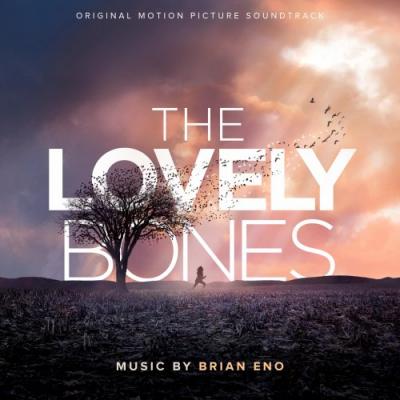
"Lovely Bones, The" Soundtrack Lyrics
Movie • 2010
Track Listing
Steely Dan
Frankie Valli And The Four Seasons
Graham Parker
The Velvet Underground
Jefferson Airplane
traditonal
David Cassidy
10cc and Godley & Creme
The Hollies
Bellamy Brothers
John Lennon
Brian Eno
Graham Bonnet
Brian Eno
This Mortal Coil
Brian Eno
Van Morrison
Cocteau Twins
"The Lovely Bones (Original Motion Picture Soundtrack)" – Album Guide to Tracks and Key Scenes
Overview
How do you score a story where a murdered fourteen-year-old girl narrates from a glowing afterlife while her family lives through a very ordinary 1970s suburbia? The soundtrack to Peter Jackson’s The Lovely Bones answers by putting Brian Eno’s ambient music at the center and stitching it to carefully chosen ’70s pop and rock.
The film (released late 2009, with a wide rollout in January 2010) sits between genres: part family drama, part serial-killer thriller, part metaphysical fantasy. The music follows that tightrope. Eno’s long, slow-moving textures and piano miniatures stretch grief and memory out into something weightless, while radio tracks from Paul McCartney & Wings, Dave Edmunds, The Hollies, Van Morrison and others nail down the period and the family’s routine. The result is a score that rarely “tells” you how to feel; it suspends you with Susie between shock and acceptance.
A lot of the soundtrack is built from Eno’s back catalogue — “1/1” from Ambient 1: Music for Airports, “First Light” from Ambient 2: The Plateaux of Mirror, “The Secret Place” and other pieces from Apollo, “The Big Ship” and “Baby’s On Fire” from his ’70s solo albums — edited and repurposed as film cues. Newer material like “Ship In A Bottle”, written with Jon Hopkins and Leo Abrahams, sits next to these older tracks without calling attention to the join.
Genre-wise, the score leans heavily on ambient, minimal piano and textural electronics, with dream-pop (Cocteau Twins, This Mortal Coil) and soft rock/AM radio classics filling out the licensed side. Ambient cues handle Susie’s “In-Between” and the spiritual imagery; dream-pop covers the most surreal, interior moments; the familiar pop/rock cuts map to family life, domestic rituals and Grandma Lynn’s chaotic energy. Ambient = limbo and inner life, dream-pop = the uncanny, classic rock/pop = surface normality that will be shattered.
How It Was Made
Peter Jackson’s production hired Brian Eno as the film’s composer, a rarity given that Eno usually avoids conventional, deadline-driven scoring work. The film credits list him as the composer, with his name appearing alongside the main creative team, and contemporary interviews and reviews emphasise how unusual the collaboration was for a mainstream studio film.
Eno did not approach the job like a traditional symphonic scorer. He supplied Jackson with long ambient pieces, improvisations and catalog tracks, which the director and editor could shape around picture. Some cues are recognisable album tracks (“1/1”, “First Light”, “The Secret Place”, “The Big Ship”); others are new or heavily re-edited works, including “Ship In A Bottle” — later released on the compilation Film Music 1976–2020 — which became a sort of main motif in marketing materials and playlists.
On the song-placement side, the production licensed a mix of well-known and cult tracks: This Mortal Coil’s “Song to the Siren”, Cocteau Twins’ “Alice”, Van Morrison’s “Celtic Swing”, Paul McCartney & Wings’ “Another Day”, Dave Edmunds’ “I Hear You Knocking”, The Hollies’ “Long Cool Woman (In a Black Dress)”, and more. Lists compiled by WhatSong and fan score reconstructions show just how much curation was involved in matching these songs to specific scenes.
Instead of a wide retail release, the core score circulated on a short promo CD under the title The Lovely Bones (Original Motion Picture Soundtrack), documented on Discogs as a 2009 “Not On Label” CD. Later, “Ship In A Bottle (From ‘The Lovely Bones’ Original Motion Picture Soundtrack)” gave the film a single official track on Eno’s film-music compilation, leaving the rest of the score trapped in the movie itself or in collector circles.
Tracks & Scenes
Below are some of the key placements, combining timing notes from soundtrack databases with scene-specific detail.
"Another Day" — Paul McCartney & Wings
Where it plays: On the morning of Susie’s last day, over an ordinary rush of cereal, chatter and jackets grabbed on the way out. Guides place it at the very start of the film, around the 0:01–0:02 mark, before the narrative darkens.
Why it matters: The song’s portrait of a woman stuck in routine quietly mirrors Abigail Salmon’s life, and the warm, slightly wistful soft-rock sound nails the early-’70s setting. It makes the opening feel like found family footage, which makes the later void in the house more painful.
"I Hear You Knocking" — Dave Edmunds
Where it plays: Used during early domestic scenes: first as an establishing track for the Salmon family (around 0:02), then again when Jack and Abigail share a playful make-out moment in the kitchen before the tragedy splits them apart.
Why it matters: The raw, driving beat and guitar licks give the family scenes a messy, lived-in feel. It paints Jack and Abigail as young, impulsive and affectionate, which sharpens the contrast with the still, silent rooms we see after Susie’s disappearance.
"1/1" — Brian Eno
Where it plays: Over the iconic snow-globe introduction and early “In-Between” imagery. WhatSong lists “1/1: Ambient 1 – Music for Airports” as the cue for the snow-globe scene, in both album and score-cue variants.
Why it matters: The looping piano figures and soft, hovering drones establish the film’s idea of limbo: time feels stretched, not broken. Paired with the snow globe — a whole world frozen in a glass bubble — it foreshadows Susie’s fate and the score’s fascination with suspended moments.
"First Light" — Harold Budd & Brian Eno
Where it plays: Around 0:06, in the hospital sequence as Susie’s family wait and fear the worst. Multiple entries on soundtrack sites confirm its use in that scene.
Why it matters: The smeared piano and reverb make the hospital feel unreal, as if we are inside Susie’s half-detached consciousness. Instead of sharp “medical drama” strings, we get something fragile and almost too gentle, which undercuts the fluorescent harshness of the setting.
Score cue "3M5" — Brian Eno / David Byrne & Brian Eno
Where it plays: Marked by cue lists as “When Susie goes to heaven”. It plays when the In-Between opens up and Susie realises she is not simply a ghost in her old world.
Why it matters: The cue introduces a more explicitly rhythmic, layered ambient figure, as if the afterlife is “switching on” around her. It is one of the moments where the score leads the edit: the visual dissolves feel cut to the ebb and flow of the music.
"Alice" — Cocteau Twins
Where it plays: At approximately 00:54, during a montage of Susie in the In-Between — trying on outfits, running through wheat, spinning as if in a private fashion shoot. WhatSong explicitly notes it for “the montage of Susie playing and dancing in her heaven dressed in different attires”.
Why it matters: Elizabeth Fraser’s floating vocal and the band’s swirling guitars make this sequence feel like pure inner fantasy. Lyrics are unintelligible, but that is the point: the music is emotion rather than statement, capturing Susie’s thrill at her new freedom and her confusion about what it means.
"Emerald and Stone" — Brian Eno
Where it plays: Around 0:47, as Susie watches Ray from the afterlife, unable to interact. Soundtrack notes tag it specifically for “Susie watching Ray from the otherworld”.
Why it matters: The piece is slow, with a steady pulse and glassy tones that feel almost like a heartbeat heard underwater. It reinforces the idea that Susie’s vantage point is intimate but distant; she can see every detail, but she cannot touch anything.
"The Secret Place" — Brian Eno
Where it plays: At roughly 0:35, when Susie realises something is wrong in George Harvey’s underground “kid’s hideout” and tries to escape. Databases list it as “Suzy trying to escape”.
Why it matters: Instead of obvious suspense stabs, the cue uses low drones and a faint rhythmic throb, as if reality itself is warping. It plays her dawning fear rather than Harvey’s threat, keeping us locked to her experience instead of his.
"Song to the Siren" — This Mortal Coil
Where it plays: In the late-film revelation where Susie meets the other girls and young women murdered by Harvey. WhatSong associates it with “when all the murdered girls by George Harvey come and meet Susie in the heaven”.
Why it matters: This is likely the most famous needle-drop in the film. The slow 3/4 pulse and ghostly vocal turn the scene into a collective elegy. Visually we see victims; musically the film insists on them as subjects with their own stories. It is both devastating and strangely gentle.
"Long Cool Woman (In a Black Dress)" — The Hollies
Where it plays: Around 1:05, over a montage of Grandma Lynn tearing through the Salmon house — smoking, drinking, vacuuming, roping the kids into chores. WhatSong notes it as playing “as Grandma Lynn moves into the Salmons’ home” and has fun with Buckley and Lindsey.
Why it matters: The swaggering riff, spy-movie guitar and chorus instantly define Lynn as trouble in the best way. She refuses to treat the house as a shrine, and the song underlines that she is there to jolt the family out of paralysis, even if her methods are chaotic.
"Baby's On Fire" — Brian Eno (and Byrne/Eno score variant)
Where it plays: At about 1:28, during the cornfield confrontation where Jack follows who he thinks is Harvey and is instead beaten badly by a teenage boy. WhatSong lists “Baby’s On Fire (2004 Remaster)” for “Susie’s dad gets beaten hard”, with a separate entry for a Byrne/Eno score version.
Why it matters: The track is spiky, sarcastic art rock. Dropping it here pushes the scene into almost surreal overdrive. Jack’s obsession has finally blown through caution, and the cue’s frenetic guitar solo makes the violence feel both terrifying and weirdly unreal, as if Susie is watching a nightmare she cannot wake him from.
"Big Ship" — Brian Eno / David Byrne & Brian Eno
Where it plays: In the sinkhole sequence, as Harvey drags the heavy safe containing Susie’s remains to the edge while Ruth sits in a shack above, sensing Susie’s presence. WhatSong marks “Big Ship” and a Byrne/Eno variant in association with Harvey trying to unload the safe.
Why it matters: “Big Ship” builds from a modest pattern to a huge, tidal swell of sound. Over the image of the safe tipping into the murky water, it feels like both the crushing weight of evidence and a wave of release. It is one of the few outright cathartic musical moments in the movie.
"Score: 7M1" — Brian Eno / David Byrne & Brian Eno
Where it plays: Used when Lindsey returns home, sees her mother has come back, and the family is briefly reunited. Cue lists mark 7M1 for that reunion beat and for a later reprise in the final montage.
Why it matters: The cue is warm but restrained, carrying a sense of fragile normality. It does not pretend the family is “fixed”; instead, it sketches a new balance that has grown around the loss. In Susie’s words, these are the “lovely bones” the story is about.
"Score: 5M3 / 5M4" — Brian Eno / David Byrne & Brian Eno
Where it plays: Across the thread where Susie watches Ray spend winter mornings with Ruth, and later when she briefly inhabits Ruth’s body to share a first and only kiss with him. WhatSong connects 5M3/5M4 to “when Susie gets her first kiss with Ray at the end” and to her voiceover about watching him let her go.
Why it matters: These cues soften the ambient texture, adding more melody and a clearer pulse. They give the kiss and its aftermath a sense of time stopping — not for a grand romantic destiny, but to complete one interrupted teenage moment.
"Celtic Swing" — Van Morrison
Where it plays: Over the end credits. Blog reconstructions like Fabio Pirovano’s “Lost and Found Soundtracks: The Lovely Bones” note it as the film’s closing piece, taken from Morrison’s album Inarticulate Speech of the Heart.
Why it matters: After so much reverb and electronics, this loose, jazzy instrumental brings the sound back to something very human: a small band playing in a room. It suggests ongoing life rather than closure, which fits a story that ends with healing, not erasure.
Trailer and non-album cues
Where they play: The main theatrical trailers use a mix of Eno’s atmospheres and generic trailer-house cues, including pulses and crescendos that never appear in the finished film. Online breakdowns by fans and playlists on YouTube group these pieces alongside the official tracks.
Why it matters: The trailer music sells The Lovely Bones as a more conventional thriller with inspirational uplift. In the cinema, Eno’s far more ambiguous score takes over, and the difference between those two sound worlds explains some viewers’ surprise at the film’s mood.
Notes & Trivia
- WhatSong’s 59-track listing for the film shows how densely Jackson and Eno wove existing recordings into the score, including deep-cut Eno pieces and obscure cues.
- Fabio Pirovano’s “Lost and Found Soundtracks” post highlights additional Eno tracks heard in the film but not released on any official album at the time.
- Chronological score fan projects break the complete score into more than 60 cues, with descriptive titles like “First Kiss”, “Sink Hole”, “Tree of Life” and “Harvey’s End”.
- The score earned Brian Eno a Best Music nomination at the Saturn Awards, despite the film’s overall mixed critical reception.
- Collectors treat the 2009 promo CD as an unofficial grail, because it is one of the only physical releases explicitly titled The Lovely Bones (Original Motion Picture Soundtrack).
Music–Story Links
Susie’s perspective dominates the film, and the music’s structure follows her more than anyone else. Early scenes grounded in her everyday life lean on period radio songs — “Another Day”, “I Hear You Knocking” — that you could imagine playing from a kitchen radio or car stereo. Once she dies, those sounds drop away and the score shifts almost entirely to ambient material, marking her transition into the In-Between.
Jack Salmon’s descent into obsession is traced through cue choices. After his initial grief, underscored by quieter ambient textures, the use of “Baby’s On Fire” in the cornfield beating signals that he has crossed a line into self-destructive rage. From that point, his scenes tend to carry more jagged or uneasy cues, while Susie’s heaven remains wrapped in softer tones, underlining their separation.
Abigail’s arc — from overwhelmed mother to woman who literally leaves — is defined as much by absences as by music. Early domestic songs sketch her as part of a lively chaos. Once she withdraws, scenes in the house often play with little or no music at all, selling the emotional vacuum she leaves behind. Grandma Lynn’s entrance explodes that silence with “Long Cool Woman”, musically announcing that she is there to fill the gap in her own outrageous way.
Harvey, by contrast, rarely gets recognisable pop music. His scenes are tied to near-silence, room tones or darker ambient drones. The film avoids glorifying him with a theme. When “Song to the Siren” swells during the sequence with his other victims, it attaches pathos to them, not to him, and the camera largely leaves him out of the equation.
Reception & Quotes
Critics were sharply divided on The Lovely Bones as a film. Review aggregators show a low critics’ score balanced by a more moderate audience grade. Visual effects, Saoirse Ronan’s and Stanley Tucci’s performances and Peter Jackson’s ambitious direction were often praised; tonal shifts between graphic violence and glossy afterlife imagery drew criticism.
The music generally fared better. Film-music specialist Jonathan Broxton at Movie Music UK described Eno’s work as a quintessential ambient score and emphasised how unusually prominent it is in a mainstream film. An essay on Independent Ethos went further, arguing that no other movie had used Eno’s music “to greater effect” than Jackson does here.
“Bold, daring original filmmaking, with arguably more emotional and intellectual meat to chew on than either the Rings trilogy or Kong.” — Ian Freer, Empire
“The ambient tone is very appealing indeed, and never turns into mere background hum.” — Movie Music UK, on the score
“No other movie … has been used to greater effect than in the manner Jackson has used it in his underrated effort in The Lovely Bones.” — Independent Ethos
The score did not pick up major mainstream trophies, but it received a Best Music nomination at the Saturn Awards, and Eno’s work was singled out in several year-end film-music roundups. The later inclusion of “Ship In A Bottle” on Film Music 1976–2020 effectively canonised at least one piece of the score in Eno’s official discography.
Interesting Facts
- The Discogs entry for the promo CD lists no commercial label (“Not On Label”), aligning with its status as an awards-promo item rather than a retail product.
- “Ship In A Bottle (From ‘The Lovely Bones’ Original Motion Picture Soundtrack)” first became widely available in 2020 via Eno’s compilation Film Music 1976–2020.
- Fan reconstructions of the complete score combine tracks from Ambient 1, Ambient 2, Apollo, Another Green World, Here Come the Warm Jets, Small Craft on a Milk Sea and more.
- Some heaven sequences appear to use early material later released on Eno’s album Small Craft on a Milk Sea, based on track overlap noted by fans.
- The film’s music credit on Wikipedia lists Brian Eno alone, but cue sheets and fan analysis suggest collaborative work from Jon Hopkins and Leo Abrahams on key tracks.
- Because of licensing and the promo-only release, there is still no “definitive” digital OST — most listeners experience the score via fan playlists built from the various source albums.
- The movie’s score regularly appears in online discussions of “great film scores attached to not-so-loved films”, which tells you how far its reputation has drifted from the movie’s reviews.
- For some viewers, this was their first encounter with Eno’s ambient work; message-board posts from the time are full of people discovering Music for Airports and Apollo via this film.
Technical Info
- Title: The Lovely Bones (Original Motion Picture Soundtrack) — promo CD
- Associated work: The Lovely Bones (2009 film; wide release January 15, 2010)
- Type: Hybrid film soundtrack (original score plus licensed songs)
- Primary composer: Brian Eno
- Additional score collaborators: Jon Hopkins, Leo Abrahams (notably on “Ship In A Bottle”); Harold Budd (co-writer of “First Light”); David Byrne (co-credited on some cue variants)
- Key score cues (selection): “1/1”, “First Light”, “The Secret Place”, “Emerald and Stone”, “Big Ship”, “Ship In A Bottle”, score cues 1M9, 2M1, 3M1, 3M5, 5M3, 5M4, 7M1, 8M1 (internal cue numbers)
- Notable licensed songs: “Another Day” (Paul McCartney & Wings), “I Hear You Knocking” (Dave Edmunds), “Long Cool Woman (In a Black Dress)” (The Hollies), “Song to the Siren” (This Mortal Coil), “Alice” (Cocteau Twins), “Celtic Swing” (Van Morrison)
- Promo album details: 2009 CD, “Not On Label” release credited to Brian Eno – The Lovely Bones (Original Motion Picture Soundtrack); short selection of score highlights
- Later appearances: “Ship In A Bottle (From ‘The Lovely Bones’ Original Motion Picture Soundtrack)” on Film Music 1976–2020 (CD and vinyl); individual source tracks on their original artist albums and streaming platforms
- Label context: Eno’s film-music compilation issued via UMC/Astralwerks; original catalog tracks on labels such as Editions EG and 4AD
- Awards/recognition: Saturn Award nomination for Best Music (Brian Eno); highlighted in 2009 year-end film-music lists and later essays on Eno’s film work
Canonical Entities & Relations
| Subject | Relation | Object |
|---|---|---|
| Peter Jackson | directed | The Lovely Bones (2009 film) |
| Alice Sebold | wrote | The Lovely Bones (2002 novel) |
| Brian Eno | composed music for | The Lovely Bones (film score) |
| Brian Eno | byArtist of | The Lovely Bones (Original Motion Picture Soundtrack) promo CD |
| Brian Eno | recorded | “1/1”, “The Secret Place”, “The Big Ship”, “Baby’s On Fire”, “Emerald and Stone” (used in film) |
| Harold Budd | co-wrote | “First Light” (used in the hospital scene) |
| This Mortal Coil | performed | “Song to the Siren” (used in the afterlife victims’ gathering) |
| Cocteau Twins | performed | “Alice” (used in Susie’s heaven dress-up montage) |
| Paul McCartney & Wings | performed | “Another Day” (used on Susie’s last morning) |
| Van Morrison | performed | “Celtic Swing” (used over end credits) |
| Mark Wahlberg | portrayed | Jack Salmon in The Lovely Bones (film) |
| Saoirse Ronan | portrayed | Susie Salmon in The Lovely Bones (film) |
| Stanley Tucci | portrayed | George Harvey in The Lovely Bones (film) |
| Paramount Pictures | distributed | The Lovely Bones (2009 theatrical release) |
| Brian Eno – Film Music 1976–2020 | includes recording | “Ship In A Bottle (From ‘The Lovely Bones’ Original Motion Picture Soundtrack)” |
| The Lovely Bones (film) | set in | Pennsylvania (1973) and the In-Between afterlife space |
Questions & Answers
- Is there an official soundtrack album for The Lovely Bones?
- There is a short promo CD titled The Lovely Bones (Original Motion Picture Soundtrack), but no wide commercial score release. Most of the music is available only via the film and the original artist albums.
- Which Brian Eno track from the film is easiest to find today?
- “Ship In A Bottle (From ‘The Lovely Bones’ Original Motion Picture Soundtrack)” is widely available on Brian Eno’s compilation Film Music 1976–2020 and on major streaming services.
- What musical style dominates the score?
- Ambient music — slow, textural, often minimal piano-based cues — dominates, with dream-pop and 1970s soft rock/AM radio cuts filling out the licensed song side.
- Which songs underscore the most emotional scenes?
- “Song to the Siren” (the gathering of Harvey’s victims), “Big Ship” (the safe at the sinkhole), “Alice” (Susie’s heaven montage) and the 5M3/5M4 score cues (Susie and Ray’s kiss) are key emotional anchors.
- Did the score receive any awards recognition?
- Yes. Brian Eno’s music for The Lovely Bones received a Best Music nomination at the Saturn Awards and has been highlighted in specialist film-music retrospectives.
Sources: WhatSong soundtrack listing; IMDb soundtrack and film credits; Wikipedia entry for the film; Discogs listings for the promo CD and Film Music 1976–2020; Movie Music UK review; Independent Ethos article on Brian Eno and the film; Fabio Pirovano’s “Lost and Found Soundtracks: The Lovely Bones”; Chrono-Score cue breakdowns.
November, 13th 2025
A-Z Lyrics Universe
Cynthia Erivo Popular
Ariana Grande Horsepower
Post Malone Ain't No Love in Oklahoma
Luke Combs Good Riddance (Time of Your Life)
Green Day Bye Bye Bye
*NSYNC You're the One That I Wan
John Travolta & Olivia Newton-John I Always Wanted a Brother
Braelyn Rankins, Theo Somolu, Kelvin Harrison Jr. and Aaron Pierre The Power of Love
Frankie Goes to Hollywood Beyond
Auli’i Cravalho feat. Rachel House MORE ›