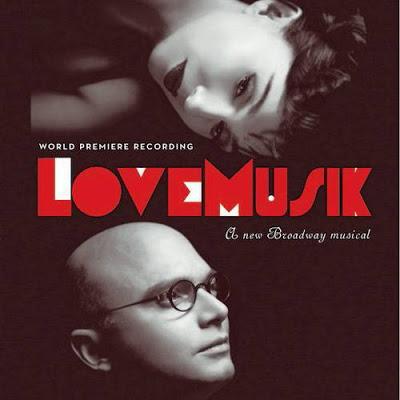
"Lovemusik" Soundtrack Lyrics
Musical • 2007
Track Listing
Kurt Weill and Lotte Lenya
Woman on Stairs
Weill's Family
Lenya's Family
Kurt Weill
Lotte Lenya
Kurt Weill, Lotte Lenya, Magistrate and Court Secretary
Bertolt Brecht and Brecht's Women
Auditioners and Lotte Lenya
Ensemble
Bertolt Brecht, Lotte Lenya, Otto and Ensemble
Kurt Weill and Bertolt Brecht
Ensemble
Kurt Weill and Lotte Lenya
Lotte Lenya, Kurt Weill, Bertolt Brecht and Ensemble
Lotte Lenya
Allen Lake
Kurt Weill
Kurt Weill
Bertolt Brecht and Brecht's Women
Lotte Lenya and Kurt Weill
George Davis and Ensemble
Kurt Weill
Ensemble
Lotte Lenya and George Davis
"LoveMusik (Original Broadway Cast Recording)" – Album Guide to Tracks and Key Scenes
Overview
What happens when a cast album has to capture not just a show, but an entire marriage? The 2007 LoveMusik (Original Broadway Cast Recording) answers that by turning Kurt Weill and Lotte Lenya’s complicated love story into a 66-minute audio biography. Drawn from the short-lived Broadway musical, the album plays like a sequence of letters set to music: wary, bruised, tender and sometimes brutally ironic.
The musical itself traces more than 25 years of Weill and Lenya’s lives, from 1920s Berlin through exile, New York fame and Weill’s early death. The album mirrors that arc by stitching together songs from across Weill’s catalogue – cabaret numbers, Broadway ballads, political satires – and re-contextualising them so they comment on the couple’s romance. You hear two people who adore each other, betray each other and somehow still remain each other’s anchor.
As a listening experience, the recording is unusually narrative for a “jukebox” score. Songs from The Threepenny Opera, Mahagonny, One Touch of Venus, Knickerbocker Holiday, Street Scene and others are reshaped into scenes: “Speak Low” becomes an opening thesis on fleeting love; “Surabaya Johnny” turns into Lenya’s howl of rage; “It Never Was You” plays like Weill’s quiet confession. The orchestrations keep a lean, theatre-pit clarity, so the voices – especially Michael Cerveris and Donna Murphy – carry the emotional storytelling.
Stylistically, the album lives at the crossroads of Weimar cabaret, jazz-tinted American musical theatre and art-song. Spiky brass and dance-band rhythms underline Brecht-flavoured cynicism, while warm strings and Broadway harmony soften songs like “September Song” or “It Never Was You.” Liturgical writing in “Kiddush” nods to Weill’s Jewish roots; the rough-edged “Alabama Song” and “Moritat (Mack the Knife)” inject grit and political bite. Cabaret equals danger and desire, big Broadway ballads signal vulnerability, and the more classical touches often mark moments where the characters try to keep up a polished surface while their personal lives unravel underneath.
How It Was Made
LoveMusik began when director Harold Prince read the letter collection Speak Low (When You Speak Love): The Letters of Kurt Weill and Lotte Lenya and asked playwright Alfred Uhry to build a musical around them. Uhry constructed a book that follows the couple from their first meeting in 1924 through their work with Bertolt Brecht, flight from Nazi Germany and eventual careers in America; Prince then threaded Weill’s existing songs through that story with the cooperation of the Kurt Weill Estate.
The Broadway production opened at Manhattan Theatre Club’s Biltmore Theatre in May 2007 and closed that June after a limited run. Michael Cerveris played Kurt Weill, Donna Murphy played Lotte Lenya, with David Pittu as Bertolt Brecht and John Scherer as George Davis. Jonathan Tunick provided detailed orchestrations, keeping a small band sound that could pivot from Berlin cabaret to mid-century Broadway sheen without ever feeling like a generic “Greatest Hits” revue.
Ghostlight Records (an imprint of Sh-K-Boom) captured the score on July 15, 2007 at Avatar Studios in New York with the original Broadway cast. Produced by Joel Moss with Kurt Deutsch as executive producer, the world-premiere cast album was released later that year on CD and digital platforms. The recording preserves most of the stage score, including choral and transition material, so it functions as a fairly complete audio version of the show rather than a slimmed-down “highlights” disc.
Tracks & Scenes
Below are some of the key numbers on the album and how they function in the musical. Placements are described in terms of act and dramatic moment rather than clock time, since stage productions vary slightly.
"Speak Low" — Michael Cerveris & Donna Murphy
Where it plays: The opening image of Act I. Weill and Lenya stand far apart on a darkened stage, each in their own pool of light, singing to one another across an invisible distance. Their duet feels like two interior monologues gradually lining up, already warning that love will be brief and fragile. The staging keeps them physically separated while the music tries to pull them together.
Why it matters: “Speak Low” sets the show’s central paradox: intimacy inside emotional distance. It also establishes one of the score’s big structural ideas – Weill’s “European” romanticism carrying the weight of a story that will soon collide with politics, exile and show business.
"Nanna’s Lied" — Ensemble soloist
Where it plays: Early in Act I, as the world of Berlin is established. A woman sings this small, bruised Brecht-Weill ballad from a staircase or balcony, watching the city’s nightlife from the margins. The scene usually plays almost like a freeze-frame: the ensemble moves slowly below while she narrates disappointment and fatigue.
Why it matters: It introduces the harsher, street-level register of Weill’s work and hints at the compromises Lenya will later make. Musically it pulls the album away from lush romance into something more angular and unsentimental.
"Alabama Song" — Company (with Donna Murphy)
Where it plays: Mid-Act I, during an audition / rehearsal sequence that showcases Lenya’s raw performance style. The number becomes a kind of onstage try-out: chorus members line up with microphones or chairs while Lenya hurls Brecht’s lyrics out over them, underlining the tug between boozy escapism and looming danger.
Why it matters: “Alabama Song” lets the album show off its Weimar cabaret side and positions Lenya as an artist who thrives in material that’s half-political sermon, half drunken prayer. On record, the cracked march rhythm and choral shouts give you a sense of the staging’s mix of fun and foreboding.
"Moritat (Mack the Knife)" — David Pittu, Donna Murphy & Company
Where it plays: Still in Act I, as the show recreates the phenomenon of The Threepenny Opera. Brecht’s Moritat-singer and Lenya lead the company in a stylised rendition, with the ensemble almost lined up like a street pageant advertising the new hit. The scene works as both a “making-of” moment and a reminder that Weill’s most famous tune is rooted in underworld violence.
Why it matters: For listeners who only know “Mack the Knife” through pop covers, hearing it in this context – snarled and sardonic – re-aligns the song with its original dramatic purpose. It also marks the peak of the Weill/Brecht artistic partnership before the show pushes them apart.
"I Don’t Love You" — Michael Cerveris & Donna Murphy
Where it plays: Late in Act I, as Weill and Lenya confront the collapse of their first attempt at marriage. The staging usually keeps them in close physical proximity – often at a table or in a small room – while the lyrics describe a refusal that neither fully believes. It feels less like a break-up than a mutual act of self-protection.
Why it matters: The number crystallises LoveMusik’s emotional tone: the language says “I’m finished with you” while the harmonies say “I can’t let go.” On the album the two voices sound almost conversational, which makes the track unusually intimate for a Broadway recording.
"How Can You Tell an American" — Ensemble
Where it plays: At the top of Act II, after Weill and Lenya have arrived in the United States. The ensemble sketches a busy American street or factory, listing stereotypes about Americans while the couple try to understand their new home. The rhythm is brisk, almost like a patter song set against marching feet and typewriters.
Why it matters: The song marks the shift from European exile drama into an American Broadway story. It lets Weill’s more patriotic, outward-looking side surface, while still keeping plenty of irony in the text.
"Buddy on the Night Shift" — Allen Lake & Ensemble
Where it plays: Mid-Act II, in a wartime factory setting. Workers trade places on the assembly line, passing the night shift like a relay baton while planes or munitions move along behind them. The staging often emphasises repetition – identical gestures, repeated pathways – so the music’s swing feels slightly exhausted underneath the cheer.
Why it matters: The number brings Weill’s collaboration with Oscar Hammerstein II into the story and shows how his music could serve American propaganda and morale as well as European satire. On the album the lyric’s conversational tone makes it one of the most straightforwardly “American” tracks.
"Surabaya Johnny" — Donna Murphy
Where it plays: In Act II, when Lenya is performing as a nightclub singer in America and surveying the wreckage of her romantic life. She sings the song almost as a confession, addressing a feckless lover while the club audience blurs into the background. The staging typically isolates her downstage, with minimal movement and a lot of volcanic stillness.
Why it matters: This is the album’s emotional earthquake for Lenya. Critics repeatedly singled out Murphy’s performance of “Surabaya Johnny” as a moment where time seems to stop; on record, her phrasing turns the song into a monologue of humiliation, fury and lingering desire all at once.
"That’s Him" — Michael Cerveris
Where it plays: Later in Act II, repurposing a song that in One Touch of Venus was originally sung by a woman. Here, Weill quietly describes the man he believes himself to be in Lenya’s eyes – or perhaps the man he wishes he could be. The scene often strips away most visual distraction so the focus is on interior realisation rather than external action.
Why it matters: Using “That’s Him” for Weill instead of a heroine tilts the lyric into self-portrait and self-doubt. On the album, Cerveris’s understated delivery turns what might be a generic love song into a character study of a man who suspects he is failing the person he loves.
"It Never Was You" — Michael Cerveris
Where it plays: Near the end of Act II, when Weill looks back over his life and career. The staging usually gives him a largely empty space – a desk, a room, a street corner – and lets the song unfold almost as a private confession. Past collaborators and lovers drift in and out around him while he admits that the thing he chased may never have been there.
Why it matters: This is the quiet heart of the cast recording. The song, originally from Knickerbocker Holiday, becomes here a summing-up of artistic compromise and emotional longing. On disc, the small orchestration and restrained vocal make the track land like a sigh rather than a big eleven-o’clock belt.
"September Song" — Donna Murphy & John Scherer
Where it plays: In the final stretch, after Weill’s death, as Lenya and George Davis negotiate a late-in-life attachment. The number often plays against images of fading glamour – old posters, empty rehearsal rooms – while the pair walk a line between romance and resignation.
Why it matters: Framing “September Song” as a duet rather than a solo underlines LoveMusik’s view that no relationship is ever purely private; there are always ghosts in the room. On the album, the blend of Murphy and Scherer’s voices gives the familiar standard a gently bruised, autumnal colour.
"The Illusion Wedding Show" — John Scherer & Company
Where it plays: Late Act II, as a satirical “show within the show” that sends up American commercialism and romantic clichés. It’s staged like a garish variety programme or radio spectacle, with chorus lines, bright lights and deliberately over-the-top staging.
Why it matters: This track lets the album flash Weill’s and Lerner’s taste for theatrical in-jokes and media parody. It also throws into relief how artificial stage love looks next to the messy, unmarketable reality of Weill and Lenya’s marriage.
It’s worth noting that the official trailer for LoveMusik cuts together brief excerpts from multiple cast numbers rather than using a unique “trailer-only” song. In other words, what you hear in that one-minute promo comes straight from the material preserved on this album.
Notes & Trivia
- The score pulls from more than two dozen Kurt Weill songs written with at least a dozen lyricists, including Bertolt Brecht, Maxwell Anderson, Ira Gershwin, Ogden Nash and Oscar Hammerstein II.
- “Kiddush,” the early family piece, adapts a sacred work Weill originally wrote for a New York synagogue, bringing his Jewish liturgical writing into a mainstream musical.
- The cast album is often described as a stronger experience than the staging itself; more than one critic recommended skipping the show but buying the recording.
- The Broadway run lasted just 61 regular performances, but the recording has kept the score in circulation far longer than the production’s brief life might suggest.
- Although the musical includes famous titles like “Mack the Knife” and “Pirate Jenny,” they’re reframed to comment on Weill and Lenya rather than their original storylines.
Music–Story Links
Because LoveMusik is built entirely out of pre-existing songs, the cast album is essentially a map of how Uhry and Prince re-wired Weill’s catalogue to trace one relationship.
“Speak Low” doesn’t just open the album; it opens the emotional argument of the show. Two separated figures sing about fleeting love before they’ve even met in the plot, so when they finally share scenes, we already know the ending they’re heading towards. The recording lets you hear that tension in the way the melody keeps reaching out and then falling back.
“I Don’t Love You” and its later reprise frame the couple’s divorce and reconciliation. Heard back-to-back on the album, they show the characters first trying to shut a door and later admitting the door never quite stayed closed. The musical uses the same material to score two different emotional states; the recording makes that structural trick very clear.
Numbers like “How Can You Tell an American” and “Buddy on the Night Shift” are doing double duty. They move the historical plot forward – arrival in the U.S., wartime factory culture – but they also underline the gap between Weill’s new public role as a patriotic Broadway composer and his private feeling of dislocation. You can hear that in the slightly “too bright” cheer of the music against darker undertones in the lyrics.
On the opposite side, “Surabaya Johnny” and “Youkali” belong more to Lenya and Brecht. They colour in the show’s view of Lenya’s sexual and artistic freedom, but they also hint at the danger in that freedom; the tracks sound seductive and poisonous at the same time. When the album gets to “It Never Was You” and “September Song,” those earlier storms make the late-life quiet feel earned rather than sentimental.
Reception & Quotes
The Broadway production of LoveMusik drew mixed but fascinated reviews. Several critics found the show structurally unwieldy yet couldn’t look away from the two central performances. The New York press in particular tended to describe it as simultaneously “tedious” and “unmissable,” which is a fair thumbnail for how dense the material can feel.
The cast recording, on the other hand, has generally been treated more kindly. Reviewers in theatre and mainstream outlets have praised it as a concentrated way to experience Weill’s songs without the staging’s dramaturgical clutter. Some Weill-focused writers have even suggested that the album functions as an ideal “gateway” into both his European and American periods.
“An audacious work… and a beguiling reflection of the complexities of love.”
David Rooney, Variety, on the stage production
“Sluggish, tedious and unmissable… stars who mold songs into thrilling windows of revelation.”
Ben Brantley, The New York Times
“More than one critic recommended skipping the play in favor of the recording.”
Weill commentary re: original cast album
The album has remained available via Ghostlight Records on CD and across major streaming platforms, where it usually appears under the “Soundtrack” or “Cast Recording” category. It hasn’t been a chart phenomenon in the pop sense, but within the Weill and musical-theatre niche it’s become a quietly respected reference recording.
Interesting Facts
- The official credits list the music as “by Kurt Weill” with “lyrics by various,” then spell out individual lyricists song by song in the programme and on the album.
- Several numbers were relatively obscure before LoveMusik; pieces like “Buddy on the Night Shift” and “Schickelgruber” rarely appeared on general Weill compilations but sit comfortably here beside standards.
- The Broadway production used a visible orchestra pit, very much in old-school fashion, which the album mirrors by keeping the band’s characterful playing up in the mix.
- Costs were kept modest by relying on Weill’s existing catalogue rather than commissioning a new score, but that also meant negotiating with the Kurt Weill Foundation and multiple other rights-holders.
- Because the musical is licensed through Concord Theatricals, later productions around the world use essentially the same song stack that this recording preserves, making the album a de facto template.
- The CD packaging leans into a sepia-and-grey palette that echoes both Weimar photography and 1940s studio portraits, reinforcing the biographical, archival feel of the project.
- “Speak Low,” “Surabaya Johnny,” “It Never Was You” and “September Song” all come from different Weill shows, but the way they’re sequenced on the album makes them feel like movements of one long, troubled love song.
Technical Info
- Title: LoveMusik (Original Broadway Cast Recording)
- Work type: Stage musical cast album (bio-musical about Kurt Weill & Lotte Lenya)
- Stage premiere: Biltmore Theatre (Manhattan Theatre Club), Broadway, 2007
- Album year: 2007 (world-premiere recording)
- Music: Kurt Weill
- Lyrics (source shows / songs): Bertolt Brecht, Maxwell Anderson, Ira Gershwin, Ogden Nash, Oscar Hammerstein II, Langston Hughes, Alan Jay Lerner, Howard Dietz, Maurice Magre, Roger Fernay and others
- Book of musical: Alfred Uhry
- Director (stage): Harold Prince
- Orchestrations: Jonathan Tunick
- Music supervision / musical staging: Patricia Birch (stage); album produced by Joel Moss, executive producer Kurt Deutsch
- Principal cast on album: Michael Cerveris (Kurt Weill), Donna Murphy (Lotte Lenya), David Pittu (Bertolt Brecht), John Scherer (George Davis) plus original ensemble
- Label: Ghostlight Records (imprint of Sh-K-Boom Records)
- Recording details: Recorded July 15, 2007 at Avatar Studios, New York City
- Release details: Commercial release late November 2007 on CD and digital services
- Approximate length: about 1 hour and a little over 20 tracks (nearly complete show score without full dialogue)
- Availability: In print on CD via Ghostlight and available on major streaming and download platforms worldwide
- Licensing of musical: Stage performance rights administered by Concord Theatricals
Canonical Entities & Relations
| Subject | Relation | Object |
|---|---|---|
| Kurt Weill | composed songs for | LoveMusik (stage musical, source works) |
| Alfred Uhry | wrote book for | LoveMusik (musical) |
| Harold Prince | directed | LoveMusik on Broadway (2007 production) |
| Donna Murphy | portrayed | Lotte Lenya in LoveMusik |
| Michael Cerveris | portrayed | Kurt Weill in LoveMusik |
| Manhattan Theatre Club | produced | Original Broadway production of LoveMusik |
| Ghostlight Records | released | LoveMusik (Original Broadway Cast Recording) |
| LoveMusik (Original Broadway Cast Recording) | is based on | Broadway production of LoveMusik (2007) |
| LoveMusik (musical) | is based on | Speak Low (When You Speak Love): The Letters of Kurt Weill and Lotte Lenya |
| Concord Theatricals | licenses | LoveMusik for stage productions |
Questions & Answers
- Is LoveMusik a jukebox musical or a traditional book musical?
- It’s a hybrid. The book is original, built from Weill and Lenya’s letters, but every major musical number repurposes an existing Kurt Weill song rather than newly composed material.
- Does the LoveMusik cast album include the full score from the Broadway production?
- It captures almost all of the major musical numbers and many transitions, but trims spoken dialogue and some brief reprises. As an audio experience it feels very close to a complete show.
- Do you need to know Kurt Weill’s work to enjoy this recording?
- No. Familiarity helps you catch references, but the album works as a self-contained story about a difficult relationship. For many listeners it has actually been a first gateway into Weill’s catalogue.
- How does this album differ from general Kurt Weill song compilations?
- Compilations usually group songs by show or period. Here, the sequencing follows Weill and Lenya’s life story, so standards like “Mack the Knife” or “September Song” gain new meaning from the surrounding scenes.
- Where can I legally stage LoveMusik or obtain performance materials?
- Licensing and authorised materials for stage productions are handled through Concord Theatricals, which controls the performance rights and supplies scores and scripts to professional and amateur companies.
Sources: Playbill, Concord Theatricals, Ghostlight Records, Kurt Weill Foundation for Music, Variety, The New York Times, BroadwayWorld, Talkin’ Broadway, Betty’s Brownies, Apple Music, Spotify, IBDB, Wikipedia.
November, 14th 2025
'LoveMusik' is a musical written by Alfred Uhry, using a selection of music by Kurt Weill. Learn more: Wikipedia, Internet Broadway DatabaseA-Z Lyrics Universe
Cynthia Erivo Popular
Ariana Grande Horsepower
Post Malone Ain't No Love in Oklahoma
Luke Combs Good Riddance (Time of Your Life)
Green Day Bye Bye Bye
*NSYNC You're the One That I Wan
John Travolta & Olivia Newton-John I Always Wanted a Brother
Braelyn Rankins, Theo Somolu, Kelvin Harrison Jr. and Aaron Pierre The Power of Love
Frankie Goes to Hollywood Beyond
Auli’i Cravalho feat. Rachel House MORE ›