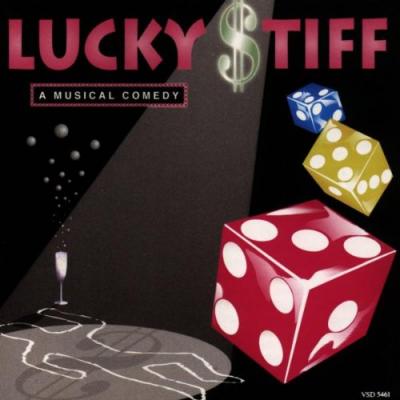
"Lucky Stiff" Soundtrack Lyrics
Musical • 2003
Track Listing
Lucky Stiff Cast
Lucky Stiff Cast
Lucky Stiff Cast
Lucky Stiff Cast
Lucky Stiff Cast
Lucky Stiff Cast
Lucky Stiff Cast
Lucky Stiff Cast
Lucky Stiff Cast
Lucky Stiff Cast
Lucky Stiff Cast
Lucky Stiff Cast
Lucky Stiff Cast
Lucky Stiff Cast
Lucky Stiff Cast
Lucky Stiff Cast
Lucky Stiff Cast
Lucky Stiff Cast
Lucky Stiff Cast
Lucky Stiff Cast
Lucky Stiff Cast
"Lucky Stiff (Original Off-Broadway Cast – The York Theatre)" – Album Guide to Tracks and Key Scenes
Overview
How do you score a musical where the most important character is a corpse in a wheelchair? The York Theatre’s 2003 concert revival of Lucky Stiff answers with a score that treats murder, inheritance and Monte Carlo chaos as a brisk, tuneful farce. The 2003 cast album – usually billed as Lucky Stiff (Original Off-Broadway Cast – The York Theatre) and released in 2004 by JAY Records – preserves that approach in 21 tightly written tracks.
This recording documents Lynn Ahrens and Stephen Flaherty’s first produced musical: a small-cast, high-speed show where songs constantly push plot, clarify motives and set up gags. You hear a very young Ahrens & Flaherty already working like seasoned technicians: patter songs that land exposition without bogging down, character ballads that sneak in feeling without pretending this is Ragtime, and ensemble numbers that juggle four or five agendas at once. The York album emphasises clarity; you can follow the entire mad storyline almost purely through the songs and snippets of dialogue.
Because this is the Mufti concert version, the sound world is lean. David Loud’s single piano replaces the larger band of the earlier studio cast recording, so the harmonic writing and lyric craft sit right in your ear. It makes the piece feel like chamber farce: nimble, slightly claustrophobic, and always on the edge of spinning out of control. Malcolm Gets and Janet Metz lead a company that also includes Mary Testa, Stuart Zagnit, Paul Kandel and others repeating or revisiting their original Playwrights Horizons roles, and you can hear their comfort with the material.
Stylistically, the album jumps between bright musical-comedy vaudeville, patter-driven farce, and more traditional musical-theatre ballads. Brassy chorus writing and cabaret pastiche underscore the Monte Carlo sequences, while Harry’s solo material sits closer to classic charm songs. Annabel’s music tends toward introspective, slightly bittersweet show ballads, and Rita’s numbers live in high belting comedy. Even the nightmares and reprises follow that logic: cartoonish yet very precise. In short, the genres telegraph how we’re meant to feel about each character – suavely silly for Monte Carlo, square and earnest for Harry, jagged and over-the-top for Rita – and that’s a big part of why the album is fun to live with.
How It Was Made
Lucky Stiff premiered off-Broadway at Playwrights Horizons in 1988, introducing the Ahrens & Flaherty team and winning the Richard Rodgers Award. For years, the only way to hear the score was the 1994 Varese Sarabande studio cast recording, built around Evan Pappas, Judy Blazer, Mary Testa and others. That disc captured the show, but it was put together years after the original run and had fuller, busier orchestrations.
In October 2003, the York Theatre Company revived the musical for five performances in its “Musicals in Mufti” concert series, directed by Graciela Daniele. Many original cast members returned – notably Mary Testa and Paul Kandel – joined by Malcolm Gets as Harry Witherspoon and Janet Metz as Annabel Glick. The performances were essentially semi-staged, with actors at music stands and minimal scenery, but the run was tight enough that the company functioned like a true repertory ensemble.
JAY Records recorded that Mufti cast, packaging the disc as an “Original Off-Broadway Cast – The York Theatre” album. According to a Broadway.com feature on the release, the new recording runs roughly ten minutes longer than the earlier one and restores material: the full Act I finale, “A Woman in My Bathroom,” and the once-cut song “Shoes” as a bonus. Musical direction is by David Loud at the piano, giving the album a crisp, cabaret-like texture rather than a big pit-orchestra sheen. The track list essentially covers the complete score, with short dialogue bridges helping listeners follow who is chasing whom through Monte Carlo.
Tracks & Scenes
Below, the key songs are tied to their moments in the stage story. Song titles follow the York Theatre track list; scene descriptions match the standard synopsis used for licensing and revival productions.
"Something Funny’s Going On" — Company
Where it plays: Prologue. A quasi–Greek chorus of minor characters steps forward to warn us that strange things are afoot: a man in silk pyjamas, a gunshot, a fortune in play. The number functions like a sung cold open, jumping between brief character flashes and framing the story as an outrageous tall tale.
Why it matters: It teaches the audience how to listen to the show. Everything will be broad, fast and slightly macabre; jokes and clues are embedded in the same lyrics. The York recording keeps the energy tightly focused, so you can hear individual voices without losing the chaotic swirl.
"Mr. Witherspoon’s Friday Night" — Malcolm Gets (Harry) & ensemble
Where it plays: Act I, early. Harry closes up the dull English shoe shop he works in, returns to his dingy rooming house and dreams of some escape. Landlady, fellow boarders and assorted London types burst in, each adding a little pressure or frustration before the fateful telegram arrives summoning him to the solicitor.
Why it matters: The song sketches Harry’s world in one go: low pay, low status, no prospects. The music plods cheerfully while the lyrics underline just how stuck he feels, so when Monte Carlo appears later, it really does sound like another planet.
"Rita’s Confession" — Mary Testa (Rita) & Stuart Zagnit (Vinnie)
Where it plays: Still Act I, back in Atlantic City. Rita explains to her timid optometrist brother Vinnie how she accidentally shot casino manager Tony Hendon during a romantic argument and how a suitcase of diamonds has gone missing. The song unfolds almost like a stand-up routine, with Vinnie interjecting horrified reactions as she digs herself in deeper.
Why it matters: This is where the “murder mystery farce” angle locks in. The music bounces along while Rita describes a crime of passion and a botched cover-up, turning what could be noir into manic comedy. It also sets up the basic chase: Rita believes her lover’s corpse is on holiday with Harry, and she wants those diamonds.
"Good to Be Alive" — Malcolm Gets (Harry), Paul Kandel (Luigi) & Company
Where it plays: Train sequence into Monte Carlo. Harry, hauling his uncle’s corpse in a wheelchair, meets the flashy Luigi Gaudi and gets swept into the promise of a glamorous gambling town. The chorus weaves in, painting the Riviera as an adult funhouse while Annabel lurks nearby taking notes.
Why it matters: Dramatically, the song flips Harry from victim to temporary golden boy: he may be stuck with a dead uncle, but he’s also standing in front of the casino doors. On the album, Kandel’s boisterous Luigi voice against Gets’s anxious brightness makes the “good to be alive” refrain feel knowingly ironic.
"Lucky" — Malcolm Gets (Harry)
Where it plays: Early Monte Carlo scenes, once the conditions of the will become clear. Harry grouses about the tasks he must complete with the corpse – sightseeing, fine dining, adventure sports – then gradually realises this is still a better life than counting shoes in England.
Why it matters: It’s the closest thing the show has to a title song. Harry’s definition of “lucky” keeps shifting, and the music walks a line between complaint and gratitude. On the York album, you can hear Gets slowly relax into the melody as the character starts to enjoy himself.
"Dogs Versus You" — Janet Metz (Annabel) & Malcolm Gets (Harry)
Where it plays: After Annabel, representing the Universal Dog Home of Brooklyn, finally confronts Harry about the will. She wants the fortune to go to the charity; he hates dogs and wants the money. They volley arguments back and forth while Uncle Anthony sits motionless between them.
Why it matters: This duet is their relationship in miniature: she’s moral, stubborn and dog-obsessed; he’s defensive, panicked and slightly selfish. The patter writing lets both characters show wit and spine. On record, the back-and-forth timing between Metz and Gets is razor-sharp, which is half the joke.
"The Phone Call" — Stuart Zagnit (Vinnie)
Where it plays: Vinnie, dragged along to France by his gun-toting sister, sneaks a call home to his wife. He tries to explain that he’s not having an affair, he’s trying not to be killed over missing diamonds. The music piles on his fluster, with half-finished sentences and rising phrases as his wife angrily hangs up.
Why it matters: This is classic farce collateral damage. The number shows the cost of Rita’s chaos on the most ordinary person in the story, giving Vinnie a sympathetic core. It also buys the plot time for Harry and Annabel to tick off more Monte Carlo tasks.
"Monte Carlo!" — Erick Devine (Emcee) & Company
Where it plays: Nightclub sequence. A glittering emcee introduces the casino floor as paradise for lovers, gamblers and anyone with a tux. Harry and Annabel are mistaken for a honeymoon couple, while the dead uncle sits propped at a table. The number is all brass, vamps and swagger.
Why it matters: This is the show’s purest “big musical-comedy” moment. It anchors the visual image of Monte Carlo in a specific musical language – loud, slightly seedy showbiz – and lets the Emcee act as a meta-commentator on the romance we know is brewing.
"Speaking French" — Rosena M. Hill (Dominique), Malcolm Gets (Harry) & Company
Where it plays: In the same nightclub, Dominique du Monaco performs her sultry cabaret act, seducing the room and then zeroing in on Harry as a special guest. There’s faux-Gallic wordplay, dancing, and the sense that Harry is completely out of his depth.
Why it matters: The number sends up musical clichés of the “sexy French chanteuse” while also moving the plot – Tony has pre-arranged this encounter; Rita will later misread it; and Annabel’s discomfort spikes. On the album, Hill leans into the parody while keeping the vocal line polished.
"Times Like This" — Janet Metz (Annabel)
Where it plays: Immediately after the nightclub chaos, with Annabel alone. Surrounded by glitz and romance she distrusts, she sings about preferring the steady love of a dog to the mess of human relationships. It’s a quiet, mid-tempo ballad with clean, unfussy piano support.
Why it matters: This is Annabel’s emotional key. She can only admit what she wants by talking about animals. A Music Theatre International article once described it as “as close as Annabel can get to exposing her true feelings,” and that’s exactly how Metz plays it on the recording – contained, honest, slightly surprised by her own vulnerability.
"Fancy Meeting You Here" — Mary Testa (Rita)
Where it plays: Back at Harry’s hotel room, Rita – disguised as a maid and nearly blind without glasses – mistakes Uncle Anthony’s corpse for her still-living lover. She pours out devotion, apologies and anger to the body before realising it’s dead.
Why it matters: It’s both morbid and touching. The song lets Rita be more than a cartoon; she’s genuinely grieving, even if she’s also after the money. Testa’s performance on the York disc walks that tonal tightrope, which is part of why this recording is so often recommended.
"Finale Act One (Good to Be Alive)" — Company
Where it plays: Casino climax of Act I. Harry is winning at roulette thanks to an infallible system, Annabel is torn between duty and attraction, Luigi watches, and Rita storms in brandishing a gun and the corpse. The entire company sings fragments of earlier material over the escalating standoff.
Why it matters: Structurally, this finale proves how integrated the score is. Motifs from “Good to Be Alive” and other songs collide while the stage picture turns into full chaos. The York album restores the full version, so you hear the carefully layered architecture rather than a trimmed-down medley.
"Him, Them, It, Her" — Malcolm Gets (Harry), Janet Metz (Annabel), Mary Testa (Rita) & Company
Where it plays: Early Act II. Harry and Annabel hunt for the missing corpse, Rita hunts for the diamonds, Vinnie blunders around, and the ensemble spins doors and disguises. Each character chases “him,” “them,” “it,” or “her,” depending on their agenda, in overlapping lines.
Why it matters: Many reviewers point to this quartet as a comic highlight. On disc, the counterpoint stays remarkably clear; you can track each character’s melodic strand. It’s a tidy demonstration of Ahrens & Flaherty’s ability to write genuine farce music rather than just dialogue with piano.
"Nice" — Janet Metz (Annabel) & Malcolm Gets (Harry)
Where it plays: After a frantic search and several near-misses, Harry and Annabel finally pause in his room, sharing champagne and admitting that, despite everything, it’s been “nice” suffering together. The number unfolds as a hesitant toast that turns into a real love duet.
Why it matters: This is the emotional payoff the first act has been aiming at. The lyric is modest on purpose – “nice,” not “forever” – and the melody sits in a narrow range, like they’re afraid to make a big gesture. On the album, the chemistry between Metz and Gets comes through cleanly.
"Welcome Back, Mr. Witherspoon" — Company
Where it plays: Harry’s nightmare. Back in his subconscious, landlady, dogs, Rita, Luigi and others morph into a monstrous chorus, taunting him for failing the will’s conditions. Uncle Anthony’s corpse even joins a tap-dancing kickline. The music borrows from earlier numbers but skews harmonies and rhythms into nightmare territory.
Why it matters: It’s one of the few times the show allows itself genuine surrealism. On record, the piano-only accompaniment still suggests a carnival-from-hell feel, and the ensemble playing sells the anxiety spiral without any visual stagecraft.
"A Woman in My Bathroom" — Malcolm Gets (Harry)
Where it plays: Immediately after the nightmare, Harry wakes to find Annabel in his bed and in his life, and he doesn’t know what to do with that. He paces and frets while she gets dressed in the bathroom, trying to decide if this is disaster or blessing.
Why it matters: This song was missing from the earlier studio album, so the York recording gives fans a more complete sense of Harry’s arc. It’s a classic “bewildered leading man” number, and Gets uses it to let a little genuine emotion leak through the farce.
"Confessions #2" — Ensemble
Where it plays: Late in Act II, when Luigi reveals he is actually Uncle Anthony’s friend, not the man in the wheelchair, and the whole diamond-smuggling backstory finally snaps into place. Everyone has something to admit; the song stacks their revelations in comic fashion.
Why it matters: It’s the structural counterpart to “Rita’s Confession,” but now the secrets are shared and sorted. The York album captures the pleasure of hearing the puzzle solved in real time without bogging down in dialogue.
"Finale Act Two (Good to Be Alive)" — Company
Where it plays: Curtain. With the money redistributed – some to the Dog Home, some in a cheque, some still hidden in the corpse – Harry and Annabel end up together, doors close on villains, and Monte Carlo fades. The “Good to Be Alive” refrain returns, now more sincere than ironic.
Why it matters: The finale reminds you that despite the guns and corpses, this is ultimately a romantic comedy about a man whose life gets knocked off its axis in a good way. The cast recording finishes on open, bright chords that feel like a wink rather than a bow.
"Shoes" — Malcolm Gets (Harry)
Where it plays: Not in the final stage script; it appears here as a bonus track. Harry muses about the customers and lives he’s observed from behind the shoe counter, turning footwear into a metaphor for paths not taken.
Why it matters: As one cast-album reviewer notes, “Shoes” is a charming cut song, and including it here deepens Harry a little. It also underlines that this recording aims to be archival, not just promotional.
Notes & Trivia
- The York Theatre run that produced this album was part of its “Musicals in Mufti” series – semi-staged concerts performed in street clothes with scripts in hand.
- Six of the ten performers on the York disc had already appeared in the original Playwrights Horizons production or the 1994 studio album, giving the cast a rare feeling of “second draft” cohesion.
- The JAY recording is roughly ten minutes longer than the earlier Varese Sarabande disc, thanks to restored material and the inclusion of “Shoes.”
- Unlike many concept recordings, this album retains bits of spoken dialogue to keep the farce mechanics intelligible between songs.
- The official track order follows the stage sequence closely, which makes it unusually useful as a study tool for regional and school productions.
Music–Story Links
The score constantly welds farce to character. Harry’s material – “Mr. Witherspoon’s Friday Night,” “Good to Be Alive,” “Lucky,” “A Woman in My Bathroom,” “Shoes” – charts his journey from grey English drudge to someone who can admit he wants more than safety. You can hear his self-image shift from meek to quietly daring as the melodic lines widen and syncopations loosen.
Annabel’s numbers track a different route. “Dogs Versus You” shows her rigidity and righteousness; “Times Like This” reveals the softness underneath; “Nice” lets her finally risk connection with another human. The harmonic language in those songs is more reflective, with gentle modulations that mirror her gradual change of mind about Harry and about happiness.
Rita and Vinnie get the most overtly comic songs, but they still serve story: “Rita’s Confession,” “The Phone Call” and “Fancy Meeting You Here” keep reminding us how high the stakes feel to them, even as the music insists we laugh. “Him, Them, It, Her” then pulls everyone into one giant chase, using overlapping motifs to show how completely their schemes have become entangled.
Finally, the repeated use of “Good to Be Alive” as opening gambit, travel anthem, first-act finale and curtain song ties the entire show together. Each reprise lands in a slightly different emotional key – cynical, dazzled, panicked, genuinely content – so the album becomes not just a record of events but a map of how the characters’ idea of “being alive” changes over two acts and one very busy corpse.
Reception & Quotes
Among cast-album collectors, the York Theatre recording is generally seen as the more theatre-like Lucky Stiff disc. The Broadway.com feature that announced its release highlighted the extended running time, the restored numbers and the presence of director Graciela Daniele, all of which help it feel like a real show document rather than a studio experiment. Cast Album Reviews later agreed that the York version “has much more of a real cast album feel” compared with its predecessor.
Critics tend to frame the score itself as highly professional but unapologetically silly. The plotting is dense, the lyrics are tight, and the melodic invention is obvious, yet the emotional stakes stay lighter than in later Ahrens & Flaherty shows. That balance is exactly what some fans love about it: the album is short, sharp and re-listenable without demanding catharsis every time.
“Lucky Stiff’s score is consistently bright, tuneful and adept.”
— Ken Mandelbaum, Broadway.com
“This recording… has much more of a real cast album feel to it.”
— CastAlbumReviews on the York Theatre disc
“Mary Testa [is] unleashed triumphantly.”
— CastAlbumReviews on Rita’s numbers
“An underappreciated jewel of a show.”
— theatre commentary on the York Musicals in Mufti production
Interesting Facts
- The York album credits appear under several slightly different titles across services – sometimes with an exclamation point after Lucky Stiff, sometimes not – but the track list is the same.
- Because the Mufti series favoured piano-only accompaniment, orchestrations had to be stripped back; that choice ended up highlighting Ahrens’s lyric detail and Flaherty’s voice-leading.
- “Shoes” pre-dates the final script and is only heard on recordings; productions usually do not perform it, so the album offers a rare extra glimpse into Harry’s inner life.
- The cast includes voice-actors familiar from other Ahrens & Flaherty projects, strengthening the sense of a loose repertory company moving through the writers’ catalogue.
- Retail listings sometimes mislabel the disc as “2003 Original Off-Broadway Cast,” even though the actual street date for the CD was in 2004.
- The same writers would go on to scores as different as Once on This Island, Ragtime and Anastasia, making this compact farce album a fascinating early snapshot.
- The 2014 film adaptation uses the same core songs but adds new material and rewrites, so this cast album remains the cleanest way to hear the original stage structure.
- Because the York recording runs nearly the full show, some theatre companies use it as an unofficial reference when planning pacing and cuts.
Technical Info
- Album title: Lucky Stiff (Original Off-Broadway Cast – The York Theatre)
- Work type: Stage musical cast recording
- Show: Lucky Stiff – musical farce based on Michael Butterworth’s novel The Man Who Broke the Bank at Monte Carlo
- Music: Stephen Flaherty
- Lyrics & book: Lynn Ahrens
- Primary recording date: 2003 (York Theatre “Musicals in Mufti” revival)
- Album release year: 2004 (JAY Records, catalogue CDJAY 1379)
- Principal cast on album: Malcolm Gets (Harry Witherspoon), Janet Metz (Annabel Glick), Mary Testa (Rita LaPorta), Stuart Zagnit (Vinnie DiRuzzio), Paul Kandel (Luigi Gaudi), Rosena M. Hill (Dominique du Monaco), Erick Devine (Emcee), Barbara Rosenblat (Landlady), plus ensemble.
- Music direction: David Loud (piano accompaniment)
- Number of tracks: 21 (including reprises and the bonus song “Shoes”)
- Approximate length: 57 minutes
- Label: JAY Records / Jay Productions Ltd.
- Recording style: Studio cast album based closely on York Theatre concert staging, with dialogue links and minimal instrumentation.
- Availability: CD and digital (Apple Music, Spotify, Tidal and other major platforms).
Canonical Entities & Relations
| Subject | Relation | Object |
|---|---|---|
| Lucky Stiff (musical) | music by | Stephen Flaherty |
| Lucky Stiff (musical) | book and lyrics by | Lynn Ahrens |
| Lucky Stiff (musical) | based on | The Man Who Broke the Bank at Monte Carlo by Michael Butterworth |
| Lucky Stiff (musical) | premiered at | Playwrights Horizons, New York (1988) |
| York Theatre Company Musicals in Mufti (2003) | presented | concert revival of Lucky Stiff |
| Lucky Stiff (Original Off-Broadway Cast – The York Theatre) | is cast album of | York Theatre Company concert production of Lucky Stiff |
| Lucky Stiff (Original Off-Broadway Cast – The York Theatre) | released by | JAY Records / Jay Productions Ltd. |
| Malcolm Gets | plays | Harry Witherspoon on the album |
| Janet Metz | plays | Annabel Glick on the album |
| Mary Testa | plays | Rita LaPorta in both original and York productions |
| Paul Kandel | plays | Luigi Gaudi on both major recordings |
| Graciela Daniele | directed | 2003 York Theatre concert production of Lucky Stiff |
Questions & Answers
- What exactly is the 2003/2004 Lucky Stiff cast album?
- It is the JAY Records recording of York Theatre Company’s 2003 “Musicals in Mufti” concert revival, with Malcolm Gets and Janet Metz leading a largely returning original cast.
- How is this album different from the 1994 studio cast recording?
- The York disc uses single-piano accompaniment, includes more dialogue, restores numbers like “A Woman in My Bathroom” and offers the cut song “Shoes” as a bonus.
- Does the album present the full stage score?
- Almost. All principal songs and reprises are present in running order, with one extra track; for most listeners it functions as a complete audio version of the show.
- Is this the same version of Lucky Stiff used in the 2014 film adaptation?
- The film keeps the core song stack but changes some details and adds material. The York album reflects the original stage structure more closely than the movie does.
- Where can I legally listen to or purchase this recording today?
- It is available on major streaming services (such as Apple Music and Spotify) and on CD from retailers that stock JAY Records’ cast albums.
Sources: MTI show materials; Wikipedia entry and synopsis for the musical; JAY Records and streaming-platform album pages; Broadway.com “CDs: A Trip to Monte Carlo” feature; CastAlbumReviews piece on both cast recordings; The Guide to Musical Theatre synopsis and song list; selected production and review notes on regional stagings.
November, 14th 2025
A-Z Lyrics Universe
Cynthia Erivo Popular
Ariana Grande Horsepower
Post Malone Ain't No Love in Oklahoma
Luke Combs Good Riddance (Time of Your Life)
Green Day Bye Bye Bye
*NSYNC You're the One That I Wan
John Travolta & Olivia Newton-John I Always Wanted a Brother
Braelyn Rankins, Theo Somolu, Kelvin Harrison Jr. and Aaron Pierre The Power of Love
Frankie Goes to Hollywood Beyond
Auli’i Cravalho feat. Rachel House MORE ›